Browsing as Guest. Progress, bookmarks and attempts are disabled.
Log in to track your work.
Feb/Mar 2019 p12 q10
1177
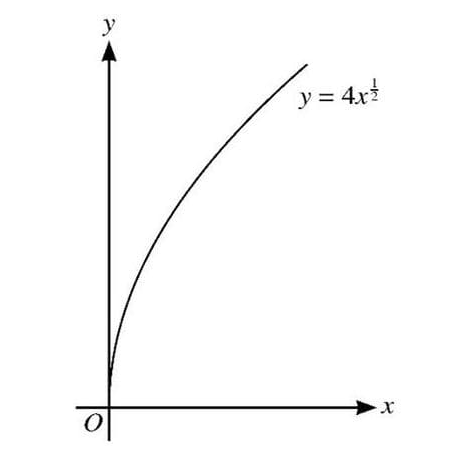
The diagram shows the curve with equation \(y = 4x^{\frac{1}{2}}\).
(i) The straight line with equation \(y = x + 3\) intersects the curve at points \(A\) and \(B\). Find the length of \(AB\).
(ii) The tangent to the curve at a point \(T\) is parallel to \(AB\). Find the coordinates of \(T\).
(iii) Find the coordinates of the point of intersection of the normal to the curve at \(T\) with the line \(AB\).
Solution
(i) To find the points of intersection, set \(4x^{\frac{1}{2}} = x + 3\). Rearrange to get \((x^{\frac{1}{2}})^2 - 4x^{\frac{1}{2}} + 3 = 0\) or \(x^2 - 10x + 9 = 0\). Solving gives \(x = 1\) or \(x = 9\). For \(x = 1\), \(y = 4\); for \(x = 9\), \(y = 12\). The points are \(A(1, 4)\) and \(B(9, 12)\). The length \(AB = \sqrt{(9-1)^2 + (12-4)^2} = \sqrt{128} = 8\sqrt{2} \approx 11.3\).
(ii) The gradient of \(AB\) is \(1\). The derivative of the curve is \(\frac{dy}{dx} = 2x^{-\frac{1}{2}}\). Set \(2x^{-\frac{1}{2}} = 1\) to find \(x = 4\). Then \(y = 4 \times 4^{\frac{1}{2}} = 8\). So, \(T(4, 8)\).
(iii) The equation of the normal at \(T\) is \(y - 8 = -1(x - 4)\) or \(y = -x + 12\). Solve \(-x + 12 = x + 3\) to find \(x = \frac{9}{2}\). Substitute into \(y = x + 3\) to get \(y = \frac{15}{2}\). The intersection point is \(\left( \frac{9}{2}, \frac{15}{2} \right)\).