Past Exam Questions
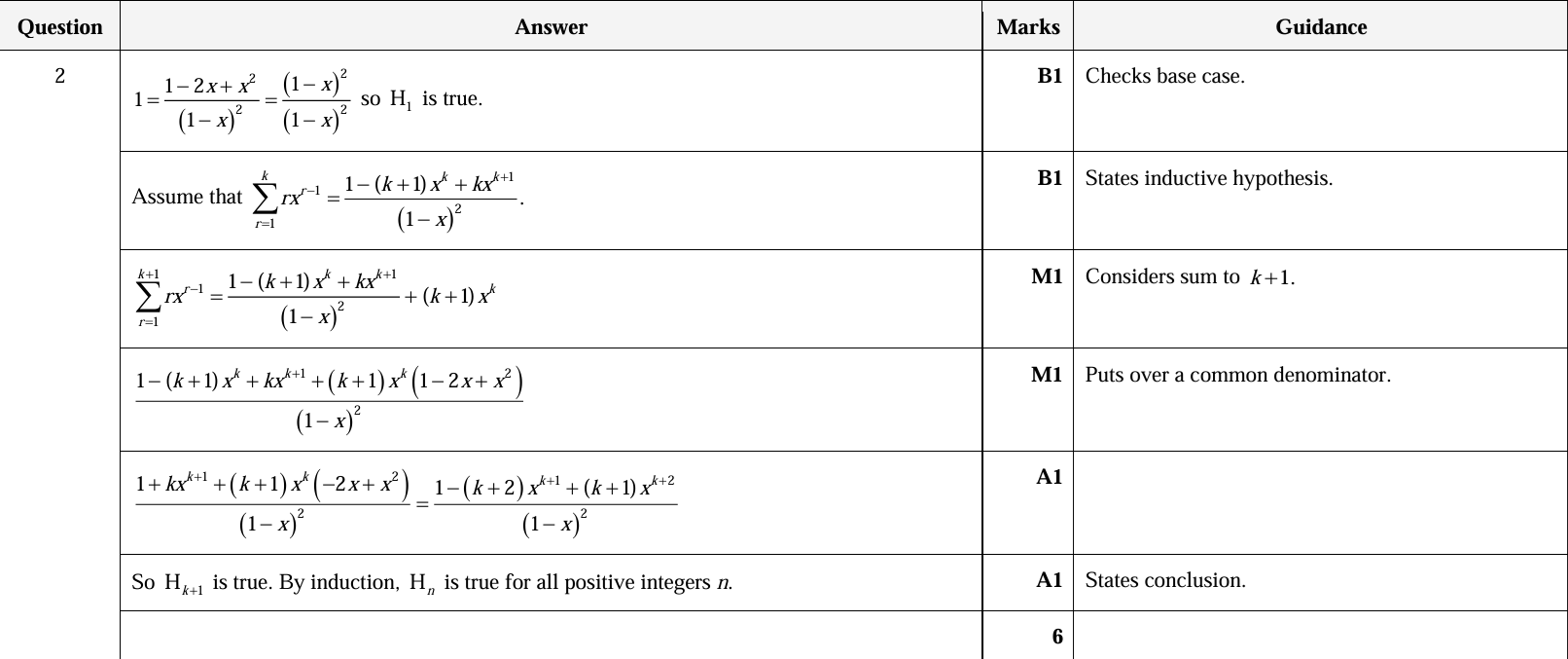
← Back9231 P11 - Nov 2023 - Q02 - 6 marks
Prove by mathematical induction that, for all positive integers \(n\),
\(1 + 2x + 3x^2 + \ldots + nx^{n-1} = \frac{1 - (n+1)x^n + nx^{n+1}}{(1-x)^2}.\)
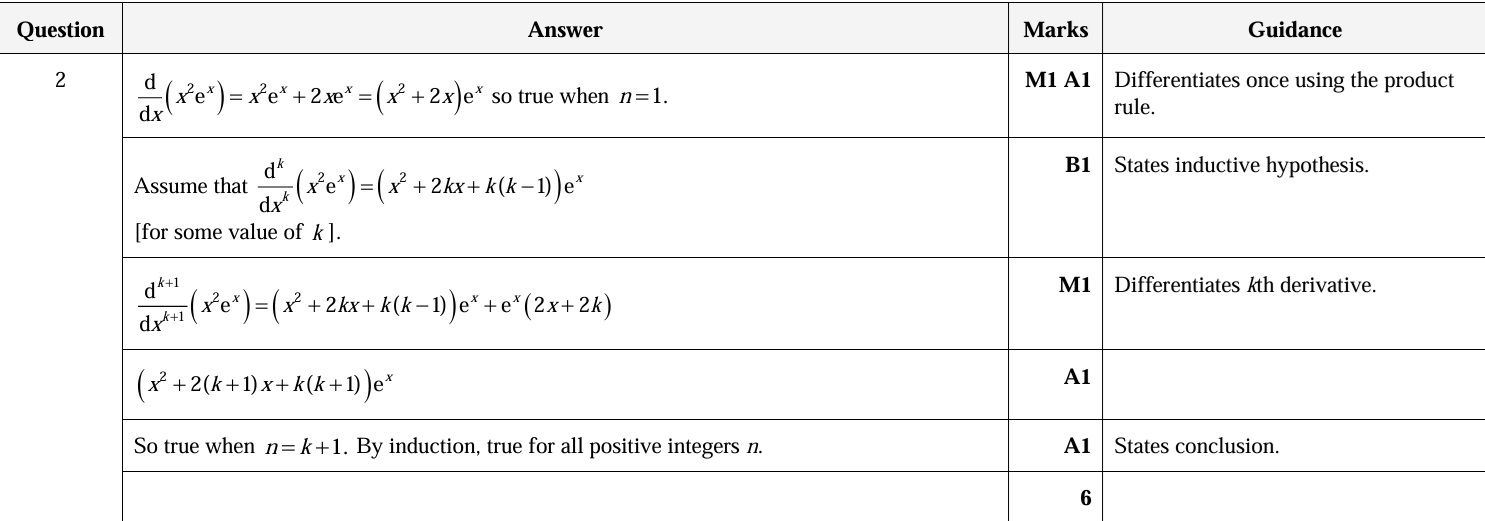
9231 P12 - Nov 2023 - Q02 - 6 marks
Prove by mathematical induction that, for all positive integers n,
\(\frac{d^n}{dx^n} \left( x^2 e^x \right) = \left( x^2 + 2nx + n(n-1) \right) e^x.\)
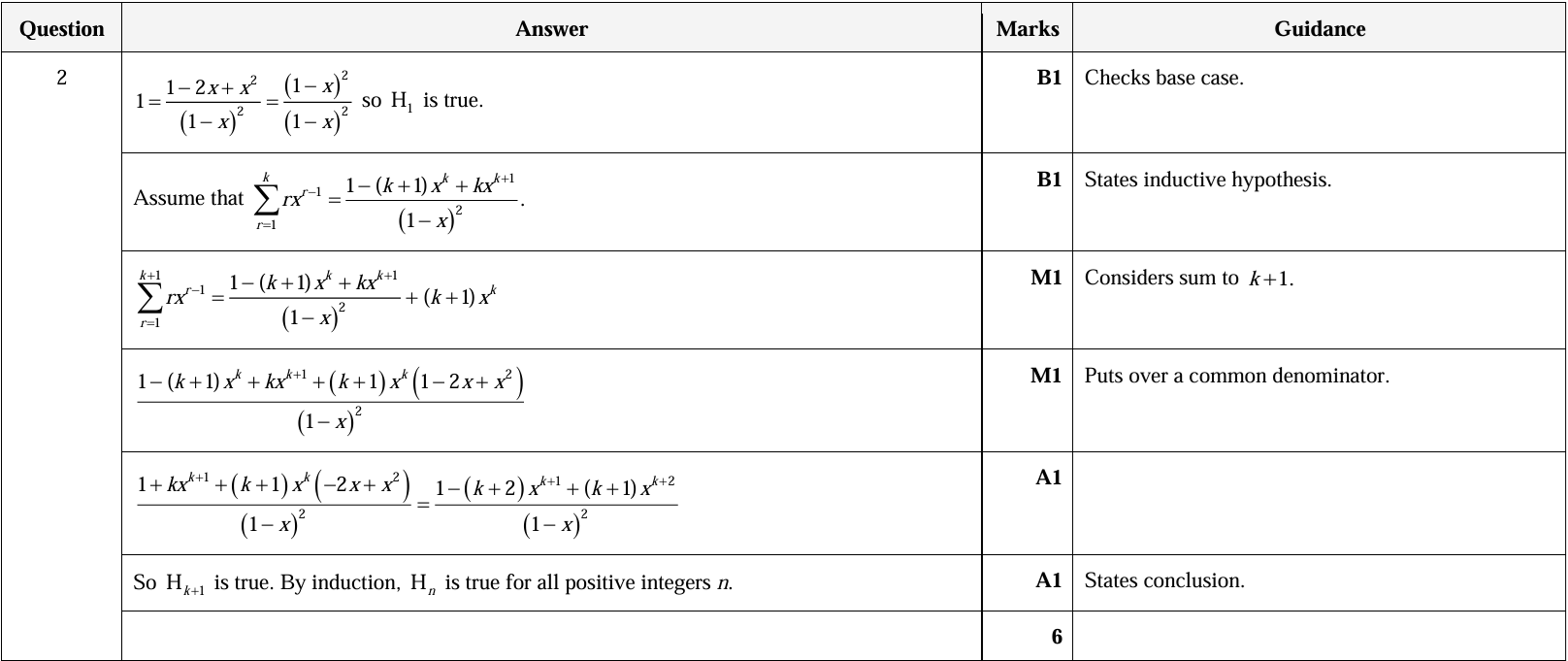
9231 P13 - Nov 2023 - Q02 - 6 marks
Prove by mathematical induction that, for all positive integers \(n\),
\(1 + 2x + 3x^2 + \ldots + nx^{n-1} = \frac{1 - (n+1)x^n + nx^{n+1}}{(1-x)^2}.\)
9231 P11 - Jun 2023 - Q01 - 7 marks
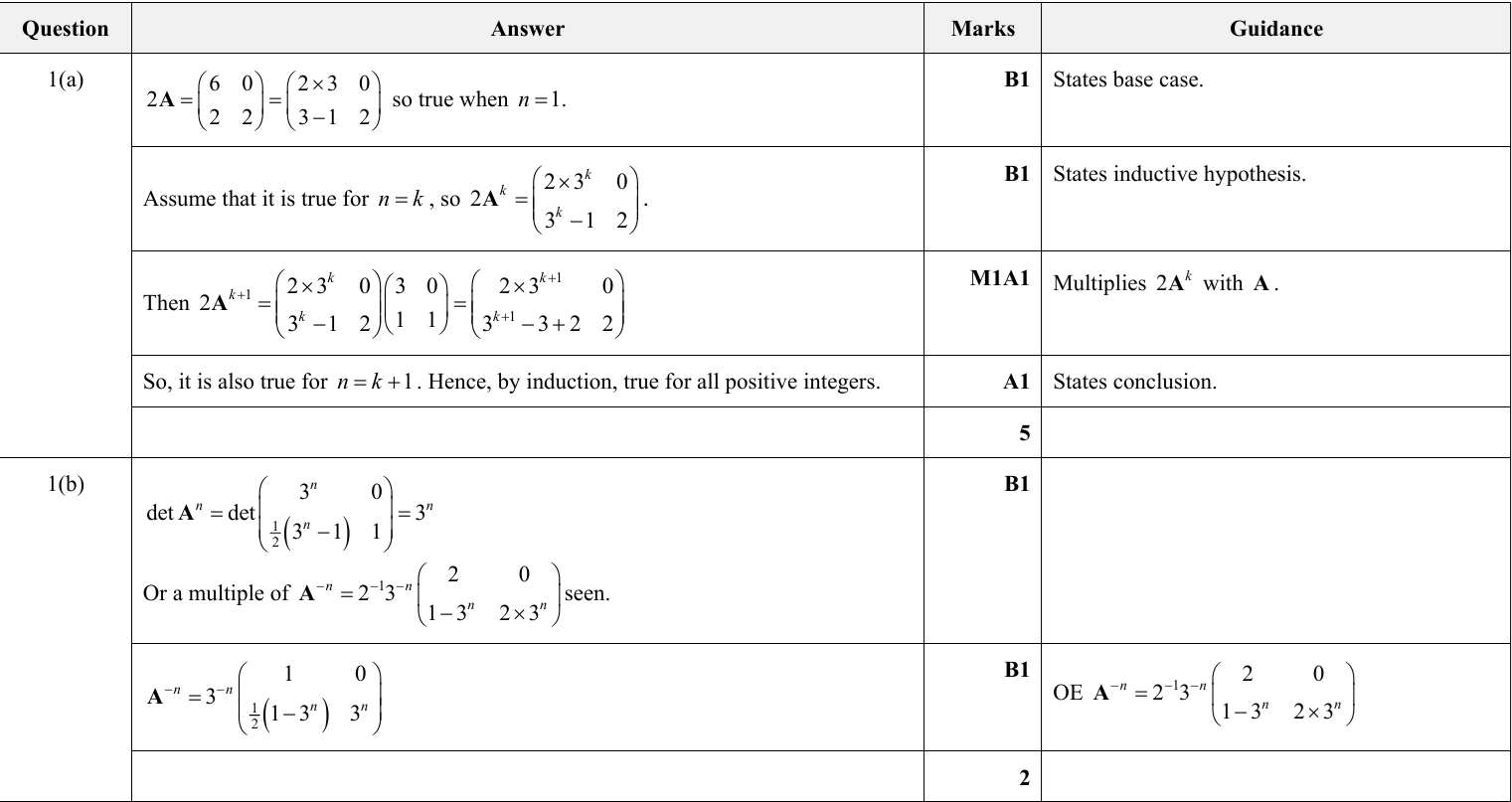
Let \(\mathbf{A} = \begin{pmatrix} 3 & 0 \\ 1 & 1 \end{pmatrix}\).
(a) Prove by mathematical induction that, for all positive integers \(n\),
\(2\mathbf{A}^n = \begin{pmatrix} 2 \times 3^n & 0 \\ 3^n - 1 & 2 \end{pmatrix}.\)
(b) Find, in terms of \(n\), the inverse of \(\mathbf{A}^n\).
9231 P12 - Jun 2023 - Q01 - 7 marks
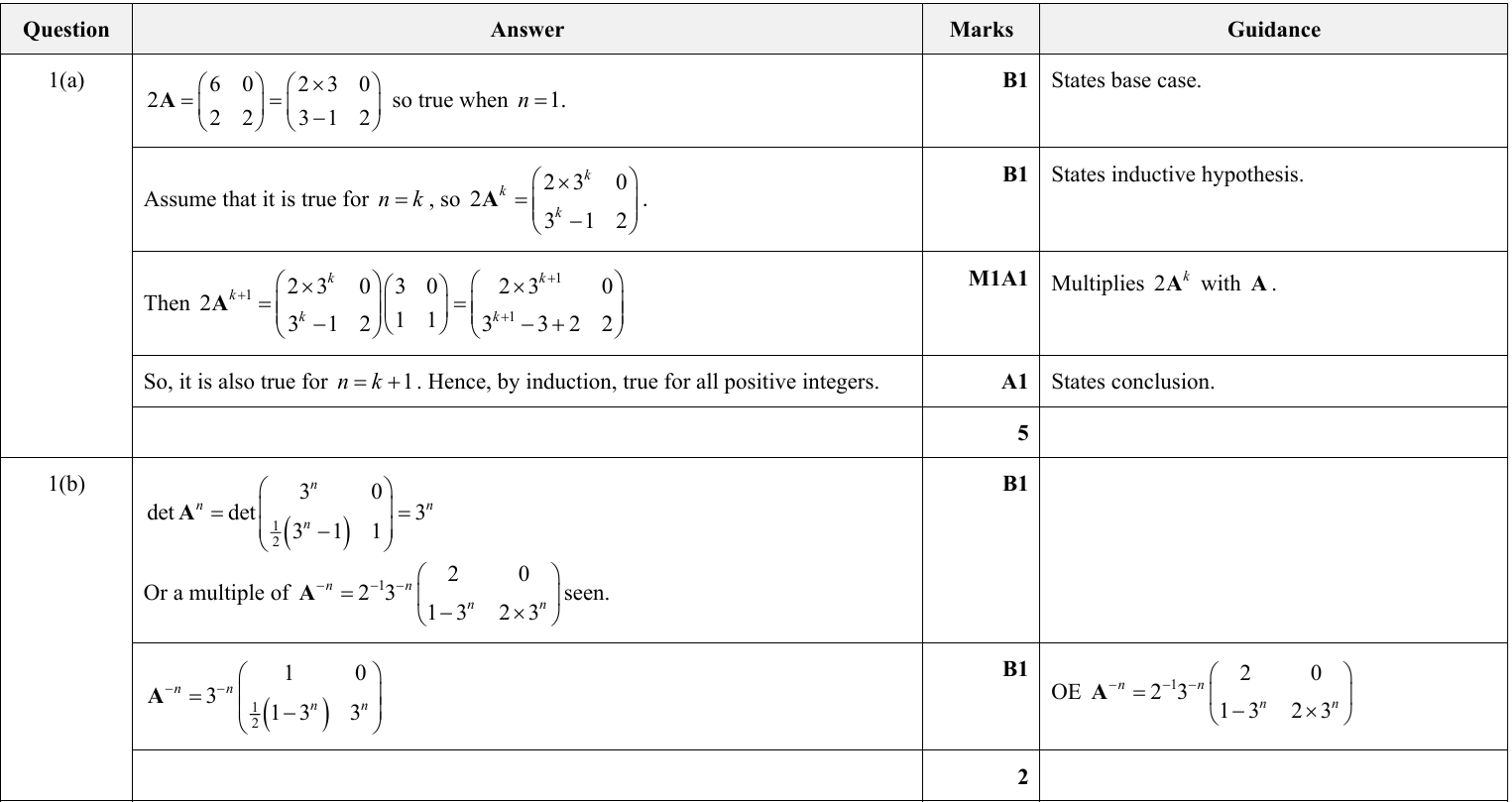
Let \(A = \begin{pmatrix} 3 & 0 \\ 1 & 1 \end{pmatrix}\).
(a) Prove by mathematical induction that, for all positive integers \(n\),
\(2A^n = \begin{pmatrix} 2 \times 3^n & 0 \\ 3^n - 1 & 2 \end{pmatrix}.\)
(b) Find, in terms of \(n\), the inverse of \(A^n\).
9231 P12 - Jun 2022 - Q03 - 8 marks
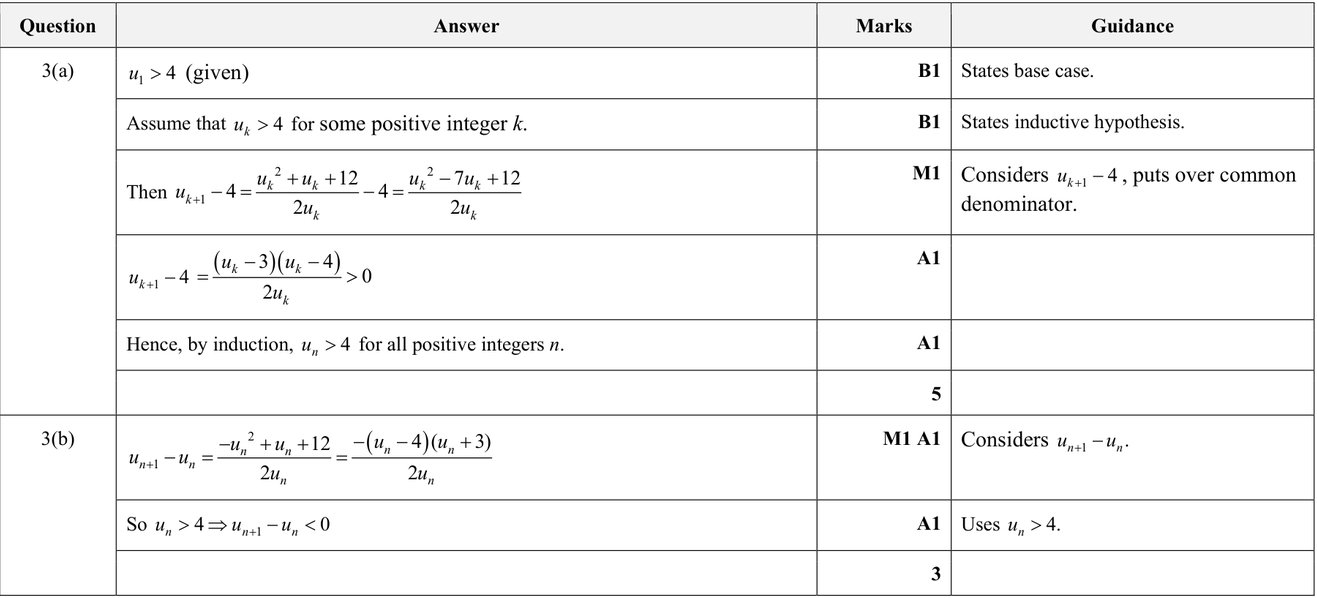
The sequence of positive numbers \(u_1, u_2, u_3, \ldots\) is such that \(u_1 > 4\) and, for \(n \geq 1\),
\(u_{n+1} = \frac{u_n^2 + u_n + 12}{2u_n}.\)
(a) By considering \(u_{n+1} - 4\), or otherwise, prove by mathematical induction that \(u_n > 4\) for all positive integers \(n\). [5]
(b) Show that \(u_{n+1} < u_n\) for \(n \geq 1\). [3]
9231 P13 - Jun 2022 - Q05 - 12 marks
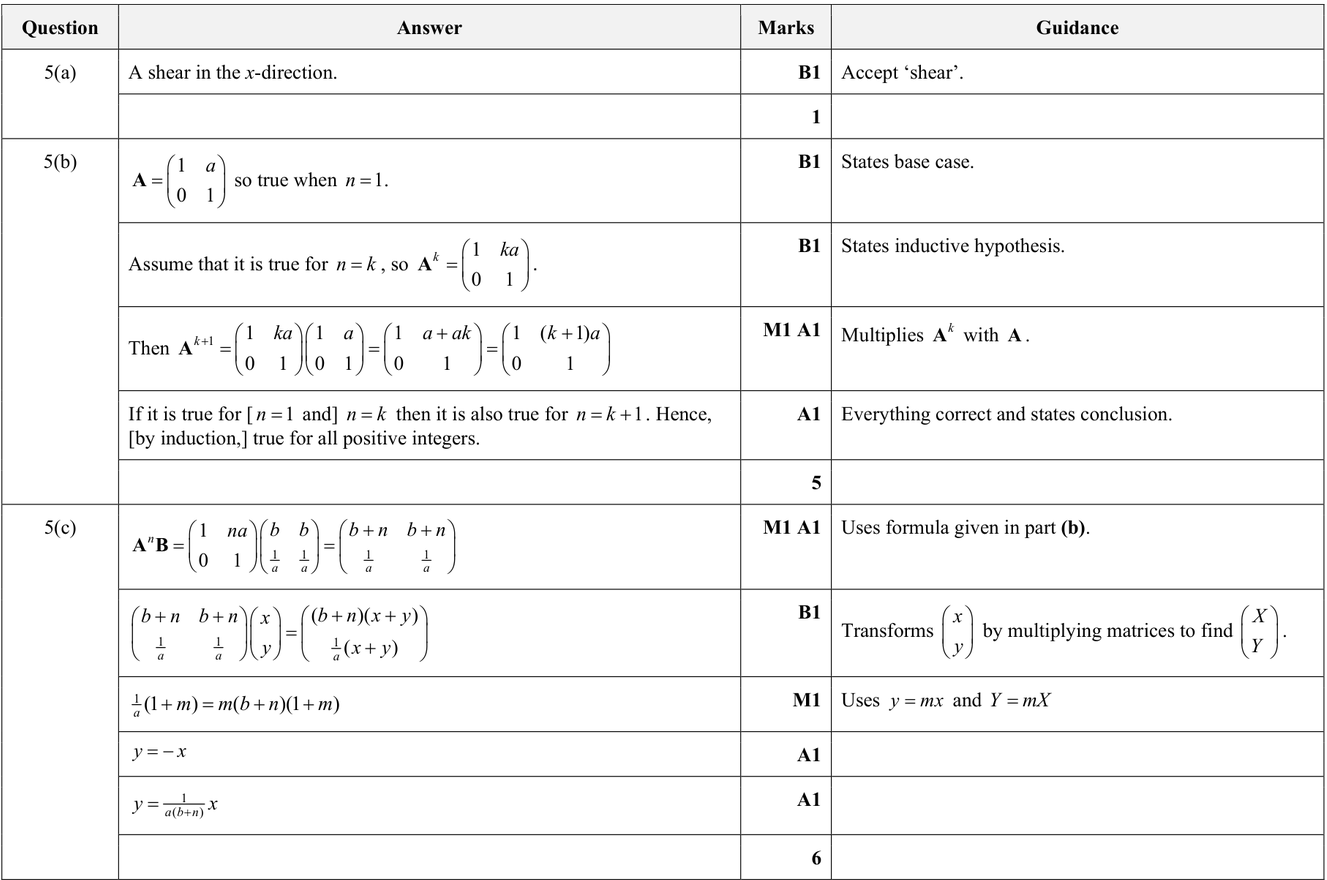
Let \(\mathbf{A} = \begin{pmatrix} 1 & a \\ 0 & 1 \end{pmatrix}\), where \(a\) is a positive constant.
(a) State the type of the geometrical transformation in the \(x-y\) plane represented by \(\mathbf{A}\). [1]
(b) Prove by mathematical induction that, for all positive integers \(n\),
\(\mathbf{A}^n = \begin{pmatrix} 1 & na \\ 0 & 1 \end{pmatrix}.\) [5]
Let \(\mathbf{B} = \begin{pmatrix} b & b \\ a^{-1} & a^{-1} \end{pmatrix}\), where \(b\) is a positive constant.
(c) Find the equations of the invariant lines, through the origin, of the transformation in the \(x-y\) plane represented by \(\mathbf{A}^n \mathbf{B}\). [6]
9231 P12 - Nov 2022 - Q04 - 7 marks
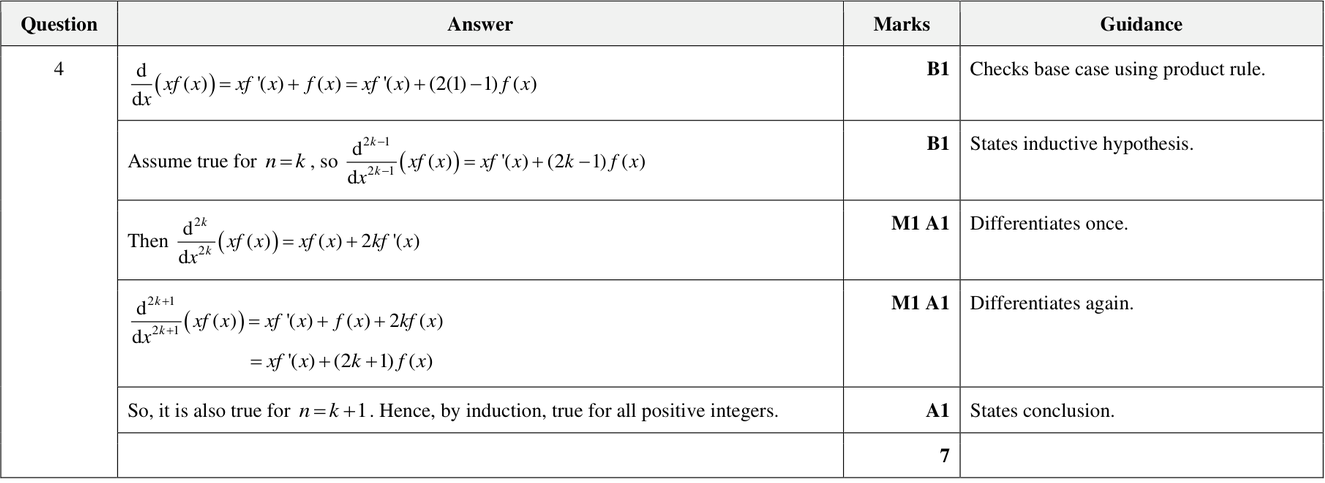
The function \(f\) is such that \(f''(x)= f(x)\)
Prove by mathematical induction that, for every positive integer n,
\(\frac{d^{2n-1}}{dx^{2n-1}}(xf(x)) = xf'(x) + (2n-1)f(x).\)
9231 P13 - Jun 2021 - Q03 - 9 marks
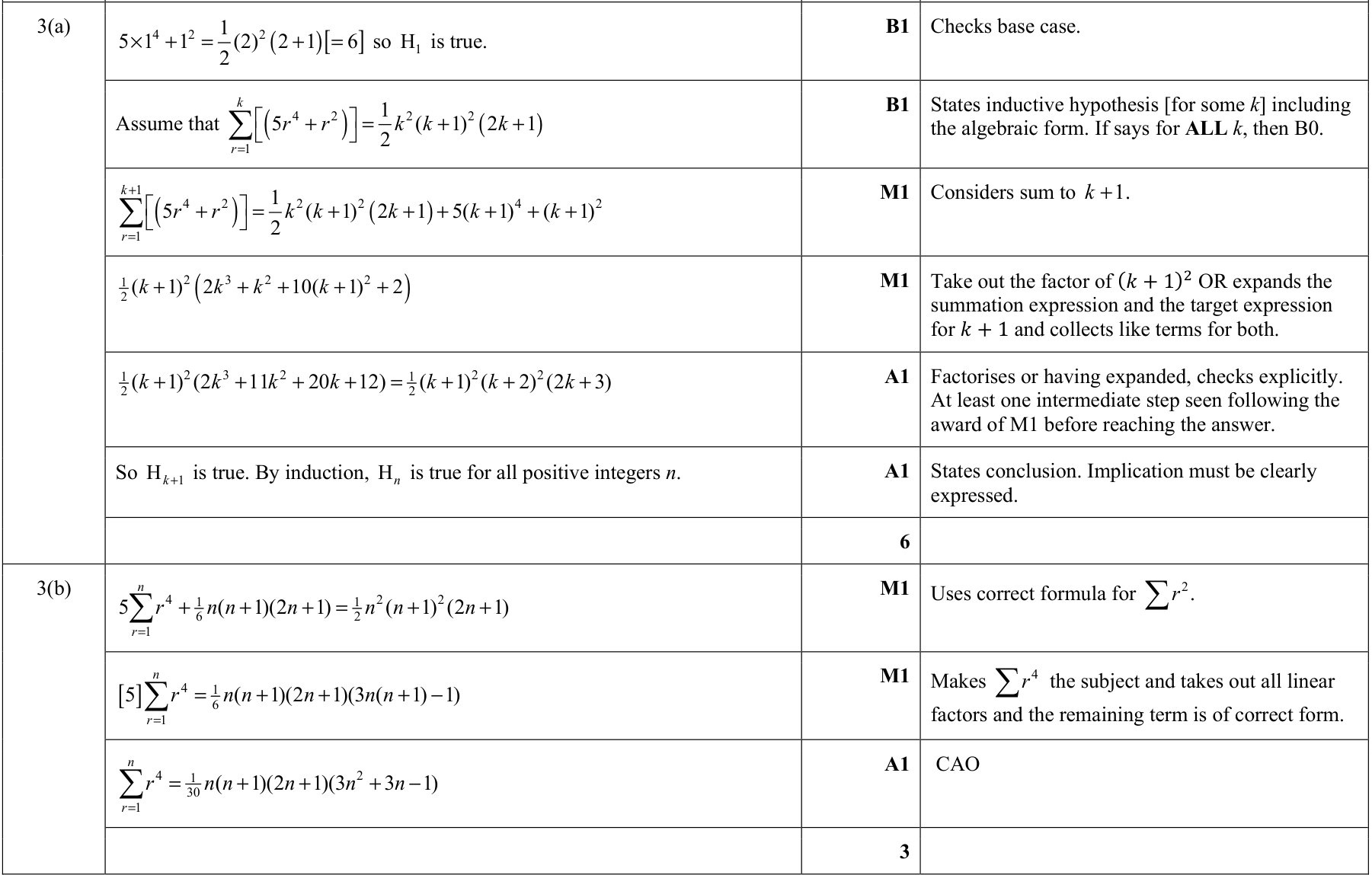
(a) Prove by mathematical induction that, for all positive integers \(n\),
\(\sum_{r=1}^{n} (5r^4 + r^2) = \frac{1}{2} n^2 (n+1)^2 (2n+1).\)
(b) Use the result given in part (a) together with the List of formulae (MF19) to find \(\sum_{r=1}^{n} r^4\) in terms of \(n\), fully factorising your answer.
9231 P11 - Nov 2021 - Q03 - 8 marks
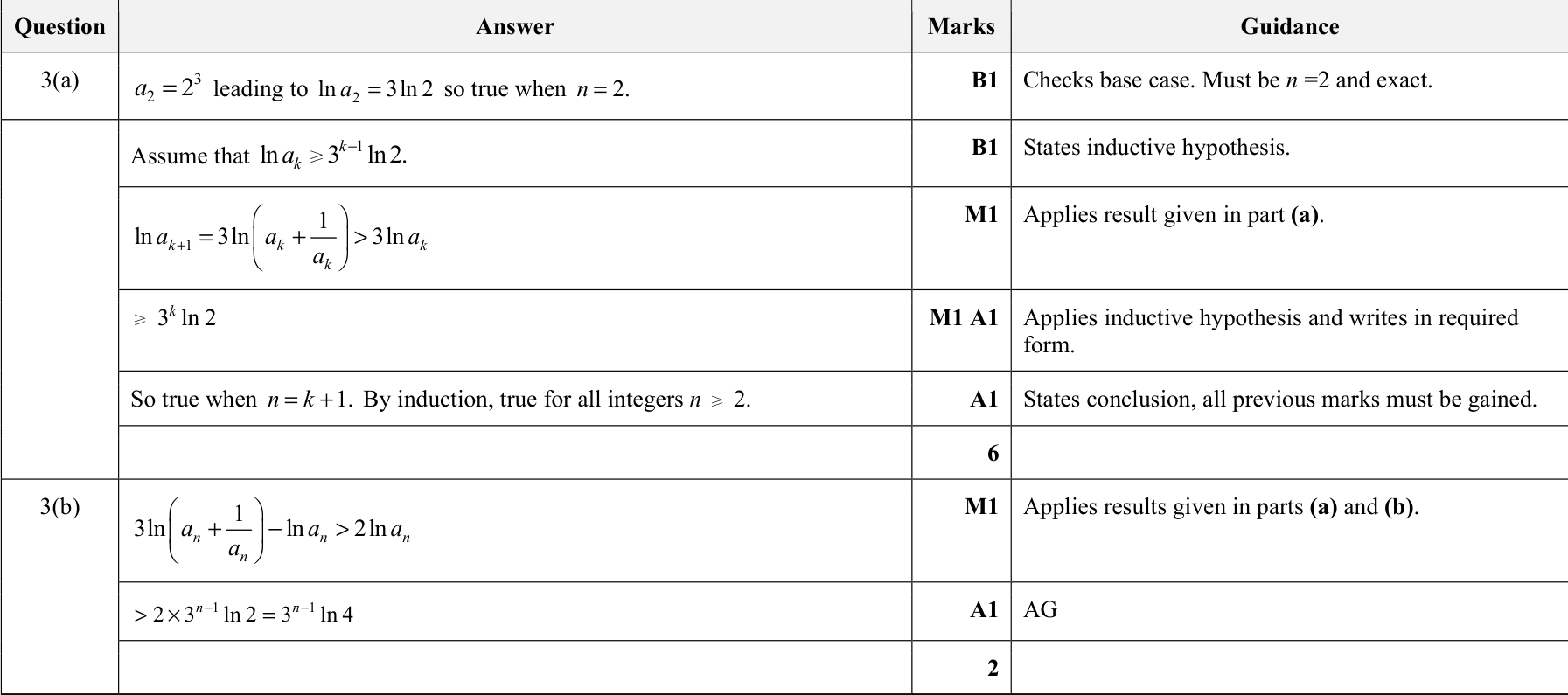
The sequence of real numbers \(a_1, a_2, a_3, \ldots\) is such that \(a_1 = 1\) and
\(a_{n+1} = \left( a_n + \frac{1}{a_n} \right)^3.\)
(a) Prove by mathematical induction that \(\ln a_n \geq 3^{n-1} \ln 2\) for all integers \(n \geq 2\).
[You may use the fact that \(\ln \left( x + \frac{1}{x} \right) > \ln x\) for \(x > 0\).]
(b) Show that \(\ln a_{n+1} - \ln a_n > 3^{n-1} \ln 4\) for \(n \geq 2\).
9231 P12 - Nov 2021 - Q02 - 6 marks
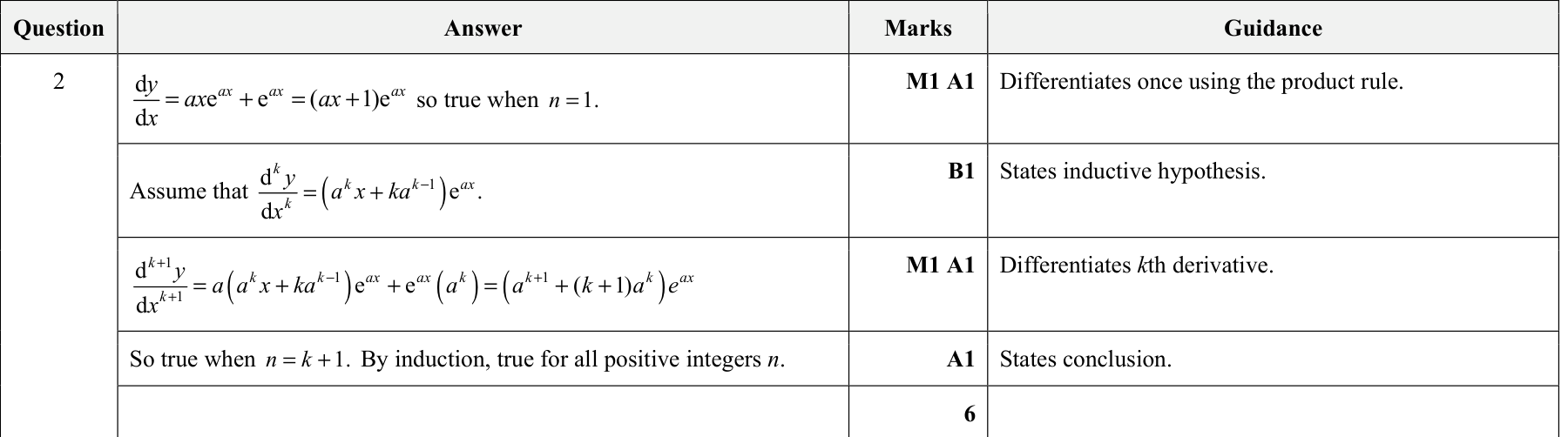
It is given that \(y = xe^{ax}\), where \(a\) is a constant.
Prove by mathematical induction that, for all positive integers \(n\),
\(\frac{d^n y}{dx^n} = \left( a^n x + na^{n-1} \right) e^{ax}.\)
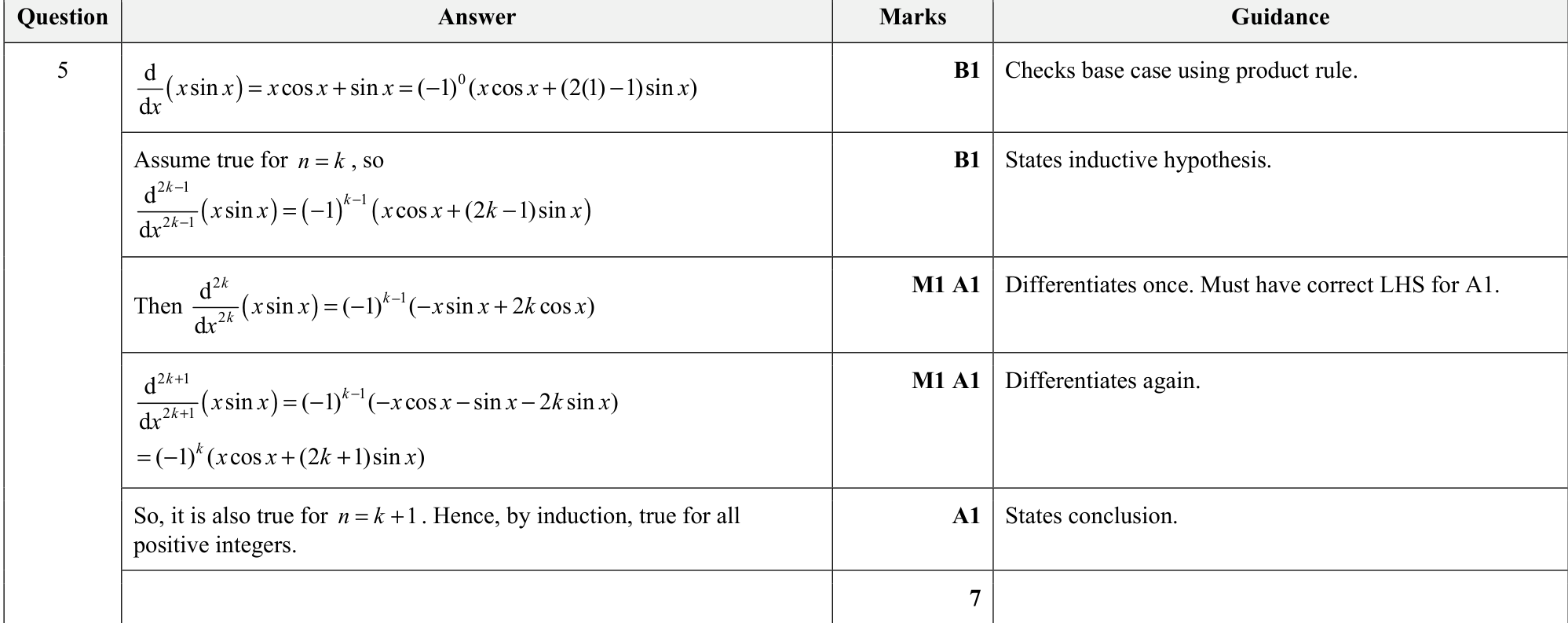
9231 P11 - Nov 2020 - Q5 - 7 marks
5 Prove by mathematical induction that, for every positive integer \(n\),
\(\frac{\mathrm{d}^{2 n-1}}{\mathrm{~d} x^{2 n-1}}(x \sin x)=(-1)^{n-1}(x \cos x+(2 n-1) \sin x)\)
9231 P11 - Jun 2020 - Q6 - 13 marks
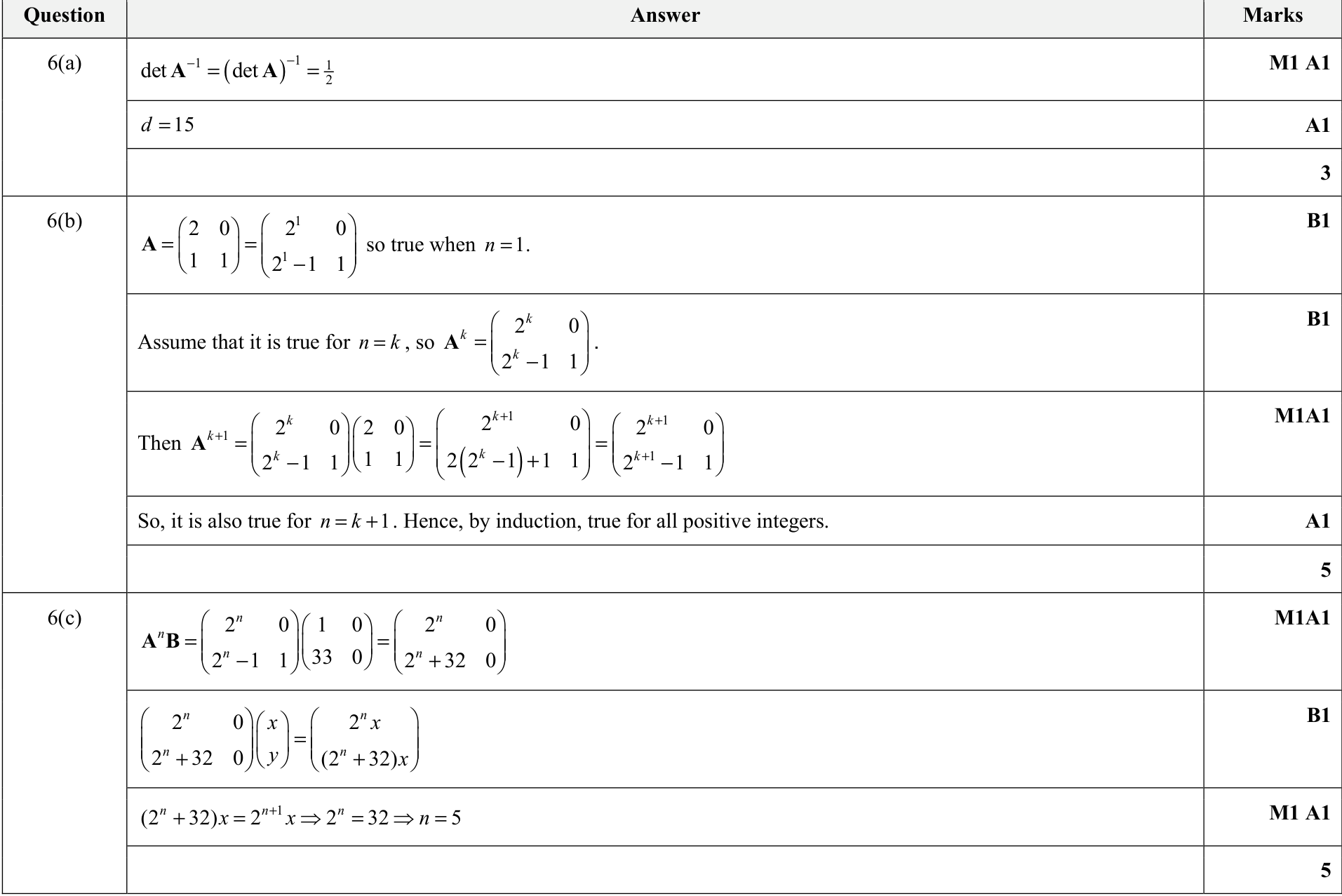
\(6 \quad\) Let \(\mathbf{A}=\left(\begin{array}{ll}2 & 0 \\ 1 & 1\end{array}\right)\).
(a) The transformation in the \(x-y\) plane represented by \(\mathbf{A}^{-1}\) transforms a triangle of area \(30 \mathrm{~cm}^{2}\) into a triangle of area \(d \mathrm{~cm}^{2}\).
Find the value of \(d\).
(b) Prove by mathematical induction that, for all positive integers \(n\),
\(\mathbf{A}^{n}=\left(\begin{array}{cc}
2^{n} & 0 \\
2^{n}-1 & 1
\end{array}\right) .\)
(c) The line \(y=2 x\) is invariant under the transformation in the \(x-y\) plane represented by \(\mathbf{A}^{n} \mathbf{B}\), where \(\mathbf{B}=\left(\begin{array}{rr}1 & 0 \\ 33 & 0\end{array}\right)\).
Find the value of \(n\).
9231 P11 - Jun 2019 - Q8 - 10 marks
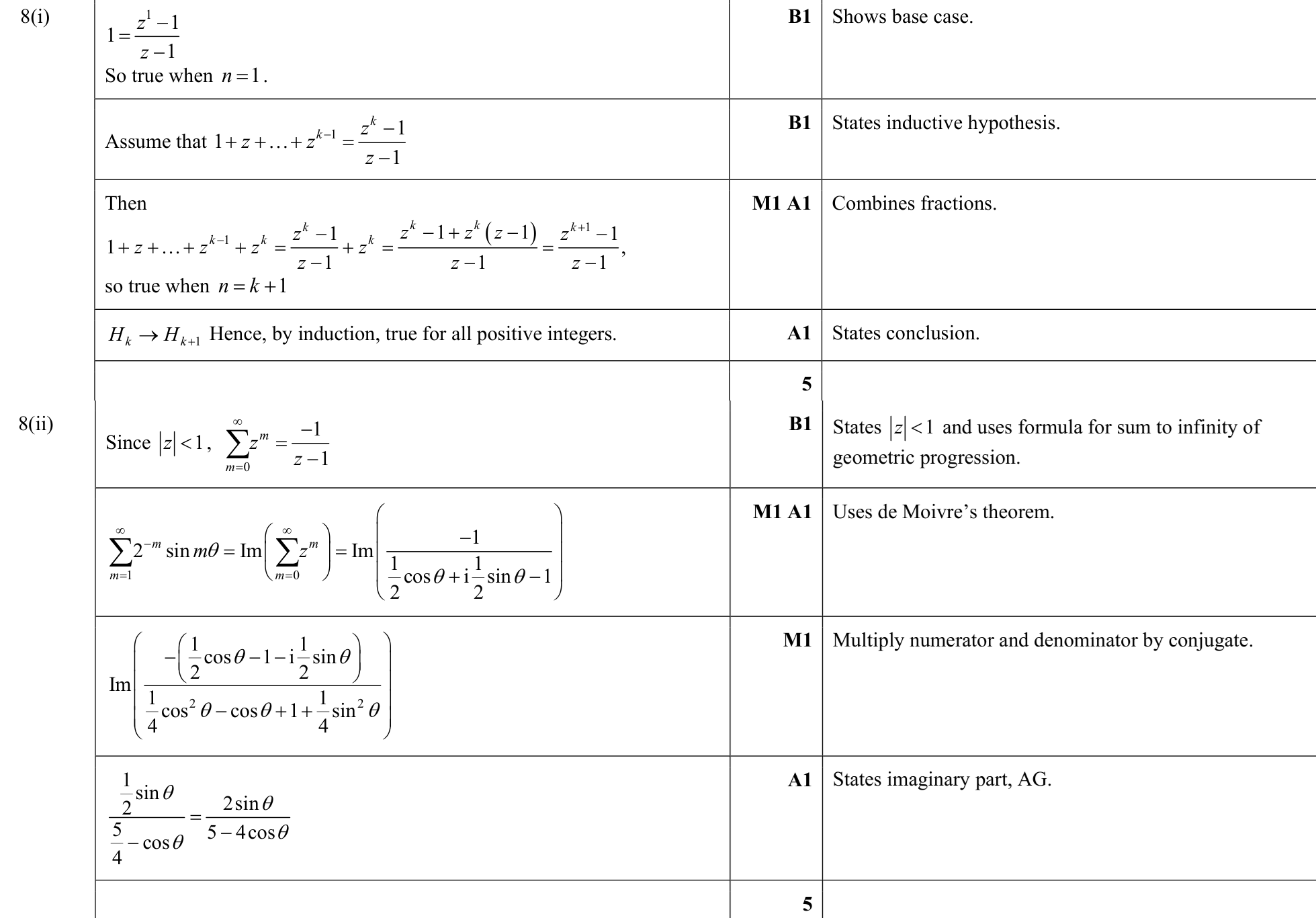
8 (i) Prove by mathematical induction that, for \(z eq 1\) and all positive integers \(n\),
\(1+z+z^{2}+\ldots+z^{n-1}=\frac{z^{n}-1}{z-1}\)
(ii) By letting \(z=\frac{1}{2}(\cos \theta+\mathrm{i} \sin \theta)\), use de Moivre's theorem to deduce that
\(\sum_{m=1}^{\infty}\left(\frac{1}{2}\right)^{m} \sin m \theta=\frac{2 \sin \theta}{5-4 \cos \theta}\)
9231 P11 - Nov 2019 - Q2 - 6 marks
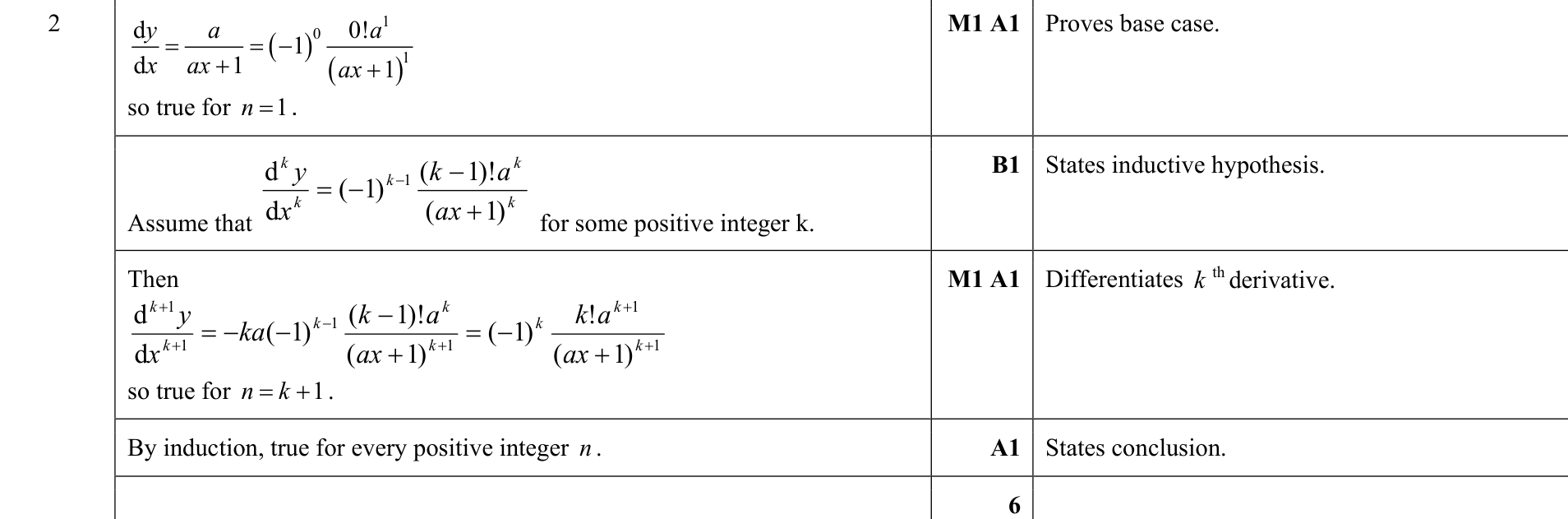
It is given that \(y=\ln (a x+1)\), where \(a\) is a positive constant. Prove by mathematical induction that, for every positive integer \(n\),
\(\frac{\mathrm{d}^{n} y}{\mathrm{~d} x^{n}}=(-1)^{n-1} \frac{(n-1)!a^{n}}{(a x+1)^{n}}\)
9231 P13 - Jun 2018 - Q9 - 10 marks
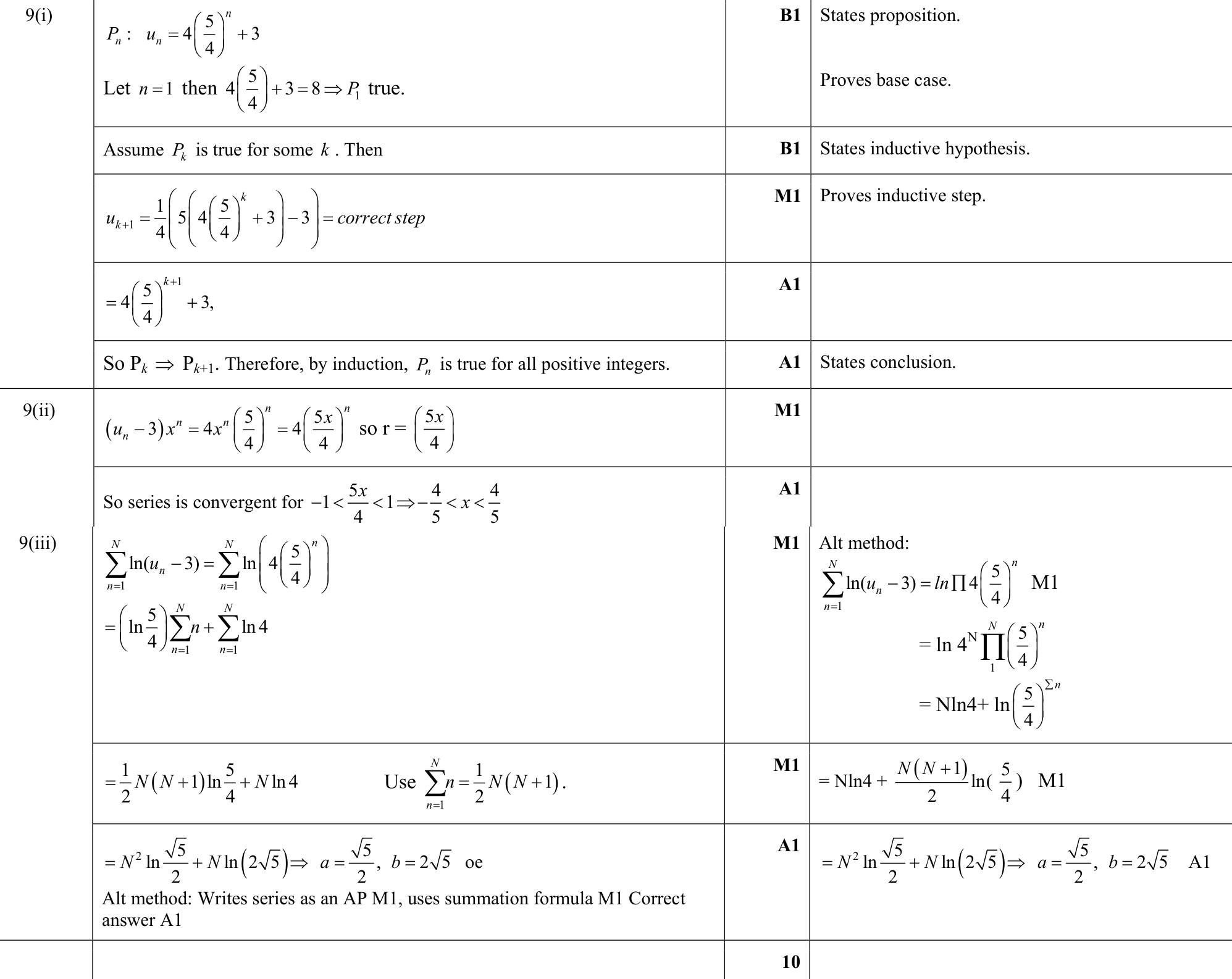
For the sequence \(u_{1}, u_{2}, u_{3}, \ldots\), it is given that \(u_{1}=8\) and
\(u_{r+1}=\frac{5 u_{r}-3}{4}\)
for all \(r\).
(i) Prove by mathematical induction that
\(u_{n}=4\left(\frac{5}{4}\right)^{n}+3,\)
for all positive integers \(n\).
(ii) Deduce the set of values of \(x\) for which the infinite series
\(\left(u_{1}-3\right) x+\left(u_{2}-3\right) x^{2}+\ldots+\left(u_{r}-3\right) x^{r}+\ldots\)
is convergent.
(iii) Use the result given in part (i) to find surds \(a\) and \(b\) such that
\(\sum_{n=1}^{N} \ln \left(u_{n}-3\right)=N^{2} \ln a+N \ln b\)
9231 P11 - Nov 2018 - Q3 - 8 marks
The sequence of positive numbers \(u_{1}, u_{2}, u_{3}, \ldots\) is such that \(u_{1}\lt 3\) and, for \(n \geqslant 1\),
\(u_{n+1}=\frac{4 u_{n}+9}{u_{n}+4} .\)
(i) By considering \(3-u_{n+1}\), or otherwise, prove by mathematical induction that \(u_{n}\lt 3\) for all positive integers \(n\).
(ii) Show that \(u_{n+1}\gt u_{n}\) for \(n \geqslant 1\).

9231 P11 - Nov 2025 - Q3 - 7 marks
Prove by mathematical induction that, for every positive integer \(n\),
\(\frac{d^{2n-1}}{dx^{2n-1}}(x\cos x)=(-1)^n\left(x\sin x-(2n-1)\cos x\right).\)
9231 P12 - Nov 2025 - Q3 - 8 marks
(a) The positive sequence \(u_1,u_2,u_3,\ldots\) satisfies \(u_1<5\) and \(u_{n+1}=\dfrac{6u_n+5}{u_n+2}\). By considering \(5-u_{n+1}\), prove by induction that \(u_n<5\) for all positive integers \(n\).
(b) Show that \(u_{n+1}>u_n\) for \(n\ge1\).
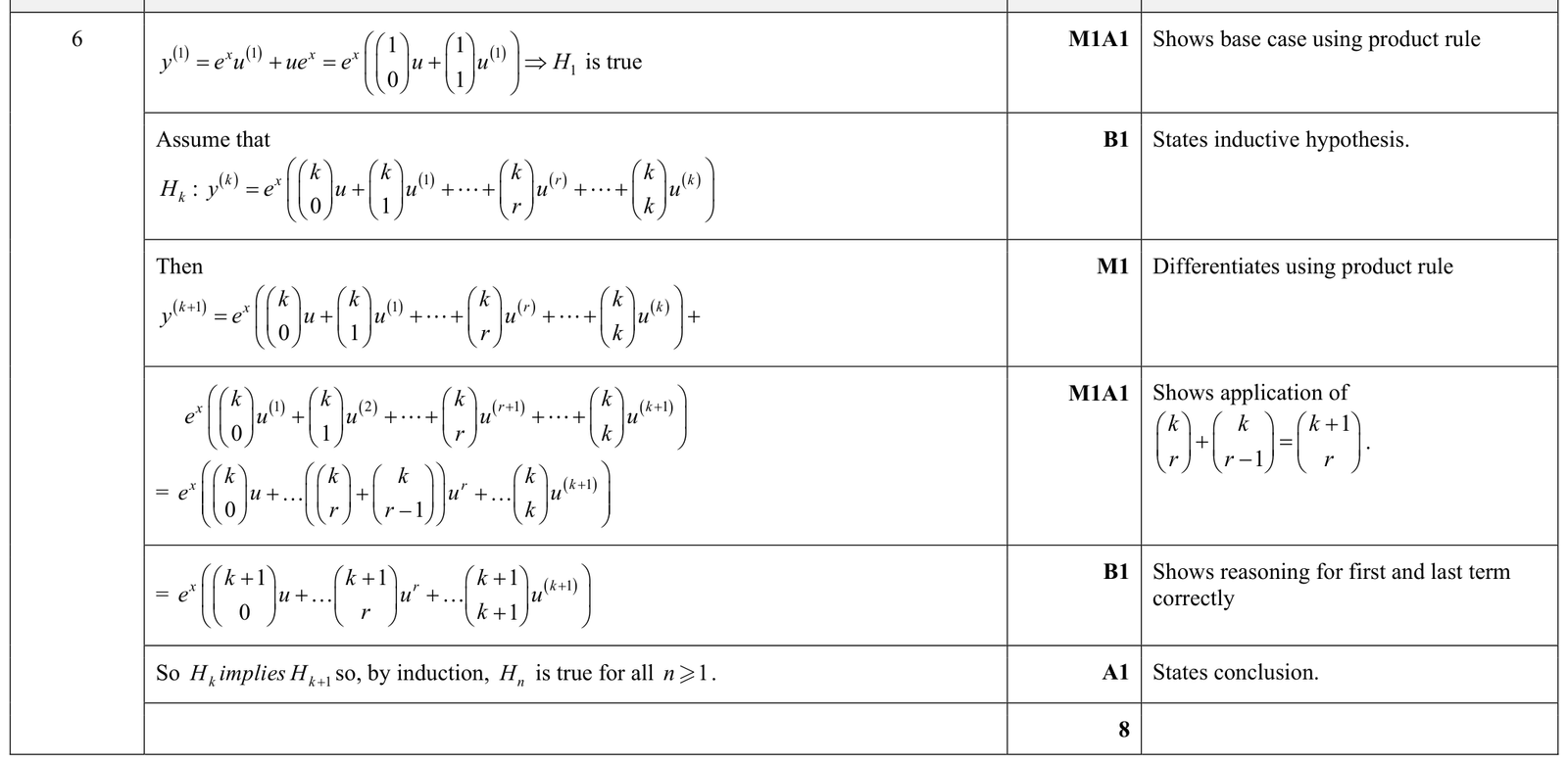
9231 P12 - Nov 2018 - Q6 - 8 marks
It is given that \(y=\mathrm{e}^{x} u\), where \(u\) is a function of \(x\). The \(r\) th derivatives \(\frac{\mathrm{d}^{2} y}{\mathrm{~d} x^{r}}\) and \(\frac{\mathrm{d}^{r} u}{\mathrm{~d} x^{r}}\) are denoted by \(y^{(r)}\) and \(u^{(r)}\) respectively. Prove by mathematical induction that, for all positive integers \(n\),
\(y^{(n)}=\mathrm{e}^{x}\left(\binom{n}{0} u+\binom{n}{1} u^{(1)}+\binom{n}{2} u^{(2)}+\ldots+\binom{n}{r} u^{(r)}+\ldots+\binom{n}{n} u^{(n)}\right) .\)
[You may use without proof the result \(\left.\binom{k}{r}+\binom{k}{r-1}=\binom{k+1}{r}.\right]\)