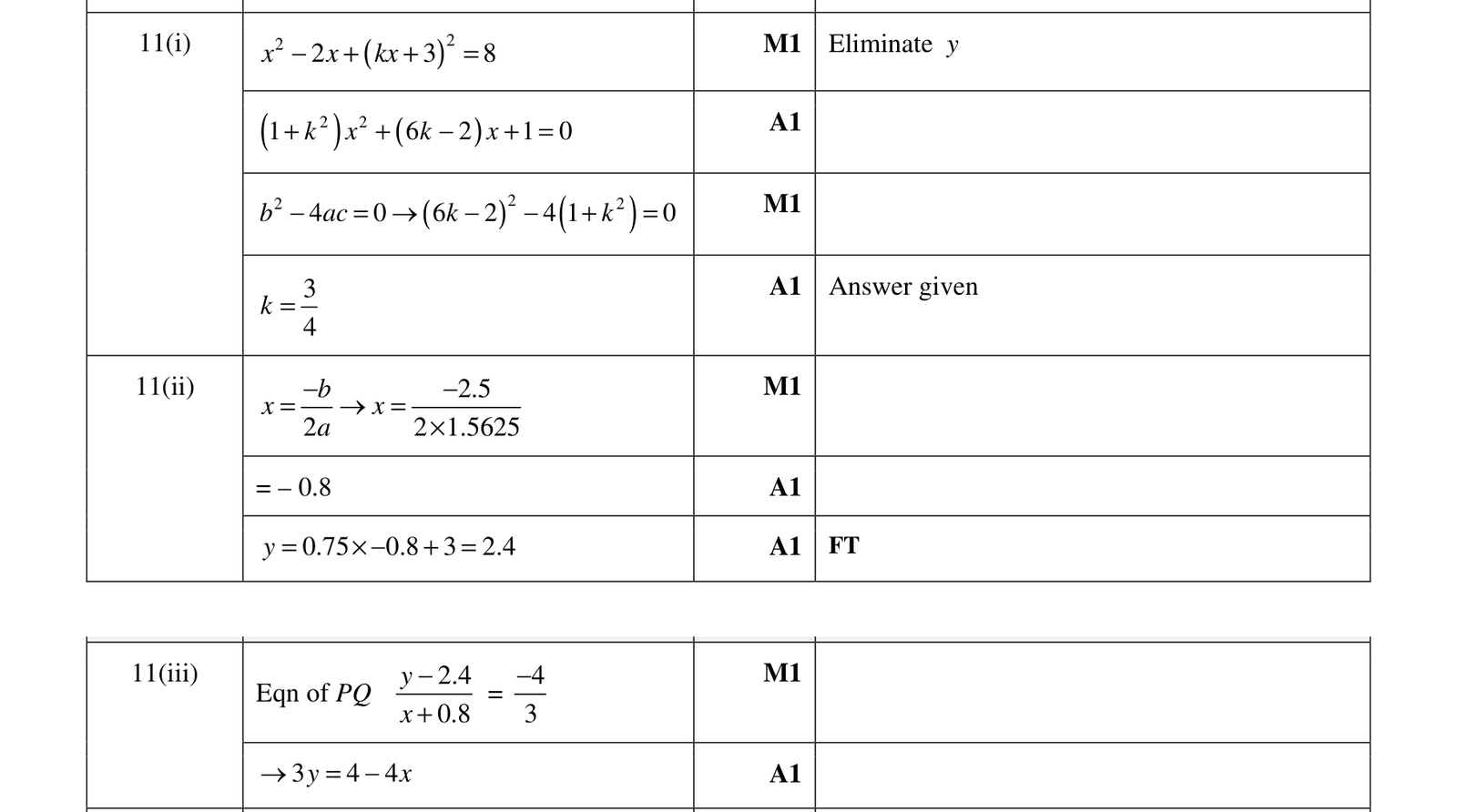
Answer: \(k=\dfrac34\); \(P=\left(-\dfrac45,\dfrac{12}{5}\right)\); normal \(4x+3y=4\).
Substitute \(y=kx+3\) into the curve:
\(x^2-2x+(kx+3)^2=8.\)
Expand:
\(x^2-2x+k^2x^2+6kx+9=8.\)
So
\((1+k^2)x^2+(6k-2)x+1=0.\)
Since the line is a tangent, this quadratic has exactly one root. Therefore its discriminant is zero:
\((6k-2)^2-4(1+k^2)(1)=0.\)
Expand and simplify:
\(36k^2-24k+4-4-4k^2=0.\)
So
\(32k^2-24k=0.\)
Hence
\(8k(4k-3)=0.\)
Since \(k\) is positive,
\(k=\dfrac34.\)
Using \(k=\dfrac34\), the tangent line is
\(y=\dfrac34x+3.\)
At tangency, the repeated root of the quadratic is
\(x=-\dfrac{b}{2a}=-\dfrac{\frac52}{2\cdot\frac{25}{16}}=-\dfrac45.\)
Then
\(y=\dfrac34\left(-\dfrac45\right)+3=\dfrac{12}{5}.\)
So
\(P=\left(-\dfrac45,\dfrac{12}{5}\right).\)
Differentiate the curve implicitly:
\(x^2-2x+y^2=8.\)
This gives
\(2x-2+2y\dfrac{dy}{dx}=0.\)
So
\(\dfrac{dy}{dx}=\dfrac{1-x}{y}.\)
At \(P\), the tangent gradient is \(\dfrac34\), so the normal gradient is
\(-\dfrac43.\)
Use point-gradient form:
\(y-\dfrac{12}{5}=-\dfrac43\left(x+\dfrac45\right).\)
Simplifying gives
\(\boxed{4x+3y=4}.\)