Past Exam Questions
← Back9709 P32 - Jun 2016 - Q7
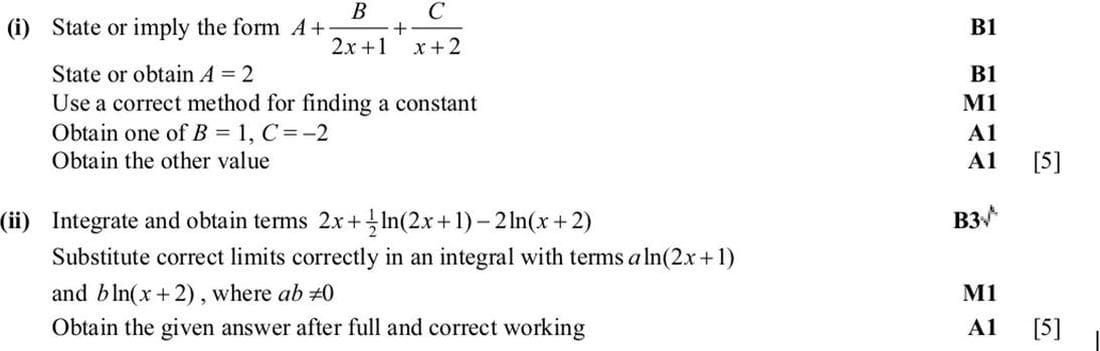
Let \(f(x) = \frac{4x^2 + 7x + 4}{(2x + 1)(x + 2)}\).
(i) Express \(f(x)\) in partial fractions.
(ii) Show that \(\int_0^4 f(x) \, dx = 8 - \ln 3\).
9709 P32 - Mar 2016 - Q9
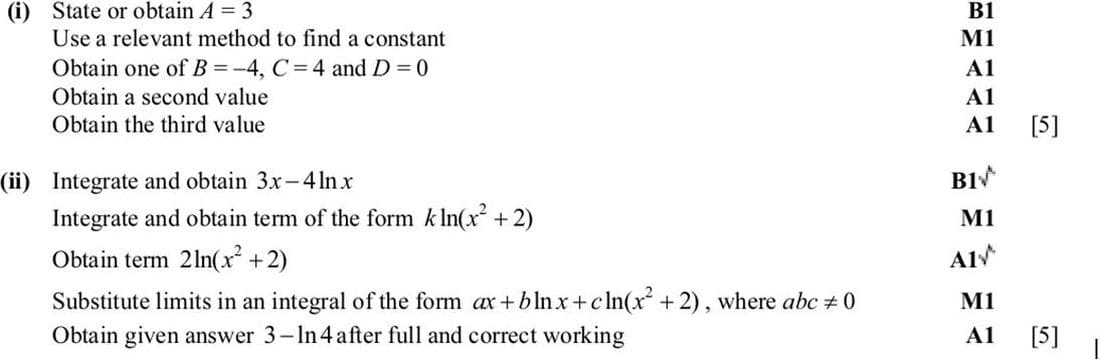
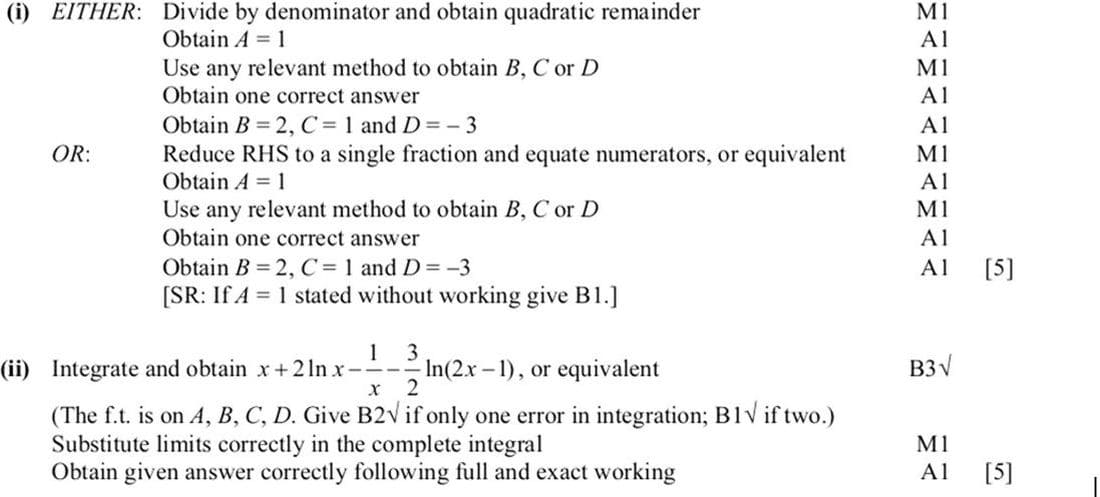
Let \(f(x) = \frac{3x^3 + 6x - 8}{x(x^2 + 2)}\).
(i) Express \(f(x)\) in the form \(A + \frac{B}{x} + \frac{Cx + D}{x^2 + 2}\).
(ii) Show that \(\int_1^2 f(x) \, dx = 3 - \ln 4\).
9709 P33 - Nov 2014 - Q10
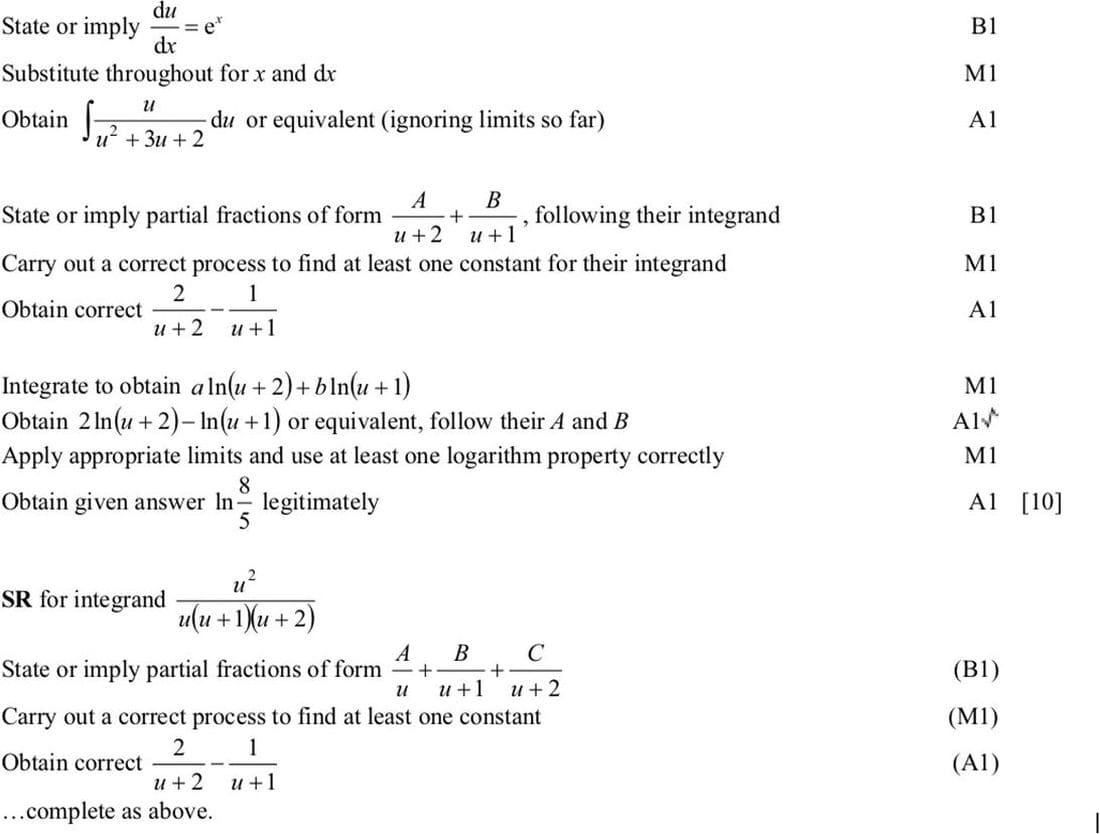
By first using the substitution \(u = e^x\), show that
\(\int_0^{\ln 4} \frac{e^{2x}}{e^{2x} + 3e^x + 2} \, dx = \ln \left( \frac{8}{5} \right).\)
9709 P33 - Jun 2012 - Q8
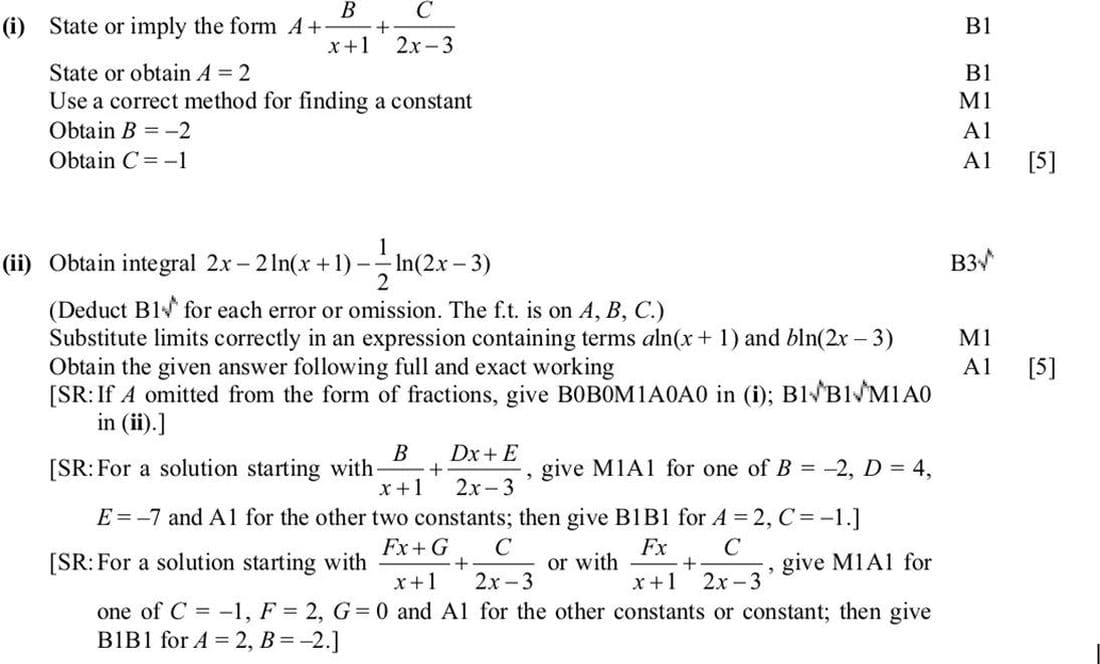
Let \(f(x) = \frac{4x^2 - 7x - 1}{(x+1)(2x-3)}\).
(i) Express \(f(x)\) in partial fractions.
(ii) Show that \(\int_2^6 f(x) \, dx = 8 - \ln\left(\frac{49}{3}\right)\).
9709 P31 - Jun 2012 - Q9
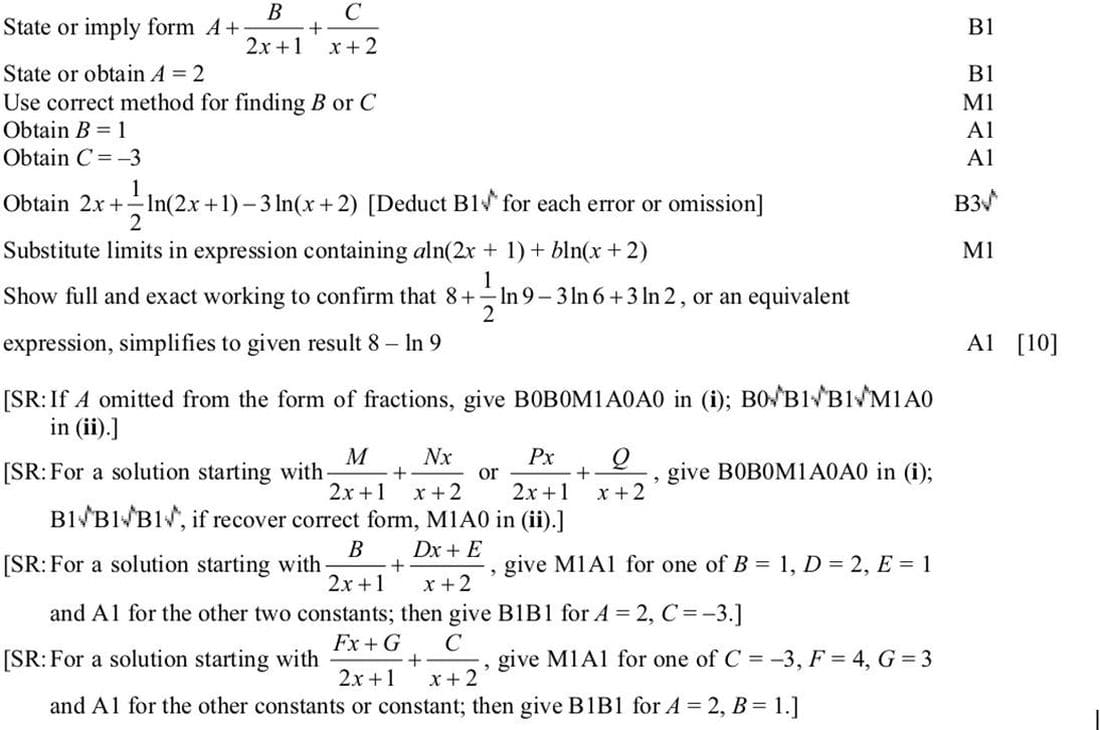
By first expressing \(\frac{4x^2 + 5x + 3}{2x^2 + 5x + 2}\) in partial fractions, show that
\(\int_0^4 \frac{4x^2 + 5x + 3}{2x^2 + 5x + 2} \, dx = 8 - \ln 9.\)
9709 P32 - Jun 2010 - Q10
Find the values of the constants \(A, B, C\) and \(D\) such that
\(\frac{2x^3 - 1}{x^2(2x-1)} \equiv A + \frac{B}{x} + \frac{C}{x^2} + \frac{D}{2x-1}.\)
Hence show that
\(\int_1^2 \frac{2x^3 - 1}{x^2(2x-1)} \, dx = \frac{3}{2} + \frac{1}{2} \ln\left(\frac{16}{27}\right).\)
9709 P32 - Jun 2023 - Q9
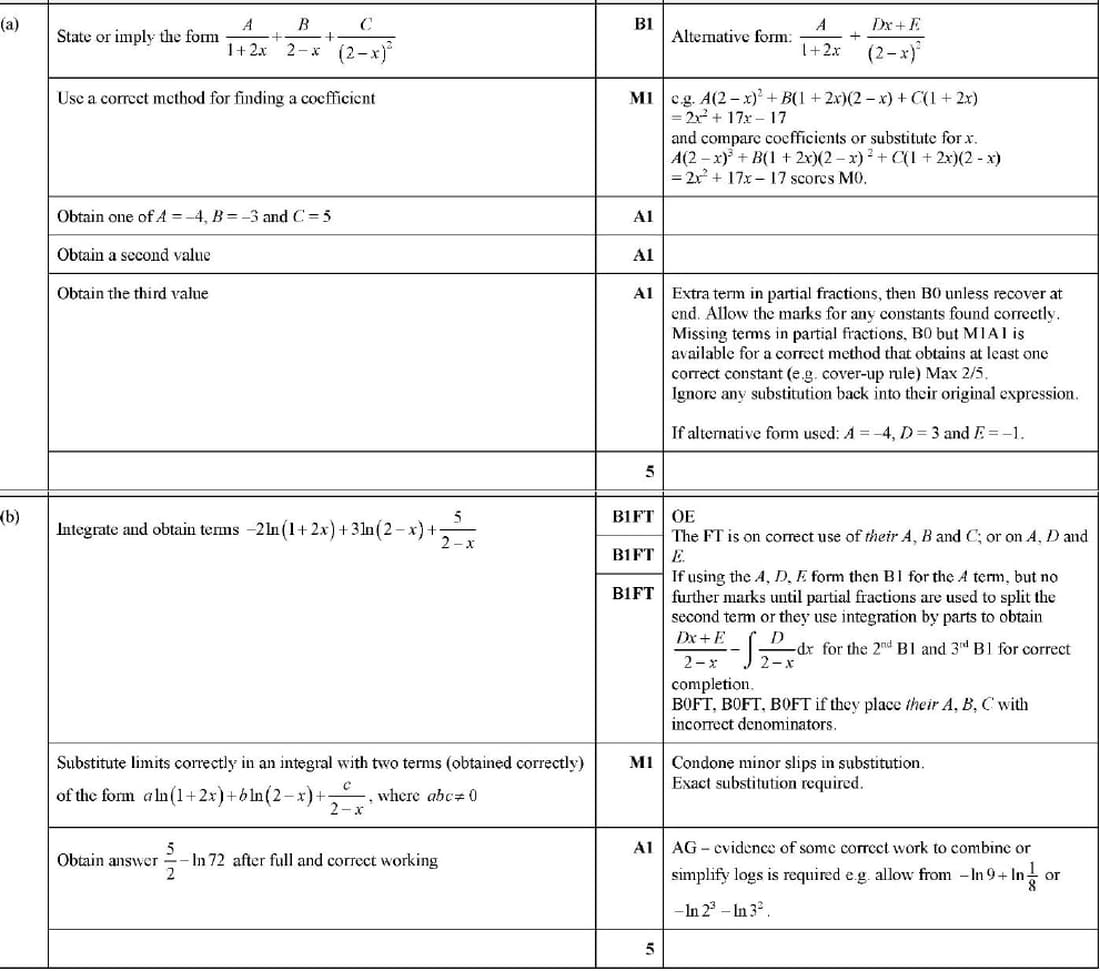
Let \(f(x) = \frac{2x^2 + 17x - 17}{(1 + 2x)(2 - x)^2}\).
(a) Express \(f(x)\) in partial fractions.
(b) Hence show that \(\int_0^1 f(x) \, dx = \frac{5}{2} - \ln 72\).
9709 P33 - Jun 2020 - Q7
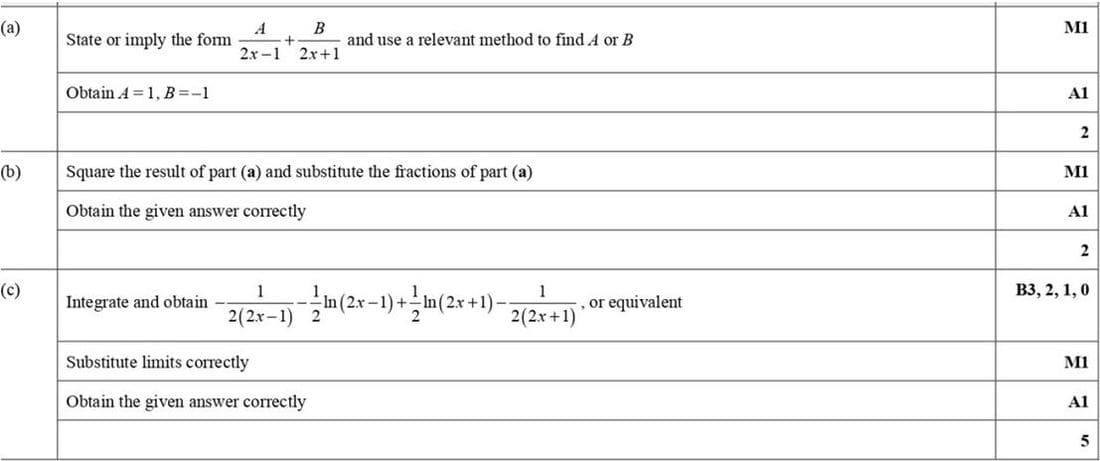
Let \(f(x) = \frac{2}{(2x-1)(2x+1)}\).
(a) Express \(f(x)\) in partial fractions.
(b) Using your answer to part (a), show that \((f(x))^2 = \frac{1}{(2x-1)^2} - \frac{1}{2x-1} + \frac{1}{2x+1} + \frac{1}{(2x+1)^2}\).
(c) Hence show that \(\int_1^2 (f(x))^2 \, dx = \frac{2}{5} + \frac{1}{2} \ln\left(\frac{5}{9}\right)\).
9709 P32 - Nov 2019 - Q8
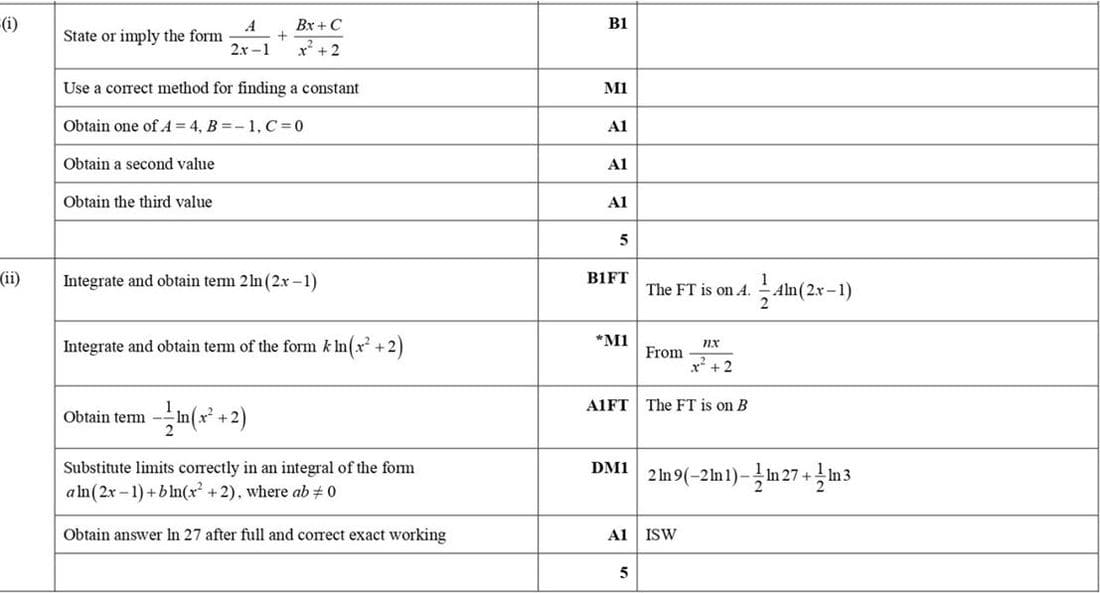
Let \(f(x) = \frac{2x^2 + x + 8}{(2x - 1)(x^2 + 2)}\).
(i) Express \(f(x)\) in partial fractions.
(ii) Hence, showing full working, find \(\int_1^5 f(x) \, dx\), giving the answer in the form \(\ln c\), where \(c\) is an integer.
9709 P31 - Nov 2019 - Q8
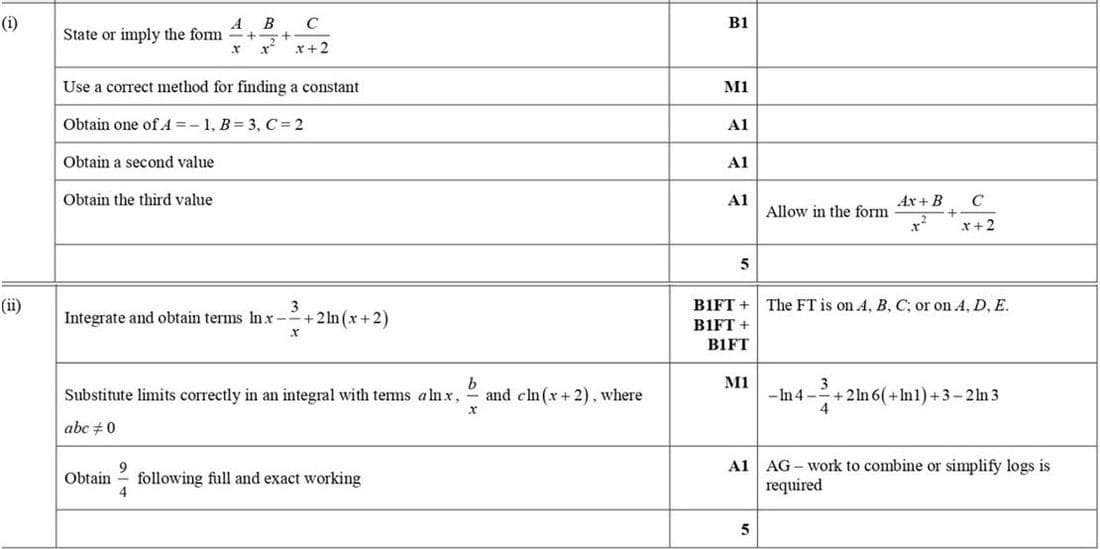
Let \(f(x) = \frac{x^2 + x + 6}{x^2(x+2)}\).
(i) Express \(f(x)\) in partial fractions.
(ii) Hence, showing full working, show that the exact value of \(\int_1^4 f(x) \, dx\) is \(\frac{9}{4}\).
9709 P32 - Jun 2019 - Q8
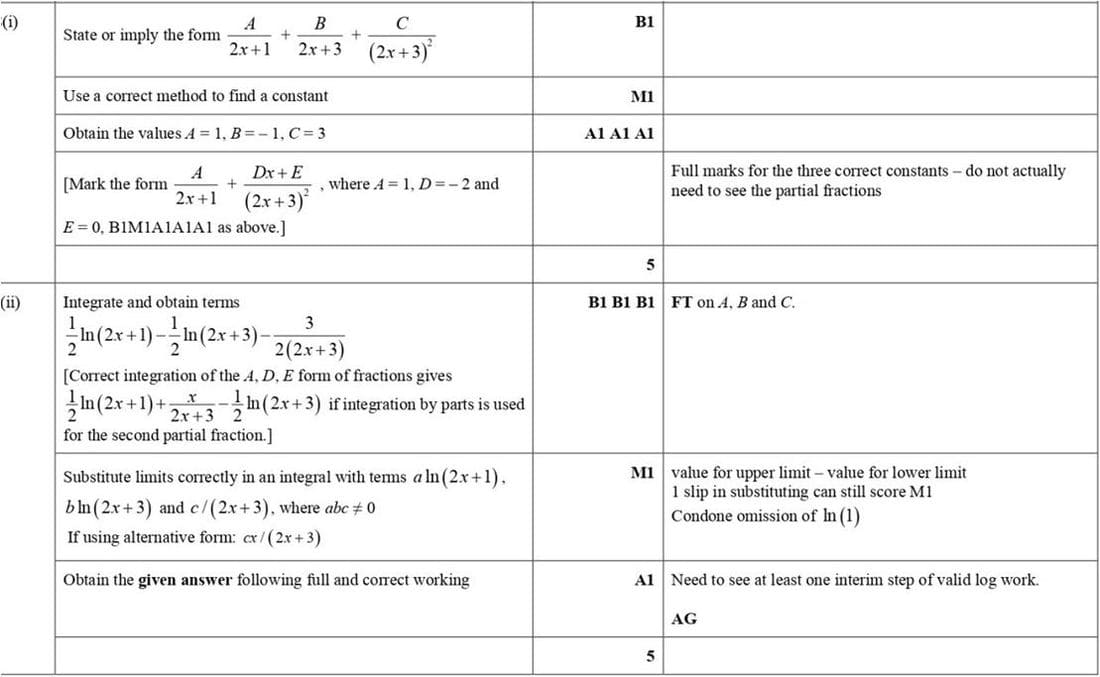
Let \(f(x) = \frac{10x + 9}{(2x + 1)(2x + 3)^2}\).
(i) Express \(f(x)\) in partial fractions.
(ii) Hence show that \(\int_0^1 f(x) \, dx = \frac{1}{2} \ln \frac{9}{5} + \frac{1}{5}\).
9709 P31 - Nov 2018 - Q9
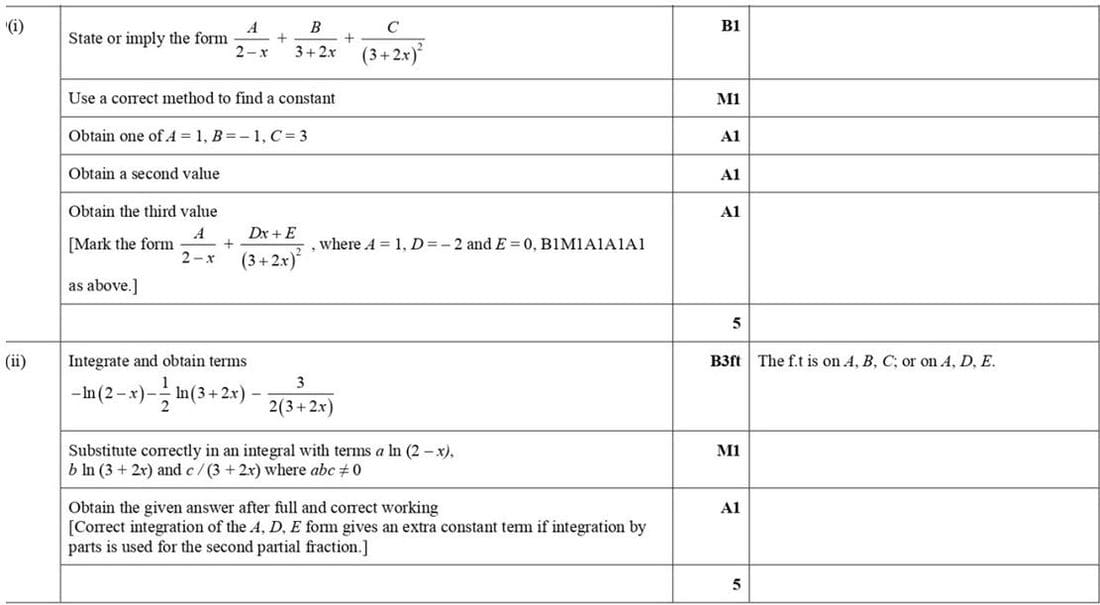
Let \(f(x) = \frac{6x^2 + 8x + 9}{(2-x)(3+2x)^2}\).
(i) Express \(f(x)\) in partial fractions.
(ii) Hence, showing all necessary working, show that \(\int_{-1}^{0} f(x) \, dx = 1 + \frac{1}{2} \ln \left( \frac{3}{4} \right)\).
9709 P32 - Mar 2018 - Q8
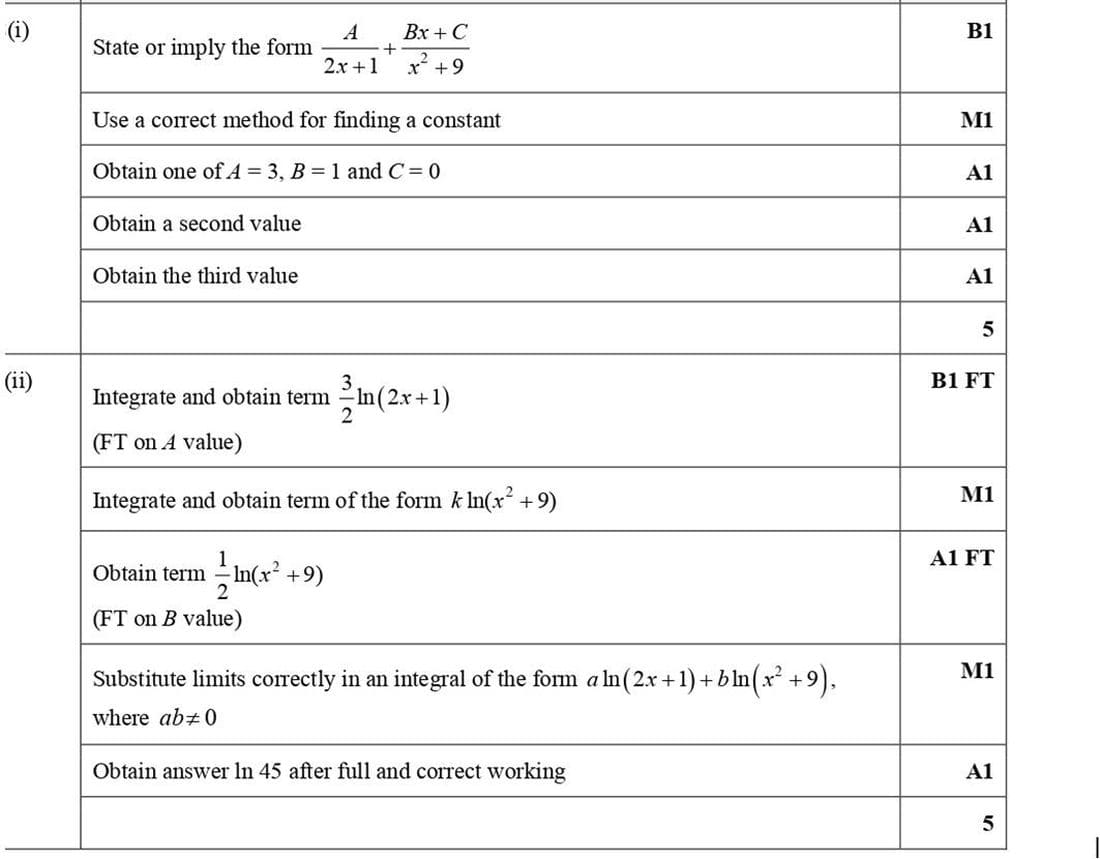
Let \(f(x) = \frac{5x^2 + x + 27}{(2x + 1)(x^2 + 9)}\).
(i) Express \(f(x)\) in partial fractions.
(ii) Hence find \(\int_0^4 f(x) \, dx\), giving your answer in the form \(\ln c\), where \(c\) is an integer.
9709 P33 - Jun 2017 - Q9
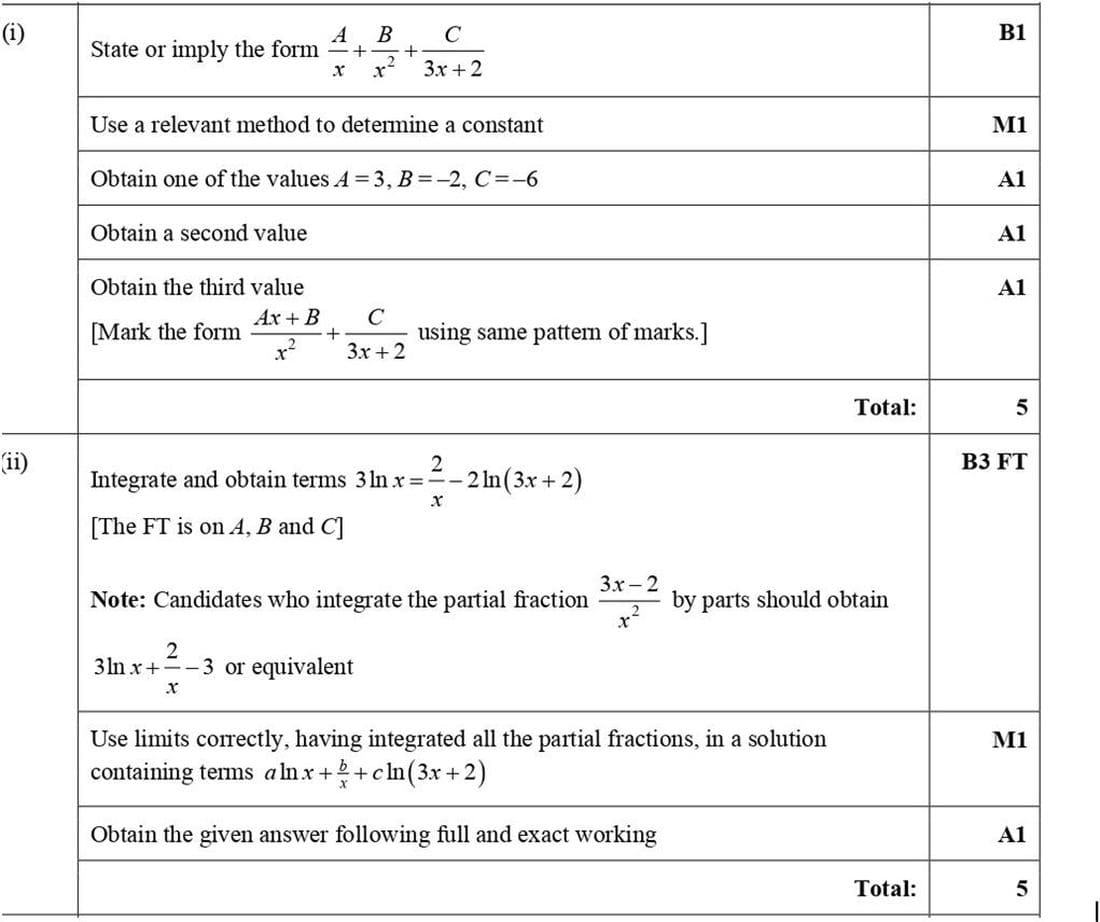
Let \(f(x) = \frac{3x^2 - 4}{x^2(3x + 2)}\).
(i) Express \(f(x)\) in partial fractions.
(ii) Hence show that \(\int_1^2 f(x) \, dx = \ln\left(\frac{25}{8}\right) - 1\).
9709 P33 - Nov 2015 - Q7
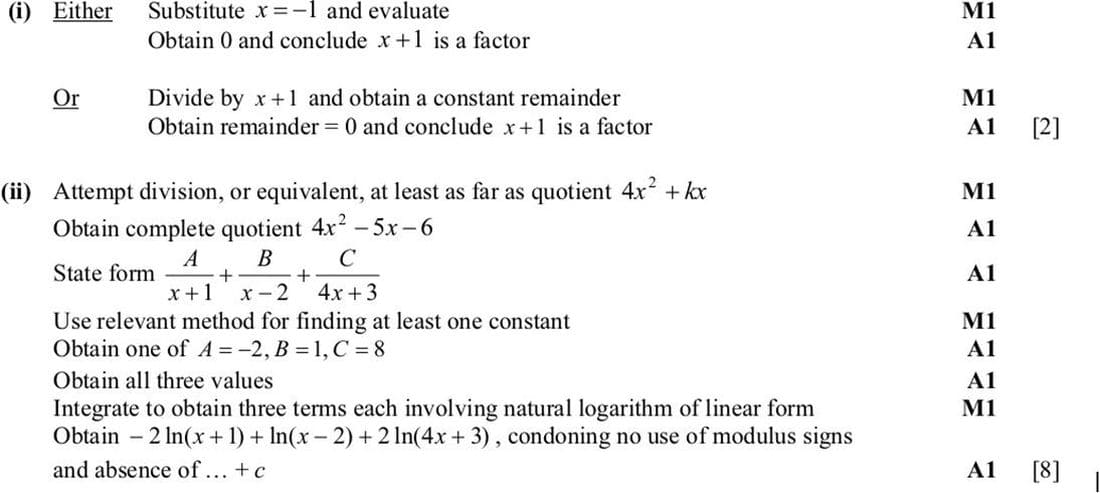
(i) Show that \((x + 1)\) is a factor of \(4x^3 - x^2 - 11x - 6\).
(ii) Find \(\int \frac{4x^2 + 9x - 1}{4x^3 - x^2 - 11x - 6} \, dx\).
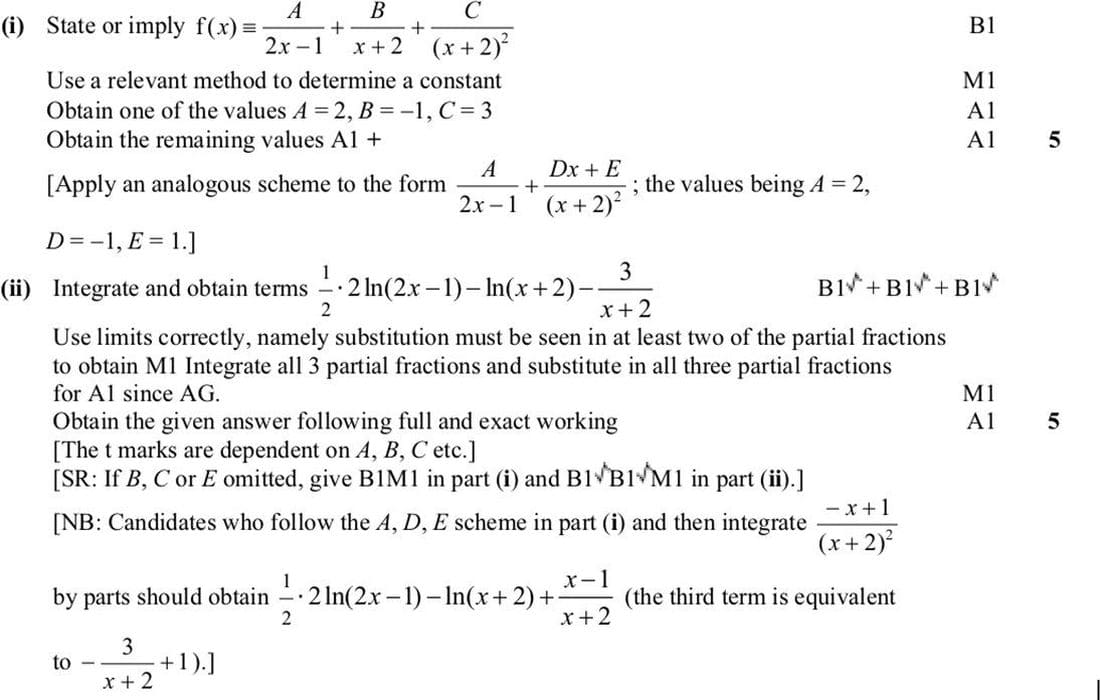
9709 P33 - Jun 2015 - Q10
Let \(f(x) = \frac{11x + 7}{(2x - 1)(x + 2)^2}\).
(i) Express \(f(x)\) in partial fractions.
(ii) Show that \(\int_1^2 f(x) \, dx = \frac{1}{4} + \ln\left(\frac{9}{4}\right)\).
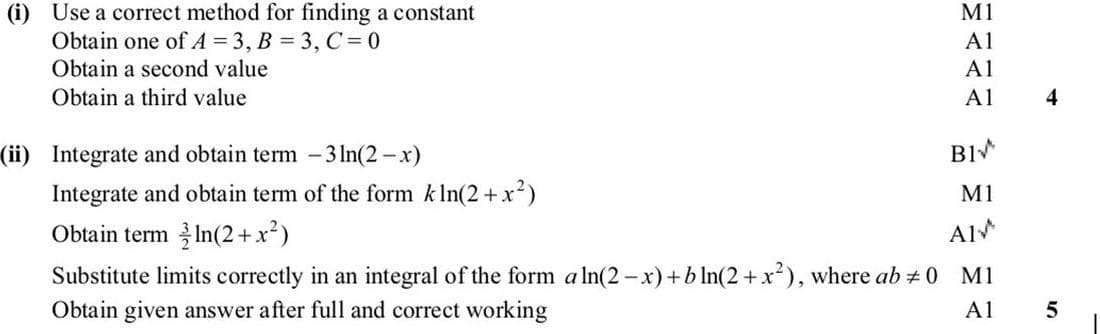
9709 P33 - Jun 2014 - Q8
Let \(f(x) = \frac{6 + 6x}{(2-x)(2+x^2)}\).
(i) Express \(f(x)\) in the form \(\frac{A}{2-x} + \frac{Bx+C}{2+x^2}\).
(ii) Show that \(\int_{-1}^{1} f(x) \, dx = 3 \ln 3\).
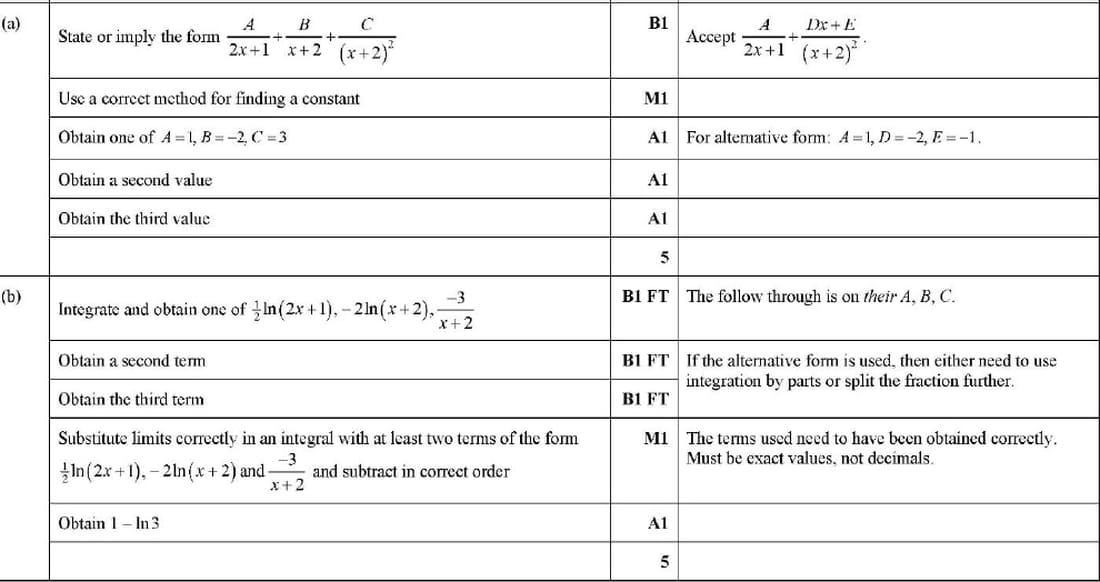
9709 P31 - Jun 2023 - Q8
Let \(f(x) = \frac{3 - 3x^2}{(2x + 1)(x + 2)^2}\).
(a) Express \(f(x)\) in partial fractions.
(b) Hence find the exact value of \(\int_0^4 f(x) \, dx\), giving your answer in the form \(a + b \ln c\), where \(a, b,\) and \(c\) are integers.
9709 P31 - Jun 2013 - Q3
Express \(\frac{7x^2 - 3x + 2}{x(x^2 + 1)}\) in partial fractions.

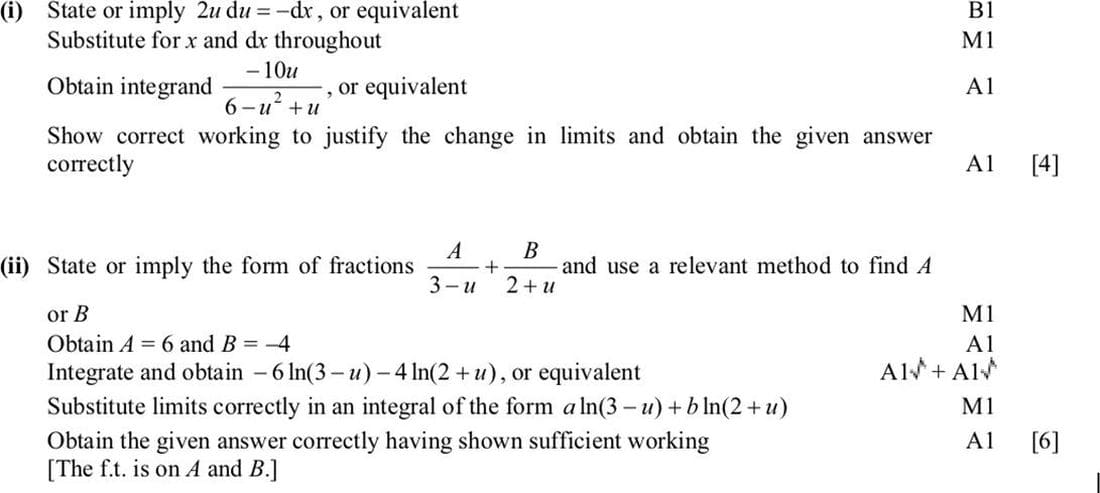
9709 P32 - Jun 2012 - Q8
Let \(I = \int_{2}^{5} \frac{5}{x + \sqrt{6-x}} \, dx\).
(i) Using the substitution \(u = \sqrt{6-x}\), show that \(I = \int_{1}^{2} \frac{10u}{(3-u)(2+u)} \, du\).
(ii) Hence show that \(I = 2 \ln\left(\frac{9}{2}\right)\).