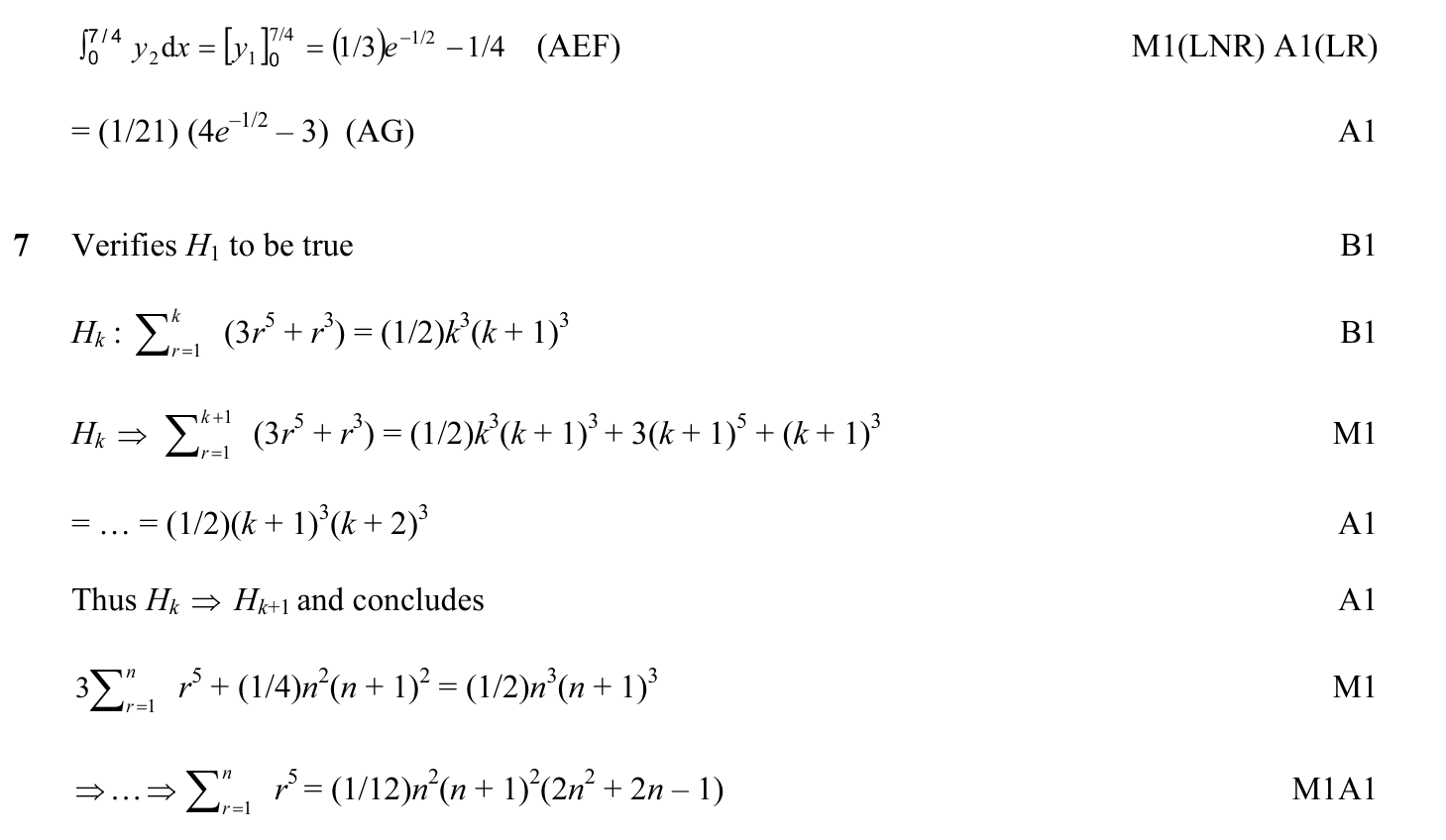
Answer: (a) Let \(H_n\) be the statement
\(\displaystyle \sum_{r=1}^{n}(3r^{5}+r^{3})=\frac12 n^{3}(n+1)^{3}.\)
For \(n=1\),
\(\displaystyle \sum_{r=1}^{1}(3r^{5}+r^{3})=3(1)^5+(1)^3=4,\)
and
\(\displaystyle \frac12\cdot 1^3\cdot 2^3=4.\)
So \(H_1\) is true.
Now assume \(H_k\) is true for some \(k\ge 1\), so that
\(\displaystyle \sum_{r=1}^{k}(3r^{5}+r^{3})=\frac12 k^{3}(k+1)^{3}.\)
Then
\(\displaystyle \sum_{r=1}^{k+1}(3r^{5}+r^{3})=\sum_{r=1}^{k}(3r^{5}+r^{3})+3(k+1)^5+(k+1)^3.\)
Using the inductive hypothesis,
\(\displaystyle \sum_{r=1}^{k+1}(3r^{5}+r^{3})=\frac12 k^{3}(k+1)^{3}+3(k+1)^5+(k+1)^3.\)
Factor out \((k+1)^3\):
\(\displaystyle =(k+1)^3\left(\frac12 k^3+3(k+1)^2+1\right).\)
Now simplify the bracket:
\(\displaystyle \frac12 k^3+3(k^2+2k+1)+1=\frac12 k^3+3k^2+6k+4.\)
Also
\(\displaystyle \frac12(k+2)^3=\frac12(k^3+6k^2+12k+8),\)
so
\(\displaystyle \frac12 k^3+3k^2+6k+4=\frac12(k+2)^3.\)
Hence
\(\displaystyle \sum_{r=1}^{k+1}(3r^{5}+r^{3})=\frac12 (k+1)^3(k+2)^3.\)
This is exactly \(H_{k+1}\), so the result follows by induction for all \(n\ge 1\).
Now use the result to find \(\sum_{r=1}^n r^5\). Since
\(\displaystyle \sum_{r=1}^{n}(3r^{5}+r^{3})=3\sum_{r=1}^{n}r^5+\sum_{r=1}^{n}r^3,\)
and the List of Formulae gives
\(\displaystyle \sum_{r=1}^{n}r^3=\left(\frac{n(n+1)}{2}\right)^2=\frac14 n^2(n+1)^2,\)
we have
\(\displaystyle 3\sum_{r=1}^{n}r^5+\frac14 n^2(n+1)^2=\frac12 n^3(n+1)^3.\)
Therefore
\(\displaystyle 3\sum_{r=1}^{n}r^5=\frac12 n^3(n+1)^3-\frac14 n^2(n+1)^2.\)
Factorising,
\(\displaystyle 3\sum_{r=1}^{n}r^5=\frac14 n^2(n+1)^2\bigl(2n(n+1)-1\bigr).\)
So
\(\displaystyle \sum_{r=1}^{n}r^5=\frac{1}{12}n^2(n+1)^2\bigl(2n^2+2n-1\bigr).\)
Thus \(\mathrm{Q}(n)=2n^2+2n-1\).
Let
\(\displaystyle H_n:\sum_{r=1}^{n}(3r^5+r^3)=\frac12 n^3(n+1)^3.\)
Base case. For \(n=1\),
\(\displaystyle \sum_{r=1}^{1}(3r^5+r^3)=3+1=4,\)
while
\(\displaystyle \frac12\cdot 1^3\cdot 2^3=4.\)
So \(H_1\) is true.
Inductive step. Assume \(H_k\) is true for some \(k\ge 1\). Then
\(\displaystyle \sum_{r=1}^{k+1}(3r^5+r^3)=\sum_{r=1}^{k}(3r^5+r^3)+3(k+1)^5+(k+1)^3.\)
Using the inductive hypothesis,
\(\displaystyle \sum_{r=1}^{k+1}(3r^5+r^3)=\frac12 k^3(k+1)^3+3(k+1)^5+(k+1)^3.\)
Factor out \((k+1)^3\):
\(\displaystyle = (k+1)^3\left(\frac12 k^3+3(k+1)^2+1\right).\)
Now simplify the bracket:
\(\displaystyle \frac12 k^3+3(k+1)^2+1=\frac12 k^3+3(k^2+2k+1)+1\)
\(\displaystyle =\frac12 k^3+3k^2+6k+4.\)
But
\(\displaystyle \frac12(k+2)^3=\frac12(k^3+6k^2+12k+8)=\frac12 k^3+3k^2+6k+4.\)
Hence
\(\displaystyle \sum_{r=1}^{k+1}(3r^5+r^3)=\frac12 (k+1)^3(k+2)^3,\)
which is exactly \(H_{k+1}\). Therefore, by induction,
\(\displaystyle \sum_{r=1}^{n}(3r^5+r^3)=\frac12 n^3(n+1)^3\)
for all \(n\ge 1\).
Now use the formula \(\displaystyle \sum_{r=1}^{n}r^3=\left(\frac{n(n+1)}{2}\right)^2=\frac14 n^2(n+1)^2\).
Since
\(\displaystyle \sum_{r=1}^{n}(3r^5+r^3)=3\sum_{r=1}^{n}r^5+\sum_{r=1}^{n}r^3,\)
we get
\(\displaystyle 3\sum_{r=1}^{n}r^5+\frac14 n^2(n+1)^2=\frac12 n^3(n+1)^3.\)
So
\(\displaystyle 3\sum_{r=1}^{n}r^5=\frac12 n^3(n+1)^3-\frac14 n^2(n+1)^2\)
\(\displaystyle =\frac14 n^2(n+1)^2\bigl(2n(n+1)-1\bigr).\)
Therefore
\(\displaystyle \sum_{r=1}^{n}r^5=\frac{1}{12}n^2(n+1)^2(2n^2+2n-1).\)
So \(\mathrm{Q}(n)=2n^2+2n-1\).