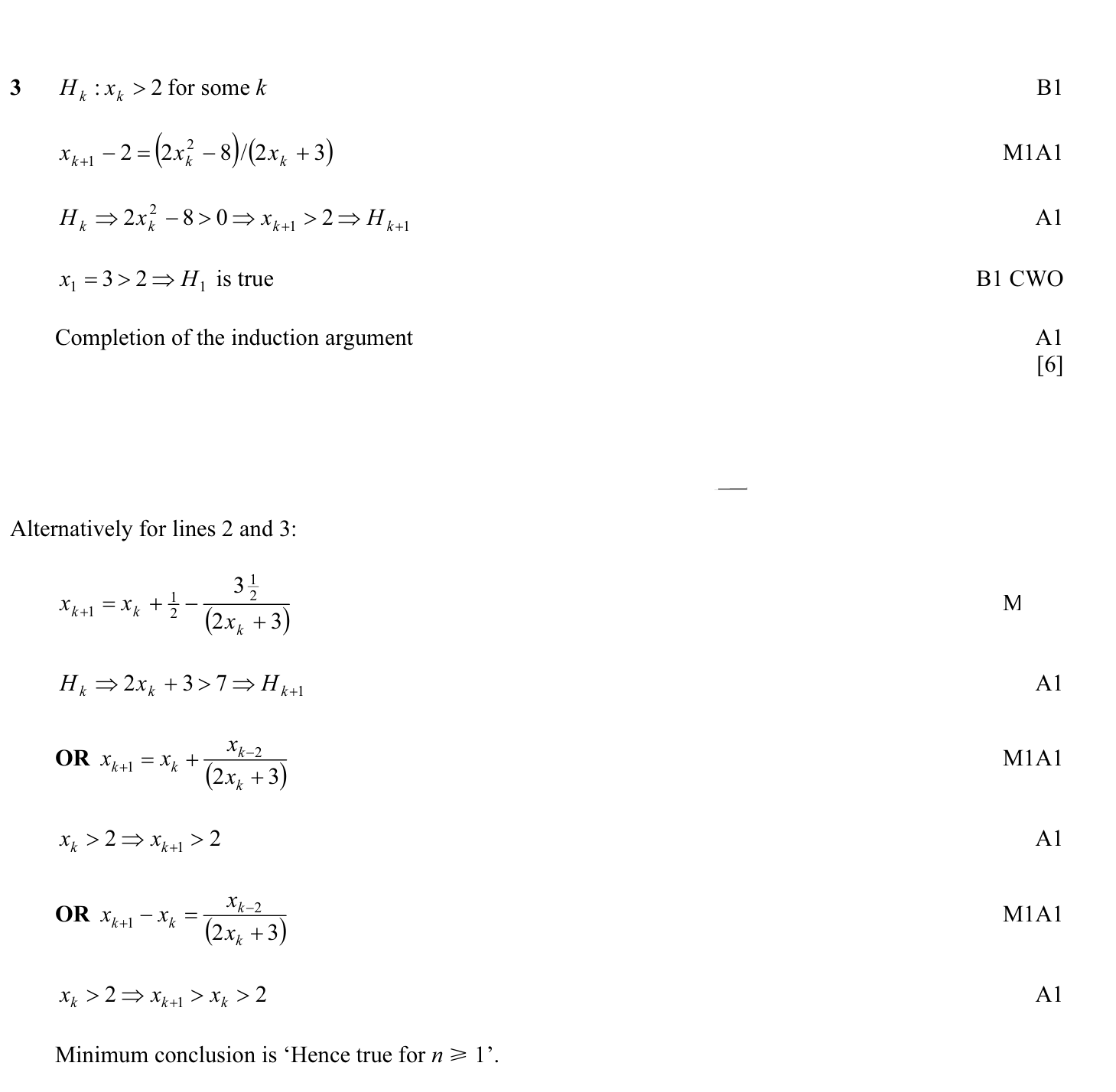
Answer: We prove by induction that \(x_n \gt 2\) for all \(n\ge 1\).
First, \(x_1=3\), so \(x_1\gt 2\).
Now assume that for some \(k\ge 1\), \(x_k\gt 2\). We must show that \(x_{k+1}\gt 2\).
Using the recurrence,
\(x_{k+1}-2=\dfrac{2x_k^2+4x_k-2}{2x_k+3}-2=\dfrac{2x_k^2+4x_k-2-(4x_k+6)}{2x_k+3}=\dfrac{2x_k^2-8}{2x_k+3}.\)
Since \(x_k\gt 2\), we have \(x_k^2\gt 4\), so \(2x_k^2-8\gt 0\). Also, \(2x_k+3\gt 0\). Therefore
\(x_{k+1}-2=\dfrac{2x_k^2-8}{2x_k+3}\gt 0,\)
which means \(x_{k+1}\gt 2\).
Hence, if \(x_k\gt 2\) then \(x_{k+1}\gt 2\), and since the result is true for \(n=1\), it follows by induction that \(x_n\gt 2\) for all \(n\ge 1\).
Let \(H_n\) be the statement \(x_n\gt 2\).
Base case: \(x_1=3\), so \(x_1\gt 2\). Thus \(H_1\) is true.
Inductive step: Assume \(H_k\) is true for some \(k\ge 1\); that is, assume \(x_k\gt 2\). We show that \(H_{k+1}\) is true.
From the recurrence,
\(x_{k+1}=\dfrac{2x_k^2+4x_k-2}{2x_k+3}.\)
Subtracting 2 gives
\(x_{k+1}-2=\dfrac{2x_k^2+4x_k-2}{2x_k+3}-2=\dfrac{2x_k^2+4x_k-2-(4x_k+6)}{2x_k+3}=\dfrac{2x_k^2-8}{2x_k+3}.\)
Now \(x_k\gt 2\) implies \(x_k^2\gt 4\), so \(2x_k^2-8\gt 0\). Also, \(2x_k+3\gt 0\). Therefore
\(x_{k+1}-2=\dfrac{2x_k^2-8}{2x_k+3}\gt 0,\)
hence \(x_{k+1}\gt 2\). So \(H_k\Rightarrow H_{k+1}\).
Since \(H_1\) is true and the truth of \(H_k\) implies the truth of \(H_{k+1}\), it follows by induction that \(x_n\gt 2\) for all \(n\ge 1\).