Past Exam Questions
← Back9709 P33 - Nov 2011 - Q7
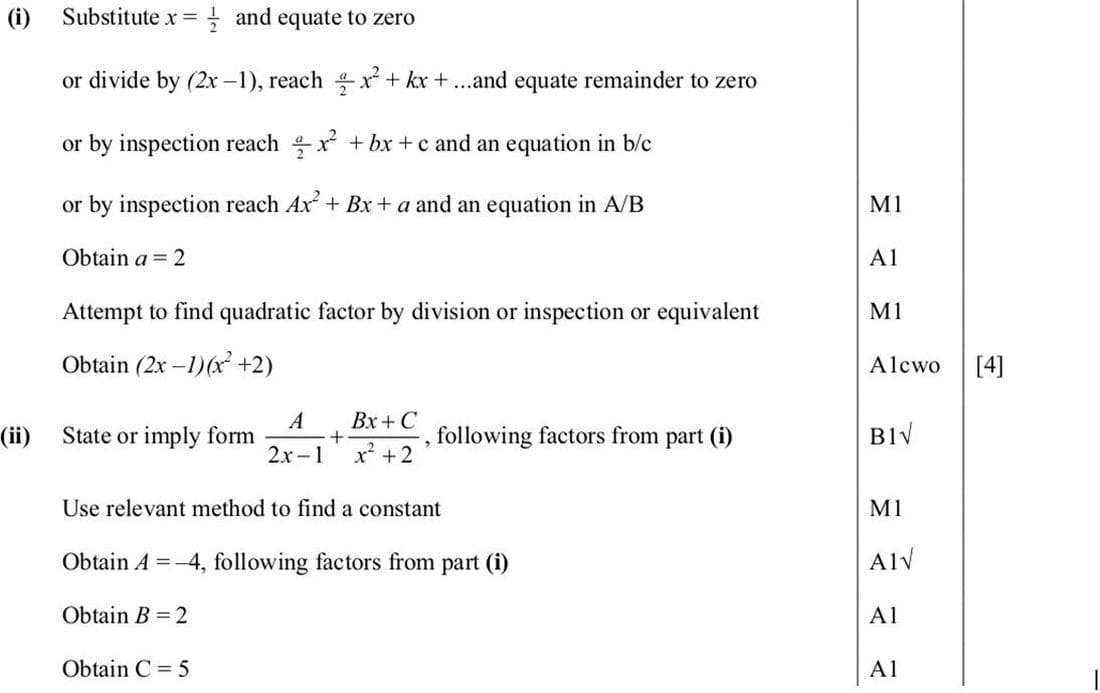
The polynomial \(p(x)\) is defined by
\(p(x) = ax^3 - x^2 + 4x - a\),
where \(a\) is a constant. It is given that \((2x - 1)\) is a factor of \(p(x)\).
- Find the value of \(a\) and hence factorise \(p(x)\).
- When \(a\) has the value found in part (i), express \(\frac{8x - 13}{p(x)}\) in partial fractions.
9709 P31 - Nov 2011 - Q8
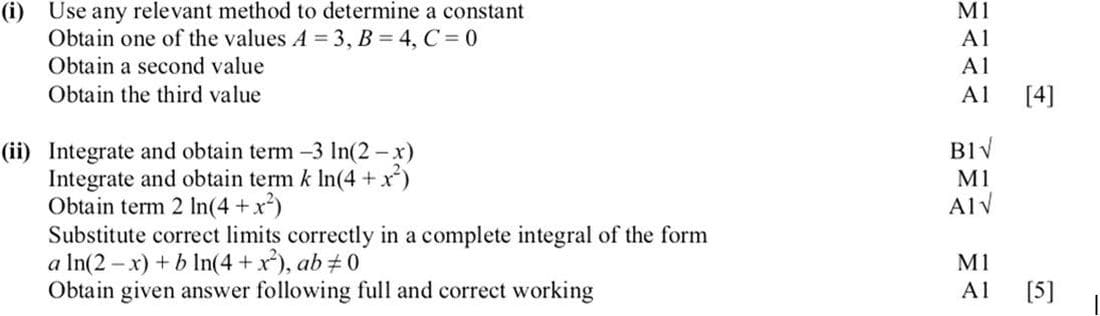
Let \(f(x) = \frac{12 + 8x - x^2}{(2-x)(4+x^2)}\).
(i) Express \(f(x)\) in the form \(\frac{A}{2-x} + \frac{Bx+C}{4+x^2}\).
(ii) Show that \(\int_0^1 f(x) \, dx = \ln\left(\frac{25}{2}\right)\).
9709 P33 - Nov 2010 - Q5
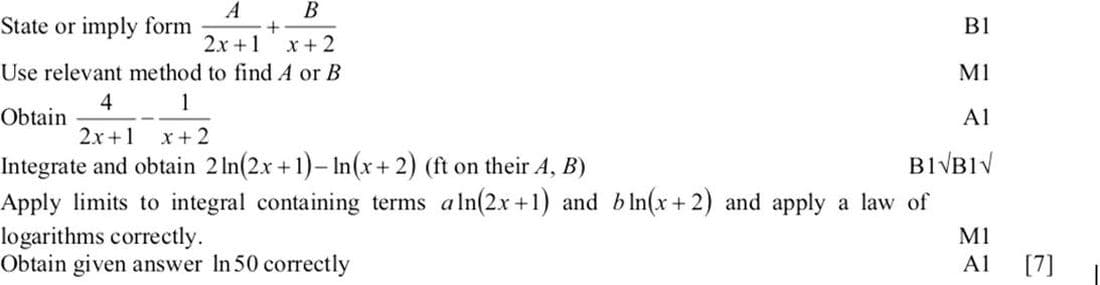
Show that \(\int_0^7 \frac{2x + 7}{(2x + 1)(x + 2)} \, dx = \ln 50\).
9709 P31 - Jun 2010 - Q8
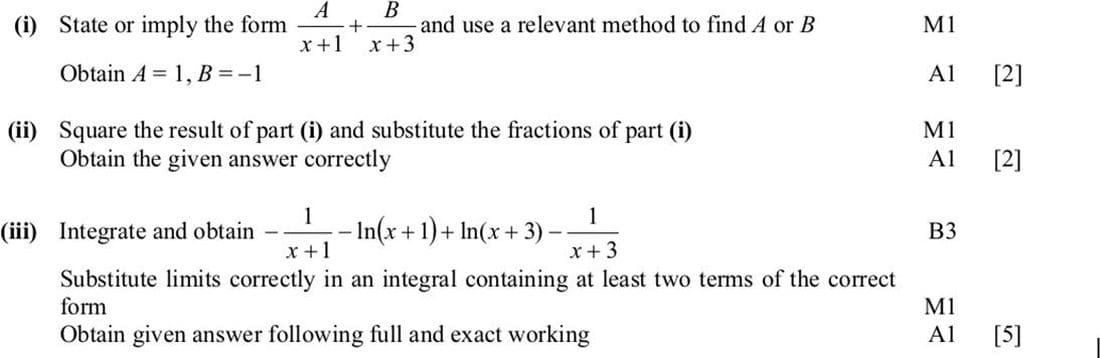
(i) Express \(\frac{2}{(x+1)(x+3)}\) in partial fractions.
(ii) Using your answer to part (i), show that \(\left( \frac{2}{(x+1)(x+3)} \right)^2 \equiv \frac{1}{(x+1)^2} - \frac{1}{x+1} + \frac{1}{x+3} + \frac{1}{(x+3)^2}\).
(iii) Hence show that \(\int_0^1 \frac{4}{(x+1)^2(x+3)^2} \, dx = \frac{7}{12} - \ln \frac{3}{2}\).
Question #2115
Show that \(\int_1^2 \frac{2}{u(4-u)} \, du = \frac{1}{2} \ln 3\).

9709 P3 - Nov 2006 - Q8
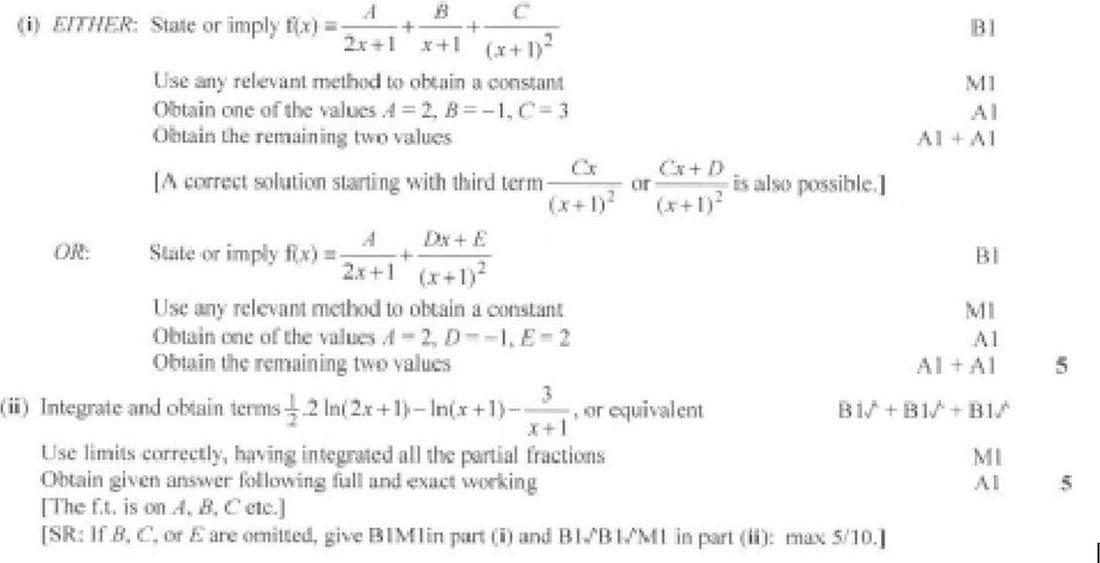
Let \(f(x) = \frac{7x + 4}{(2x + 1)(x + 1)^2}\).
(i) Express \(f(x)\) in partial fractions.
(ii) Hence show that \(\int_0^2 f(x) \, dx = 2 + \ln \frac{5}{3}\).
9709 P3 - Nov 2004 - Q8
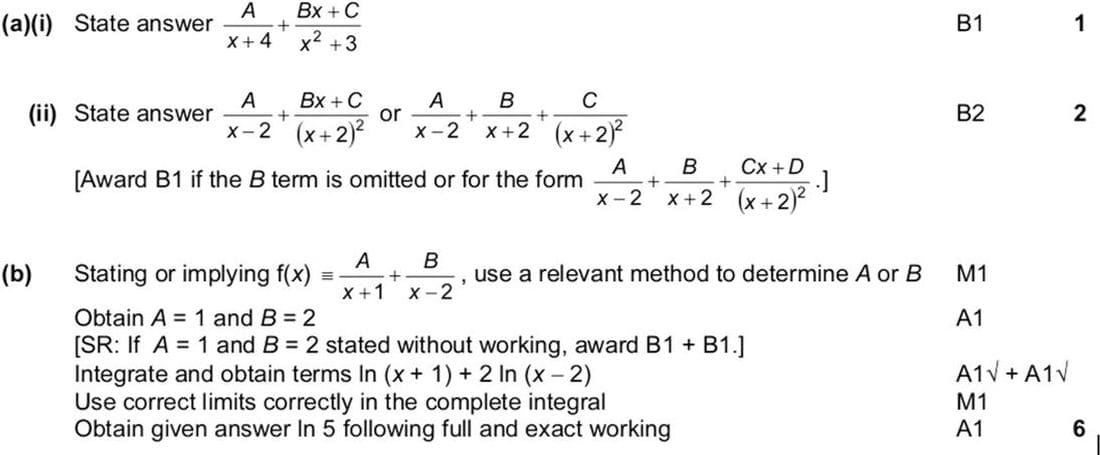
An appropriate form for expressing \(\frac{3x}{(x+1)(x-2)}\) in partial fractions is \(\frac{A}{x+1} + \frac{B}{x-2}\), where \(A\) and \(B\) are constants.
(a) Without evaluating any constants, state appropriate forms for expressing the following in partial fractions:
(i) \(\frac{4x}{(x+4)(x^2+3)}\)
(ii) \(\frac{2x+1}{(x-2)(x+2)^2}\)
(b) Show that \(\int_3^4 \frac{3x}{(x+1)(x-2)} \, dx = \ln 5\).
9709 P3 - Jun 2002 - Q6
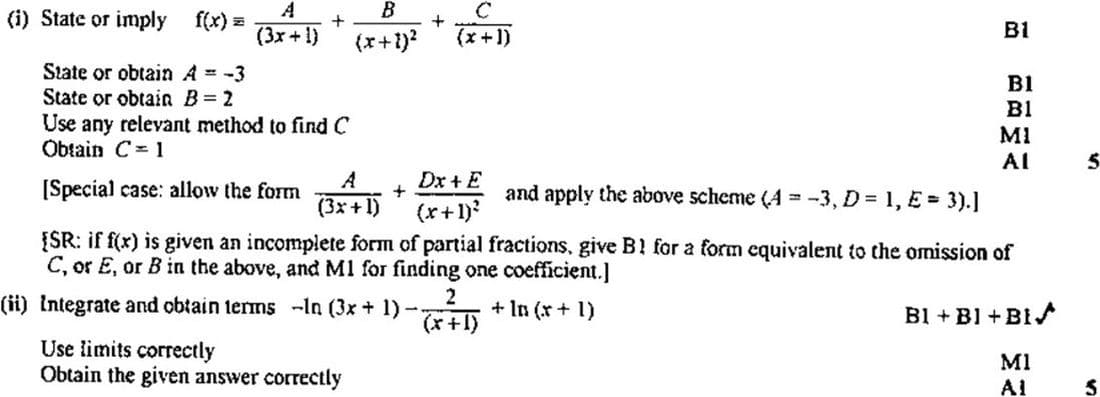
Let \(f(x) = \frac{4x}{(3x+1)(x+1)^2}\).
(i) Express \(f(x)\) in partial fractions.
(ii) Hence show that \(\int_0^1 f(x) \, dx = 1 - \ln 2\).
9709 P32 - Mar 2023 - Q11
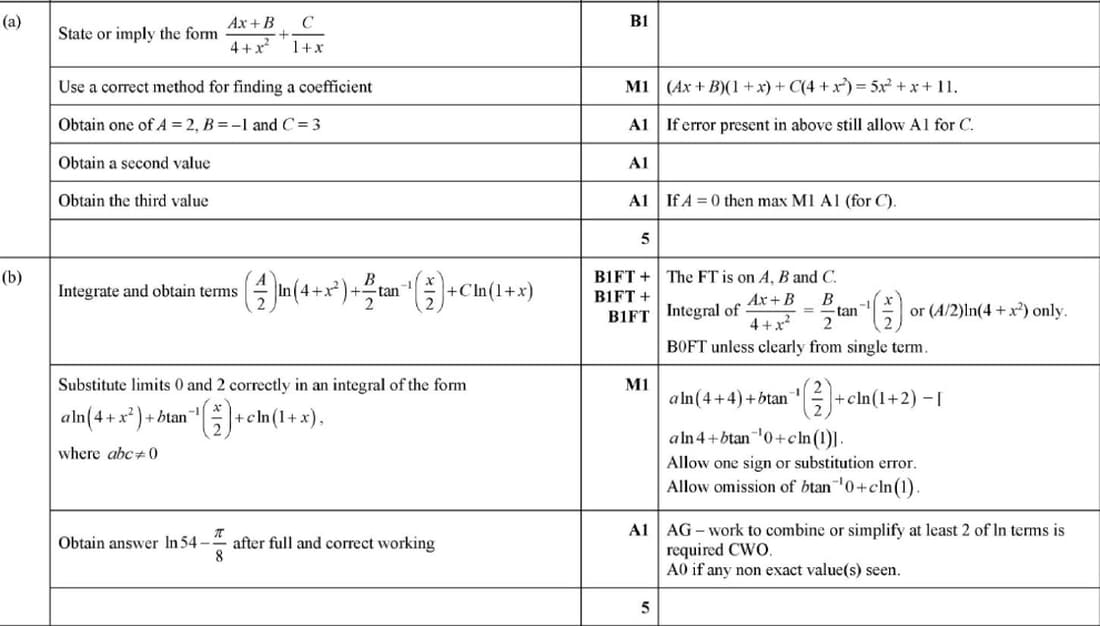
Let \(f(x) = \frac{5x^2 + x + 11}{(4 + x^2)(1 + x)}\).
(a) Express \(f(x)\) in partial fractions.
(b) Hence show that \(\int_0^2 f(x) \, dx = \ln 54 - \frac{1}{8}\pi\).
9709 P33 - Nov 2022 - Q11
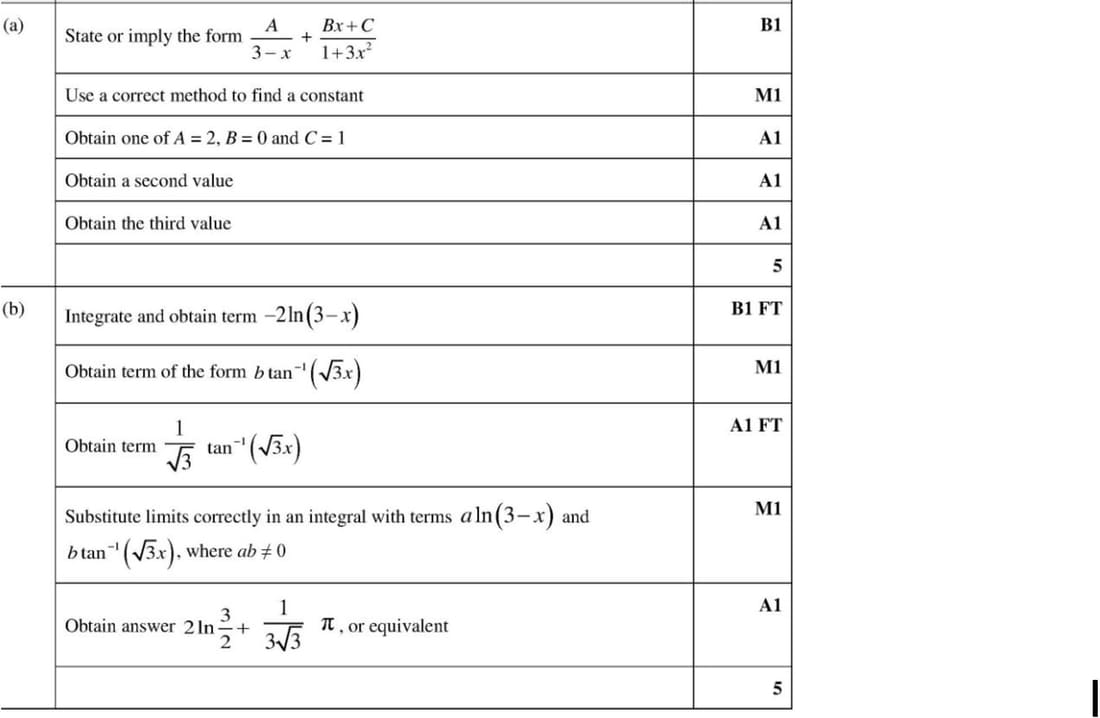
Let \(f(x) = \frac{5-x+6x^2}{(3-x)(1+3x^2)}\).
(a) Express \(f(x)\) in partial fractions.
(b) Find the exact value of \(\int_0^1 f(x) \, dx\), simplifying your answer.
9709 P32 - Nov 2022 - Q10
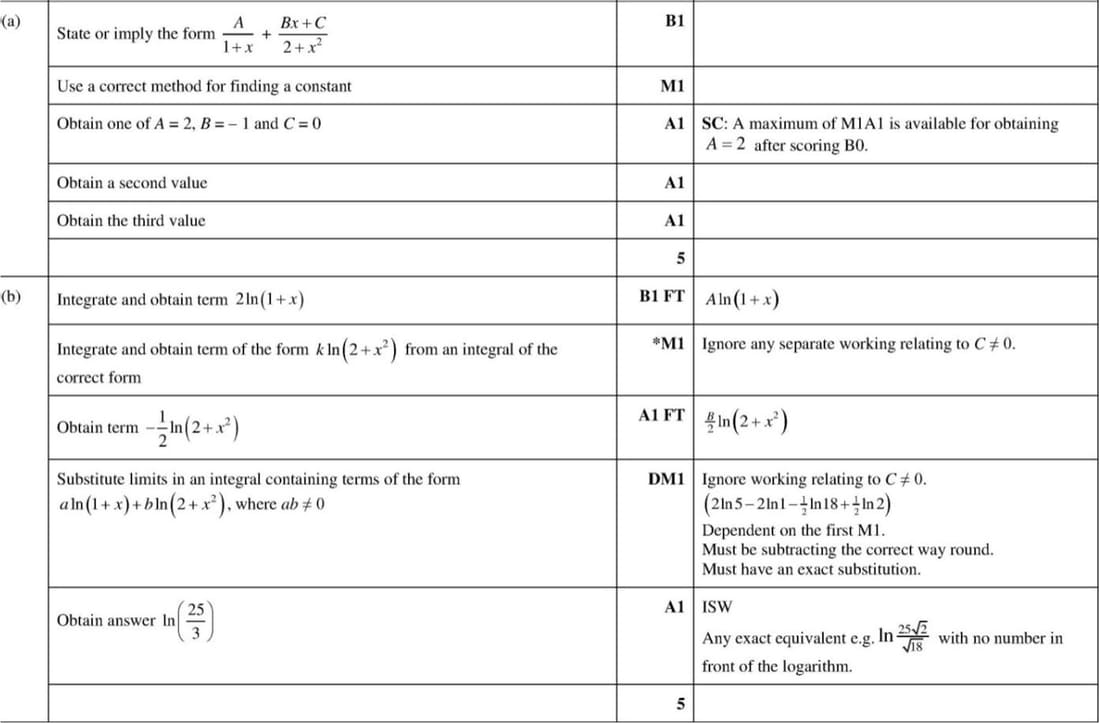
Let \(f(x) = \frac{4 - x + x^2}{(1 + x)(2 + x^2)}\).
(a) Express \(f(x)\) in partial fractions.
(b) Find the exact value of \(\int_0^4 f(x) \, dx\). Give your answer as a single logarithm.
9709 P32 - Jun 2022 - Q8
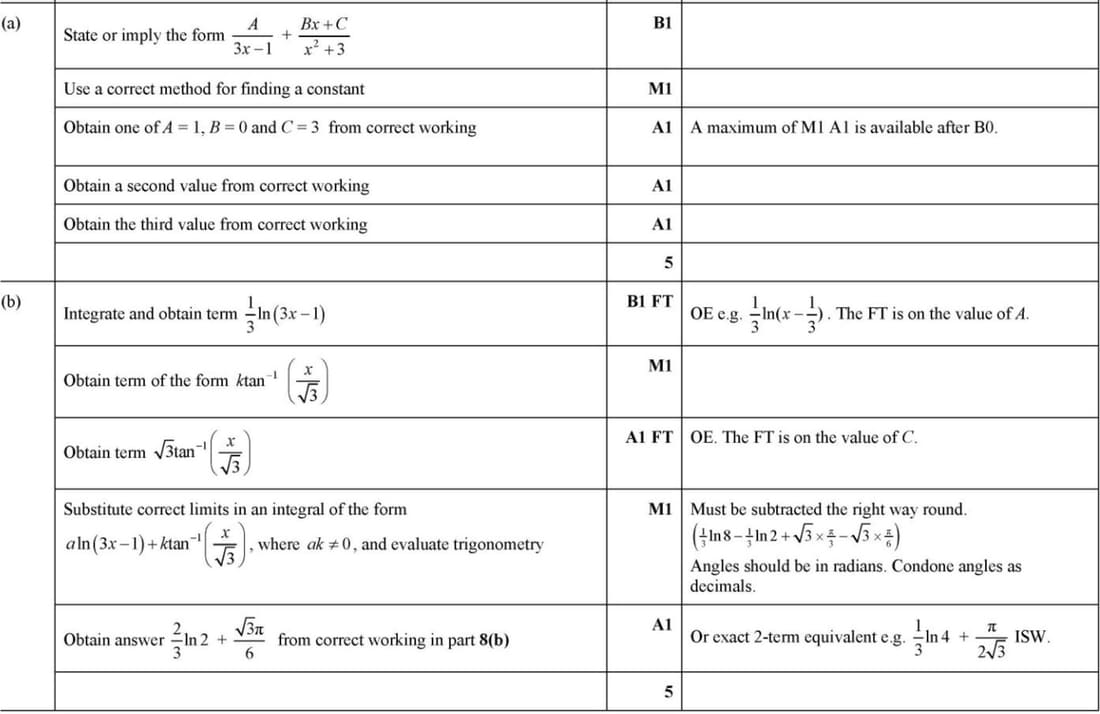
Let \(f(x) = \frac{x^2 + 9x}{(3x - 1)(x^2 + 3)}\).
(a) Express \(f(x)\) in partial fractions.
(b) Hence find \(\int_1^3 f(x) \, dx\), giving your answer in a simplified exact form.
9709 P33 - Jun 2021 - Q4
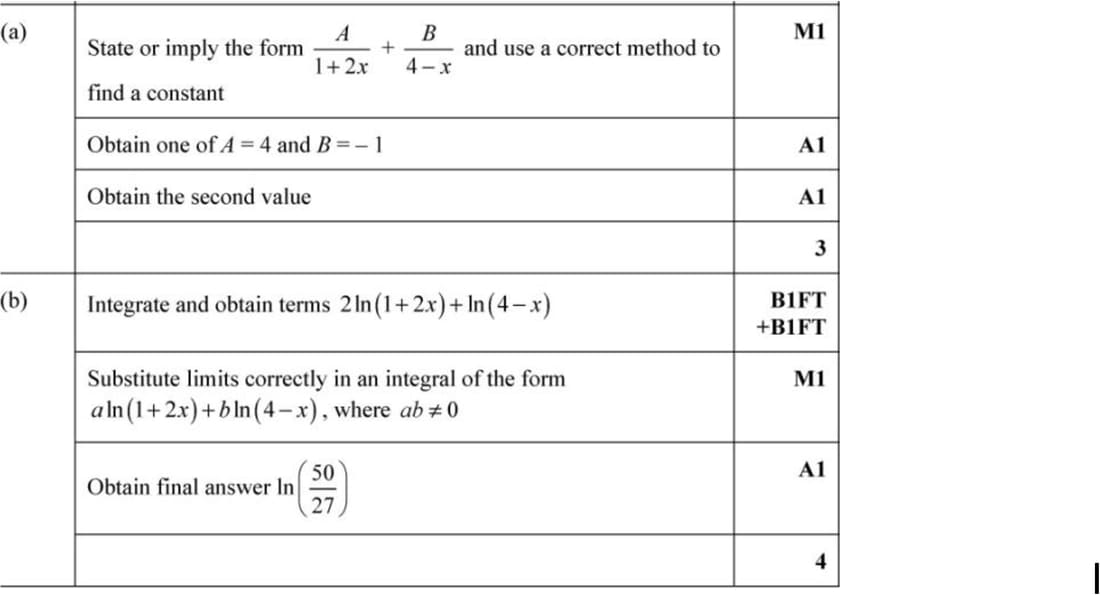
Let \(f(x) = \frac{15 - 6x}{(1 + 2x)(4 - x)}\).
(a) Express \(f(x)\) in partial fractions.
(b) Hence find \(\int_1^2 f(x) \, dx\), giving your answer in the form \(\ln \left( \frac{a}{b} \right)\), where \(a\) and \(b\) are integers.
9709 P32 - Mar 2021 - Q6
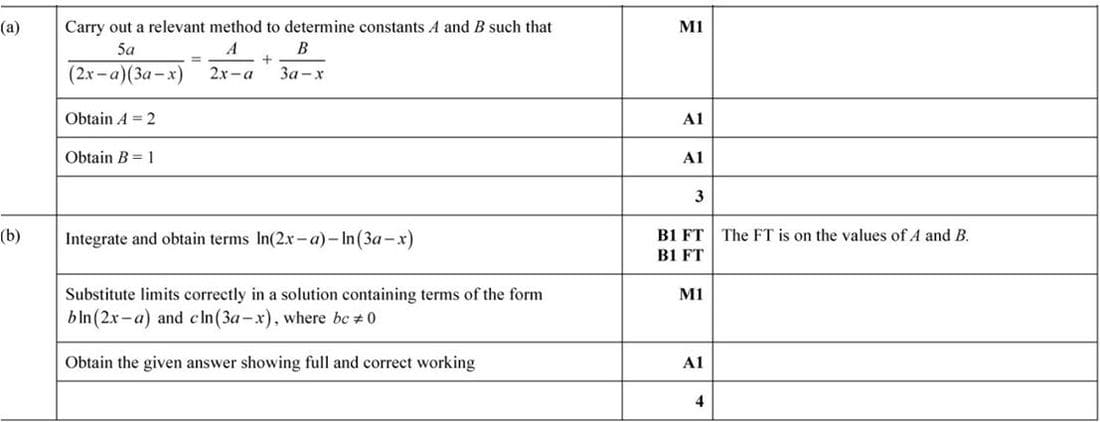
Let \(f(x) = \frac{5a}{(2x-a)(3a-x)}\), where \(a\) is a positive constant.
(a) Express \(f(x)\) in partial fractions.
(b) Hence show that \(\int_a^{2a} f(x) \, dx = \ln 6\).
9709 P32 - Nov 2020 - Q9
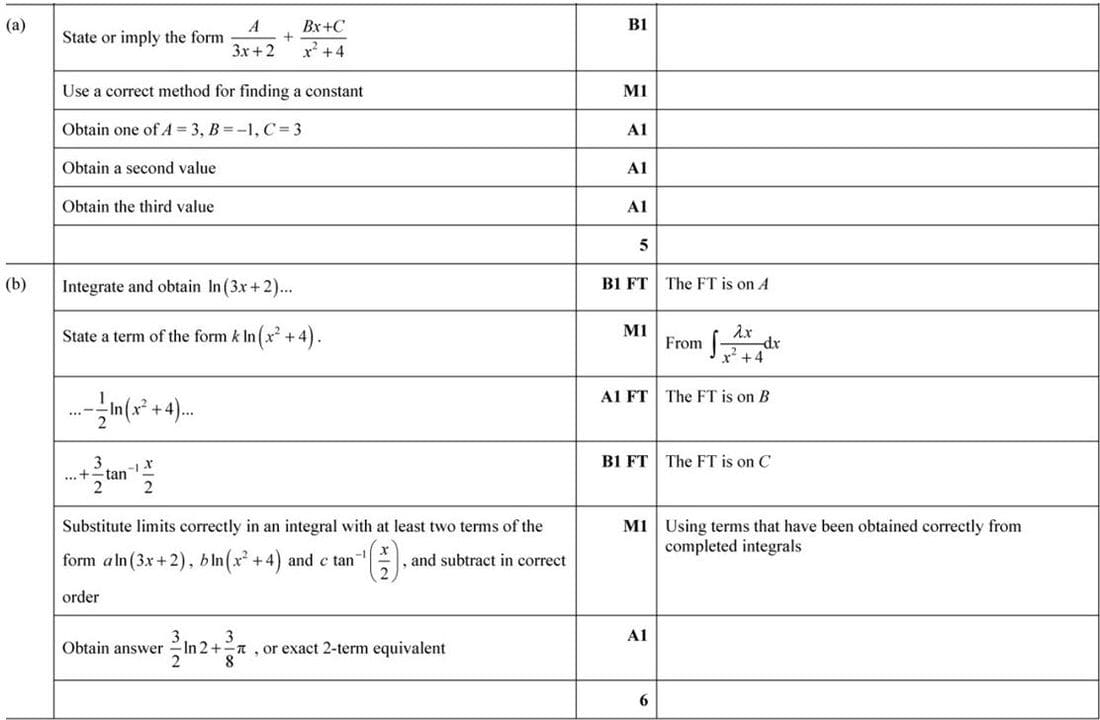
Let \(f(x) = \frac{7x + 18}{(3x + 2)(x^2 + 4)}\).
(a) Express \(f(x)\) in partial fractions.
(b) Hence find the exact value of \(\int_0^2 f(x) \, dx\).
9231 P14 - Jun 2025 - Q02 - 6 marks
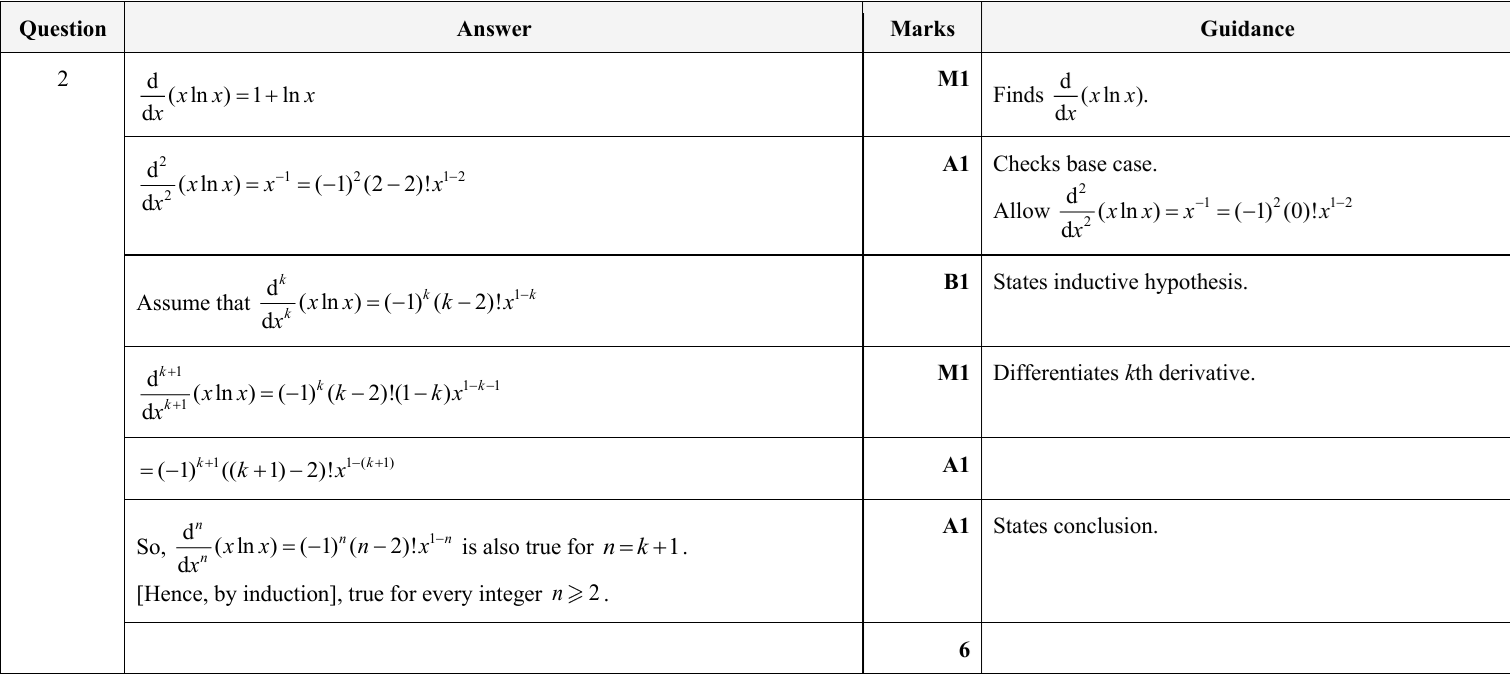
Prove by mathematical induction that, for every integer \(n \geq 2\),
\(\frac{d^n}{dx^n}(x \ln x) = (-1)^n (n-2)! x^{1-n}.\)
9231 P11 - Nov 2024 - Q02 - 6 marks
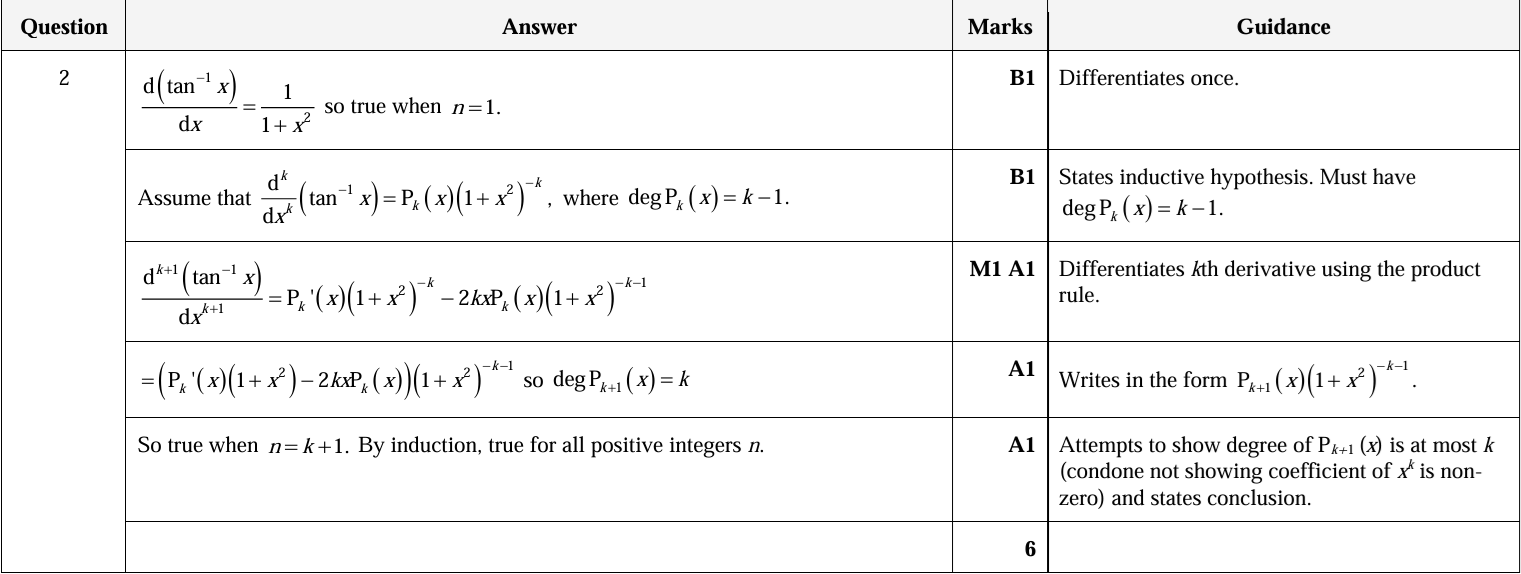
Prove by mathematical induction that, for all positive integers n,
\(\frac{d^n}{dx^n}(\arctan x) = P_n(x)(1+x^2)^{-n},\)
where \(P_n(x)\) is a polynomial of degree \(n-1\).
9231 P12 - Nov 2024 - Q01 - 5 marks
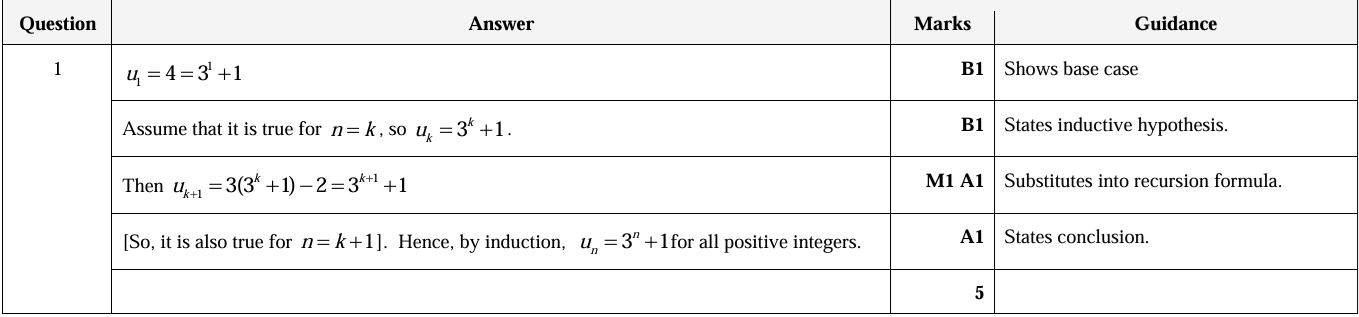
The sequence \(u_1, u_2, u_3, \ldots\) is such that \(u_1 = 4\) and \(u_{n+1} = 3u_n - 2\) for \(n \geq 1\).
Prove by induction that \(u_n = 3^n + 1\) for all positive integers \(n\).
9231 P13 - Nov 2024 - Q02 - 6 marks
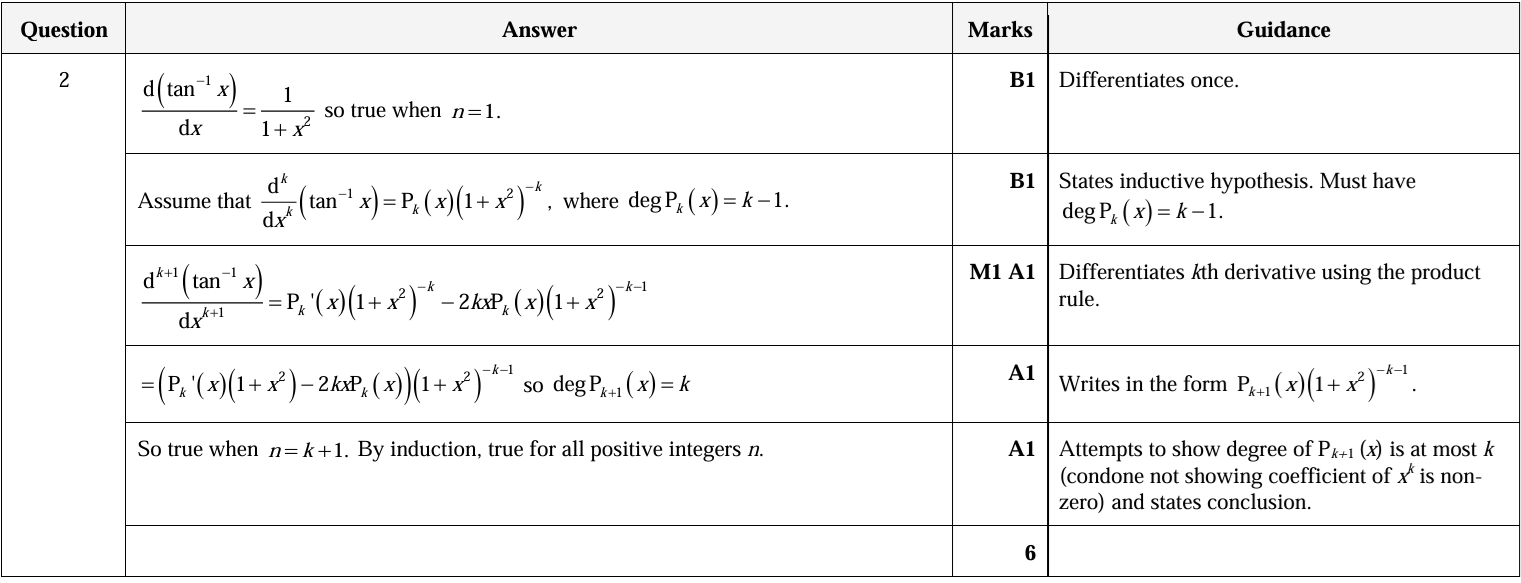
Prove by mathematical induction that, for all positive integers n,
\(\frac{d^n}{dx^n} \left( \arctan x \right) = P_n(x) (1 + x^2)^{-n},\)
where \(P_n(x)\) is a polynomial of degree \(n - 1\).
9231 P13 - Jun 2024 - Q04 - 13 marks
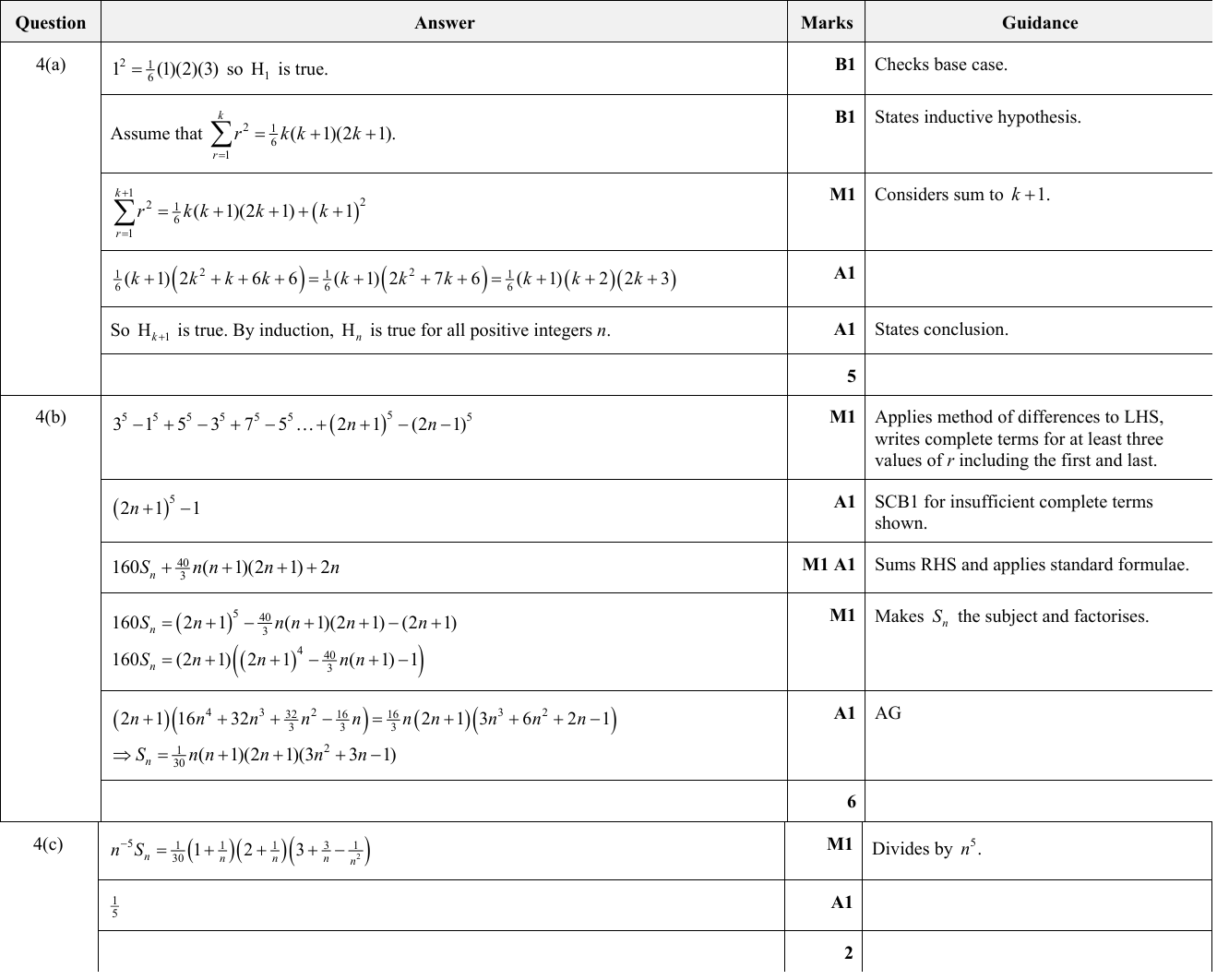
(a) Prove by mathematical induction that, for all positive integers \(n\),
\(\sum_{r=1}^{n} r^2 = \frac{1}{6}n(n+1)(2n+1).\)
The sum \(S_n\) is defined by \(S_n = \sum_{r=1}^{n} r^4\).
(b) Using the identity
\((2r+1)^5 - (2r-1)^5 \equiv 160r^4 + 80r^2 + 2,\)
show that \(S_n = \frac{1}{30}n(n+1)(2n+1)(3n^2 + 3n - 1).\)
(c) Find the value of \(\lim_{n \to \infty} \left( n^{-5}S_n \right).\)