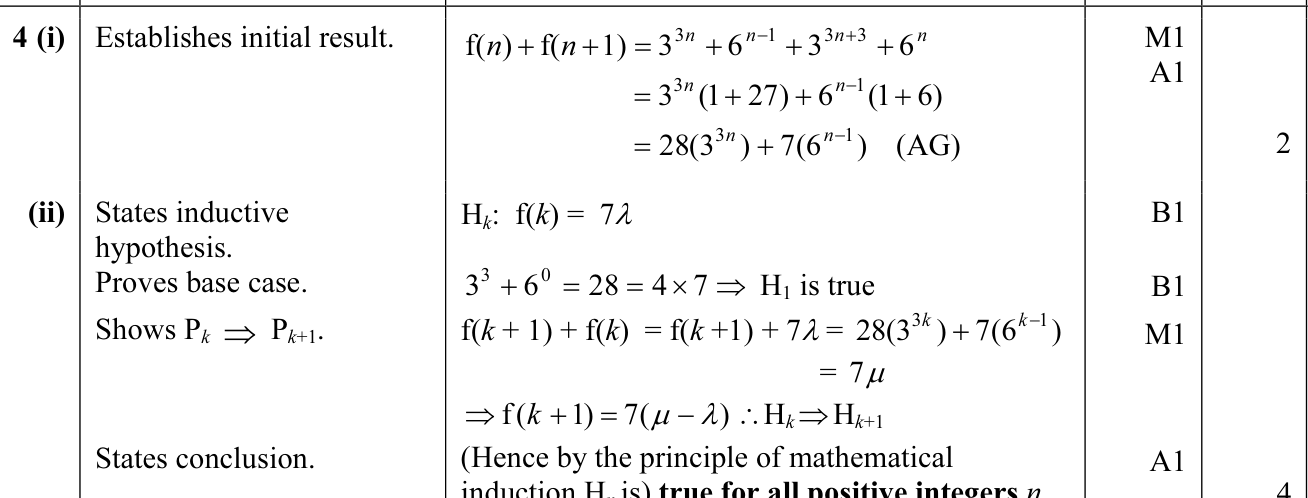
Answer: (a) \t\t\t\t\(f(n+1)+f(n)=28(3^{3n})+7(6^{n-1})\).
(b) For \(n=1\), \(f(1)=3^3+6^0=27+1=28\), so \(f(1)\) is divisible by \(7\). Assume that for some positive integer \(k\), \(f(k)\) is divisible by \(7\); write \(f(k)=7\lambda\) for some integer \(\lambda\). From part (a), \(f(k+1)+f(k)\) is divisible by \(7\), so \(f(k+1)+7\lambda=7\mu\) for some integer \(\mu\). Hence \(f(k+1)=7(\mu-\lambda)\), which is divisible by \(7\). Therefore, if \(f(k)\) is divisible by \(7\), then so is \(f(k+1)\). Since the result is true for \(n=1\), it follows by induction that \(f(n)\) is divisible by \(7\) for every positive integer \(n\).
(a) We substitute \(n+1\) into the definition of \(f\):
\(f(n+1)=3^{3(n+1)}+6^{(n+1)-1}=3^{3n+3}+6^n\).
So
\(f(n)+f(n+1)=\bigl(3^{3n}+6^{n-1}\bigr)+\bigl(3^{3n+3}+6^n\bigr)\).
Now factor each pair:
\(=3^{3n}(1+27)+6^{n-1}(1+6)\).
Hence
\(f(n)+f(n+1)=28(3^{3n})+7(6^{n-1})\).
(b) Let \(P_n\) be the statement that \(f(n)\) is divisible by \(7\).
First, check the base case \(n=1\):
\(f(1)=3^3+6^0=27+1=28\), which is divisible by \(7\). So \(P_1\) is true.
Now assume that \(P_k\) is true for some positive integer \(k\). Then \(f(k)=7\lambda\) for some integer \(\lambda\).
From part (a),
\(f(k)+f(k+1)=28(3^{3k})+7(6^{k-1})\).
The right-hand side is clearly divisible by \(7\), so \(f(k)+f(k+1)=7\mu\) for some integer \(\mu\). Substituting \(f(k)=7\lambda\), we get
\(7\lambda+f(k+1)=7\mu\).
Therefore
\(f(k+1)=7(\mu-\lambda)\),
which shows that \(f(k+1)\) is divisible by \(7\).
Thus \(P_k \Rightarrow P_{k+1}\). Since the base case is true, it follows by mathematical induction that \(f(n)\) is divisible by \(7\) for every positive integer \(n\).