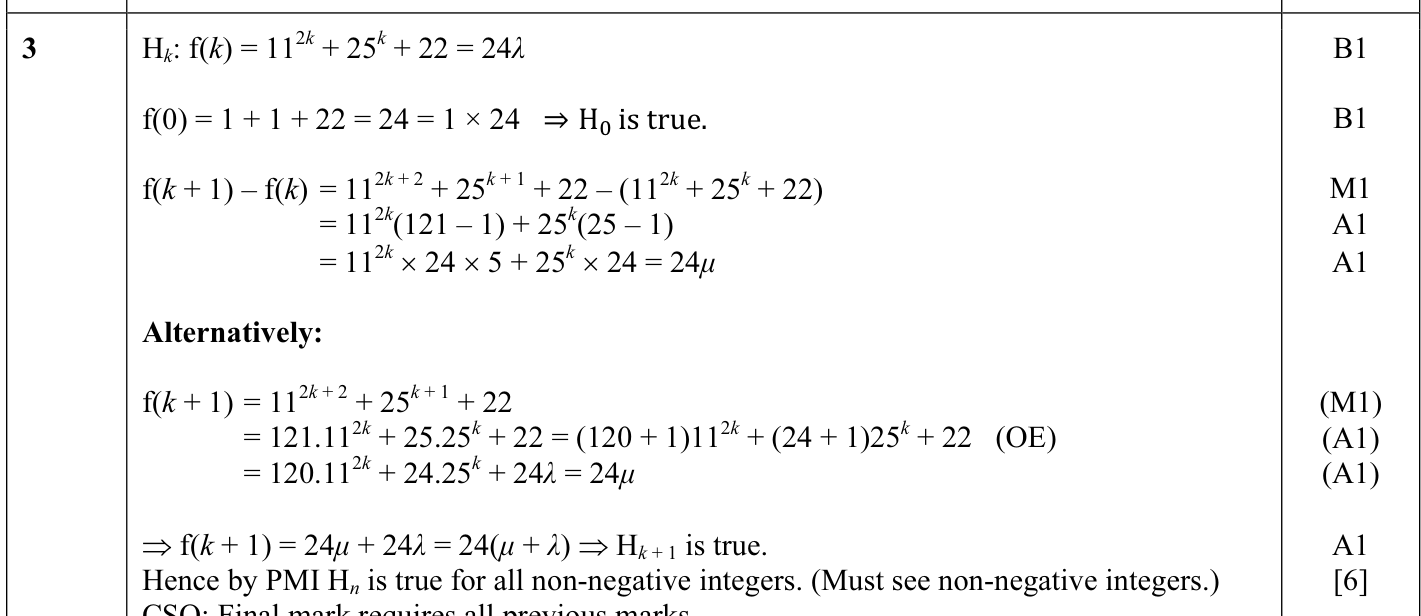
Answer: For all non-negative integers \(n\), \(11^{2n}+25^n+22\) is divisible by \(24\).
Let \(P(n)\) be the statement that \(11^{2n}+25^n+22\) is divisible by \(24\).
Base case: when \(n=0\),
\(11^{2\cdot 0}+25^0+22=1+1+22=24\),
which is divisible by \(24\). So \(P(0)\) is true.
Inductive step: assume \(P(k)\) is true for some non-negative integer \(k\). Then
\(11^{2k}+25^k+22\) is divisible by \(24\).
We must show that \(11^{2(k+1)}+25^{k+1}+22\) is divisible by \(24\).
Consider the difference:
\(\begin{aligned} (11^{2(k+1)}+25^{k+1}+22) - (11^{2k}+25^k+22) &= 11^{2k}(11^2-1)+25^k(25-1) \\ &= 11^{2k}(121-1)+25^k\cdot 24 \\ &= 11^{2k}\cdot 120 + 25^k\cdot 24 \\ &= 24(5\cdot 11^{2k}+25^k). \end{aligned}\)
So the difference is divisible by \(24\). Since \(11^{2k}+25^k+22\) is divisible by \(24\) by the inductive hypothesis, adding a multiple of \(24\) gives that \(11^{2(k+1)}+25^{k+1}+22\) is also divisible by \(24\).
Therefore \(P(k+1)\) is true.
Hence, by mathematical induction, \(11^{2n}+25^n+22\) is divisible by \(24\) for all non-negative integers \(n\).