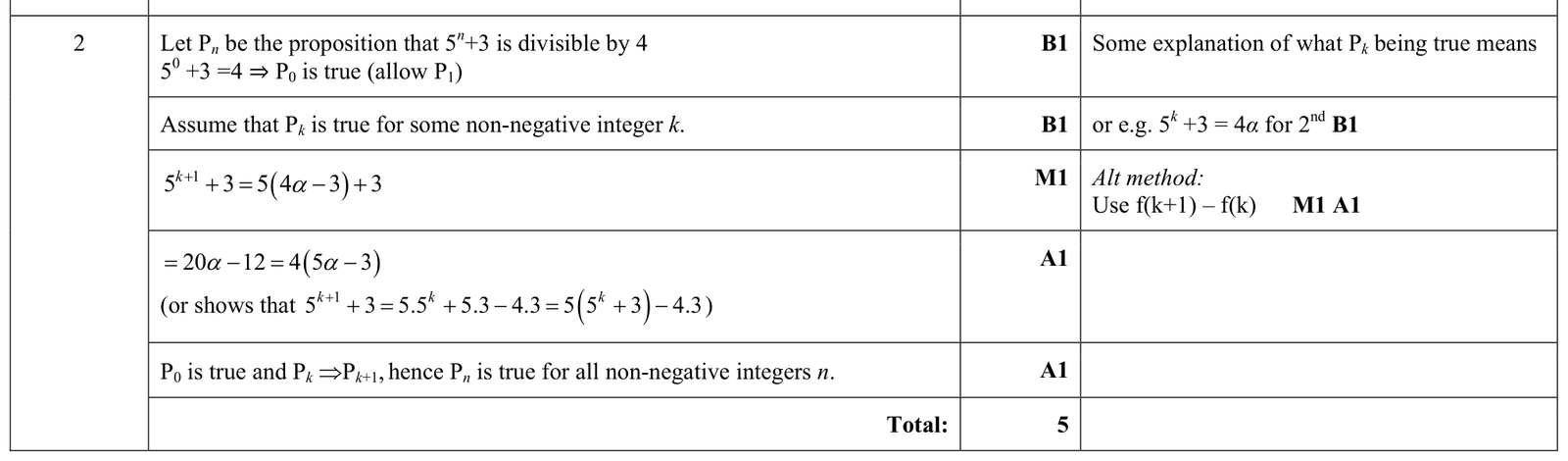
Answer: Let \(P_n\) be the statement that \(5^n+3\) is divisible by \(4\).
When \(n=0\), \(5^0+3=1+3=4\), which is divisible by \(4\). So \(P_0\) is true.
Now assume that \(P_k\) is true for some non-negative integer \(k\). Then \(5^k+3\) is divisible by \(4\), so we can write \(5^k+3=4\alpha\) for some integer \(\alpha\).
Then
\(5^{k+1}+3=5\cdot 5^k+3=5(4\alpha-3)+3=20\alpha-15+3=20\alpha-12=4(5\alpha-3).\)
So \(5^{k+1}+3\) is also divisible by \(4\). Hence \(P_k\Rightarrow P_{k+1}\).
Therefore, since \(P_0\) is true and truth of \(P_k\) implies truth of \(P_{k+1}\), it follows by induction that \(5^n+3\) is divisible by \(4\) for all non-negative integers \(n\).
We prove the result by induction on \(n\).
Let \(P_n\) be the statement that \(5^n+3\) is divisible by \(4\).
Base case: When \(n=0\),
\(5^0+3=1+3=4\),
and \(4\) is divisible by \(4\). So \(P_0\) is true.
Inductive step: Assume that \(P_k\) is true for some non-negative integer \(k\). Then \(5^k+3\) is divisible by \(4\), so there exists an integer \(\alpha\) such that
\(5^k+3=4\alpha.\)
Rearranging gives \(5^k=4\alpha-3\). Therefore
\(5^{k+1}+3=5\cdot 5^k+3=5(4\alpha-3)+3.\)
Simplifying,
\(5^{k+1}+3=20\alpha-15+3=20\alpha-12=4(5\alpha-3).\)
This is divisible by \(4\), so \(P_{k+1}\) is true.
Since \(P_0\) is true and \(P_k\Rightarrow P_{k+1}\) for all non-negative integers \(k\), it follows by induction that \(5^n+3\) is divisible by \(4\) for all non-negative integers \(n\).