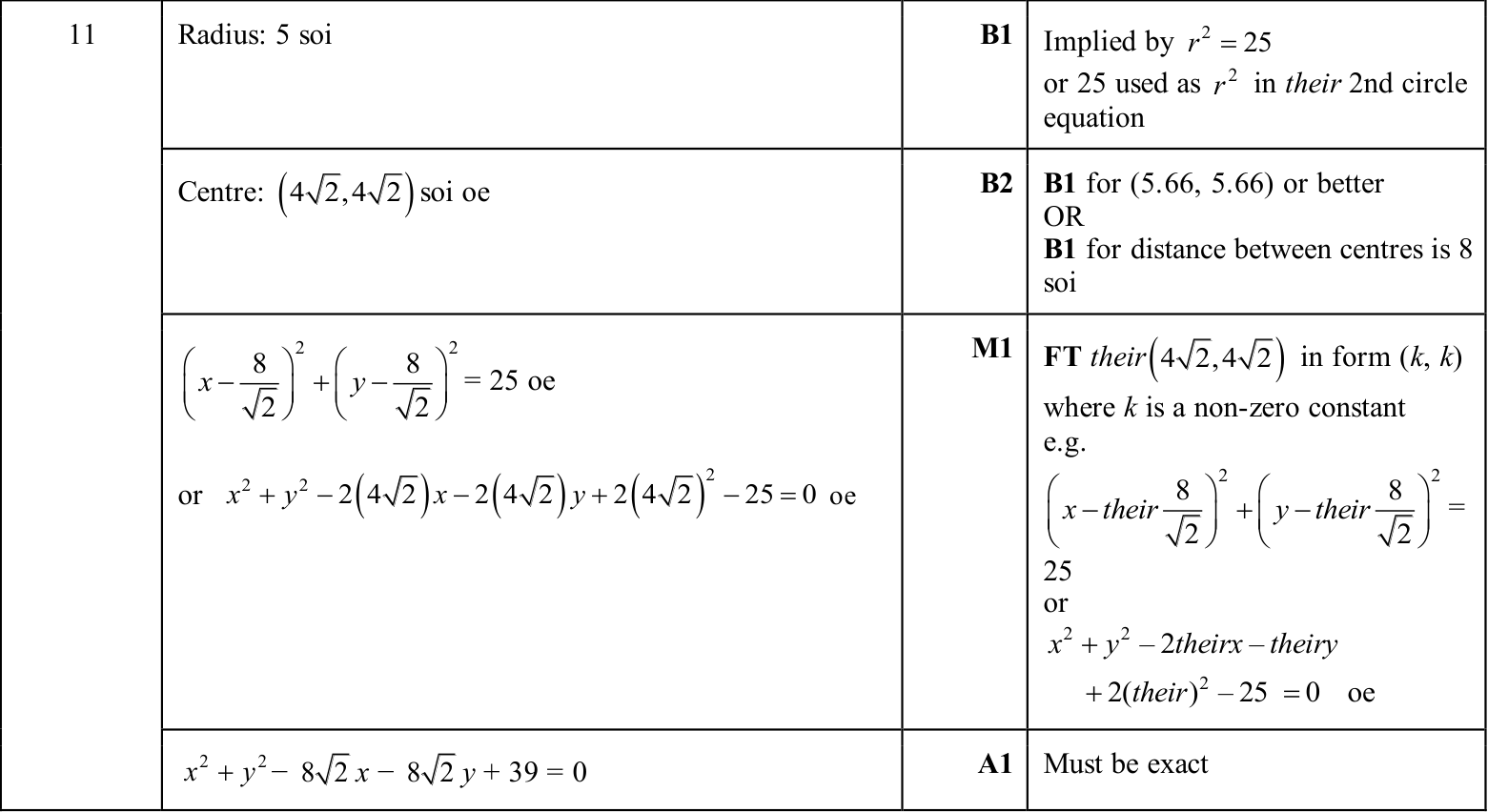
Answer: \(x^2+y^2-8\sqrt2x-8\sqrt2y+39=0\).
The first circle is
\(x^2+y^2-25=0\),
so its centre is \((0,0)\) and its radius is
\(5\).
The second circle has the same radius, so its radius is also \(5\). Let its centre be \(C\).
The two circles intersect at \(A\) and \(B\), and \(AB\) is their common chord. The line joining the centres of two intersecting equal circles is perpendicular to their common chord.
The chord \(AB\) is parallel to
\(y=-x\),
which has gradient \(-1\). Therefore the line joining the two centres has gradient \(1\).
Since the coordinates of the centre of the second circle are both positive, write
\(C=(k,k)\), where \(k\gt0\).
The chord \(AB\) has length \(6\), so half the chord has length \(3\).
In a circle of radius \(5\), the perpendicular distance from the centre to a chord of length \(6\) is found using Pythagoras:
\(\sqrt{5^2-3^2}=\sqrt{25-9}=4\).
For two equal circles, the common chord lies halfway between the two centres. Therefore the distance between the centres is
\(2\times4=8\).
So
\(OC=8\).
But \(O=(0,0)\) and \(C=(k,k)\), hence
\(OC=\sqrt{k^2+k^2}=k\sqrt2\).
Thus
\(k\sqrt2=8\),
so
\(k=4\sqrt2\).
The centre of the second circle is therefore
\((4\sqrt2,4\sqrt2)\).
Its equation is
\((x-4\sqrt2)^2+(y-4\sqrt2)^2=25\).
Expanding,
\(x^2-8\sqrt2x+32+y^2-8\sqrt2y+32=25\).
Therefore
\(x^2+y^2-8\sqrt2x-8\sqrt2y+39=0\).