Past Exam Questions
← Back0606 P11 - Jun 2025 - Q3 - 6 marks
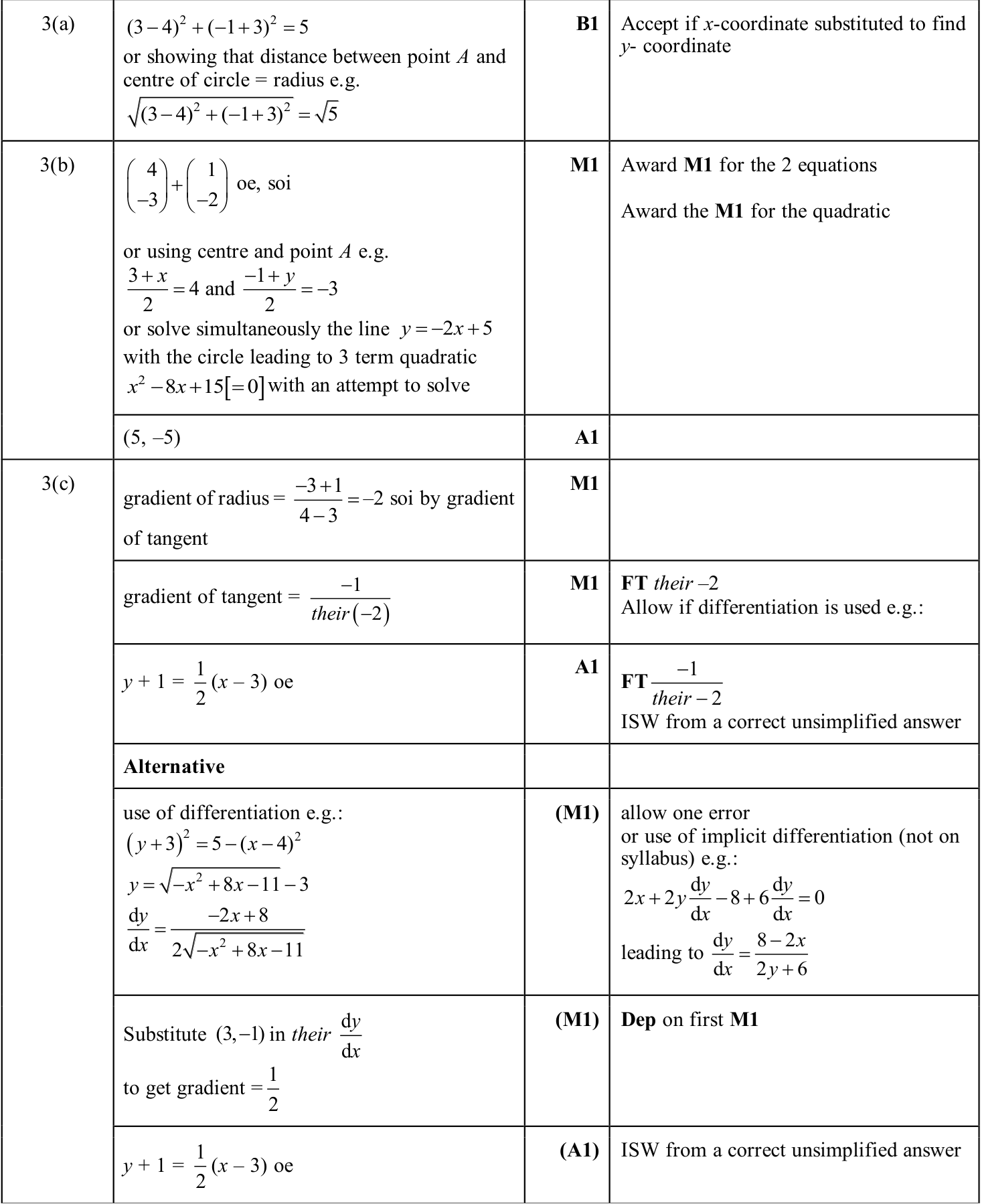
Point \(A\) has coordinates \((3,-1)\).
A circle has equation \((x-4)^2+(y+3)^2=5\).
(a) Show that \(A\) lies on the circumference of the circle.
(b) Given that \(AB\) is a diameter of the circle, find the coordinates of \(B\).
(c) Find the equation of the tangent to the circle at \(A\).
0606 P12 - Jun 2025 - Q3 - 8 marks
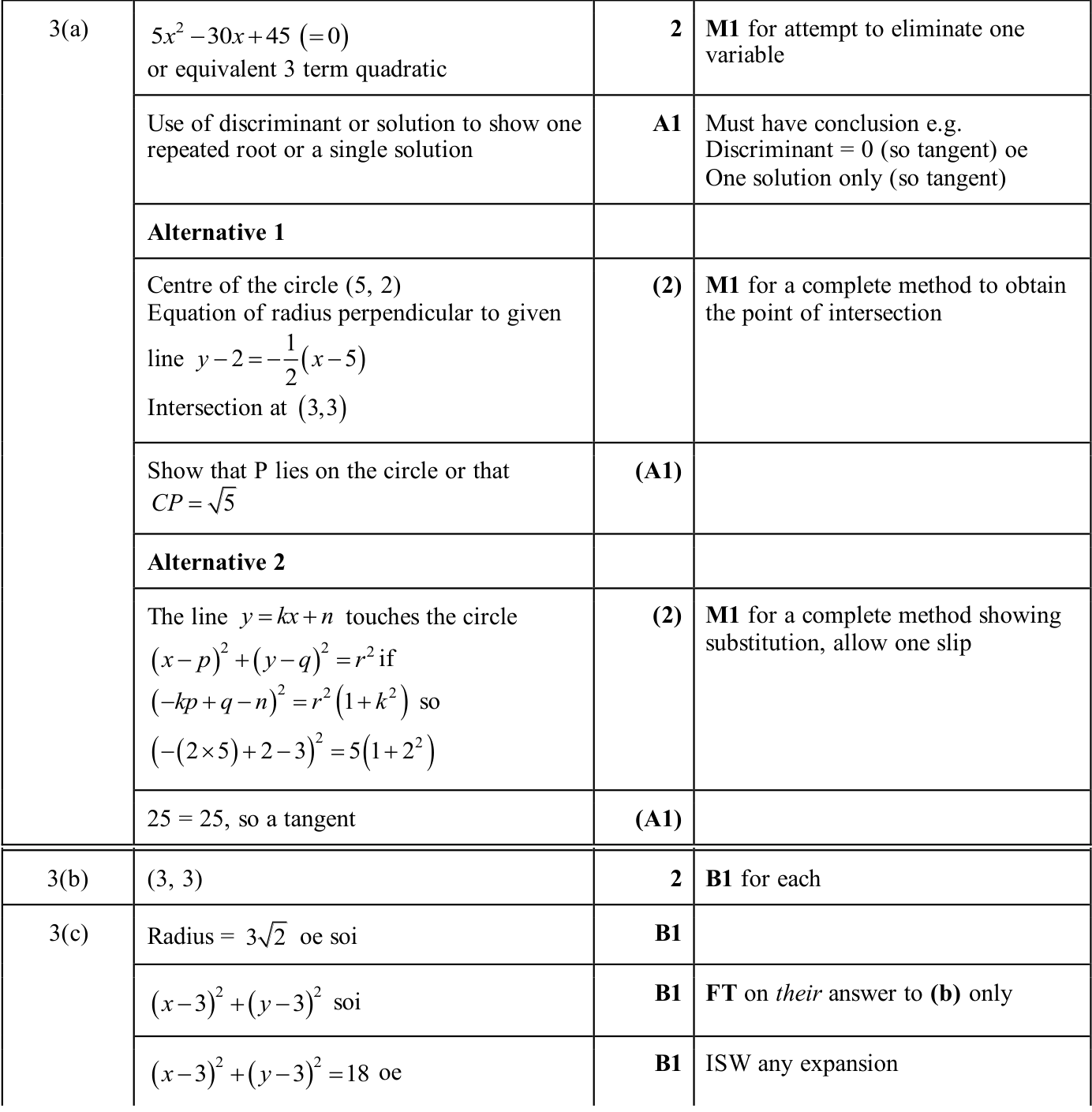
A circle with centre \(C\) has the equation \(x^2+y^2-10x-4y+24=0\).
(a) Show that the line \(y=2x-3\) is a tangent to this circle.
(b) Given that this tangent touches the circle at the point \(P\), find the coordinates of \(P\).
(c) Find the equation of the circle which has its centre at \(P\) and passes through the origin.
0606 P13 - Jun 2025 - Q5 - 6 marks
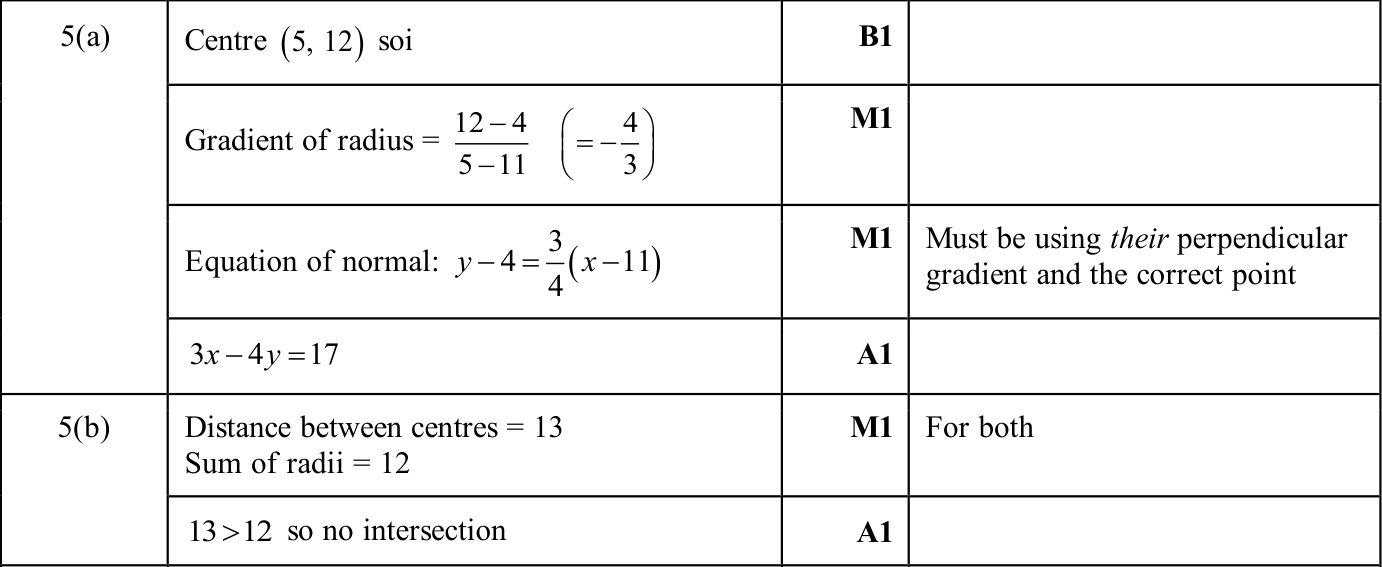
Solutions by accurate drawing will not be accepted. A circle, \(C\), has equation \((x-5)^{2}+(y-12)^{2}=100\). (a) Find the equation of the tangent to \(C\) at the point \((11,4)\).
Give your answer in the form \(a x+b y=c\), where \(a, b\) and \(c\) are integers. (b) Show that \(C\) and the circle with equation \(x^{2}+y^{2}=4\) do not intersect.
0606 P12 - Mar 2025 - Q3 - 4 marks
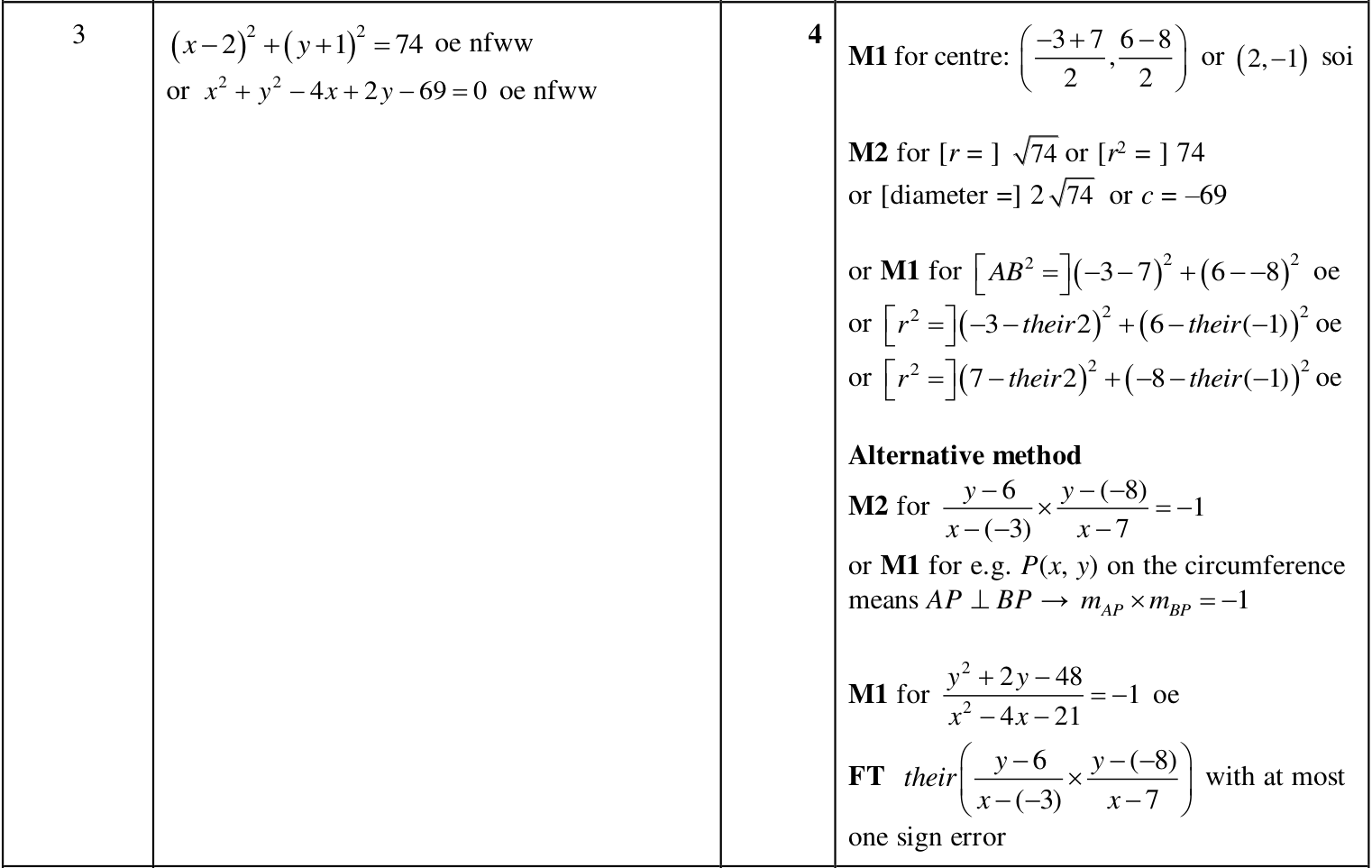
The point \(A\) has coordinates \((-3,6)\).
The point \(B\) has coordinates \((7,-8)\).
Given that the line \(AB\) is the diameter of a circle, find the equation of the circle.
0606 P23 - Nov 2025 - Q11 - 5 marks
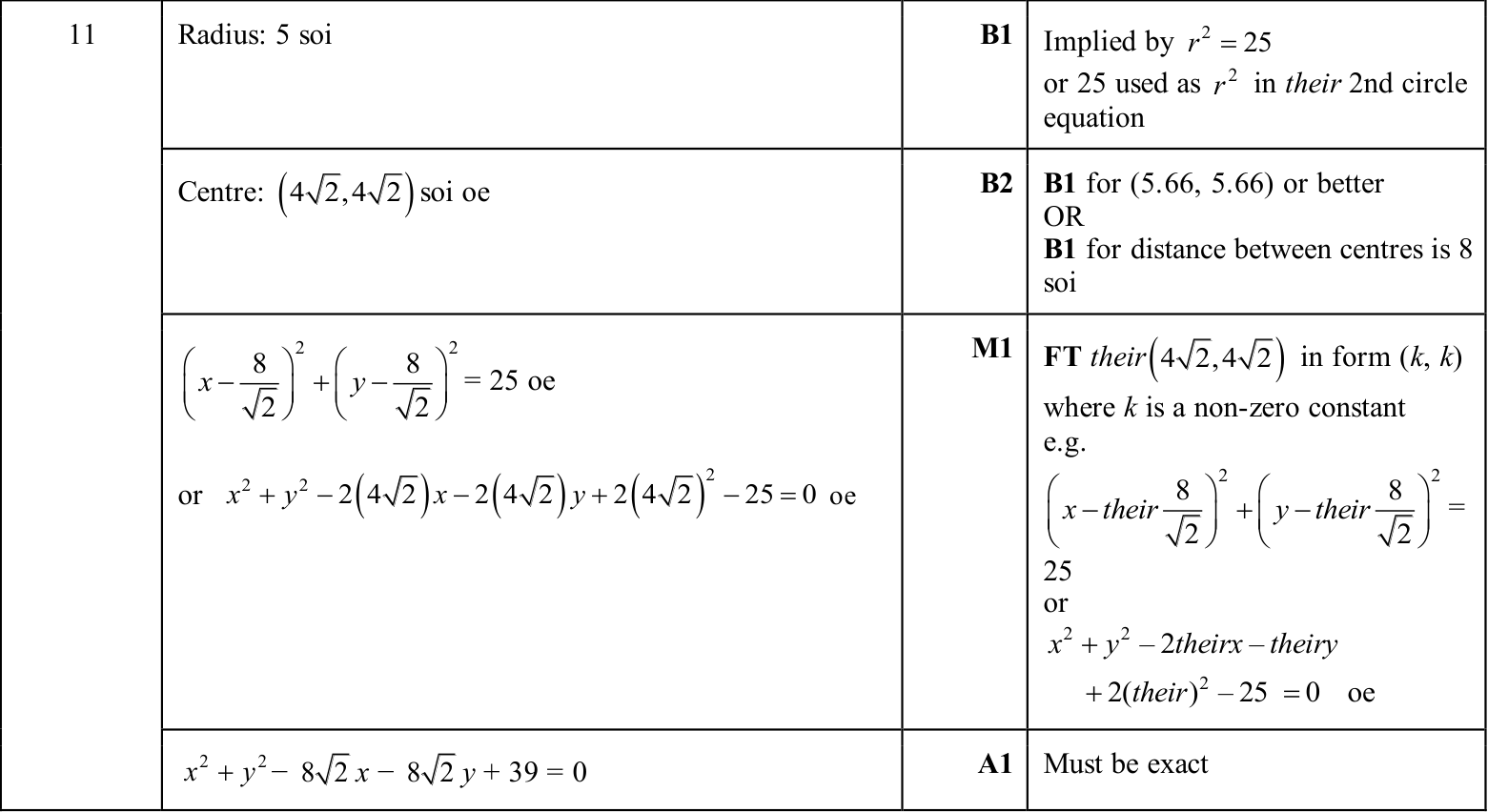
A circle has equation \(x^{2}+y^{2}-25=0\).
A second circle has the same radius as the first circle, and the coordinates of its centre are both positive.
The two circles intersect at the points \(A\) and \(B\).
The line \(A B\) has length 6 and is parallel to the line \(y=-x\).
Find the equation of the second circle in the form \(x^{2}+y^{2}+a x+b y+c=0\), where \(a, b\) and \(c\) are constants.
0606 P13 - Nov 2025 - Q11 - 7 marks
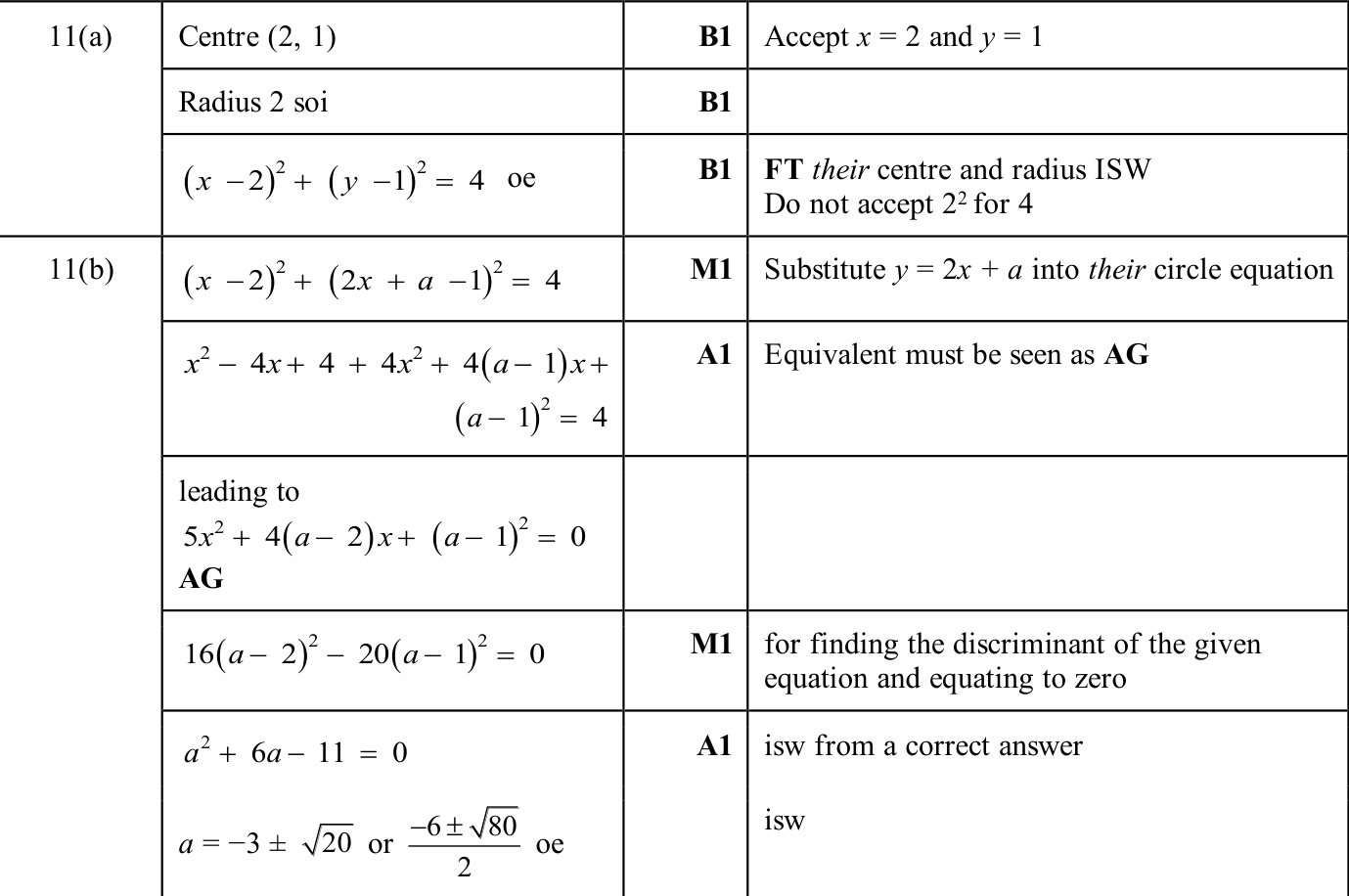
The lines \(x=0\), \(x=4\), \(y=3\) and \(y=-1\) are tangents to a circle.
(a) Find the equation of the circle.
The line \(y=2x+a\), where \(a\) is a constant, is also a tangent to the circle.
(b) Show that \(5x^2+4(a-2)x+(a-1)^2=0\), and hence find the possible values of \(a\). Give your answers in exact form.
0606 P21 - Jun 2023 - Q11 - 9 marks
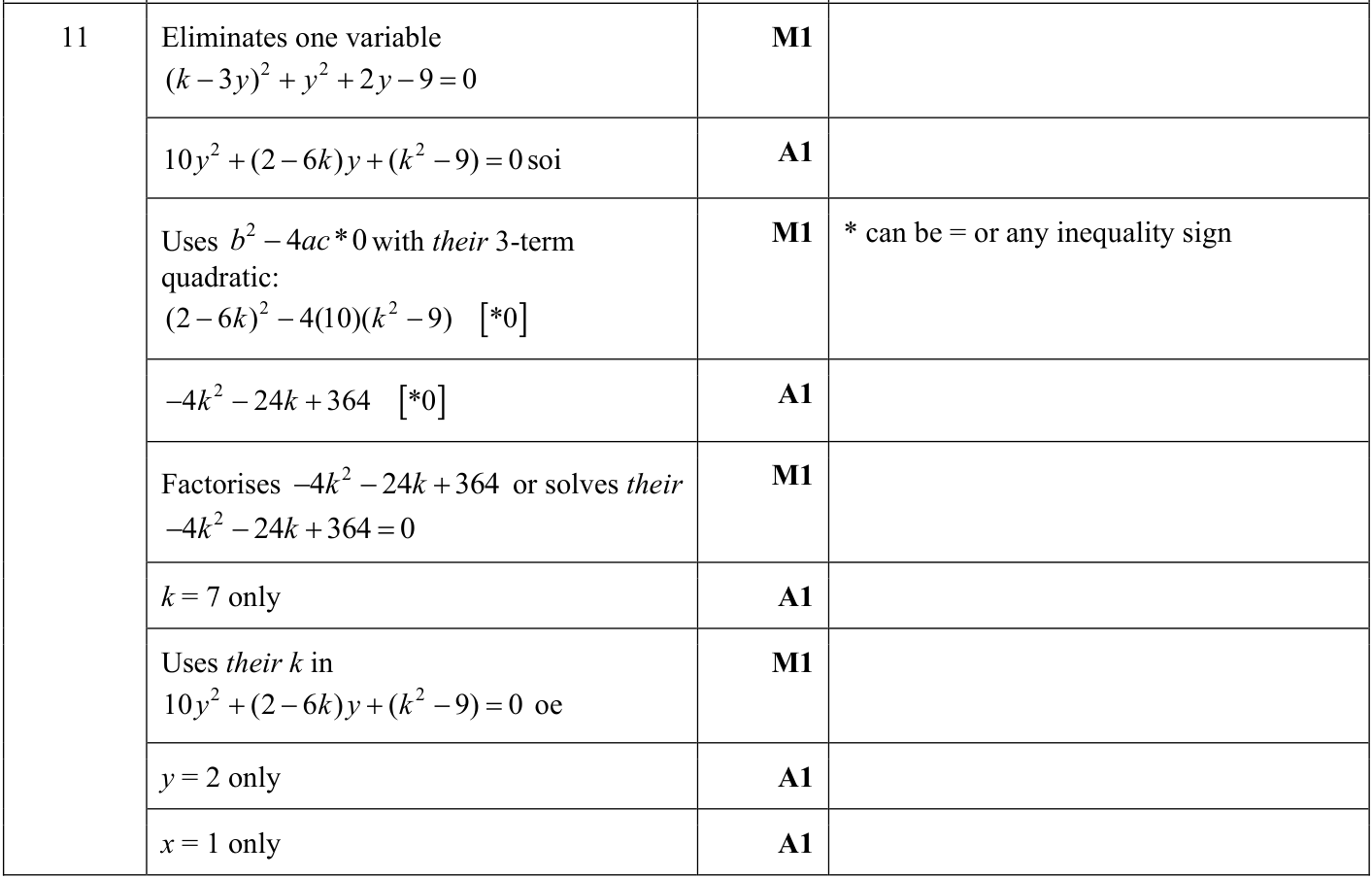
The line with equation
\(x+3y=k,\)
where \(k\) is a positive constant, is a tangent to the curve with equation
\(x^2+y^2+2y-9=0.\)
Find the value of \(k\) and hence find the coordinates of the point where the line touches the curve.
0606 P21 - Jun 2021 - Q5 - 8 marks
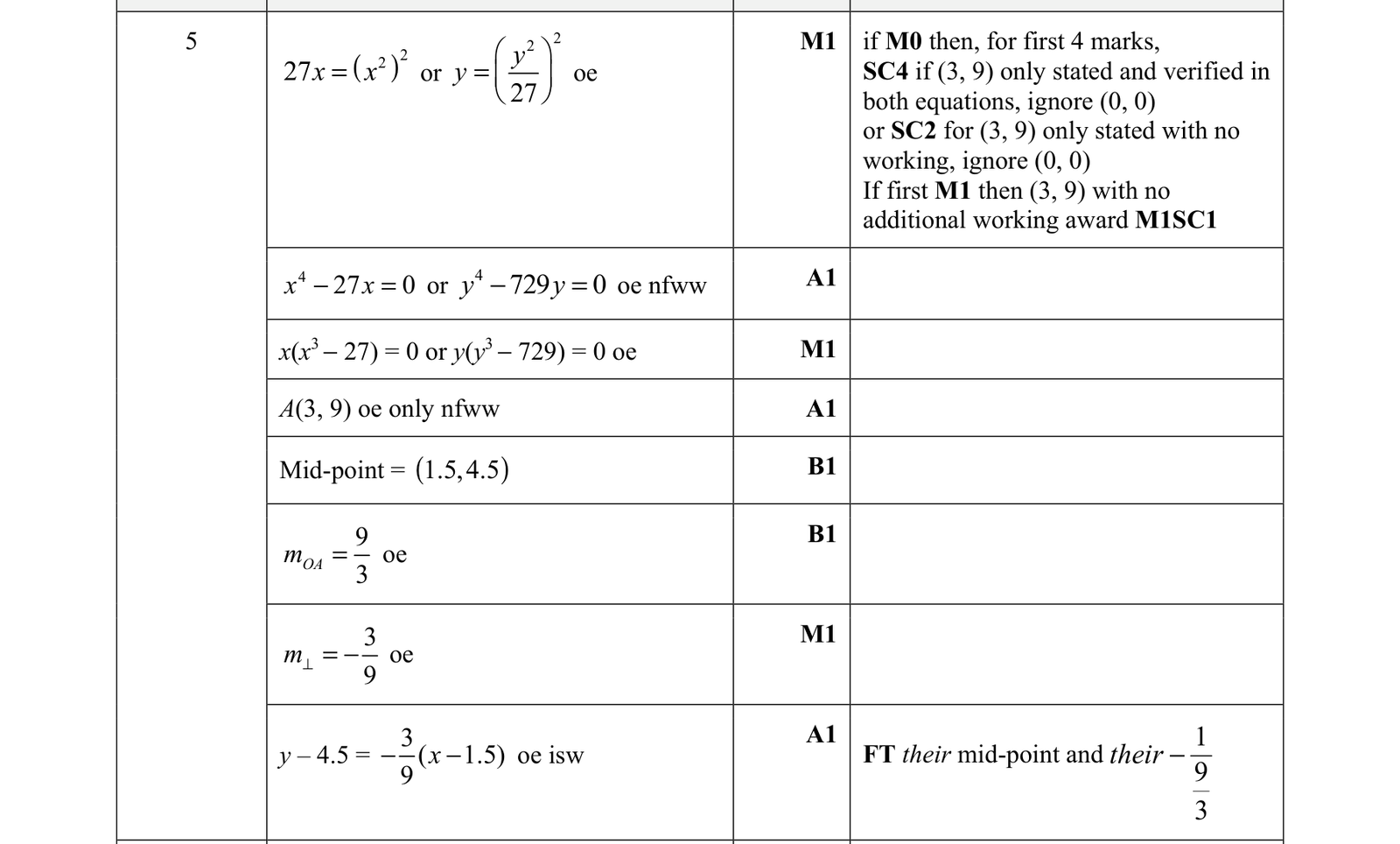
The curves
\(y=x^2 \quad\text{and}\quad y^2=27x\)
intersect at \(O(0,0)\) and at the point \(A\). Find the equation of the perpendicular bisector of the line \(OA\).
0606 P22 - Jun 2018 - Q4 - 5 marks
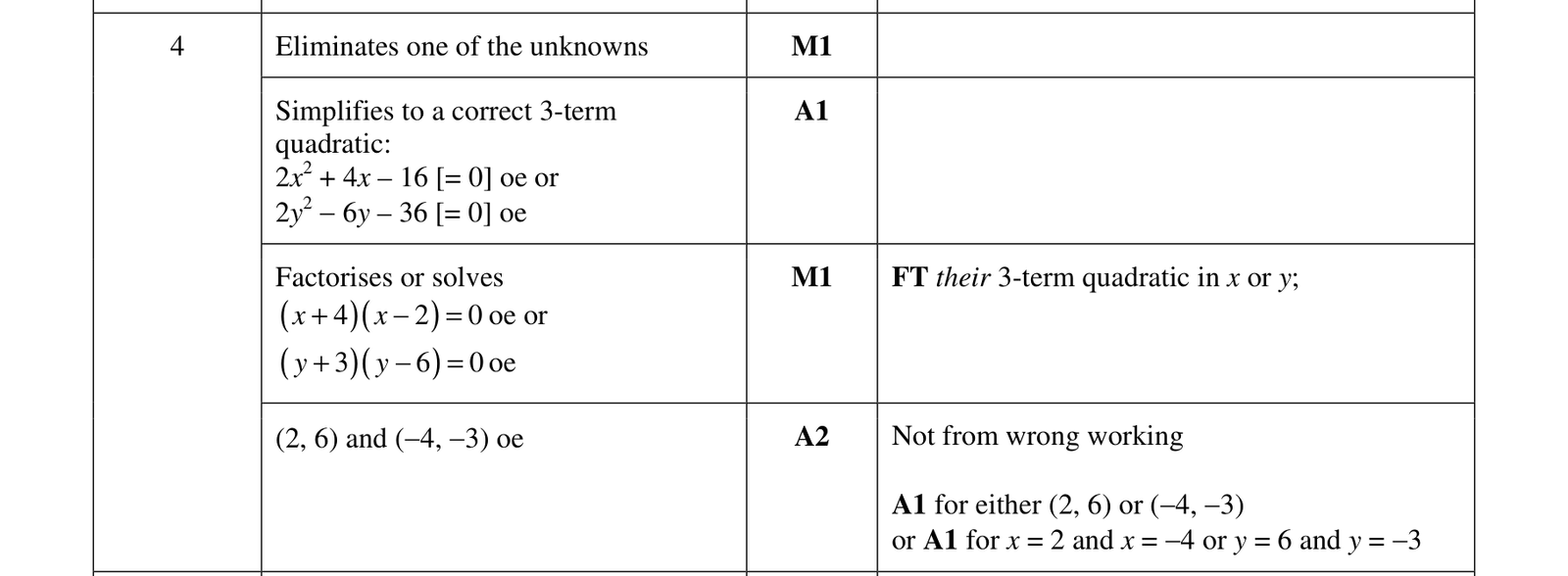
Find the coordinates of the points where the line \(2y-3x=6\) intersects the curve
\(\frac{x^2}{4}+\frac{y^2}{9}=5.\)
0606 P21 - Nov 2017 - Q11 - 9 marks
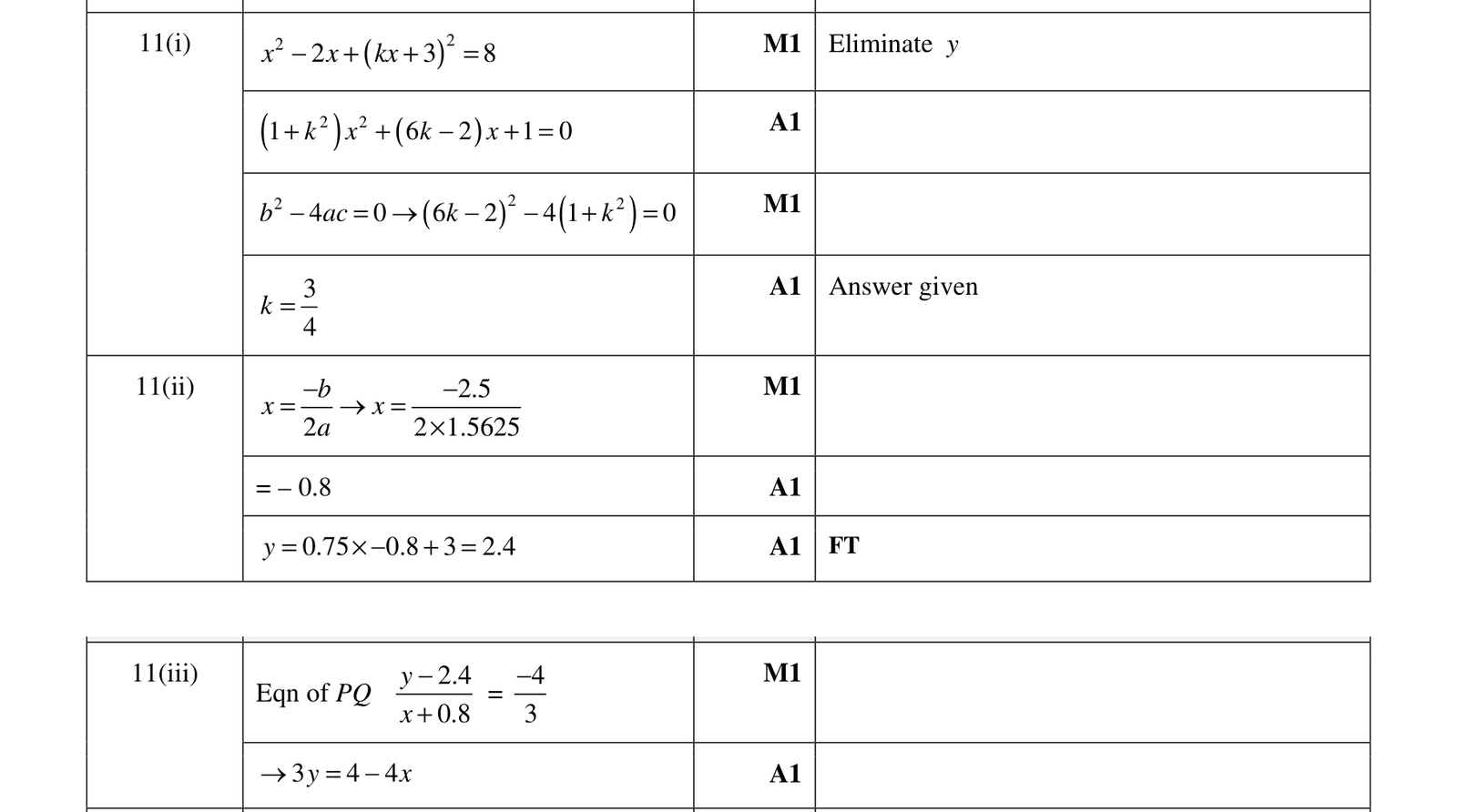
The line \(y=kx+3\), where \(k\) is a positive constant, is a tangent to the curve \(x^2-2x+y^2=8\) at the point \(P\).
(i) Find the value of \(k\).
(ii) Find the coordinates of \(P\).
(iii) Find the equation of the normal to the curve at \(P\).
9709 P13 - Jun 2011 - Q4
Differentiate \(\frac{2x^3 + 5}{x}\) with respect to \(x\).

9709 P1 - Jun 2003 - Q3
Differentiate \(4x + \frac{6}{x^2}\) with respect to \(x\).

9709 P11 - Nov 2022 - Q8
The function f is defined by \(f(x) = 2 - \frac{3}{4x-p}\) for \(x > \frac{p}{4}\), where \(p\) is a constant.
Find \(f'(x)\) and hence determine whether \(f\) is an increasing function, a decreasing function or neither.

9709 P11 - Nov 2017 - Q2
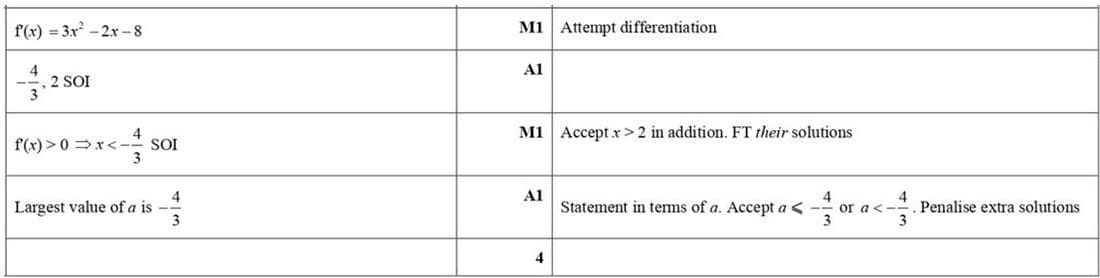
A function \(f\) is defined by \(f : x \mapsto x^3 - x^2 - 8x + 5\) for \(x < a\). It is given that \(f\) is an increasing function. Find the largest possible value of the constant \(a\).
9709 P13 - Nov 2016 - Q4
The function \(f\) is such that \(f(x) = x^3 - 3x^2 - 9x + 2\) for \(x > n\), where \(n\) is an integer. It is given that \(f\) is an increasing function. Find the least possible value of \(n\).

9709 P13 - Nov 2015 - Q3
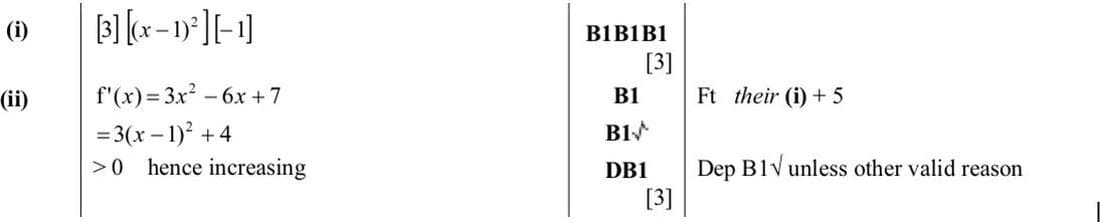
(i) Express \(3x^2 - 6x + 2\) in the form \(a(x+b)^2 + c\), where \(a, b\) and \(c\) are constants.
(ii) The function \(f\), where \(f(x) = x^3 - 3x^2 + 7x - 8\), is defined for \(x \in \mathbb{R}\). Find \(f'(x)\) and state, with a reason, whether \(f\) is an increasing function, a decreasing function or neither.
9709 P13 - Jun 2015 - Q8
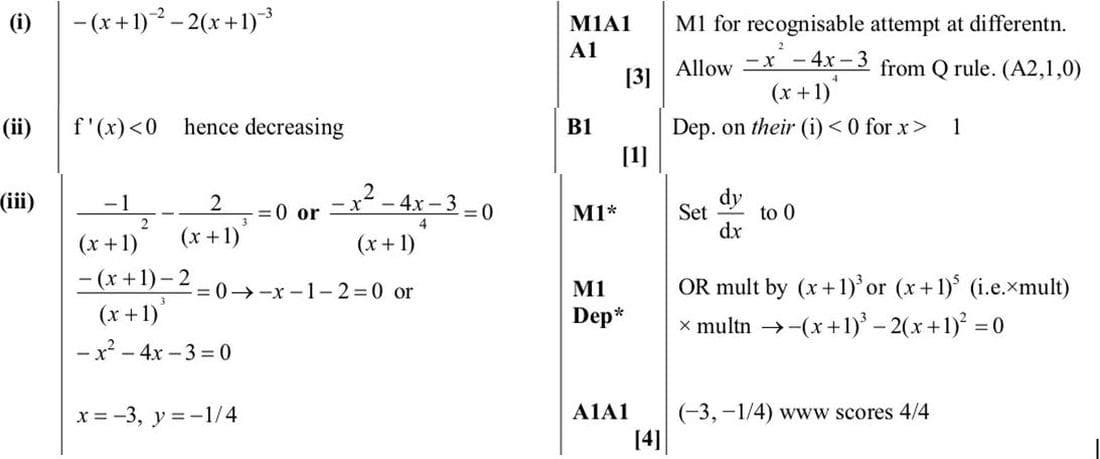
The function f is defined by \(f(x) = \frac{1}{x+1} + \frac{1}{(x+1)^2}\) for \(x > -1\).
- Find \(f'(x)\).
- State, with a reason, whether f is an increasing function, a decreasing function or neither.
The function g is defined by \(g(x) = \frac{1}{x+1} + \frac{1}{(x+1)^2}\) for \(x < -1\).
- Find the coordinates of the stationary point on the curve \(y = g(x)\).
9709 P13 - Nov 2014 - Q3
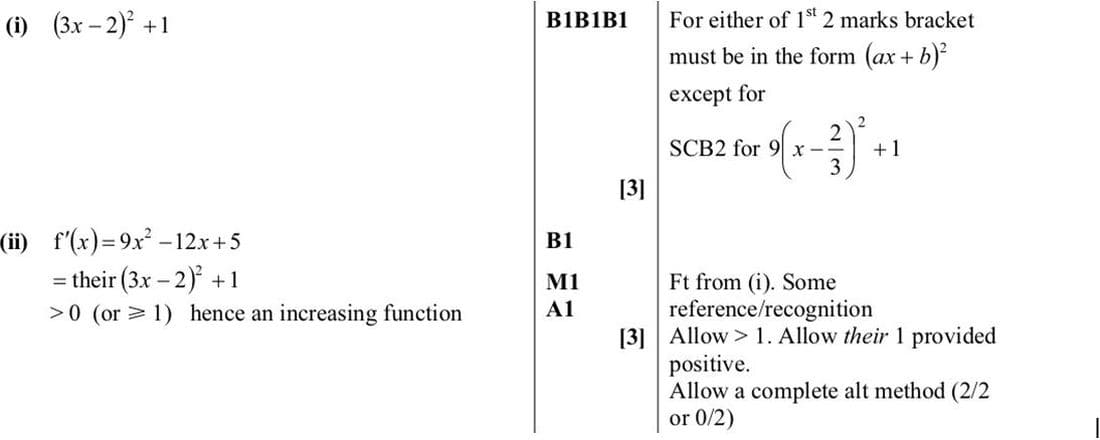
(i) Express \(9x^2 - 12x + 5\) in the form \((ax + b)^2 + c\).
(ii) Determine whether \(3x^3 - 6x^2 + 5x - 12\) is an increasing function, a decreasing function or neither.
9709 P12 - Nov 2014 - Q6
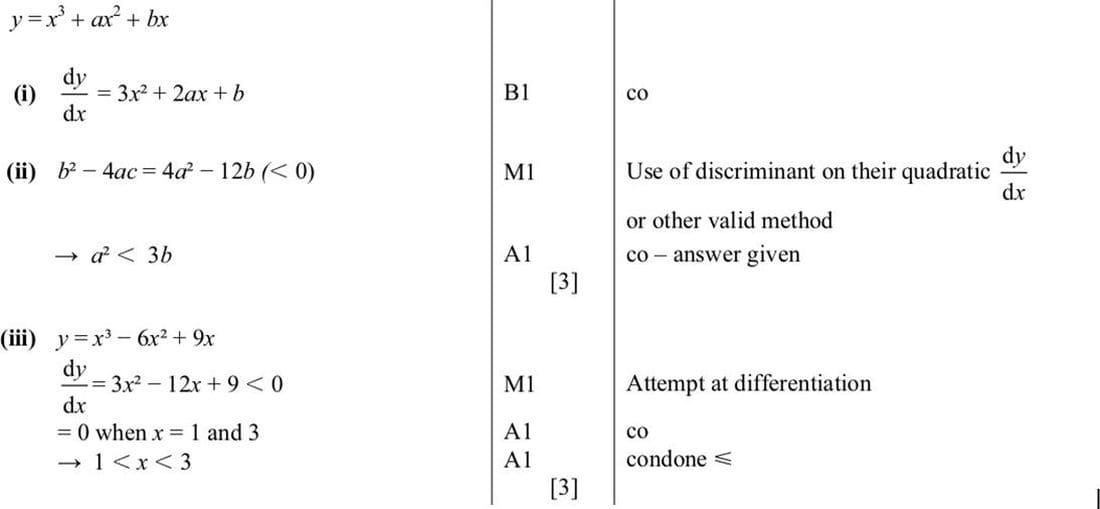
The equation of a curve is \(y = x^3 + ax^2 + bx\), where \(a\) and \(b\) are constants.
(i) In the case where the curve has no stationary point, show that \(a^2 < 3b\).
(ii) In the case where \(a = -6\) and \(b = 9\), find the set of values of \(x\) for which \(y\) is a decreasing function of \(x\).
9709 P12 - Jun 2013 - Q9
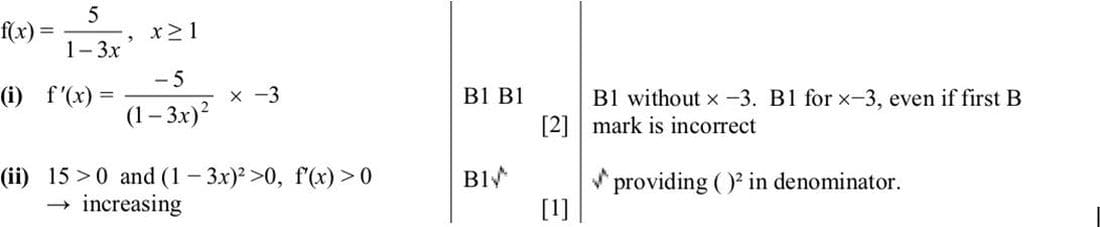
A function \(f\) is defined by \(f(x) = \frac{5}{1 - 3x}\), for \(x \geq 1\).
(i) Find an expression for \(f'(x)\).
(ii) Determine, with a reason, whether \(f\) is an increasing function, a decreasing function or neither.