Browsing as Guest. Progress, bookmarks and attempts are disabled.
Log in to track your work.
9709 P12 - Jun 2017 - Q9
1067
The equation of a curve is \(y = 8\sqrt{x} - 2x\).
Find the coordinates of the stationary point of the curve. [3]
Find an expression for \(\frac{d^2y}{dx^2}\) and hence, or otherwise, determine the nature of the stationary point. [2]
Find the values of \(x\) at which the line \(y = 6\) meets the curve. [3]
State the set of values of \(k\) for which the line \(y = k\) does not meet the curve. [1]
Solution
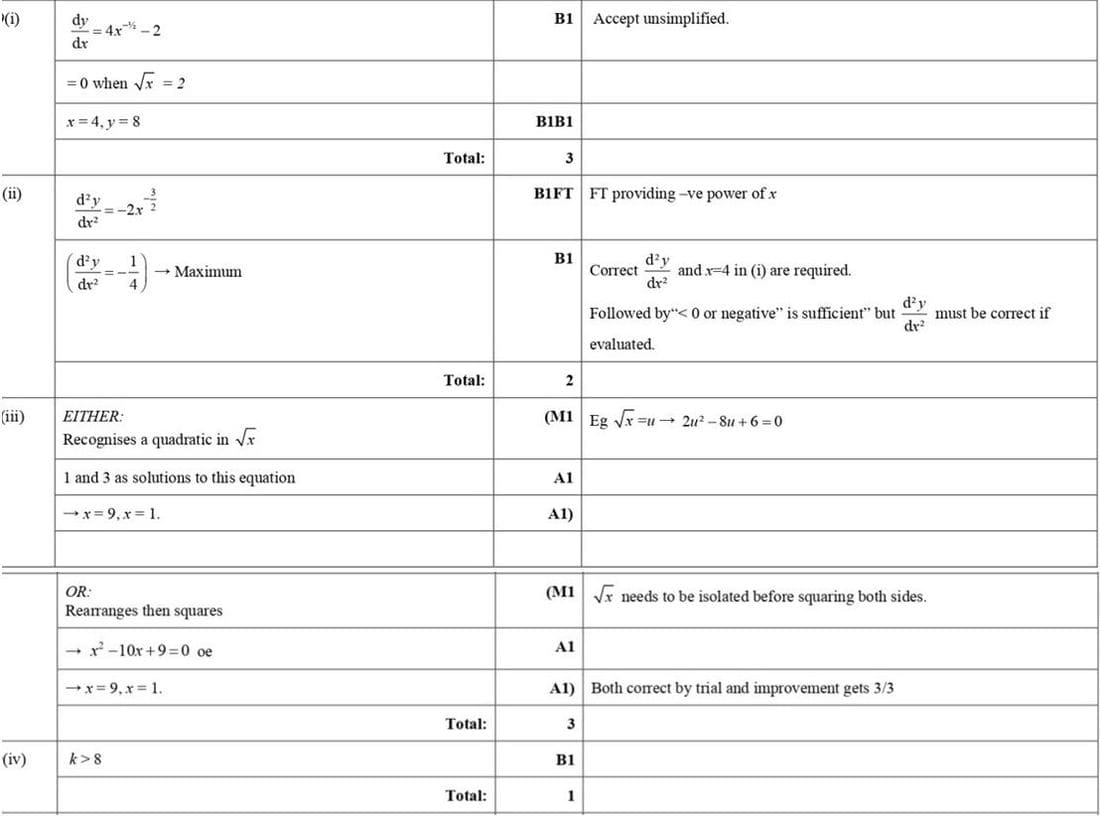
(i) Differentiate \(y = 8\sqrt{x} - 2x\) to find \(\frac{dy}{dx} = 4x^{-\frac{1}{2}} - 2\). Set \(\frac{dy}{dx} = 0\) to find the stationary point: \(4x^{-\frac{1}{2}} - 2 = 0\). Solving gives \(\sqrt{x} = 2\), so \(x = 4\). Substitute back to find \(y = 8 \sqrt{4} - 2 \times 4 = 8\). The stationary point is \((4, 8)\).
(ii) Differentiate again to find \(\frac{d^2y}{dx^2} = -2x^{-\frac{3}{2}}\). At \(x = 4\), \(\frac{d^2y}{dx^2} = -\frac{1}{4}\), which is negative, indicating a maximum.
(iii) Set \(y = 6\) in the curve equation: \(8\sqrt{x} - 2x = 6\). Rearrange to form a quadratic in \(\sqrt{x}\): \(2u^2 - 8u + 6 = 0\) where \(u = \sqrt{x}\). Solve to find \(u = 1\) or \(u = 3\), giving \(x = 1\) or \(x = 9\).
(iv) For the line \(y = k\) not to meet the curve, \(k > 8\) since the maximum value of \(y\) on the curve is 8.