A function \(f\) is such that \(f(x) = \frac{15}{2x+3}\) for \(0 \leq x \leq 6\).
Find an expression for \(f'(x)\) and use your result to explain why \(f\) has an inverse.
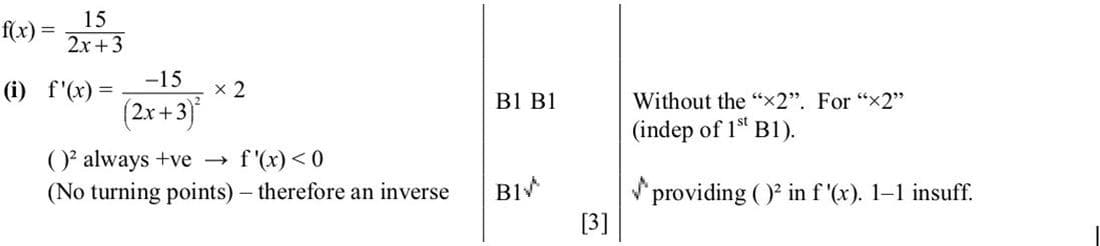
To find \(f'(x)\), we use the quotient rule for differentiation. The function \(f(x) = \frac{15}{2x+3}\) can be rewritten as \(f(x) = 15(2x+3)^{-1}\).
The derivative of \(f(x)\) is:
\(f'(x) = -15(2x+3)^{-2} \cdot 2 = \frac{-30}{(2x+3)^2}\).
Since \((2x+3)^2\) is always positive, \(f'(x) < 0\) for all \(x\) in the domain \(0 \leq x \leq 6\). This means \(f(x)\) is strictly decreasing, and therefore, \(f\) has an inverse.