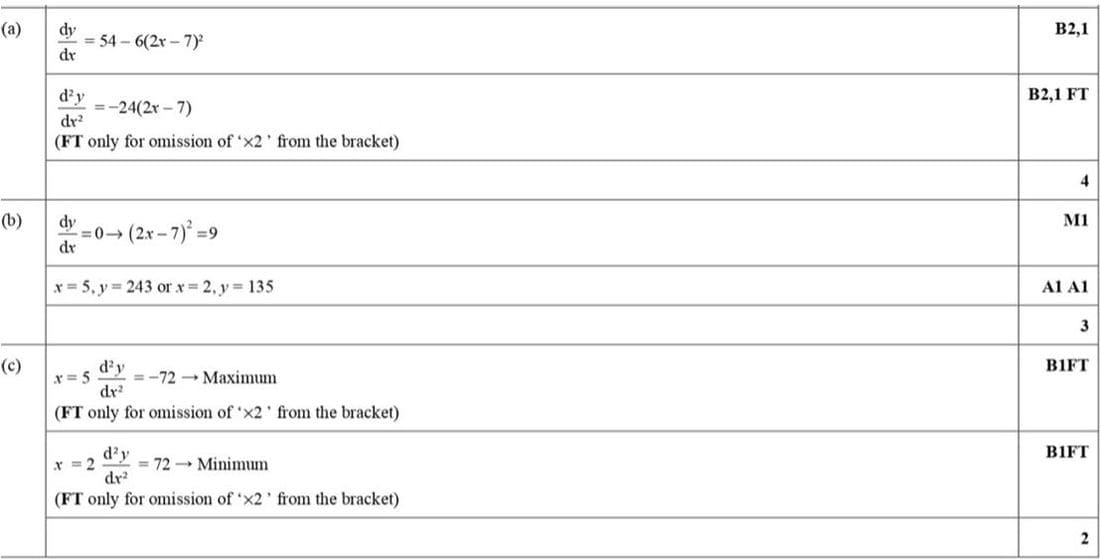
(a) Differentiate \(y = 54x - (2x - 7)^3\) with respect to \(x\):
\(\frac{dy}{dx} = 54 - 3(2x - 7)^2 \cdot 2\)
\(\frac{dy}{dx} = 54 - 6(2x - 7)^2\)
Differentiate again to find \(\frac{d^2y}{dx^2}\):
\(\frac{d^2y}{dx^2} = -6 \cdot 2(2x - 7) \cdot 2\)
\(\frac{d^2y}{dx^2} = -24(2x - 7)\)
(b) Set \(\frac{dy}{dx} = 0\):
\(54 - 6(2x - 7)^2 = 0\)
\(6(2x - 7)^2 = 54\)
\((2x - 7)^2 = 9\)
\(2x - 7 = \pm 3\)
\(2x = 10\) or \(2x = 4\)
\(x = 5\) or \(x = 2\)
For \(x = 5\), \(y = 54(5) - (2(5) - 7)^3 = 270 - 27 = 243\)
For \(x = 2\), \(y = 54(2) - (2(2) - 7)^3 = 108 - (-3)^3 = 135\)
(c) Evaluate \(\frac{d^2y}{dx^2}\) at the stationary points:
For \(x = 5\), \(\frac{d^2y}{dx^2} = -24(3) = -72\), indicating a maximum.
For \(x = 2\), \(\frac{d^2y}{dx^2} = -24(-3) = 72\), indicating a minimum.