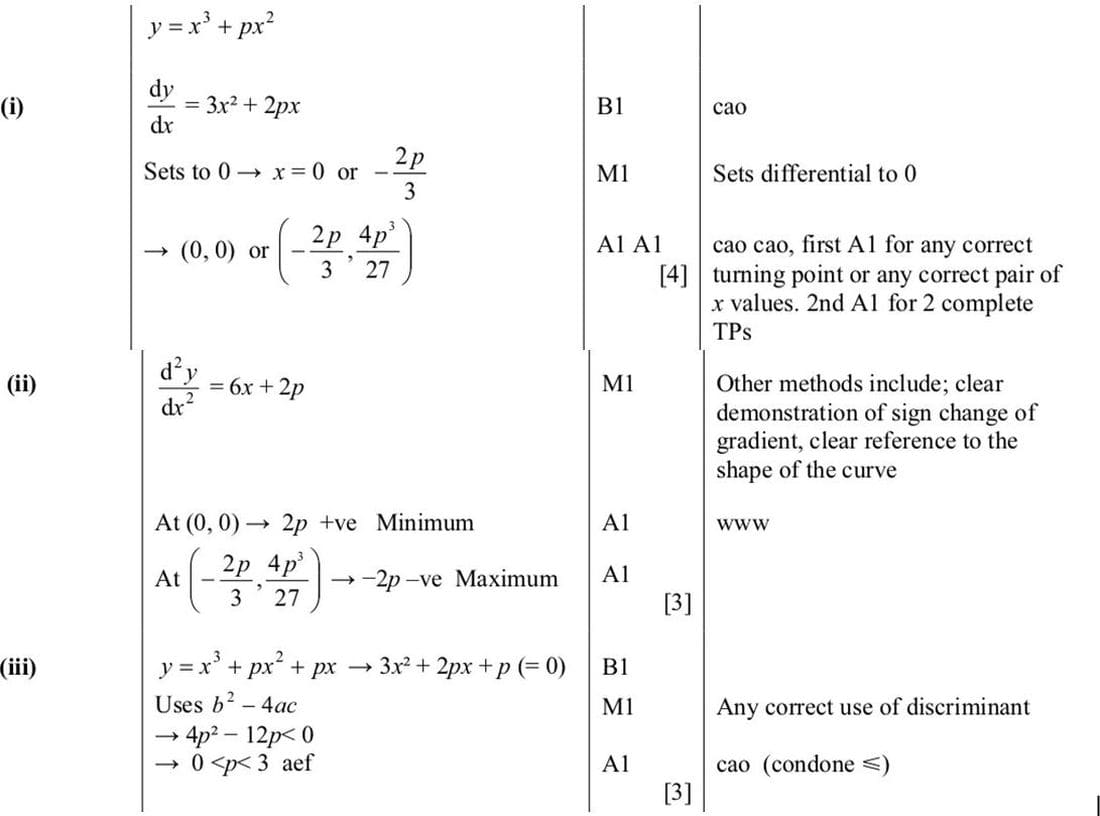
(i) To find stationary points, set the derivative \(\frac{dy}{dx} = 3x^2 + 2px\) to zero:
\(3x^2 + 2px = 0\)
\(x(3x + 2p) = 0\)
Thus, \(x = 0\) or \(x = -\frac{2p}{3}\).
For \(x = 0\), \(y = 0\), so one stationary point is \((0, 0)\).
For \(x = -\frac{2p}{3}\), substitute back into the equation:
\(y = \left(-\frac{2p}{3}\right)^3 + p\left(-\frac{2p}{3}\right)^2\)
\(y = -\frac{8p^3}{27} + \frac{4p^3}{9} = \frac{4p^3}{27}\)
So the other stationary point is \(\left(-\frac{2p}{3}, \frac{4p^3}{27}\right)\).
(ii) To determine the nature, find the second derivative:
\(\frac{d^2y}{dx^2} = 6x + 2p\)
At \((0, 0)\), \(\frac{d^2y}{dx^2} = 2p > 0\), so it is a minimum.
At \(\left(-\frac{2p}{3}, \frac{4p^3}{27}\right)\), \(\frac{d^2y}{dx^2} = -2p < 0\), so it is a maximum.
(iii) For the curve \(y = x^3 + px^2 + px\), the derivative is:
\(\frac{dy}{dx} = 3x^2 + 2px + p\)
Using the discriminant \(b^2 - 4ac\) for \(3x^2 + 2px + p = 0\):
\((2p)^2 - 4 \cdot 3 \cdot p < 0\)
\(4p^2 - 12p < 0\)
\(4p(p - 3) < 0\)
Thus, \(0 < p < 3\).