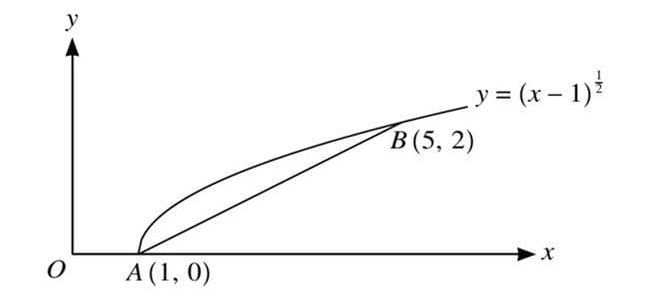
The diagram shows the curve \(y = (x - 1)^{\frac{1}{2}}\) and points \(A(1, 0)\) and \(B(5, 2)\) lying on the curve.
(i) Find the equation of the line \(AB\), giving your answer in the form \(y = mx + c\).
(ii) Find, showing all necessary working, the equation of the tangent to the curve which is parallel to \(AB\).
(iii) Find the perpendicular distance between the line \(AB\) and the tangent parallel to \(AB\). Give your answer correct to 2 decimal places.
Solution
(i) To find the equation of line \(AB\), calculate the gradient: \(\text{Gradient of } AB = \frac{2 - 0}{5 - 1} = \frac{1}{2}\).
The equation of the line is \(y = \frac{1}{2}x - \frac{1}{2}\).
(ii) The derivative of the curve \(y = (x - 1)^{\frac{1}{2}}\) is \(\frac{dy}{dx} = \frac{1}{2}(x - 1)^{-\frac{1}{2}}\).
Set \(\frac{dy}{dx} = \frac{1}{2}\) to find the tangent parallel to \(AB\):
\(\frac{1}{2}(x - 1)^{-\frac{1}{2}} = \frac{1}{2}\) gives \(x = 2\), \(y = 1\).
The equation of the tangent is \(y - 1 = \frac{1}{2}(x - 2)\), simplifying to \(y = \frac{1}{2}x\).
(iii) The perpendicular distance \(d\) between the line \(AB\) and the tangent is given by:
\(d = \sin(26.5^\circ) = 0.45\).
Log in to record attempts.