Past Exam Questions
← Back9709 P43 - Nov 2022 - Q7
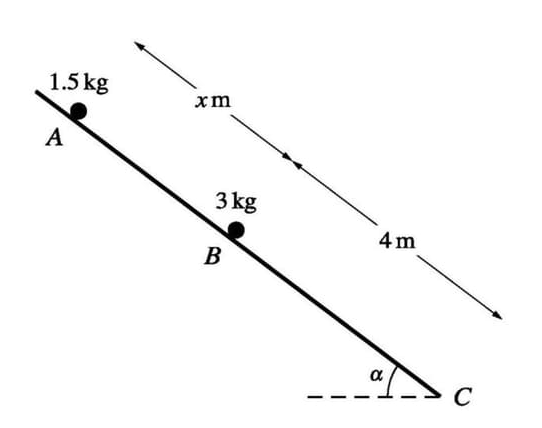
Particles of masses 1.5 kg and 3 kg lie on a plane which is inclined at an angle of \(\alpha\) to the horizontal, where \(\tan \alpha = \frac{3}{4}\). The section of the plane from \(A\) to \(B\) is smooth and the section of the plane from \(B\) to \(C\) is rough. The 1.5 kg particle is held at rest at \(A\) and the 3 kg particle is in limiting equilibrium at \(B\). The distance \(AB\) is \(x\) m and the distance \(BC\) is 4 m (see diagram).
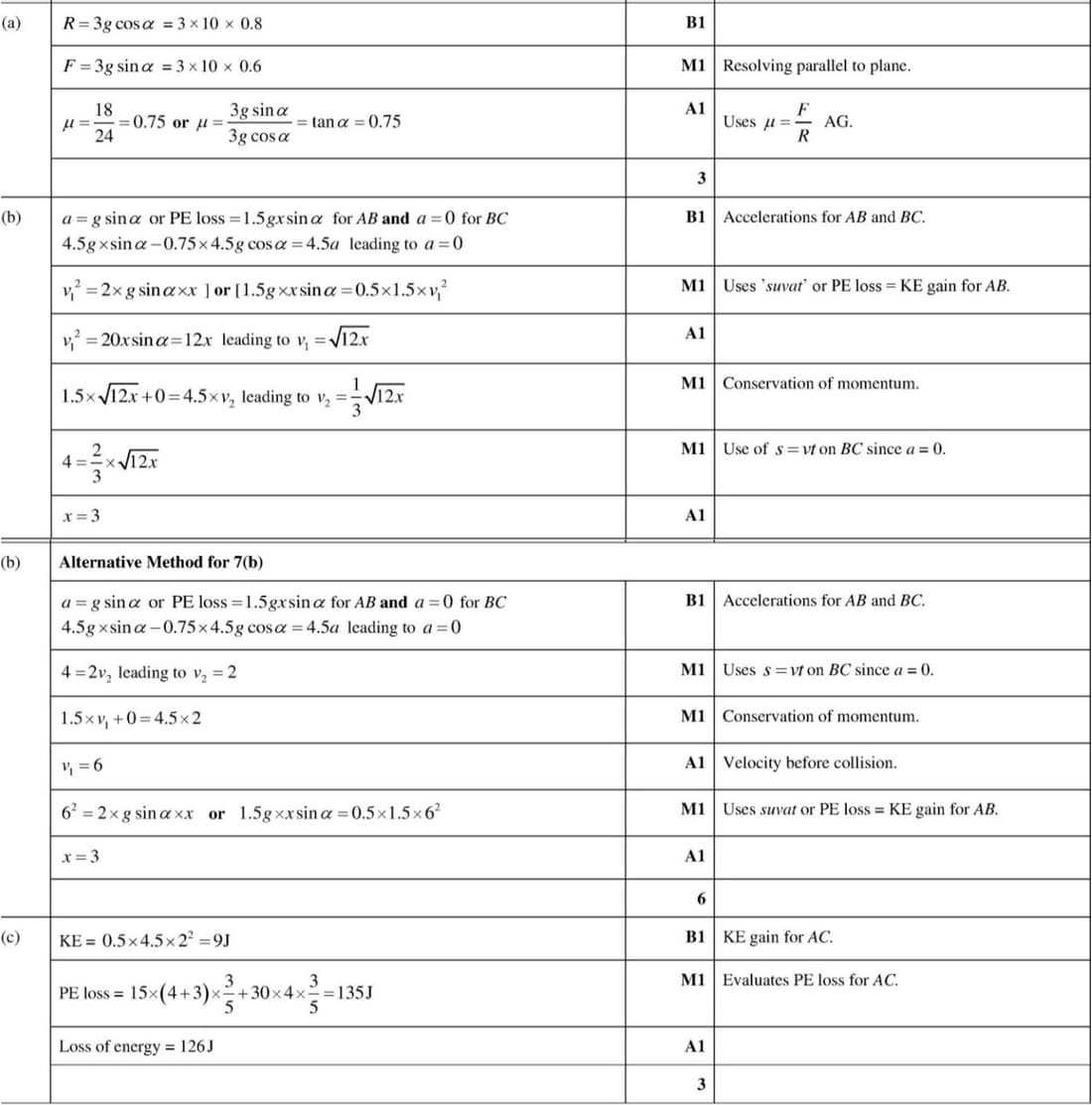
(a) Show that the coefficient of friction between the particle at \(B\) and the plane is 0.75.
The 1.5 kg particle is released from rest. In the subsequent motion the two particles collide and coalesce. The time taken for the combined particle to travel from \(B\) to \(C\) is 2 s. The coefficient of friction between the combined particle and the plane is still 0.75.
(b) Find \(x\).
(c) Find the total loss of energy of the particles from the time the 1.5 kg particle is released until the combined particle reaches \(C\).
9709 P42 - Nov 2022 - Q6
Three particles A, B and C of masses 0.3 kg, 0.4 kg and m kg respectively lie at rest in a straight line on a smooth horizontal plane. The distance between B and C is 2.1 m. A is projected directly towards B with speed 2 m/s. After A collides with B the speed of A is reduced to 0.6 m/s, still moving in the same direction.
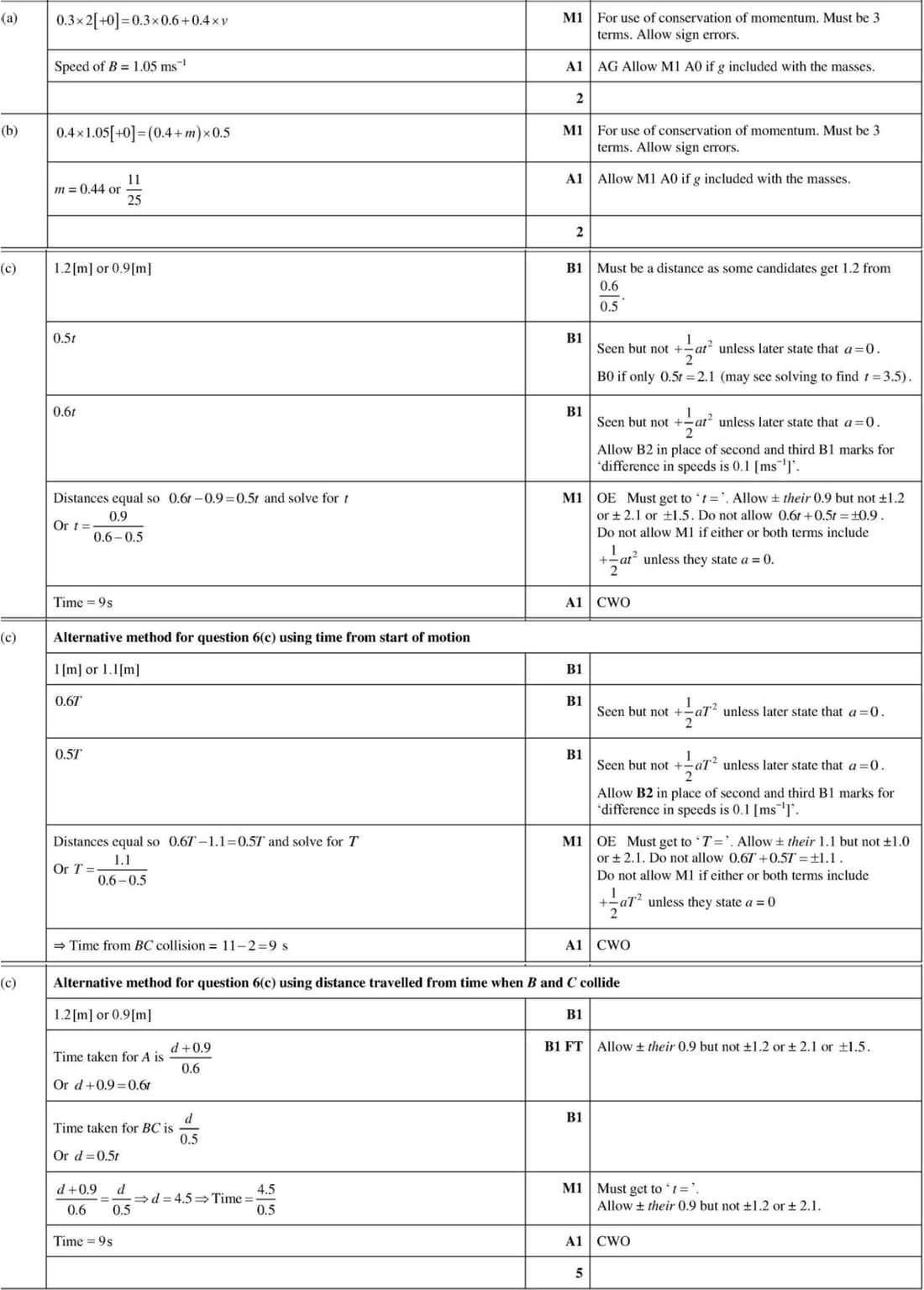
- Show that the speed of B after the collision is 1.05 m/s.
- After the collision between A and B, B moves directly towards C. Particle B now collides with C. After this collision, the two particles coalesce and have a combined speed of 0.5 m/s.
- Find m.
- Find the time that it takes, from the instant when B and C collide, until A collides with the combined particle.
9709 P41 - Nov 2022 - Q2
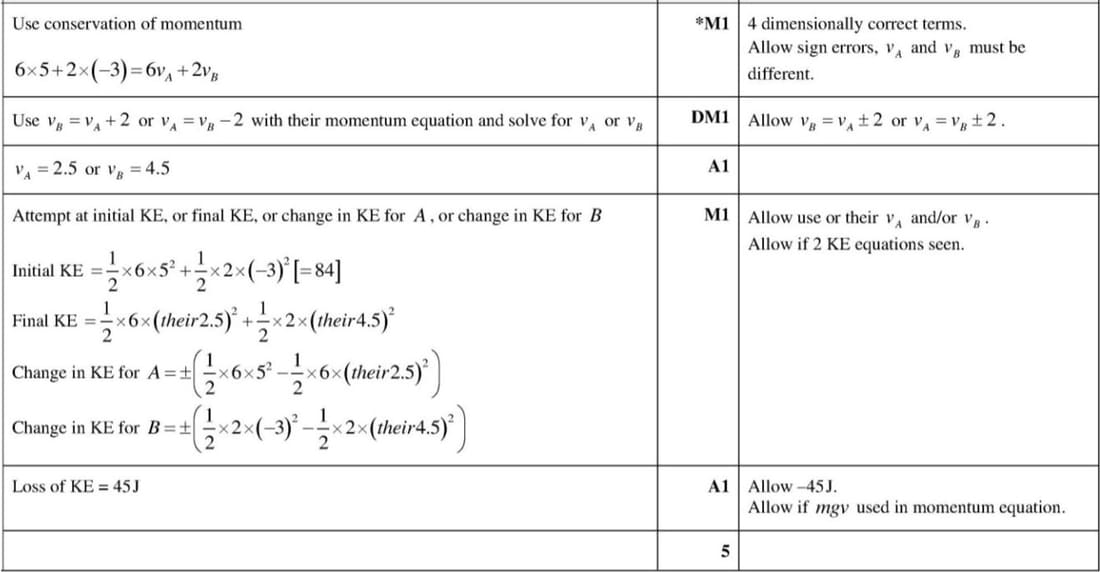
Small smooth spheres A and B, of equal radii and of masses 6 kg and 2 kg respectively, lie on a smooth horizontal plane. Initially A is moving towards B with speed 5 m s-1 and B is moving towards A with speed 3 m s-1. After the spheres collide, both A and B move in the same direction and the difference in the speeds of the spheres is 2 m s-1.
Find the loss of kinetic energy of the system due to the collision.
9231 P11 - Nov 2018 - Q1 - 5 marks
The vectors \(\mathbf a\), \(\mathbf b\), \(\mathbf c\) and \(\mathbf d\) in \(\mathbb R^3\) are given by
\(\mathbf a=\begin{pmatrix}1\\2\\1\end{pmatrix},\quad \mathbf b=\begin{pmatrix}2\\9\\0\end{pmatrix},\quad \mathbf c=\begin{pmatrix}3\\3\\4\end{pmatrix},\quad \mathbf d=\begin{pmatrix}0\\-8\\3\end{pmatrix}.\)
(i) Show that \(\{\mathbf a,\mathbf b,\mathbf c\}\) is a basis for \(\mathbb R^3\).
(ii) Express \(\mathbf d\) in terms of \(\mathbf a\), \(\mathbf b\) and \(\mathbf c\).

9231 P11 - Jun 2019 - Q3 - 8 marks
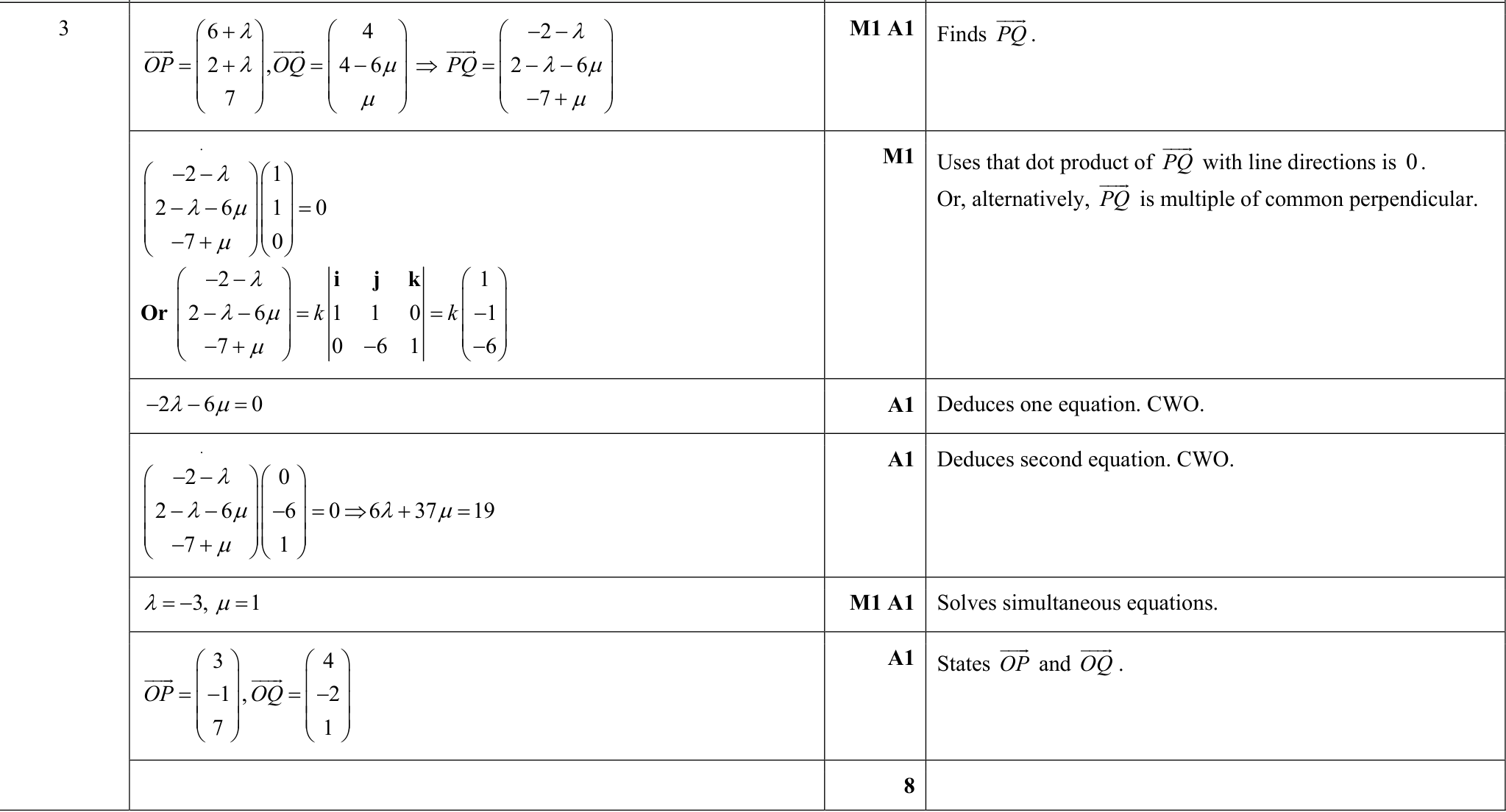
3 The lines \(l_{1}\) and \(l_{2}\) have equations \(\mathbf{r}=6 \mathbf{i}+2 \mathbf{j}+7 \mathbf{k}+\lambda(\mathbf{i}+\mathbf{j})\) and \(\mathbf{r}=4 \mathbf{i}+4 \mathbf{j}+\mu(-6 \mathbf{j}+\mathbf{k})\) respectively. The point \(P\) on \(l_{1}\) and the point \(Q\) on \(l_{2}\) are such that \(P Q\) is perpendicular to both \(l_{1}\) and \(l_{2}\). Find the position vectors of \(P\) and \(Q\).
9231 P11 - Jun 2011 - Q6 - 9 marks
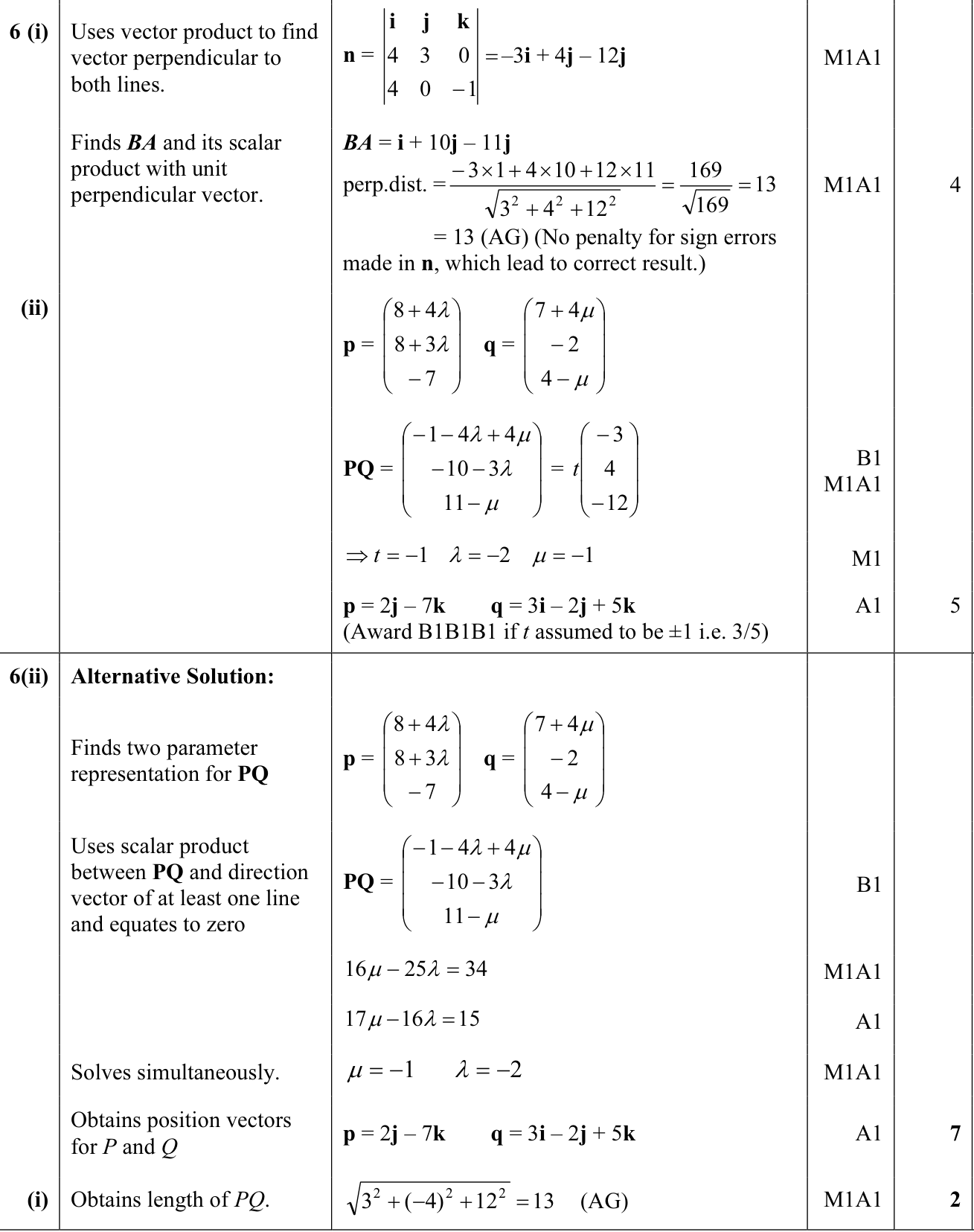
The line \(l_{1}\) passes through the point with position vector \(8 \mathbf{i}+8 \mathbf{j}-7 \mathbf{k}\) and is parallel to the vector \(4 \mathbf{i}+3 \mathbf{j}\). The line \(l_{2}\) passes through the point with position vector \(7 \mathbf{i}-2 \mathbf{j}+4 \mathbf{k}\) and is parallel to the vector \(4 \mathbf{i}-\mathbf{k}\). The point \(P\) on \(l_{1}\) and the point \(Q\) on \(l_{2}\) are such that \(P Q\) is perpendicular to both \(l_{1}\) and \(l_{2}\). In either order,
(i) show that \(P Q=13\),
(ii) find the position vectors of \(P\) and \(Q\).
9231 P1 - Nov 2009 - Q2 - 6 marks
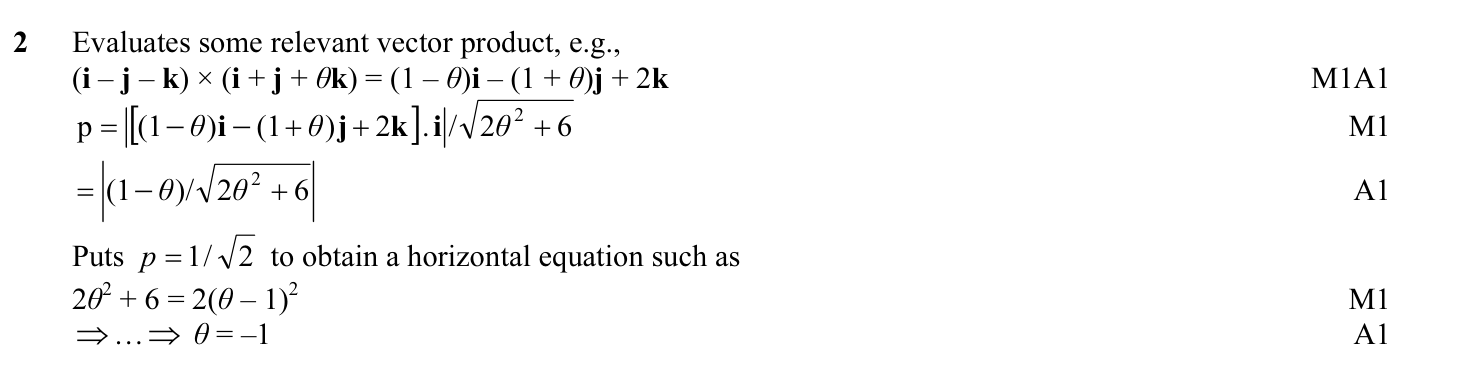
Relative to an origin \(O\), the points \(A, B, C\) have position vectors
\(\mathbf{i}, \quad \mathbf{j}+\mathbf{k}, \quad \mathbf{i}+\mathbf{j}+\theta \mathbf{k}\),
respectively. The shortest distance between the lines \(A B\) and \(O C\) is \(\frac{1}{\sqrt{2}}\). Find the value of \(\theta\).
9231 P12 - Jun 2025 - Q04 - 9 marks
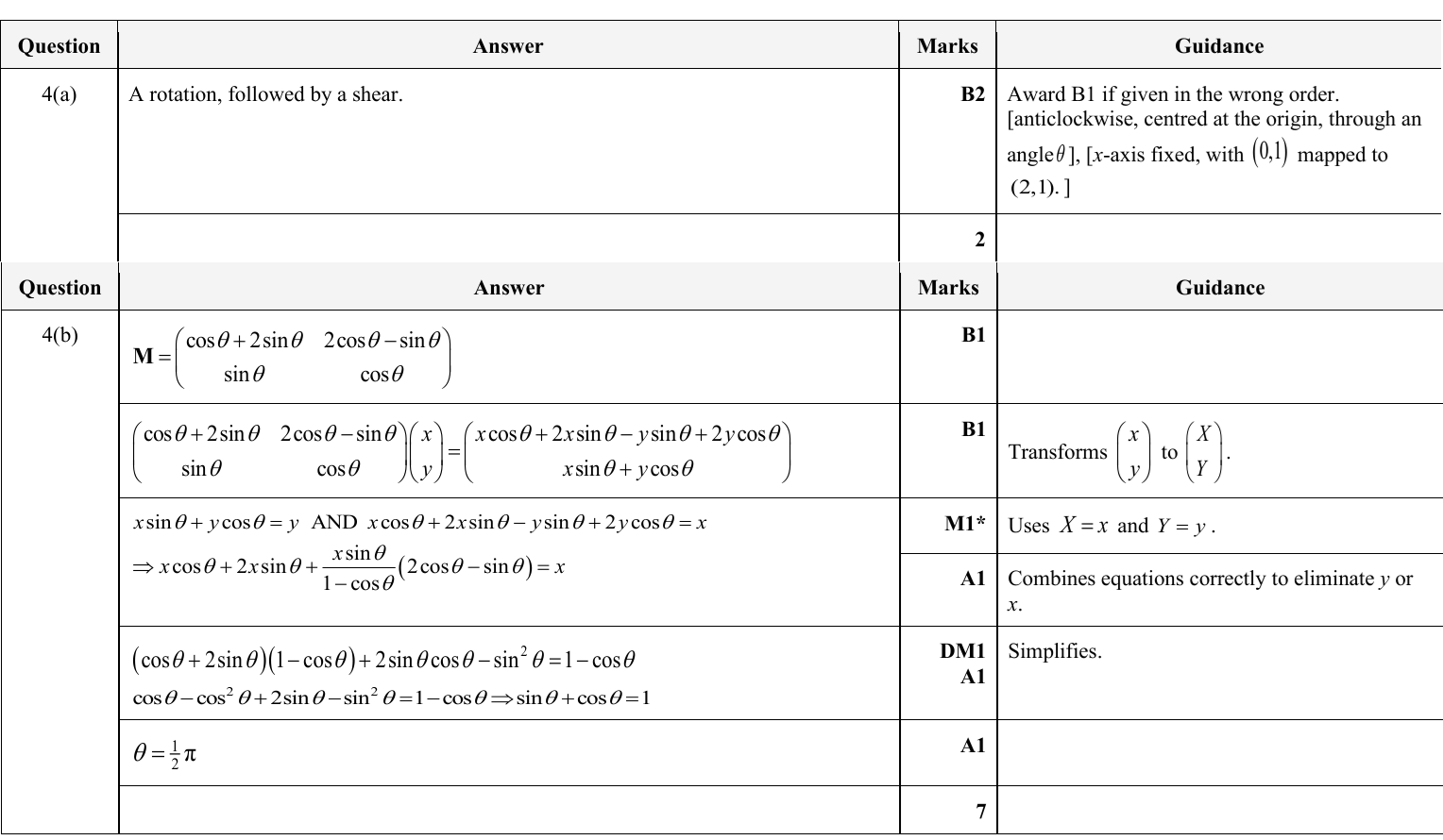
The matrix \(\mathbf{M}\) is given by \(\mathbf{M} = \begin{pmatrix} 1 & 2 \\ 0 & 1 \end{pmatrix} \begin{pmatrix} \cos \theta & -\sin \theta \\ \sin \theta & \cos \theta \end{pmatrix}\), where \(0 < \theta < 2\pi\).
(a) The matrix \(\mathbf{M}\) represents a sequence of two geometrical transformations in the \(x-y\) plane. State the type of each transformation, and make clear the order in which they are applied.
(b) Find the value of \(\theta\) for which the transformation represented by \(\mathbf{M}\) has a line of invariant points.
9231 P12 - Jun 2025 - Q06 - 16 marks
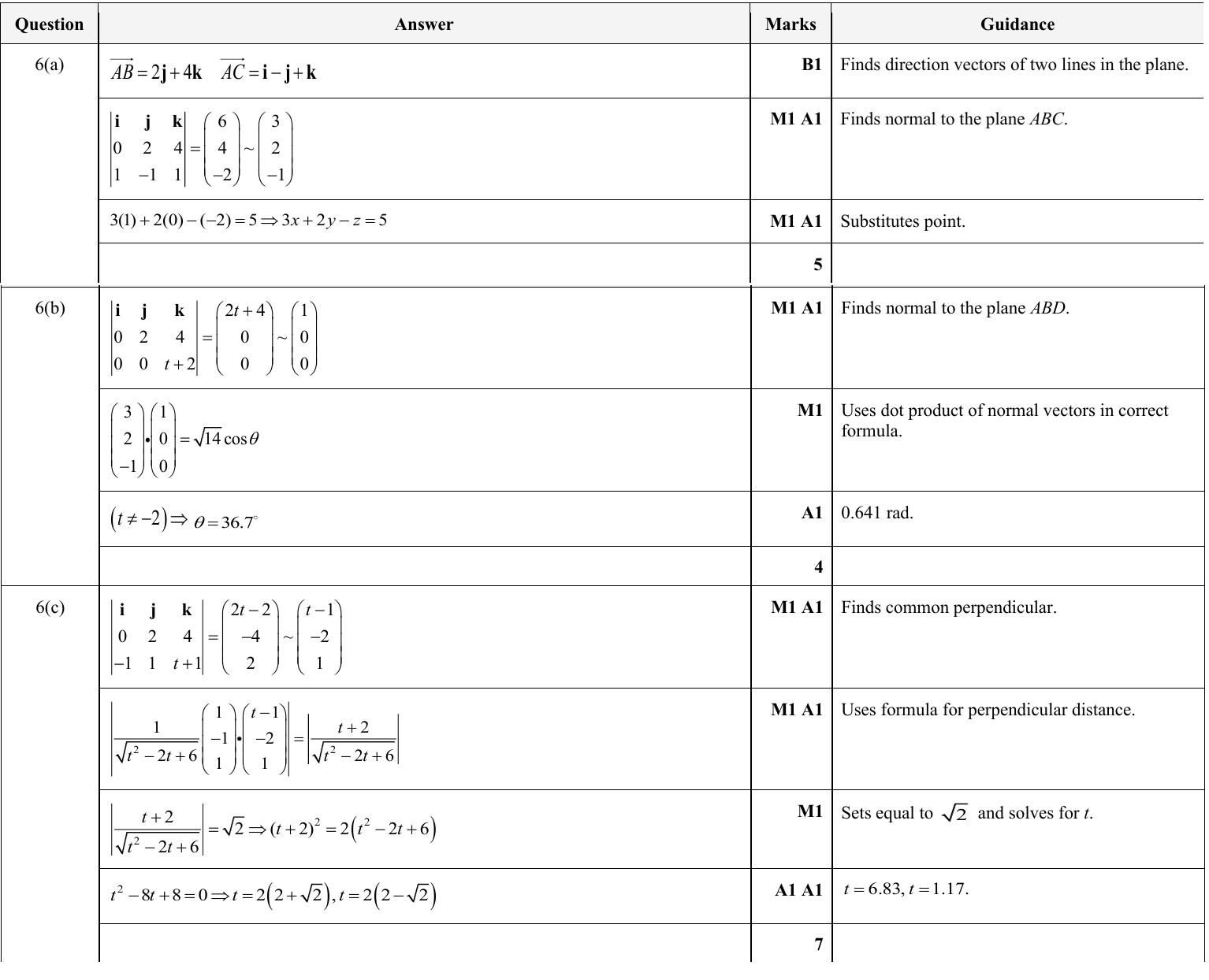
The points A, B, C have position vectors
\(\mathbf{i} - 2\mathbf{k}, \quad \mathbf{i} + 2\mathbf{j} + 2\mathbf{k}, \quad 2\mathbf{i} - \mathbf{j} - \mathbf{k},\)
respectively.
(a) Find the equation of the plane ABC, giving your answer in the form \(ax + by + cz = d\).
A point D has position vector \(\mathbf{i} + t\mathbf{k}\), where \(t \neq -2\).
(b) Find the acute angle between the planes ABC and ABD.
(c) Find the values of \(t\) such that the shortest distance between the lines AB and CD is \(\sqrt{2}\).
9231 P11 - Jun 2025 - Q04 - 9 marks
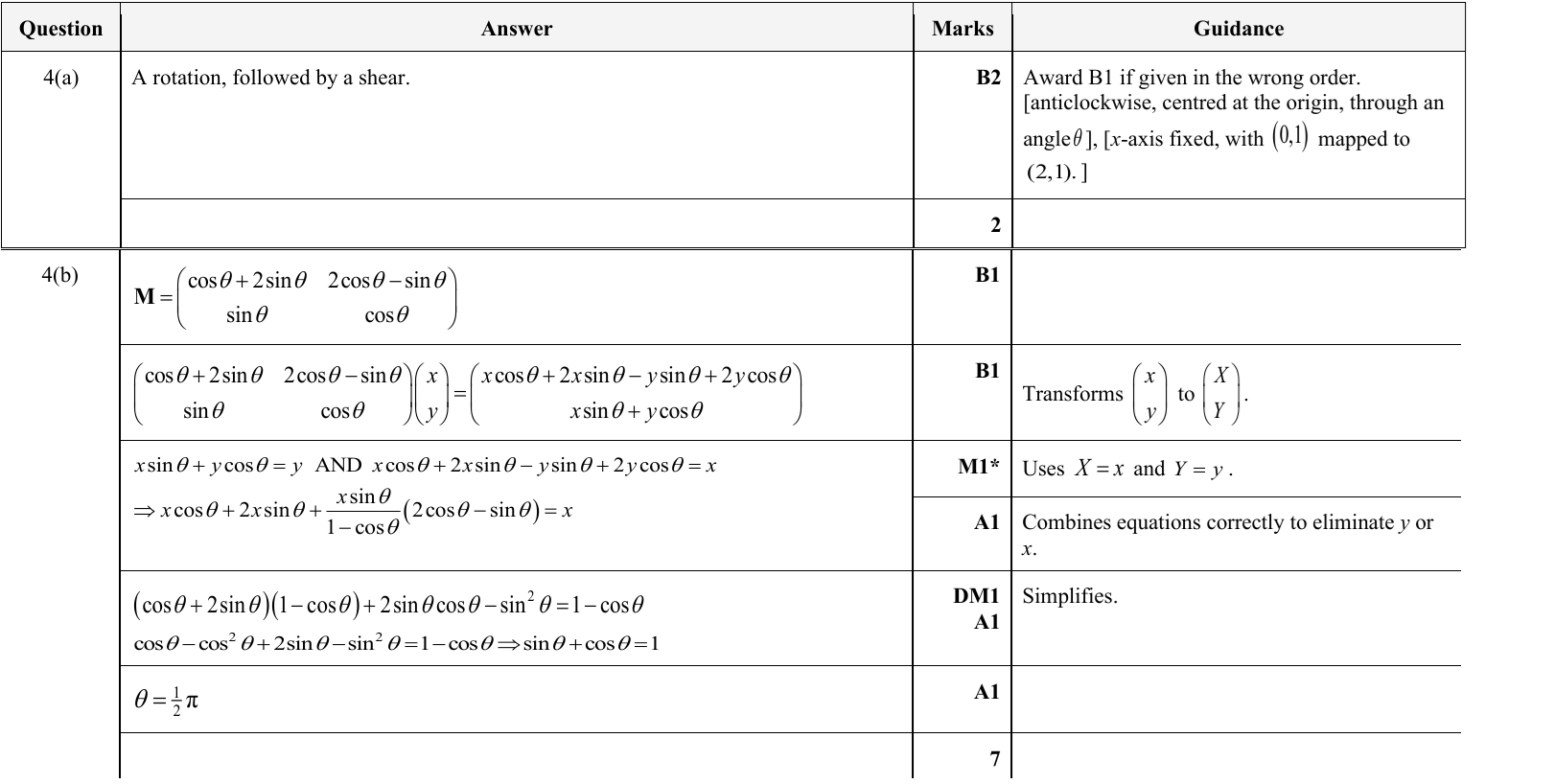
The matrix M is given by \(\mathbf{M} = \begin{pmatrix} 1 & 2 \\ 0 & 1 \end{pmatrix} \begin{pmatrix} \cos \theta & -\sin \theta \\ \sin \theta & \cos \theta \end{pmatrix}\), where \(0 < \theta < 2\pi\).
(a) The matrix M represents a sequence of two geometrical transformations in the x–y plane. State the type of each transformation, and make clear the order in which they are applied.
(b) Find the value of \(\theta\) for which the transformation represented by M has a line of invariant points.
9231 P11 - Jun 2025 - Q06 - 16 marks
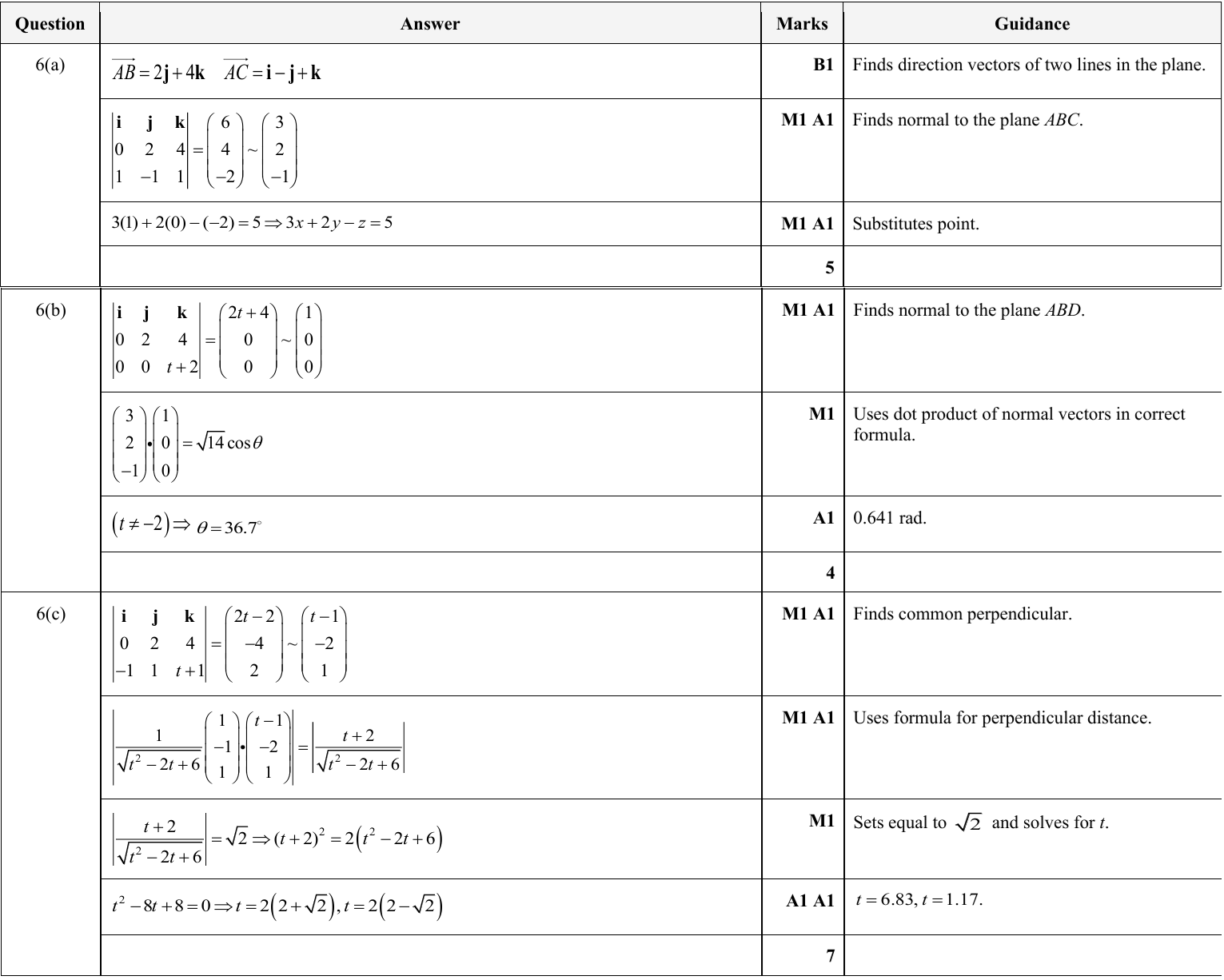
The points A, B, C have position vectors \(\mathbf{i} - 2\mathbf{k}, \mathbf{i} + 2\mathbf{j} + 2\mathbf{k}, 2\mathbf{i} - \mathbf{j} - \mathbf{k}\), respectively.
(a) Find the equation of the plane ABC, giving your answer in the form \(ax + by + cz = d\).
A point D has position vector \(\mathbf{i} + t\mathbf{k}\), where \(t \neq -2\).
(b) Find the acute angle between the planes ABC and ABD.
(c) Find the values of \(t\) such that the shortest distance between the lines AB and CD is \(\sqrt{2}\).
9231 P13 - Jun 2025 - Q01 - 11 marks
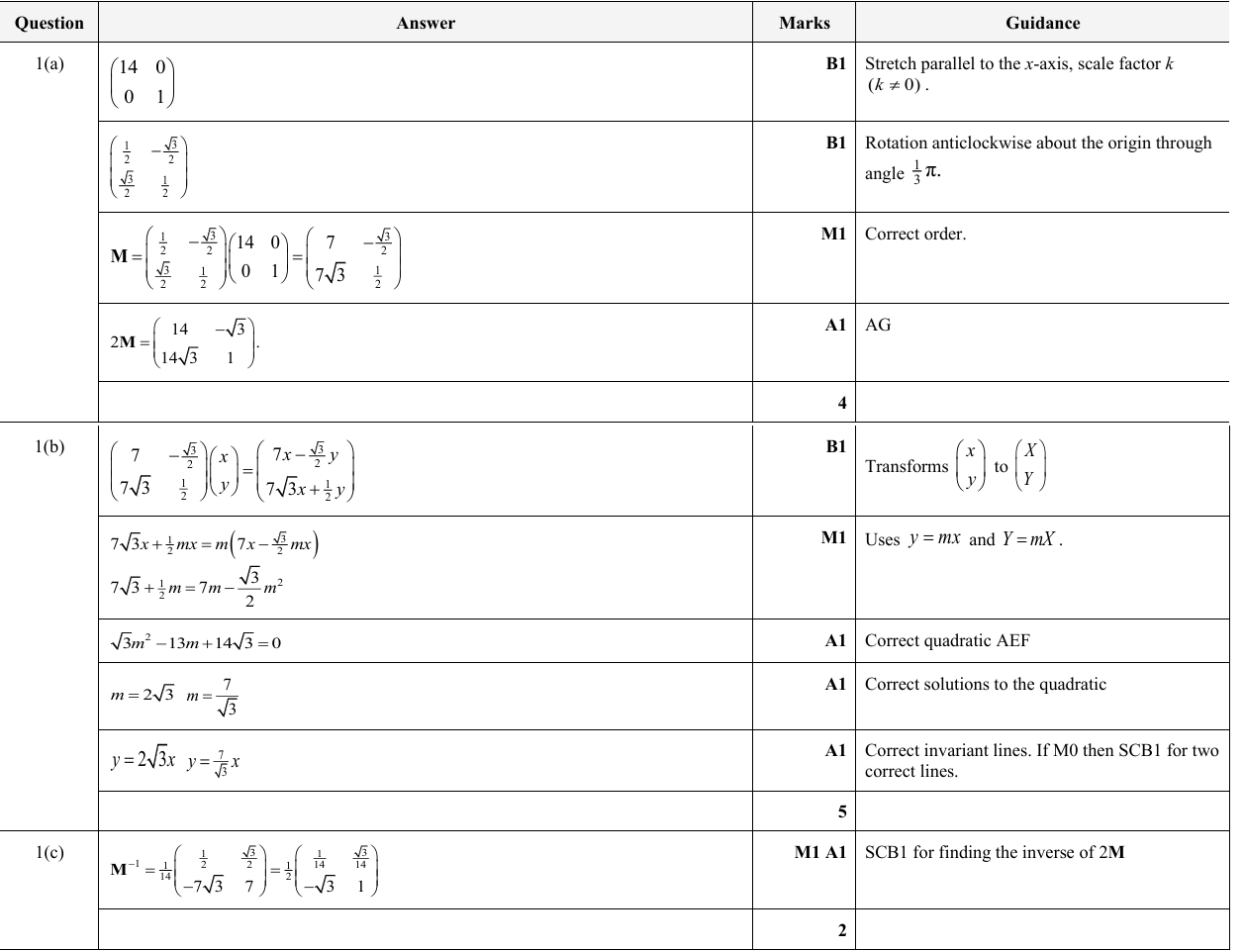
The matrix M represents the sequence of two transformations in the x-y plane given by a stretch parallel to the x-axis, scale factor 14, followed by a rotation anticlockwise about the origin through angle \(\frac{1}{3} \pi\).
(a) Show that \(2\mathbf{M} = \begin{pmatrix} 14 & -\sqrt{3} \\ 14\sqrt{3} & 1 \end{pmatrix}\).
(b) Find the equations of the invariant lines, through the origin, of the transformation in the x-y plane represented by M.
The unit square S in the x-y plane is transformed by M onto the rectangle P.
(c) Find the matrix which transforms P onto S.
9231 P13 - Jun 2025 - Q05 - 11 marks
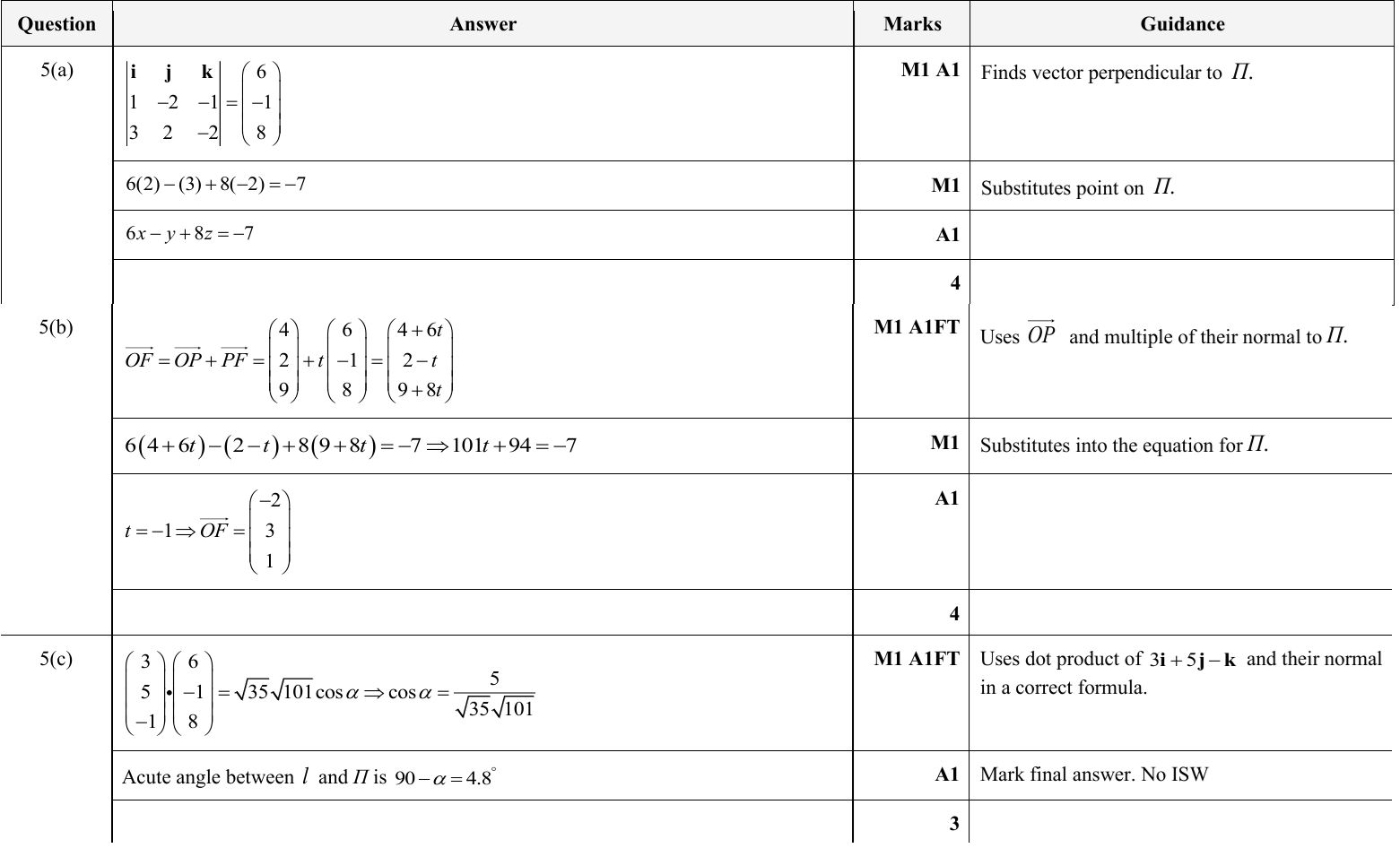
The plane \(\Pi\) has equation \(\mathbf{r} = 2\mathbf{i} + 3\mathbf{j} - 2\mathbf{k} + \lambda (\mathbf{i} - 2\mathbf{j} - \mathbf{k}) + \mu (3\mathbf{i} + 2\mathbf{j} - 2\mathbf{k})\).
(a) Find a Cartesian equation of \(\Pi\), giving your answer in the form \(ax + by + cz = d\).
The point \(P\) has position vector \(4\mathbf{i} + 2\mathbf{j} + 9\mathbf{k}\).
(b) Find the position vector of the foot of the perpendicular from \(P\) to \(\Pi\).
The line \(l\) is parallel to the vector \(3\mathbf{i} + 5\mathbf{j} - \mathbf{k}\).
(c) Find the acute angle between \(l\) and \(\Pi\).
9231 P14 - Jun 2025 - Q03 - 10 marks
The points A, B and C have position vectors
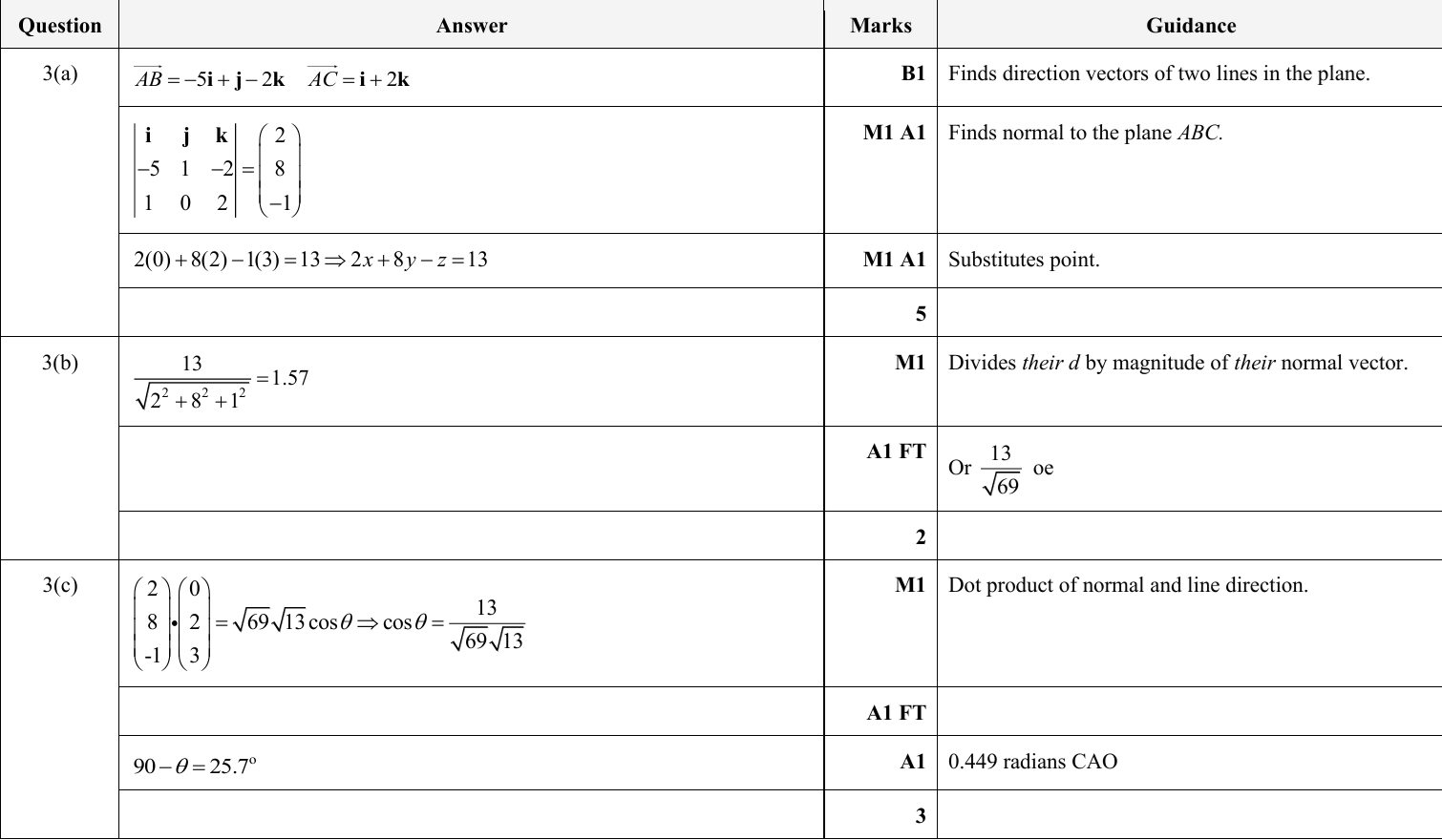
\(2\mathbf{j} + 3\mathbf{k}, \quad -5\mathbf{i} + 3\mathbf{j} + \mathbf{k} \quad \text{and} \quad \mathbf{i} + 2\mathbf{j} + 5\mathbf{k}\)
respectively, relative to the origin O.
(a) Find the equation of the plane ABC, giving your answer in the form \(ax + by + cz = d\).
(b) Find the perpendicular distance from O to the plane ABC.
(c) Find the acute angle between the line OA and the plane ABC.
9231 P14 - Jun 2025 - Q05 - 14 marks
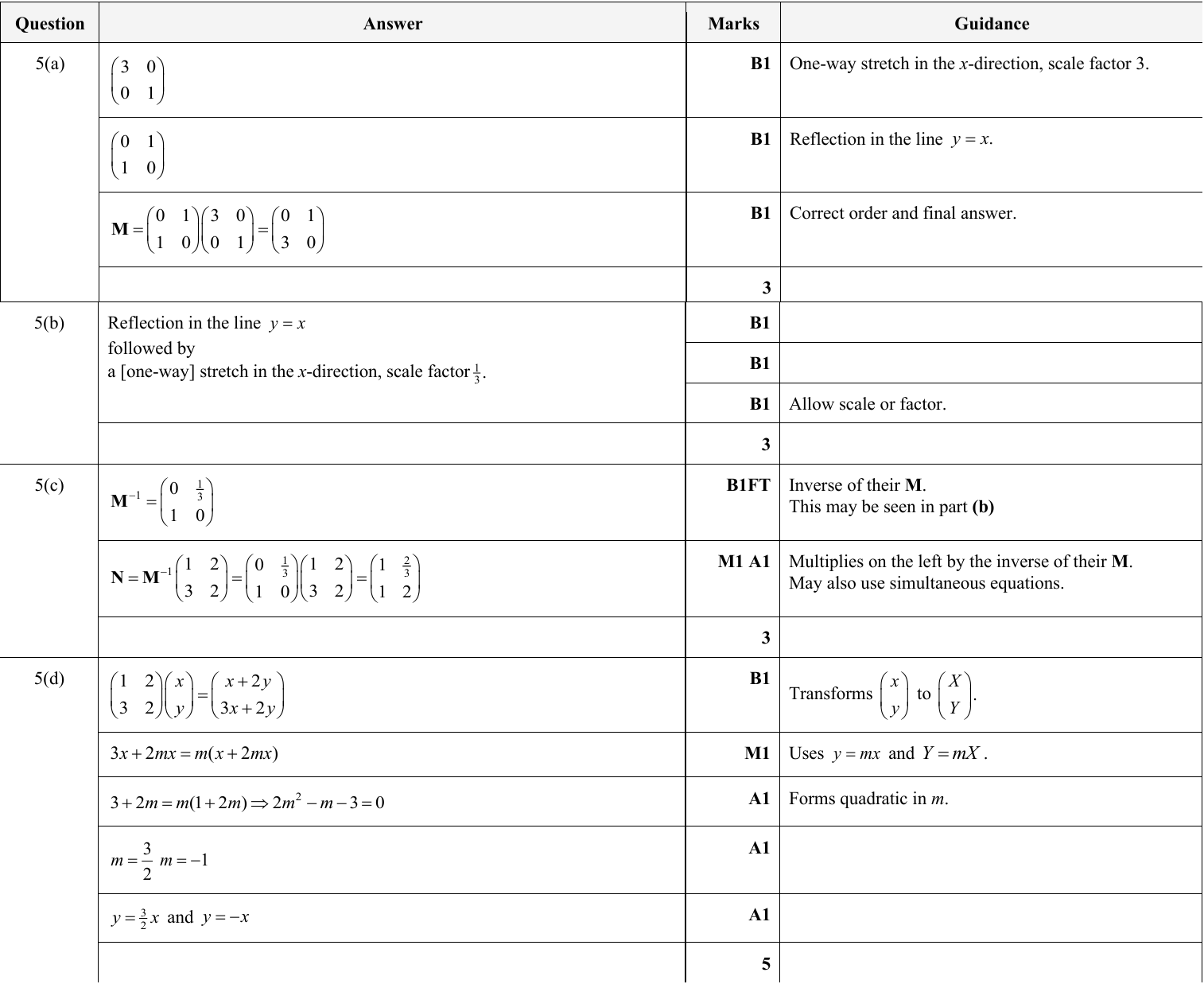
The matrix M represents a sequence of two transformations in the x-y plane given by a one-way stretch in the x-direction, scale factor 3, followed by a reflection in the line y = x.
(a) Find M.
(b) Give full details of the geometrical transformation in the x-y plane represented by M-1.
The matrix N is such that MN = \(\begin{pmatrix} 1 & 2 \\ 3 & 2 \end{pmatrix}\).
(c) Find N.
\((d) Find the equations of the invariant lines, through the origin, of the transformation in the x-y plane represented by MN.\)
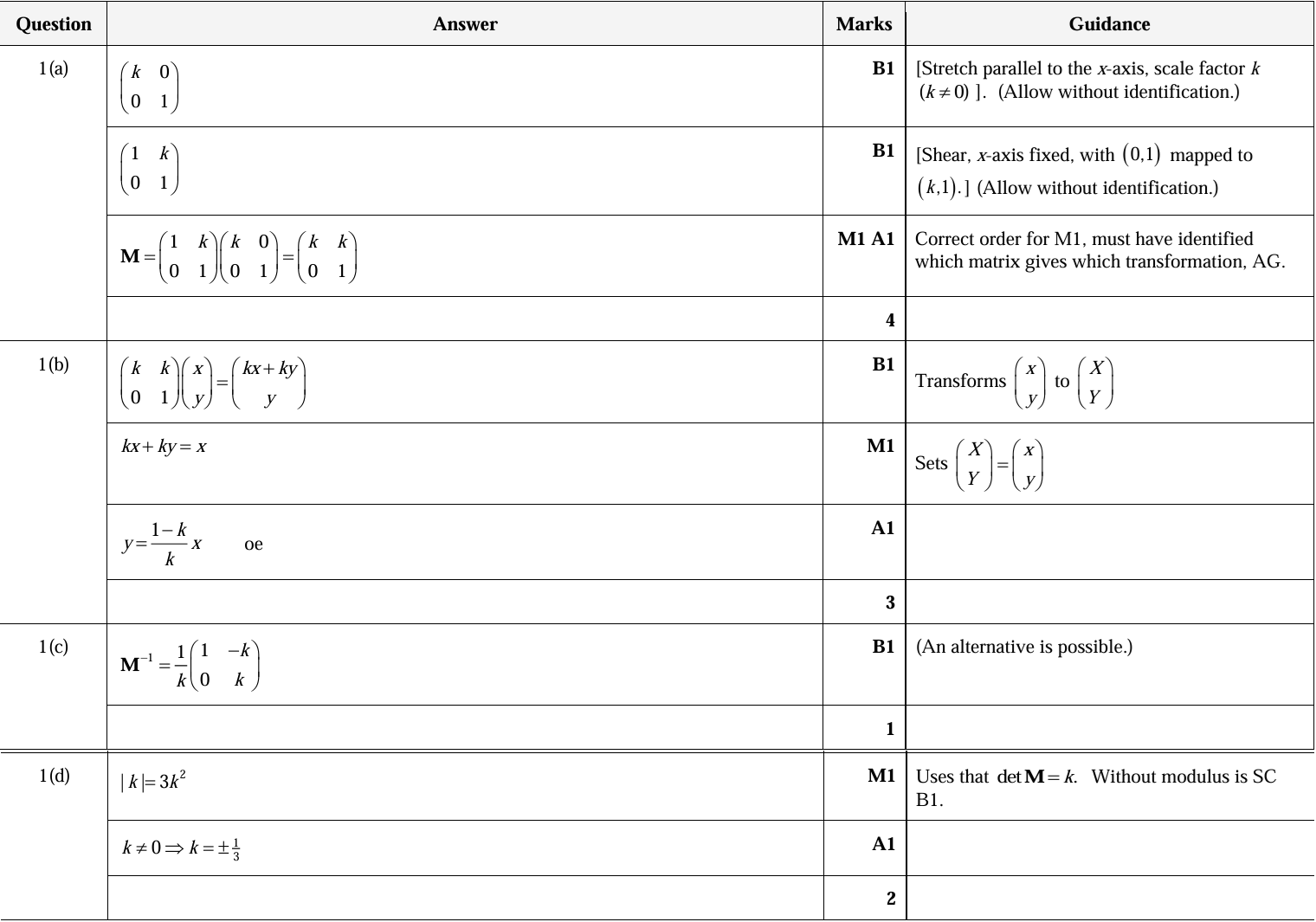
9231 P11 - Nov 2024 - Q01 - 10 marks
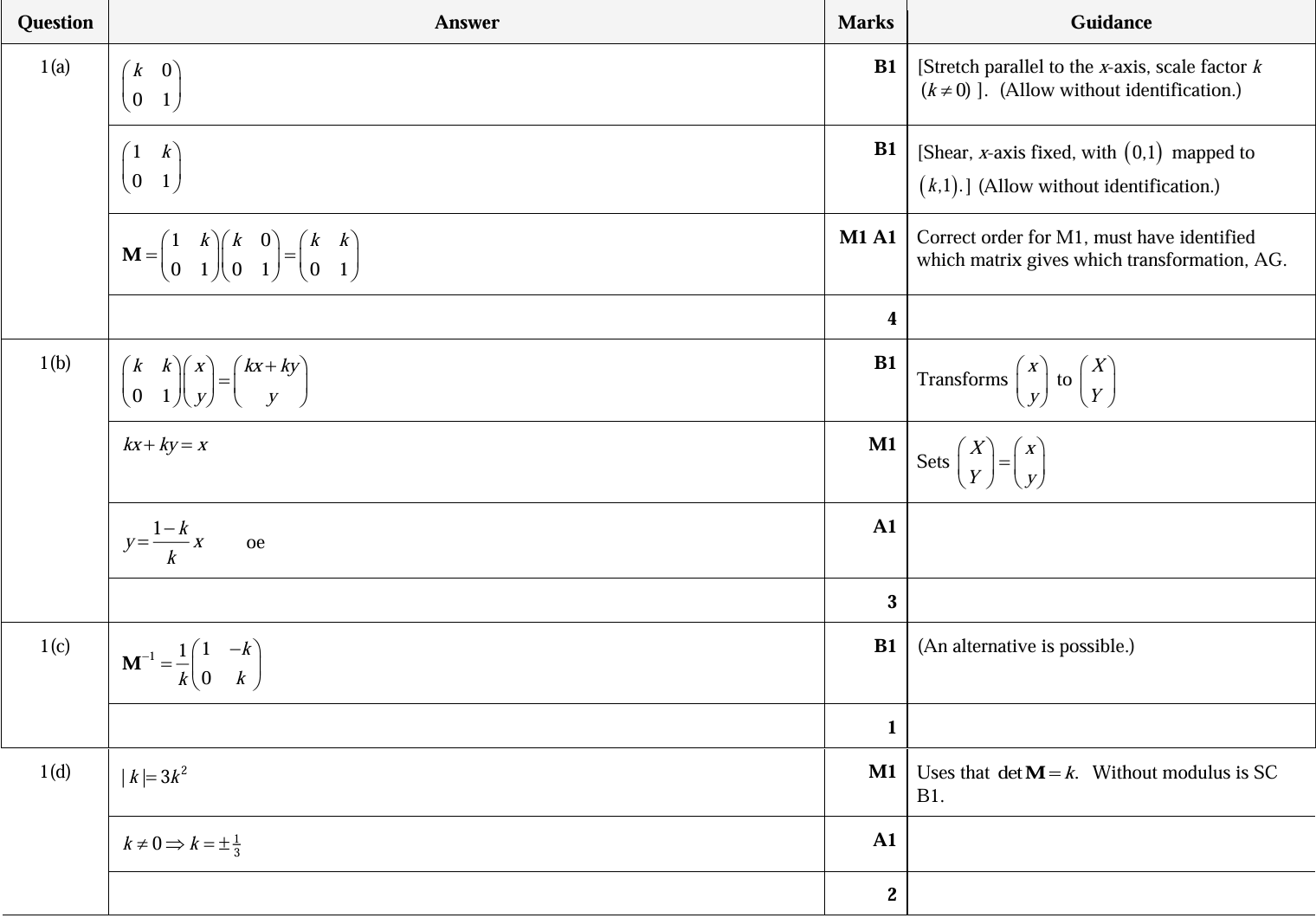
The matrix M represents the sequence of two transformations in the x-y plane given by a stretch parallel to the x-axis, scale factor k (k ≠ 0), followed by a shear, x-axis fixed, with (0, 1) mapped to (k, 1).
(a) Show that M = \(\begin{pmatrix} k & k \\ 0 & 1 \end{pmatrix}\).
\((b) The transformation represented by M has a line of invariant points. Find, in terms of k, the equation of this line.\)
The unit square S in the x-y plane is transformed by M onto the parallelogram P.
(c) Find, in terms of k, a matrix which transforms P onto S.
(d) Given that the area of P is \(3k^2\) units\(^2\), find the possible values of k.
9231 P11 - Nov 2024 - Q07 - 15 marks
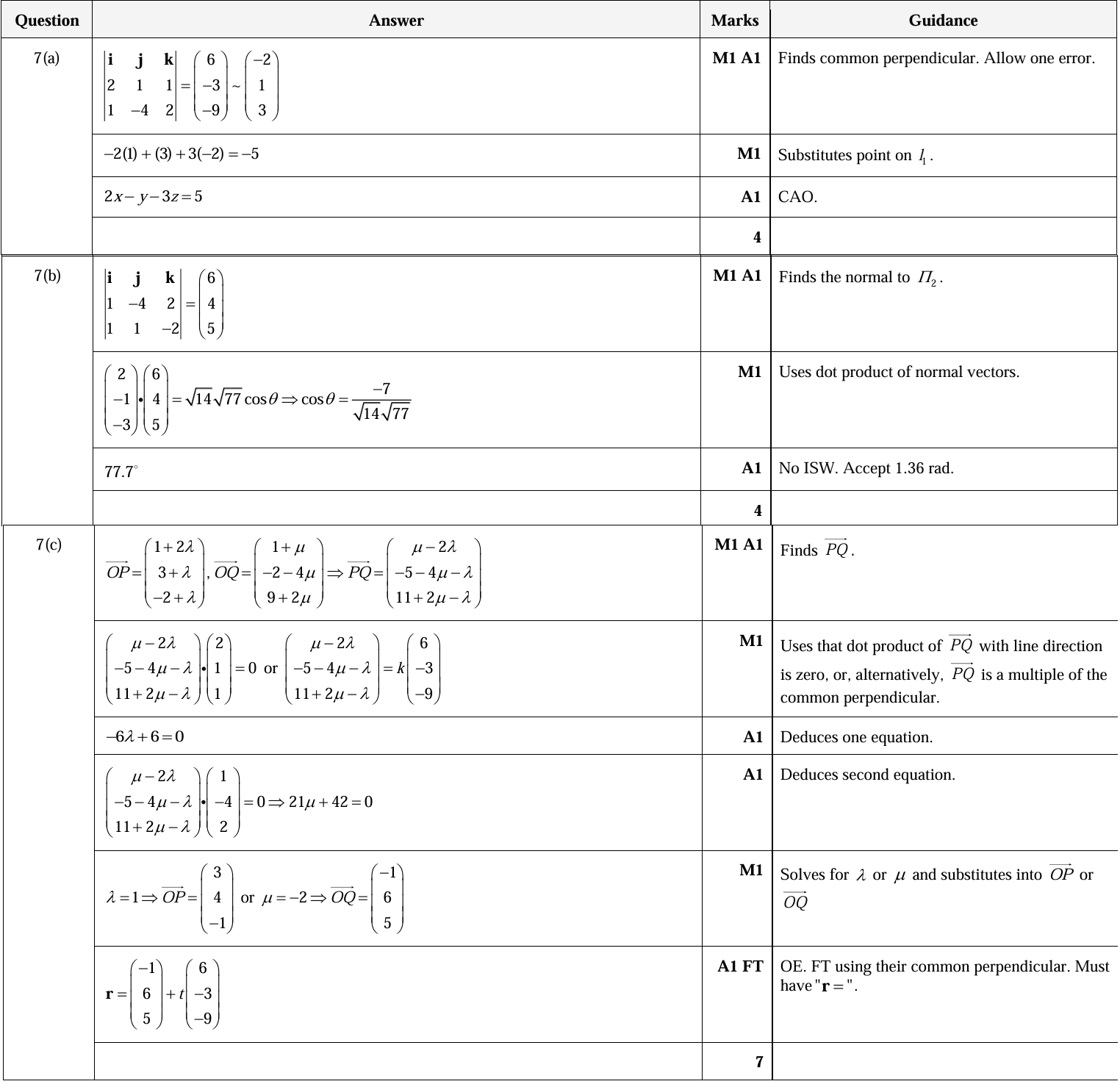
The lines \(l_1\) and \(l_2\) have equations \(\mathbf{r} = \mathbf{i} + 3\mathbf{j} - 2\mathbf{k} + \lambda(2\mathbf{i} + \mathbf{j} + \mathbf{k})\) and \(\mathbf{r} = \mathbf{i} - 2\mathbf{j} + 9\mathbf{k} + \mu(\mathbf{i} - 4\mathbf{j} + 2\mathbf{k})\) respectively. The plane \(\Pi_1\) contains \(l_1\) and is parallel to \(l_2\).
(a) Find the equation of \(\Pi_1\), giving your answer in the form \(ax + by + cz = d\).
The plane \(\Pi_2\) contains \(l_2\) and the point with coordinates \((2, -1, 7)\).
(b) Find the acute angle between \(\Pi_1\) and \(\Pi_2\).
The point \(P\) on \(l_1\) and the point \(Q\) on \(l_2\) are such that \(PQ\) is perpendicular to both \(l_1\) and \(l_2\).
(c) Find a vector equation for \(PQ\).
9231 P12 - Nov 2024 - Q02 - 7 marks
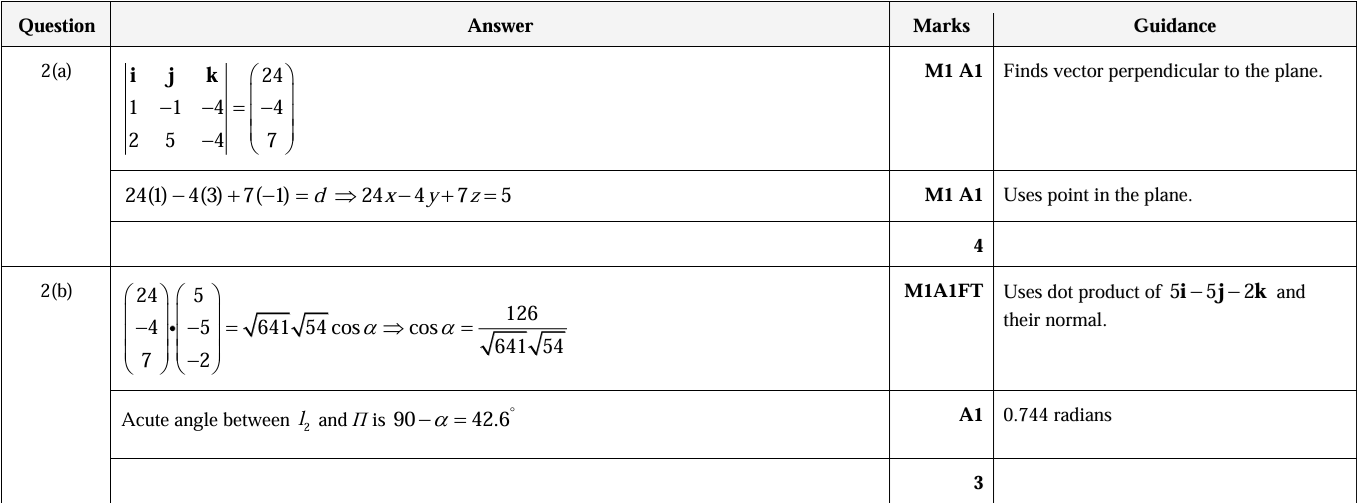
The line \(l_1\) has equation \(\mathbf{r} = \mathbf{i} + 3\mathbf{j} - \mathbf{k} + \lambda (\mathbf{i} - \mathbf{j} - 4\mathbf{k})\).
The plane \(\Pi\) contains \(l_1\) and is parallel to the vector \(2\mathbf{i} + 5\mathbf{j} - 4\mathbf{k}\).
(a) Find the equation of \(\Pi\), giving your answer in the form \(ax + by + cz = d\).
The line \(l_2\) is parallel to the vector \(5\mathbf{i} - 5\mathbf{j} - 2\mathbf{k}\).
(b) Find the acute angle between \(l_2\) and \(\Pi\).
9231 P12 - Nov 2024 - Q04 - 13 marks
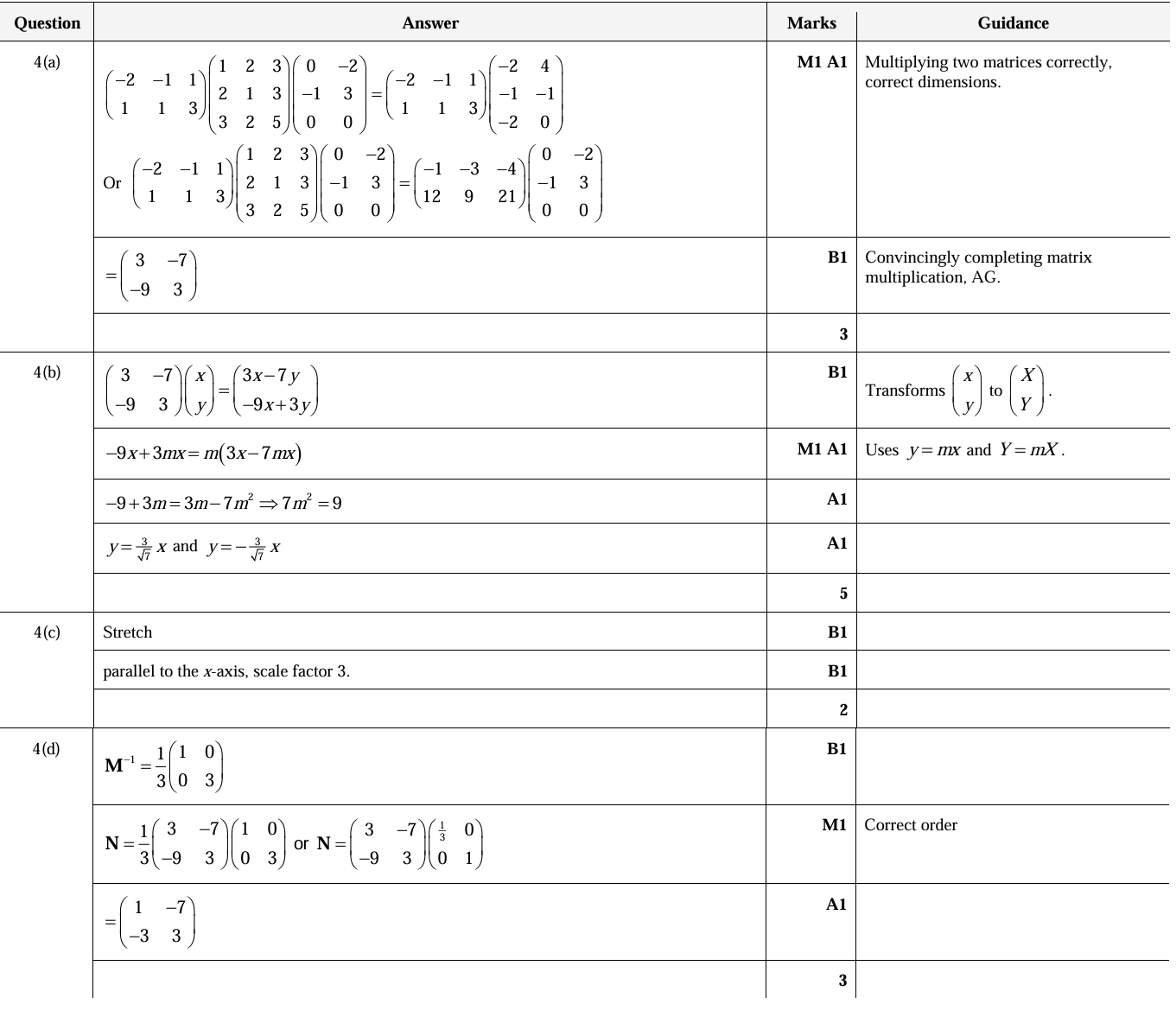
The matrices A, B and C are given by
\(A = \begin{pmatrix} 1 & 2 & 3 \\ 2 & 1 & 3 \\ 3 & 2 & 5 \end{pmatrix}, \ B = \begin{pmatrix} 0 & -2 \\ -1 & 3 \\ 0 & 0 \end{pmatrix} \text{ and } C = \begin{pmatrix} -2 & -1 \\ 1 & 1 \end{pmatrix}.\)
(a) Show that \(CAB = \begin{pmatrix} 3 & -7 \\ -9 & 3 \end{pmatrix}.\) [3]
(b) Find the equations of the invariant lines, through the origin, of the transformation in the \(x-y\) plane represented by \(CAB.\) [5]
Let \(M = \begin{pmatrix} 3 & 0 \\ 0 & 1 \end{pmatrix}.\)
(c) Give full details of the transformation represented by \(M.\) [2]
(d) Find the matrix \(N\) such that \(NM = CAB.\) [3]
9231 P13 - Nov 2024 - Q01 - 10 marks
The matrix M represents the sequence of two transformations in the x-y plane given by a stretch parallel to the x-axis, scale factor k (k \neq 0), followed by a shear, x-axis fixed, with (0, 1) mapped to (k, 1).
(a) Show that M = \(\begin{pmatrix} k & k \\ 0 & 1 \end{pmatrix}\).
\((b) The transformation represented by M has a line of invariant points. Find, in terms of k, the equation of this line.\)
The unit square S in the x-y plane is transformed by M onto the parallelogram P.
(c) Find, in terms of k, a matrix which transforms P onto S.
(d) Given that the area of P is \(3k^2\) units\(^2\), find the possible values of k.