Past Exam Questions
← Back9709 P33 - Jun 2011 - Q6
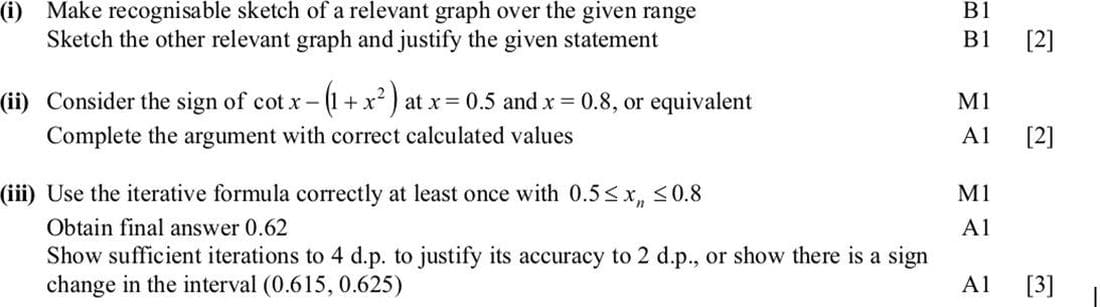
(i) By sketching a suitable pair of graphs, show that the equation \(\cot x = 1 + x^2\), where \(x\) is in radians, has only one root in the interval \(0 < x < \frac{1}{2}\pi\).
(ii) Verify by calculation that this root lies between 0.5 and 0.8.
(iii) Use the iterative formula \(x_{n+1} = \arctan\left( \frac{1}{1 + x_n^2} \right)\) to determine this root correct to 2 decimal places. Give the result of each iteration to 4 decimal places.
9709 P31 - Nov 2023 - Q8
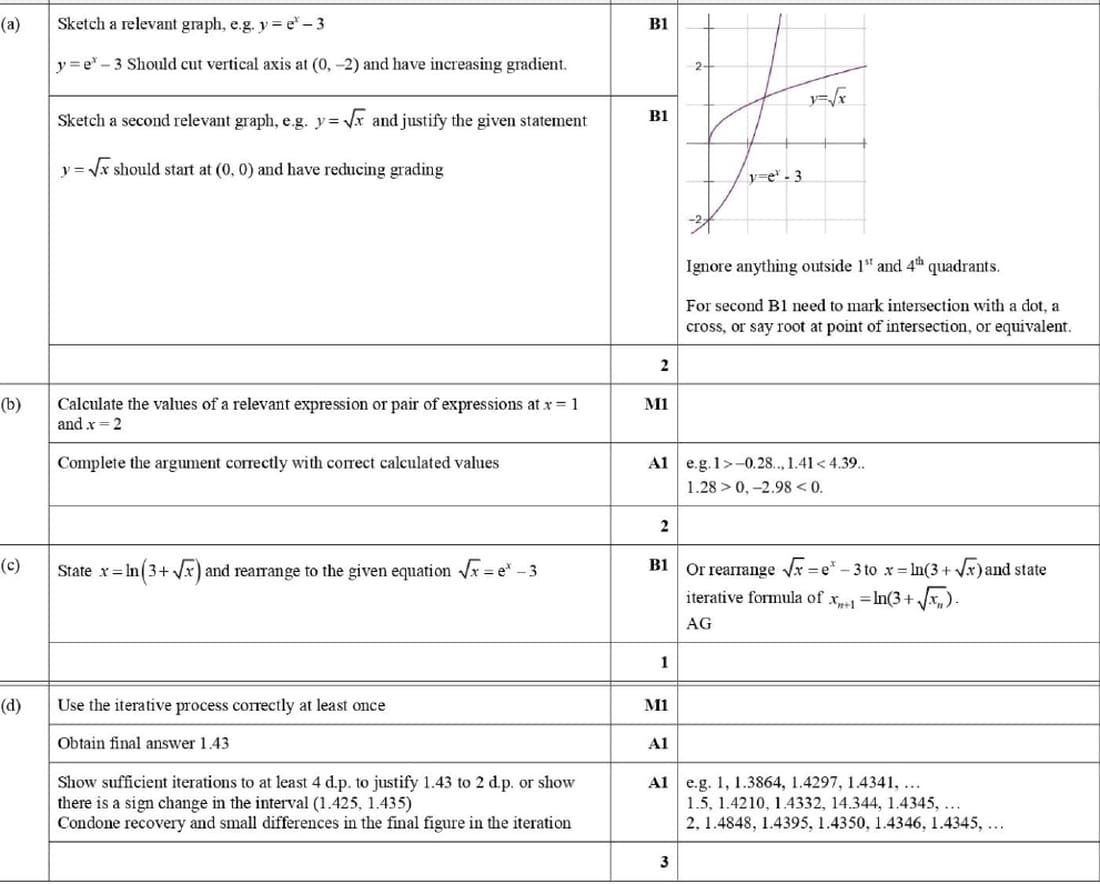
(a) By sketching a suitable pair of graphs, show that the equation \(\sqrt{x} = e^x - 3\) has only one root.
(b) Show by calculation that this root lies between 1 and 2.
(c) Show that, if a sequence of values given by the iterative formula \(x_{n+1} = \ln(3 + \sqrt{x_n})\) converges, then it converges to the root of the equation in (a).
(d) Use the iterative formula to calculate the root correct to 2 decimal places. Give the result of each iteration to 4 decimal places.
9709 P31 - Nov 2010 - Q4
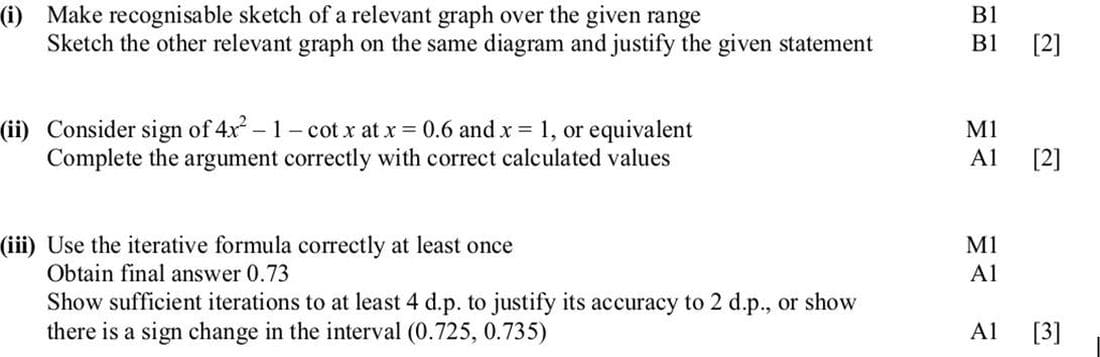
(i) By sketching suitable graphs, show that the equation \(4x^2 - 1 = \cot x\) has only one root in the interval \(0 < x < \frac{1}{2}\pi\).
(ii) Verify by calculation that this root lies between 0.6 and 1.
(iii) Use the iterative formula \(x_{n+1} = \frac{1}{2}\sqrt{1 + \cot x_n}\) to determine the root correct to 2 decimal places. Give the result of each iteration to 4 decimal places.
9709 P3 - Nov 2008 - Q9
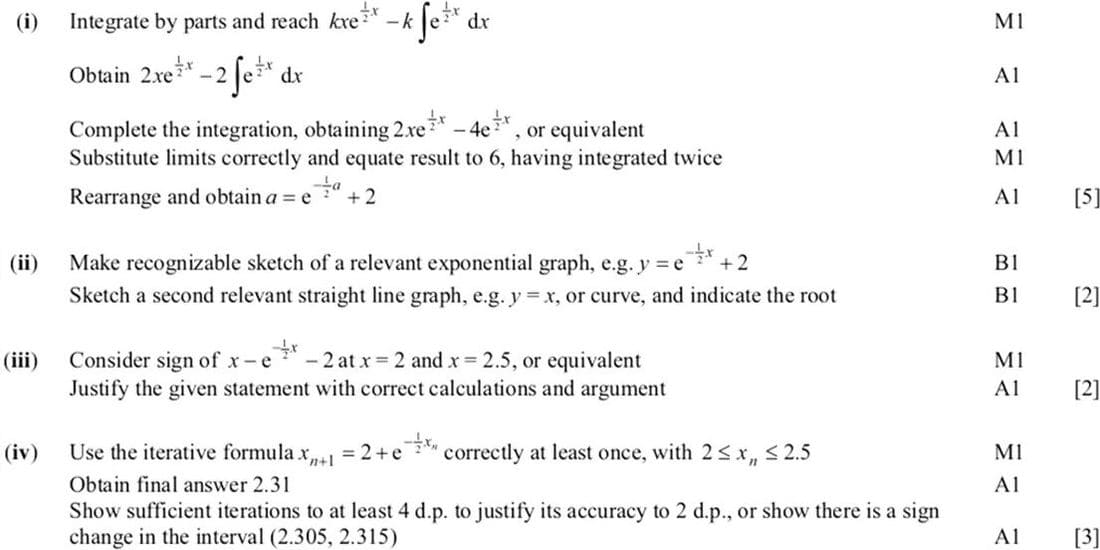
The constant a is such that \(\int_{0}^{a} xe^{\frac{1}{2}x} \, dx = 6\).
(i) Show that a satisfies the equation \(x = 2 + e^{-\frac{1}{2}x}\).
(ii) By sketching a suitable pair of graphs, show that this equation has only one root.
(iii) Verify by calculation that this root lies between 2 and 2.5.
(iv) Use an iterative formula based on the equation in part (i) to calculate the value of a correct to 2 decimal places. Give the result of each iteration to 4 decimal places.
9709 P3 - Nov 2007 - Q6
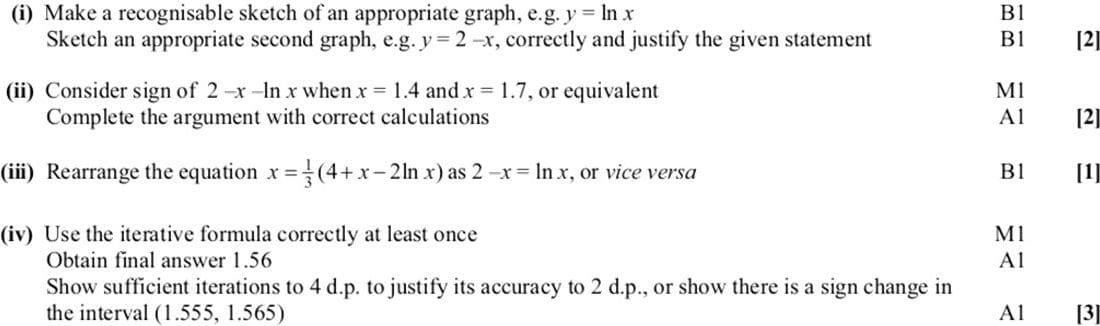
(i) By sketching a suitable pair of graphs, show that the equation \(2 - x = \ln x\) has only one root.
(ii) Verify by calculation that this root lies between 1.4 and 1.7.
(iii) Show that this root also satisfies the equation \(x = \frac{1}{3}(4 + x - 2 \ln x)\).
(iv) Use the iterative formula \(x_{n+1} = \frac{1}{3}(4 + x_n - 2 \ln x_n)\), with initial value \(x_1 = 1.5\), to determine this root correct to 2 decimal places. Give the result of each iteration to 4 decimal places.
9709 P3 - Jun 2006 - Q6
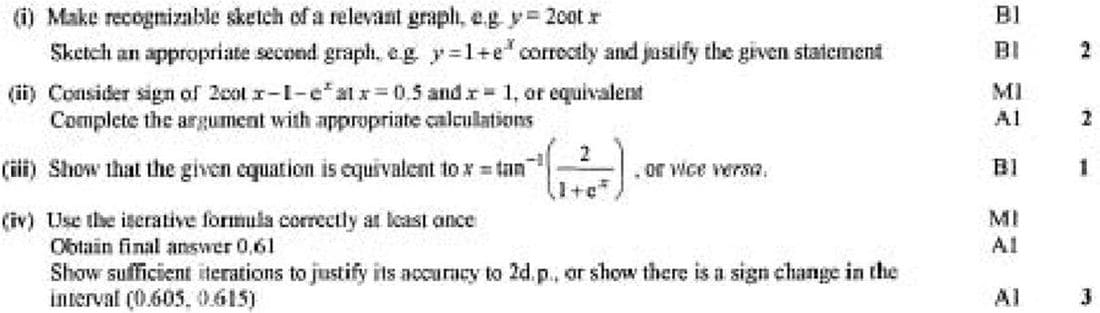
(i) By sketching a suitable pair of graphs, show that the equation \(2 \cot x = 1 + e^x\), where \(x\) is in radians, has only one root in the interval \(0 < x < \frac{1}{2} \pi\).
(ii) Verify by calculation that this root lies between 0.5 and 1.0.
(iii) Show that this root also satisfies the equation \(x = \arctan\left(\frac{2}{1 + e^x}\right)\).
(iv) Use the iterative formula \(x_{n+1} = \arctan\left(\frac{2}{1 + e^{x_n}}\right)\), with initial value \(x_1 = 0.7\), to determine this root correct to 2 decimal places. Give the result of each iteration to 4 decimal places.
9709 P3 - Jun 2005 - Q7
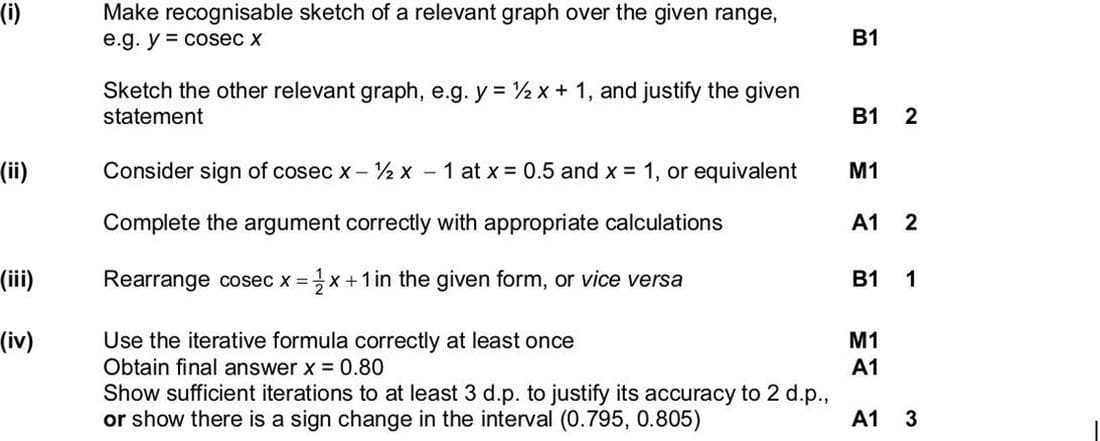
(i) By sketching a suitable pair of graphs, show that the equation \(\csc x = \frac{1}{2}x + 1\), where \(x\) is in radians, has a root in the interval \(0 < x < \frac{1}{2}\pi\).
(ii) Verify, by calculation, that this root lies between 0.5 and 1.
(iii) Show that this root also satisfies the equation \(x = \sin^{-1} \left( \frac{2}{x+2} \right)\).
(iv) Use the iterative formula \(x_{n+1} = \sin^{-1} \left( \frac{2}{x_n+2} \right)\), with initial value \(x_1 = 0.75\), to determine this root correct to 2 decimal places. Give the result of each iteration to 4 decimal places.
9709 P3 - Nov 2004 - Q5
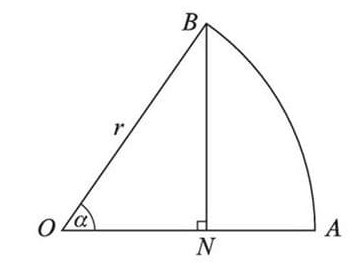
The diagram shows a sector OAB of a circle with centre O and radius r. The angle AOB is \(\alpha\) radians, where \(0 < \alpha < \frac{1}{2}\pi\). The point N on OA is such that BN is perpendicular to OA. The area of the triangle ONB is half the area of the sector OAB.
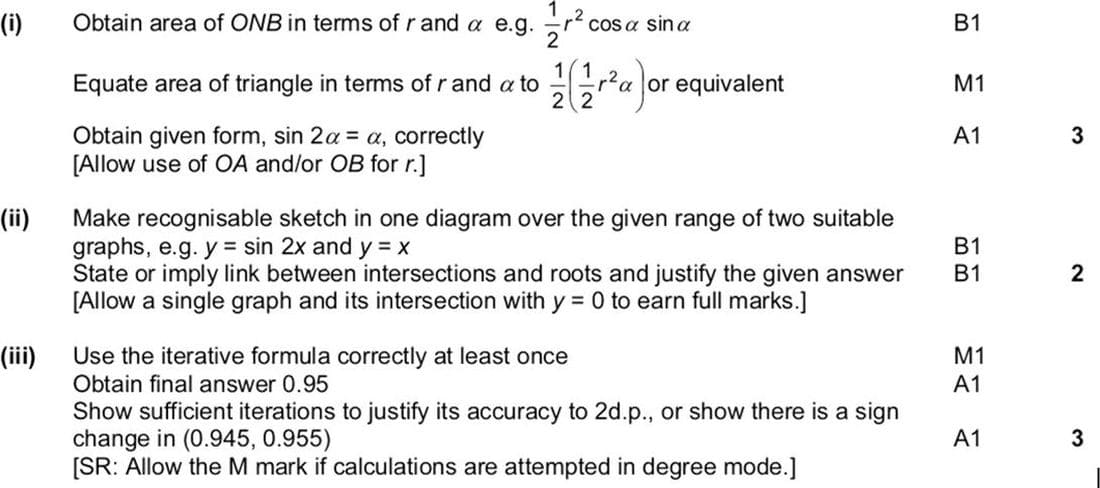
- Show that \(\alpha\) satisfies the equation \(\sin 2x = x\).
- By sketching a suitable pair of graphs, show that this equation has exactly one root in the interval \(0 < x < \frac{1}{2}\pi\).
- Use the iterative formula \(x_{n+1} = \sin(2x_n)\), with initial value \(x_1 = 1\), to find \(\alpha\) correct to 2 decimal places, showing the result of each iteration.
9709 P3 - Nov 2003 - Q5
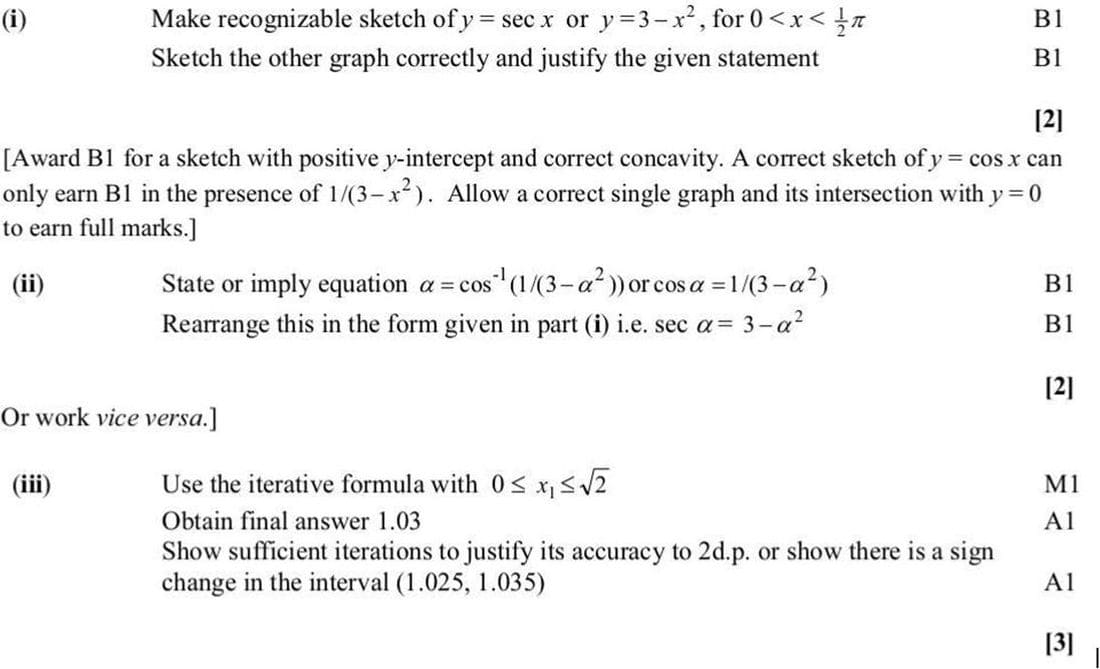
(i) By sketching suitable graphs, show that the equation \(\sec x = 3 - x^2\) has exactly one root in the interval \(0 < x < \frac{1}{2}\pi\).
(ii) Show that, if a sequence of values given by the iterative formula \(x_{n+1} = \cos^{-1} \left( \frac{1}{3-x_n^2} \right)\) converges, then it converges to a root of the equation given in part (i).
(iii) Use this iterative formula, with initial value \(x_1 = 1\), to determine the root in the interval \(0 < x < \frac{1}{2}\pi\) correct to 2 decimal places, showing the result of each iteration.
9709 P32 - Jun 2022 - Q5
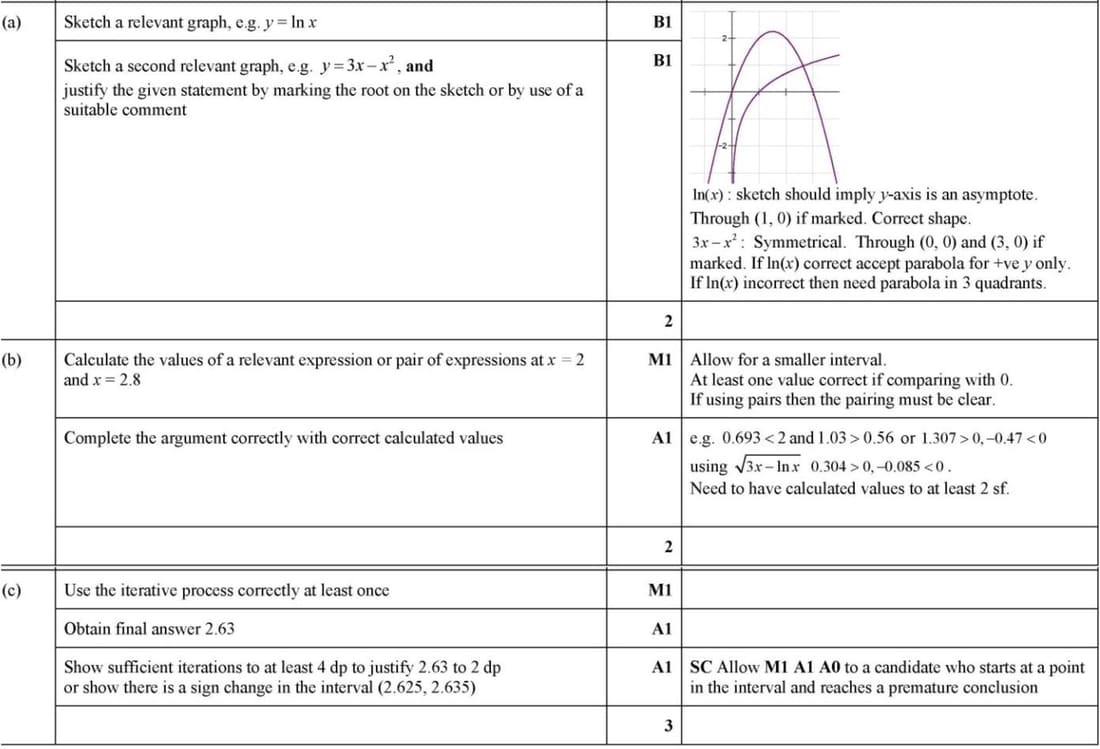
(a) By sketching a suitable pair of graphs, show that the equation \(\ln x = 3x - x^2\) has one real root.
(b) Verify by calculation that the root lies between 2 and 2.8.
(c) Use the iterative formula \(x_{n+1} = \sqrt{3x_n - \ln x_n}\) to determine the root correct to 2 decimal places. Give the result of each iteration to 4 decimal places.
9709 P32 - Mar 2022 - Q7
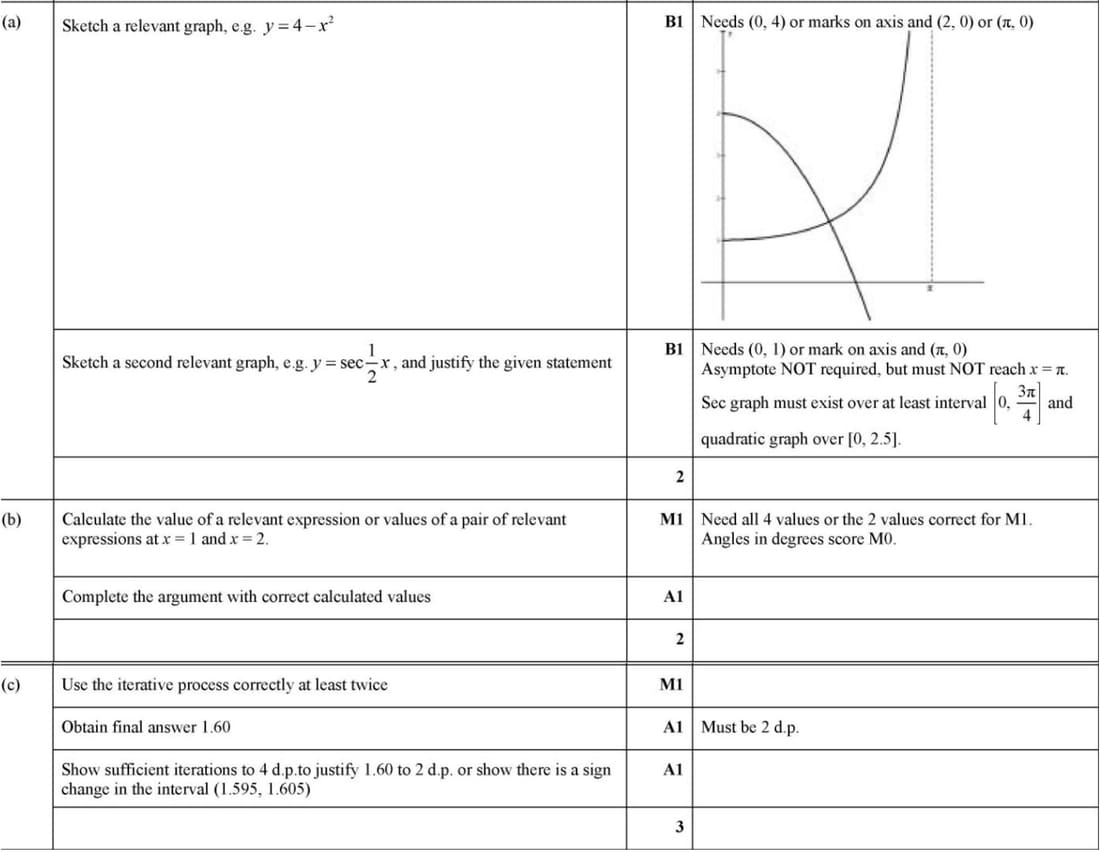
(a) By sketching a suitable pair of graphs, show that the equation \(4 - x^2 = \sec \frac{1}{2}x\) has exactly one root in the interval \(0 \leq x < \pi\).
(b) Verify by calculation that this root lies between 1 and 2.
(c) Use the iterative formula \(x_{n+1} = \sqrt{4 - \sec \frac{1}{2}x_n}\) to determine the root correct to 2 decimal places. Give the result of each iteration to 4 decimal places.
9709 P33 - Jun 2021 - Q6
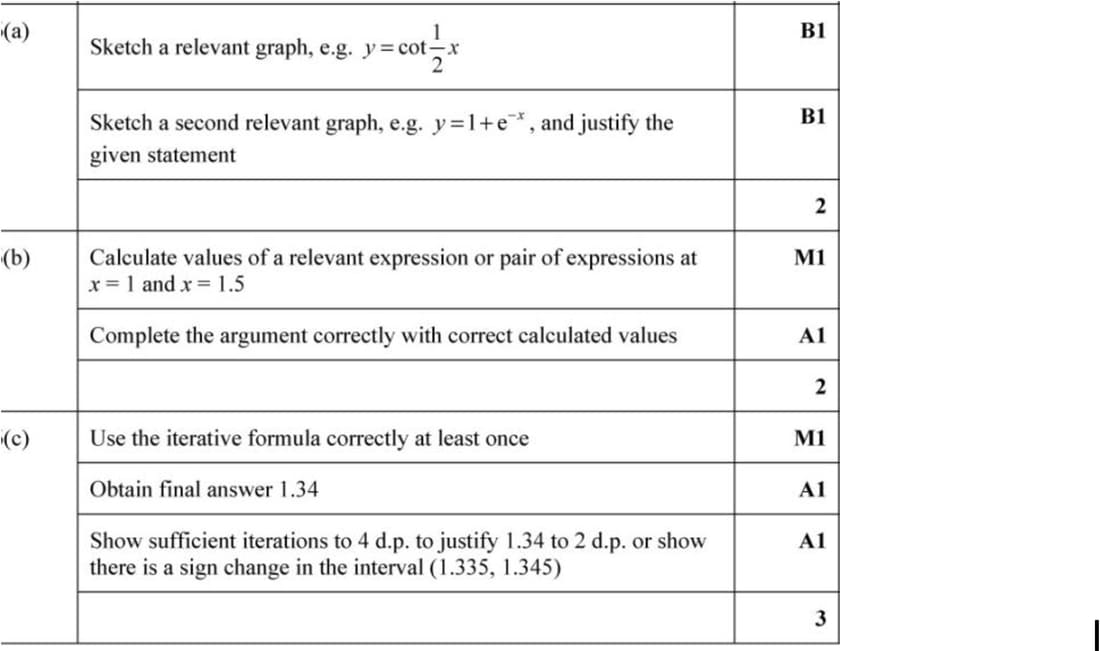
(a) By sketching a suitable pair of graphs, show that the equation \(\cot \frac{1}{2}x = 1 + e^{-x}\) has exactly one root in the interval \(0 < x \leq \pi\).
(b) Verify by calculation that this root lies between 1 and 1.5.
(c) Use the iterative formula \(x_{n+1} = 2 \arctan \left( \frac{1}{1 + e^{-x_n}} \right)\) to determine the root correct to 2 decimal places. Give the result of each iteration to 4 decimal places.
9709 P31 - Nov 2020 - Q5
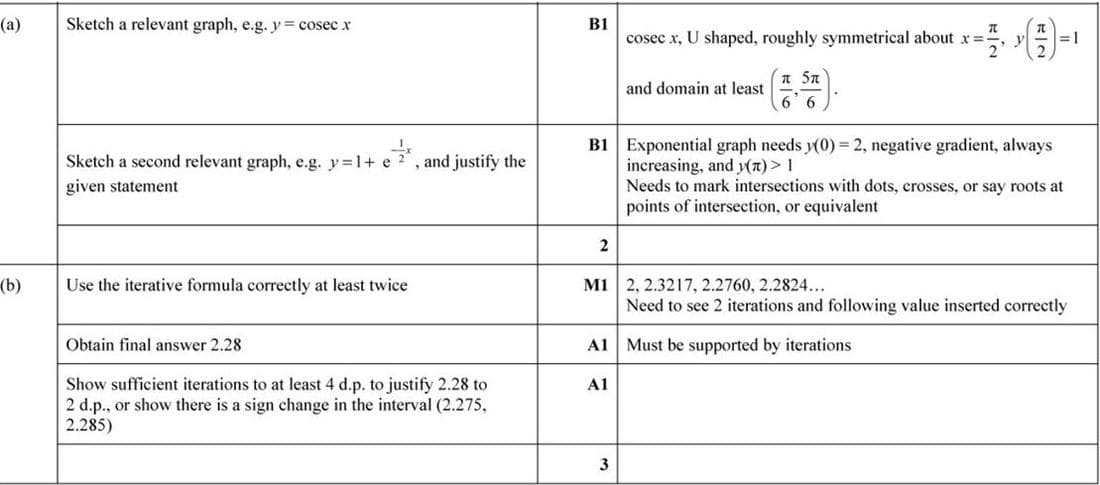
(a) By sketching a suitable pair of graphs, show that the equation \(\csc x = 1 + e^{-\frac{1}{2}x}\) has exactly two roots in the interval \(0 < x < \pi\).
(b) The sequence of values given by the iterative formula \(x_{n+1} = \pi - \sin^{-1}\left( \frac{1}{e^{-\frac{1}{2}x_n} + 1} \right)\), with initial value \(x_1 = 2\), converges to one of these roots. Use the formula to determine this root correct to 2 decimal places. Give the result of each iteration to 4 decimal places.
9709 P33 - Jun 2020 - Q6
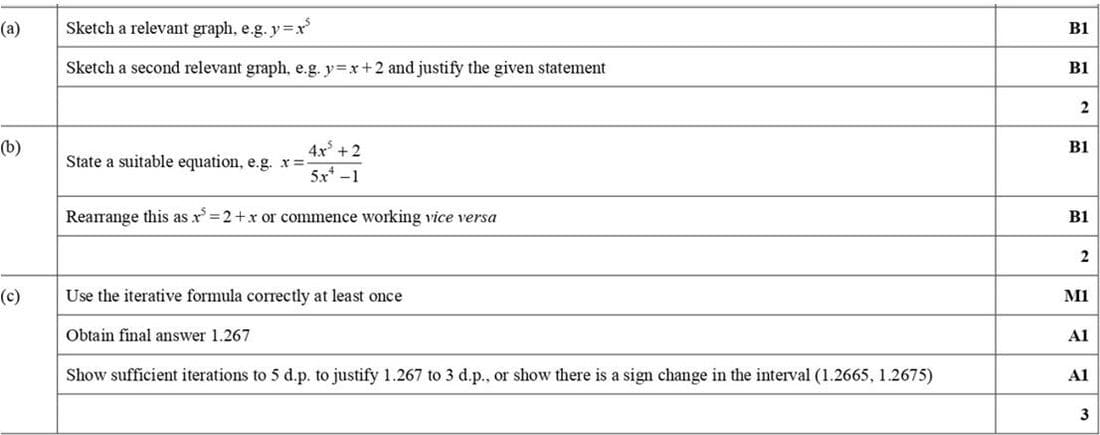
(a) By sketching a suitable pair of graphs, show that the equation \(x^5 = 2 + x\) has exactly one real root.
(b) Show that if a sequence of values given by the iterative formula \(x_{n+1} = \frac{4x_n^5 + 2}{5x_n^4 - 1}\) converges, then it converges to the root of the equation in part (a).
(c) Use the iterative formula with initial value \(x_1 = 1.5\) to calculate the root correct to 3 decimal places. Give the result of each iteration to 5 decimal places.
9709 P32 - Mar 2020 - Q3
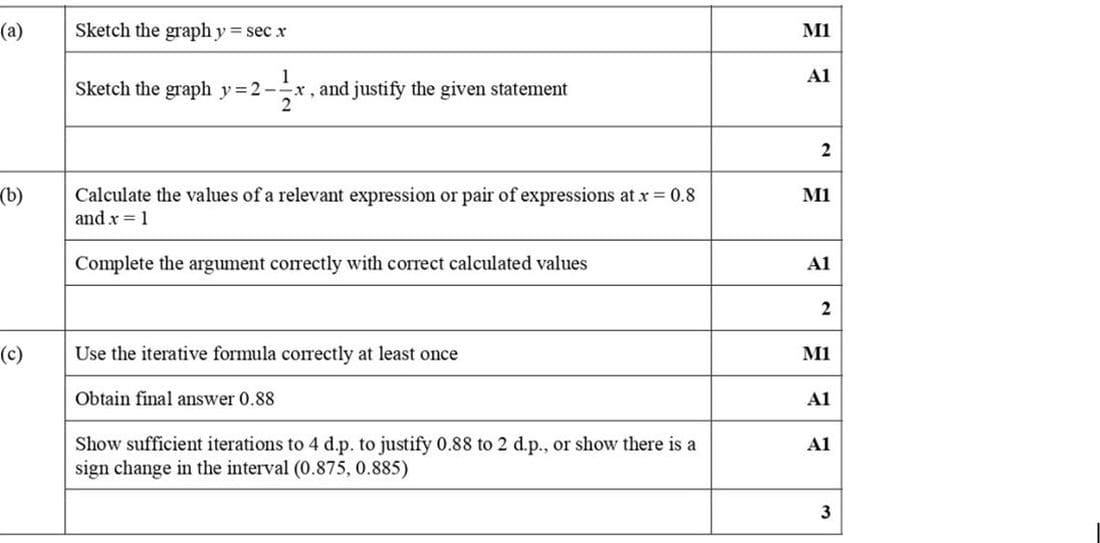
(a) By sketching a suitable pair of graphs, show that the equation \(\sec x = 2 - \frac{1}{2}x\) has exactly one root in the interval \(0 \leq x < \frac{1}{2}\pi\).
(b) Verify by calculation that this root lies between 0.8 and 1.
(c) Use the iterative formula \(x_{n+1} = \cos^{-1}\left(\frac{2}{4-x_n}\right)\) to determine the root correct to 2 decimal places. Give the result of each iteration to 4 decimal places.
9709 P33 - Nov 2019 - Q5
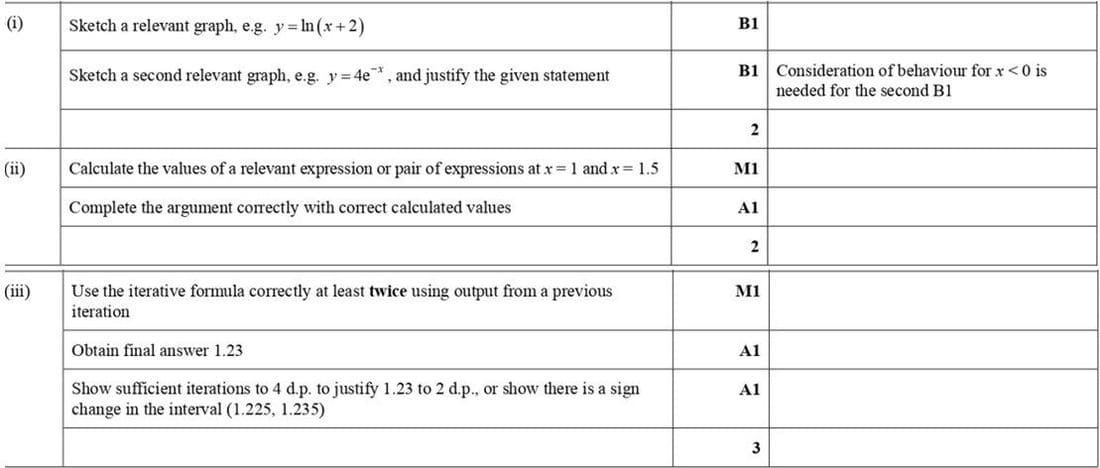
(i) By sketching a suitable pair of graphs, show that the equation \(\ln(x+2) = 4e^{-x}\) has exactly one real root.
(ii) Show by calculation that this root lies between \(x = 1\) and \(x = 1.5\).
(iii) Use the iterative formula \(x_{n+1} = \ln\left( \frac{4}{\ln(x_n + 2)} \right)\) to determine the root correct to 2 decimal places. Give the result of each iteration to 4 decimal places.
9709 P42 - Nov 2023 - Q5
A particle A of mass 0.5 kg is projected vertically upwards from horizontal ground with speed 25 m s-1.
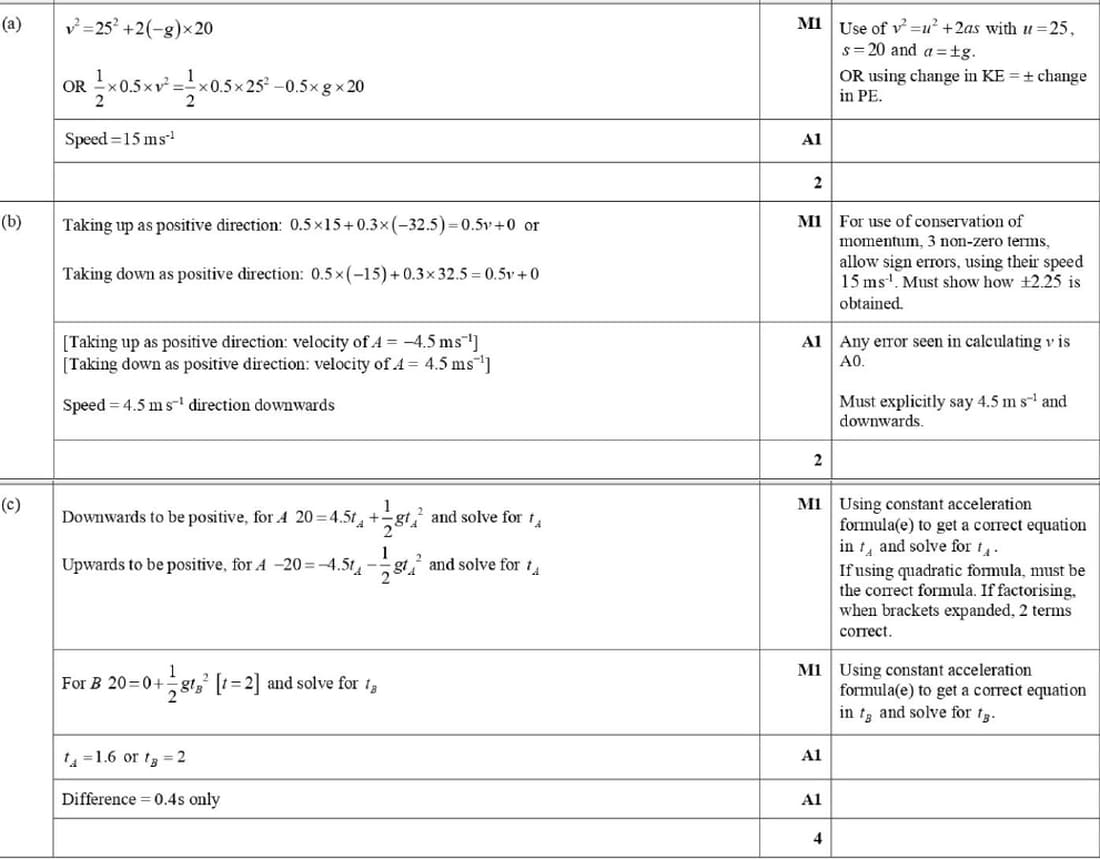
(a) Find the speed of A when it reaches a height of 20 m above the ground.
When A reaches a height of 20 m, it collides with a particle B of mass 0.3 kg which is moving downwards in the same vertical line as A with speed 32.5 m s-1. In the collision between the two particles, B is brought to instantaneous rest.
(b) Show that the velocity of A immediately after the collision is 4.5 m s-1 downwards.
(c) Find the time interval between A and B reaching the ground. You should assume that A does not bounce when it reaches the ground.
9709 P43 - Jun 2022 - Q1
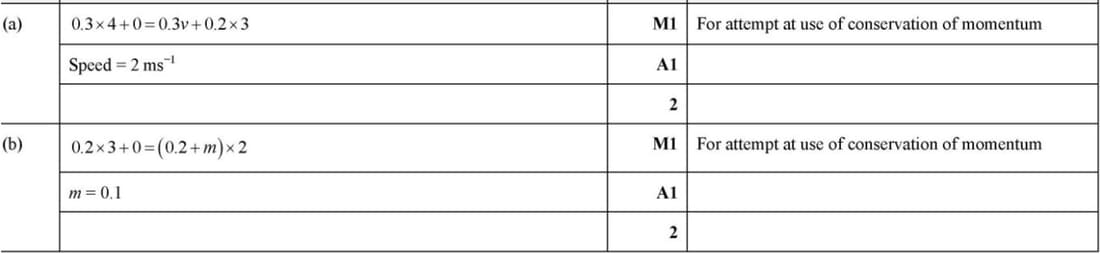
Two particles P and Q, of masses 0.3 kg and 0.2 kg respectively, are at rest on a smooth horizontal plane. P is projected at a speed of 4 m s-1 directly towards Q. After P and Q collide, Q begins to move with a speed of 3 m s-1.
(a) Find the speed of P after the collision.
After the collision, Q moves directly towards a third particle R, of mass m kg, which is at rest on the plane. The two particles Q and R coalesce on impact and move with a speed of 2 m s-1.
(b) Find m.
9709 P42 - Jun 2022 - Q1
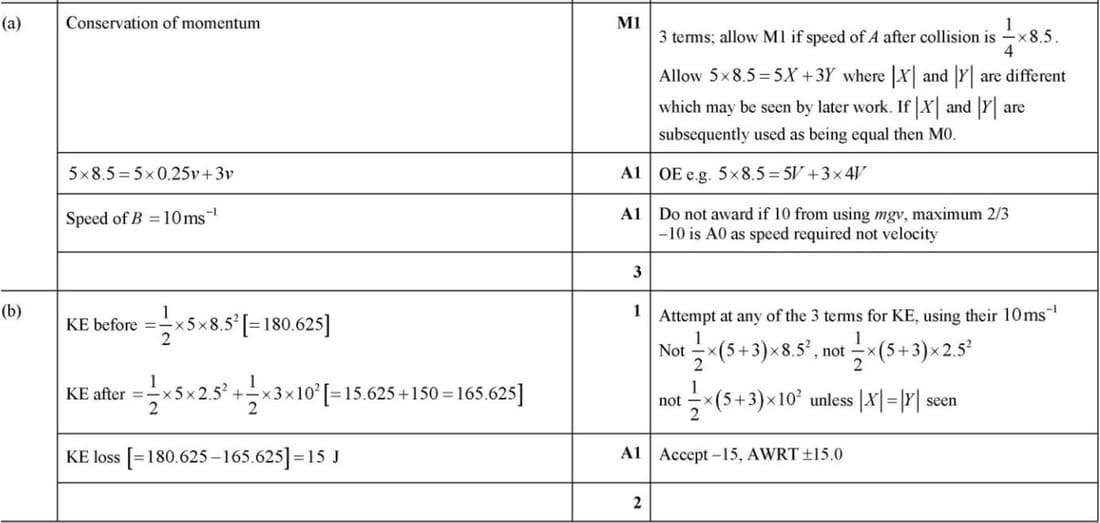
Small smooth spheres A and B, of equal radii and of masses 5 kg and 3 kg respectively, lie on a smooth horizontal plane. Initially B is at rest and A is moving towards B with speed 8.5 m/s. The spheres collide and after the collision A continues to move in the same direction but with a quarter of the speed of B.
(a) Find the speed of B after the collision.
(b) Find the loss of kinetic energy of the system due to the collision.
9709 P41 - Jun 2022 - Q7
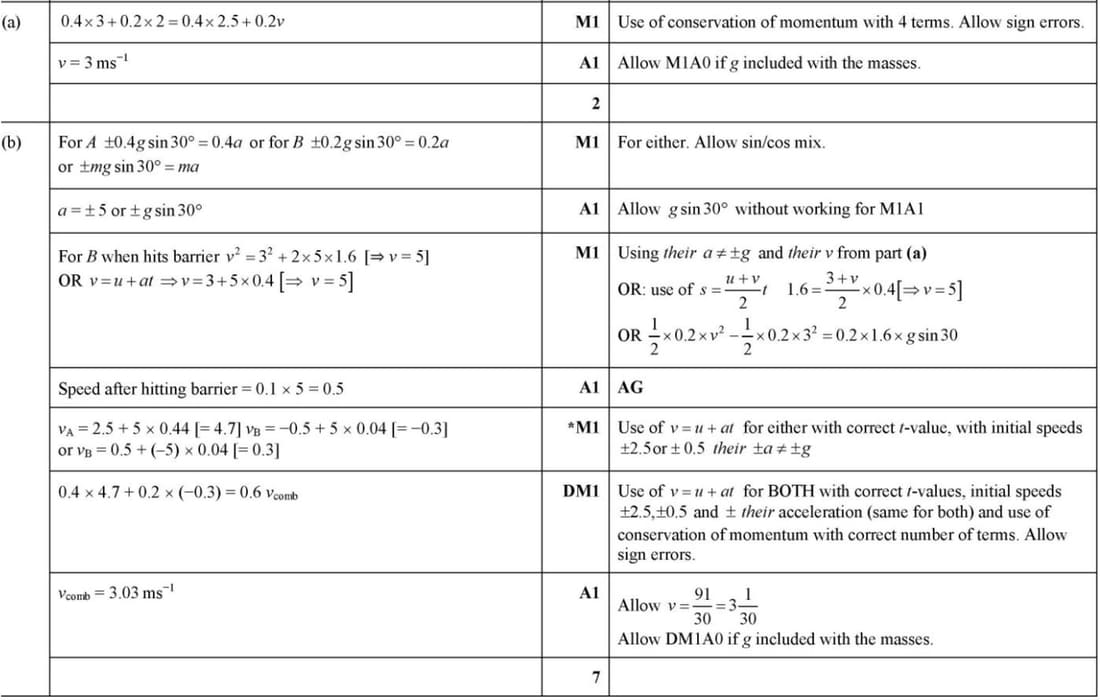
Two particles A and B, of masses 0.4 kg and 0.2 kg respectively, are moving down the same line of greatest slope of a smooth plane. The plane is inclined at 30° to the horizontal, and A is higher up the plane than B. When the particles collide, the speeds of A and B are 3 m/s and 2 m/s respectively. In the collision between the particles, the speed of A is reduced to 2.5 m/s.
(a) Find the speed of B immediately after the collision.
After the collision, when B has moved 1.6 m down the plane from the point of collision, it hits a barrier and returns back up the same line of greatest slope. B hits the barrier 0.4 s after the collision, and when it hits the barrier, its speed is reduced by 90%. The two particles collide again 0.44 s after their previous collision, and they then coalesce on impact.
(b) Show that the speed of B immediately after it hits the barrier is 0.5 m/s-1. Hence find the speed of the combined particle immediately after the second collision between A and B.