9231 P11 - Nov 2023 - Q05 - 15 marks
4182
Let k be a constant. The matrices A, B and C are given by
\(\mathbf{A} = \begin{pmatrix} 1 & k & 3 \\ 2 & 1 & 3 \\ 3 & 2 & 5 \end{pmatrix}, \quad \mathbf{B} = \begin{pmatrix} 0 & -2 \\ -1 & 3 \\ 0 & 0 \end{pmatrix} \quad \text{and} \quad \mathbf{C} = \begin{pmatrix} -2 & -1 & 1 \\ 1 & 1 & 3 \end{pmatrix}.\)
It is given that A is singular.
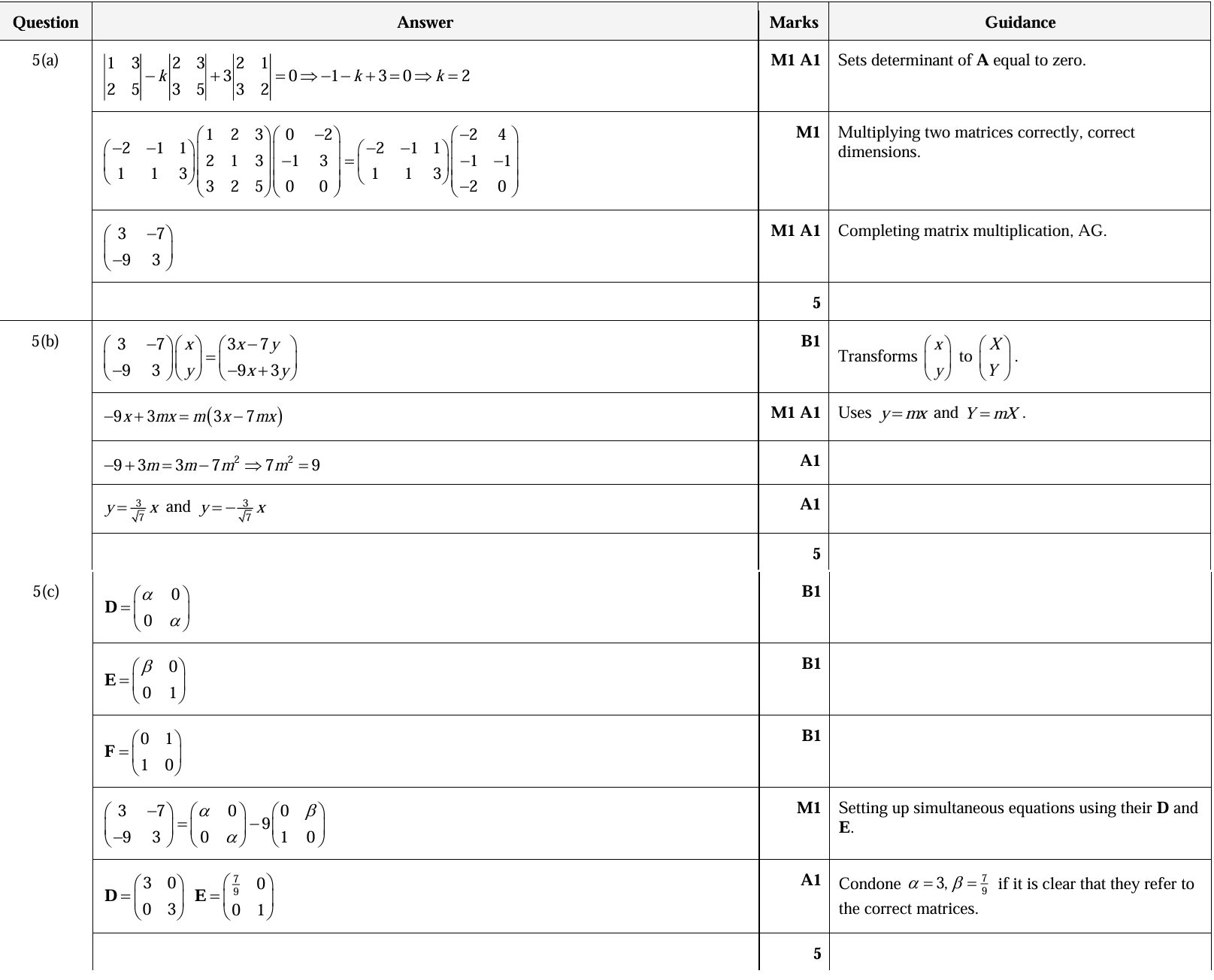
(a) Show that \(\mathbf{CAB} = \begin{pmatrix} 3 & -7 \\ -9 & 3 \end{pmatrix}\).
(b) Find the equations of the invariant lines, through the origin, of the transformation in the x–y plane represented by CAB.
(c) The matrices D, E and F represent geometrical transformations in the x–y plane.
- D represents an enlargement, centre the origin.
- E represents a stretch parallel to the x-axis.
- F represents a reflection in the line y = x.
Given that \(\mathbf{CAB} = \mathbf{D} - 9\mathbf{EF}\), find D, E and F.