Past Exam Questions
← Back9709 P3 - Jun 2007 - Q6
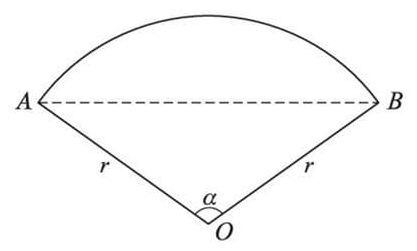
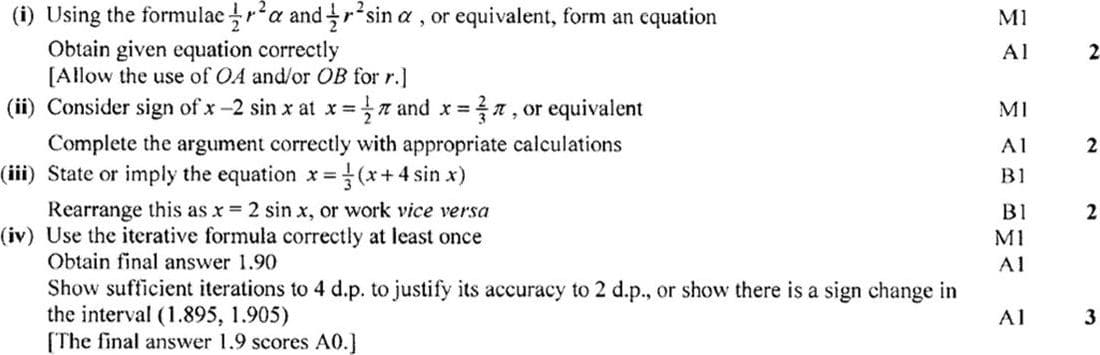
The diagram shows a sector AOB of a circle with centre O and radius r. The angle AOB is \(\alpha\) radians, where \(0 < \alpha < \pi\). The area of triangle AOB is half the area of the sector.
- Show that \(\alpha\) satisfies the equation \(x = 2 \sin x\).
- Verify by calculation that \(\alpha\) lies between \(\frac{1}{2} \pi\) and \(\frac{2}{3} \pi\).
- Show that, if a sequence of values given by the iterative formula \(x_{n+1} = \frac{1}{3}(x_n + 4 \sin x_n)\) converges, then it converges to a root of the equation in part (i).
- Use this iterative formula, with initial value \(x_1 = 1.8\), to find \(\alpha\) correct to 2 decimal places. Give the result of each iteration to 4 decimal places.
9709 P3 - Nov 2002 - Q7
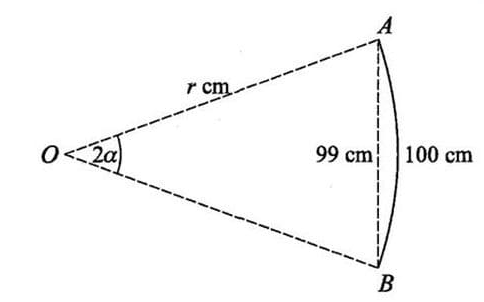
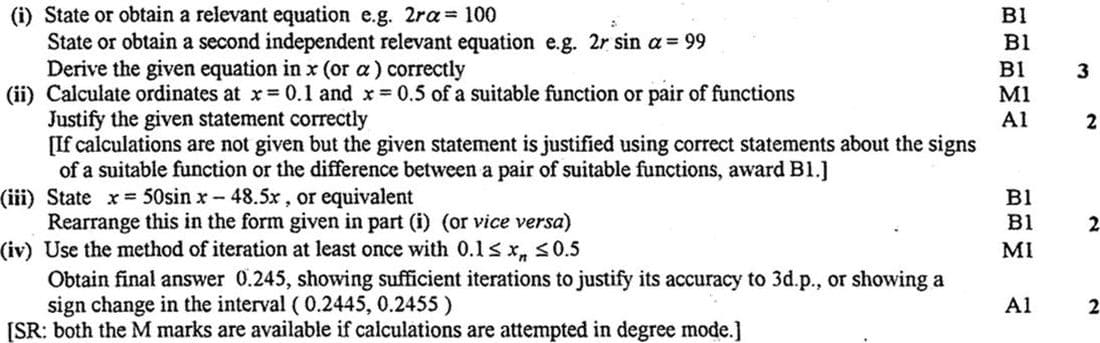
The diagram shows a curved rod AB of length 100 cm which forms an arc of a circle. The end points A and B of the rod are 99 cm apart. The circle has radius r cm and the arc AB subtends an angle of 2α radians at O, the centre of the circle.
(i) Show that α satisfies the equation \(\frac{99}{100}x = \sin x\).
(ii) Given that this equation has exactly one root in the interval \(0 < x < \frac{1}{2} \pi\), verify by calculation that this root lies between 0.1 and 0.5.
(iii) Show that if the sequence of values given by the iterative formula \(x_{n+1} = 50 \sin x_n - 48.5 x_n\) converges, then it converges to a root of the equation in part (i).
(iv) Use this iterative formula, with initial value \(x_1 = 0.25\), to find α correct to 3 decimal places, showing the result of each iteration.
9709 P32 - Nov 2022 - Q9
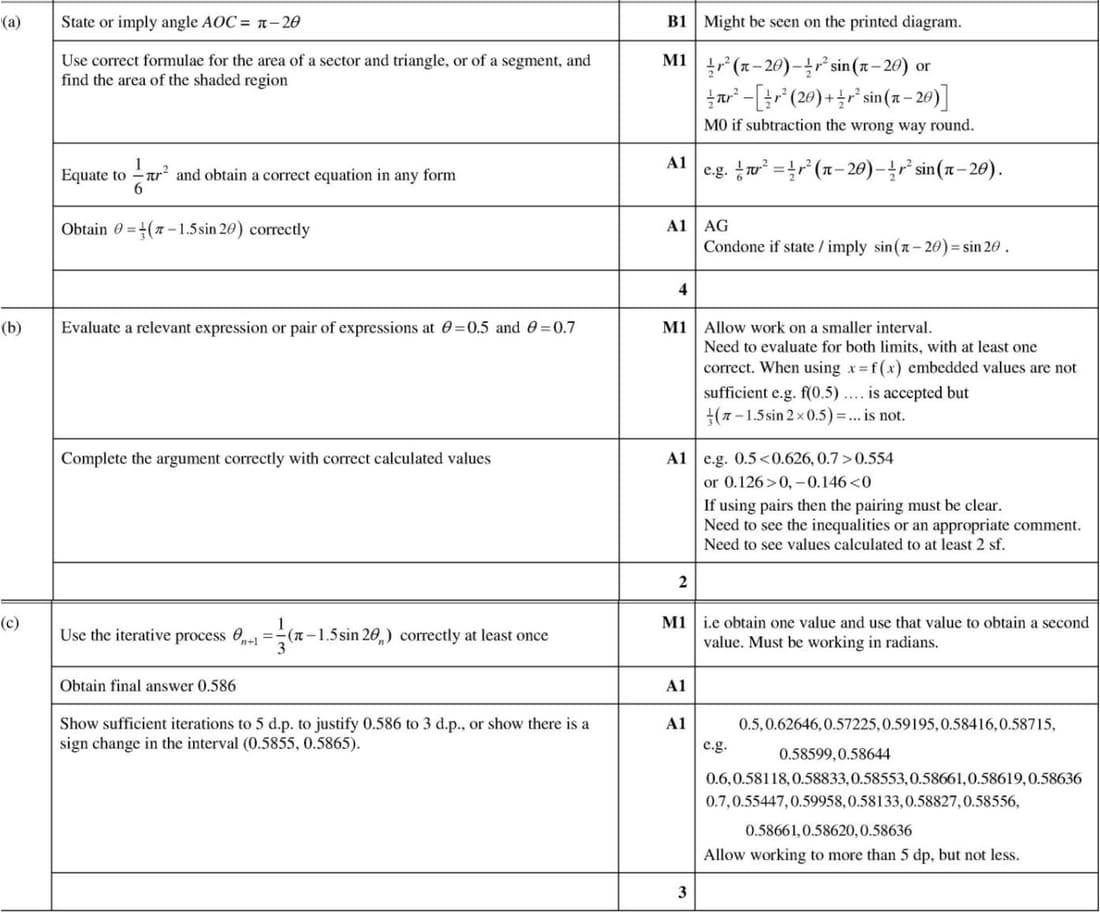
The diagram shows a semicircle with diameter \(AB\), centre \(O\) and radius \(r\). The shaded region is the minor segment on the chord \(AC\) and its area is one third of the area of the semicircle. The angle \(CAB\) is \(\theta\) radians.
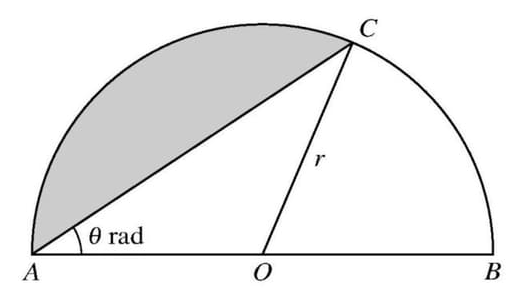
(a) Show that \(\theta = \frac{1}{3}(\pi - 1.5 \sin 2\theta)\).
(b) Verify by calculation that \(0.5 < \theta < 0.7\).
(c) Use an iterative formula based on the equation in part (a) to determine \(\theta\) correct to 3 decimal places. Give the result of each iteration to 5 decimal places.
9709 P32 - Jun 2021 - Q10
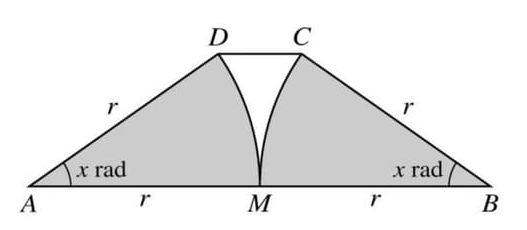
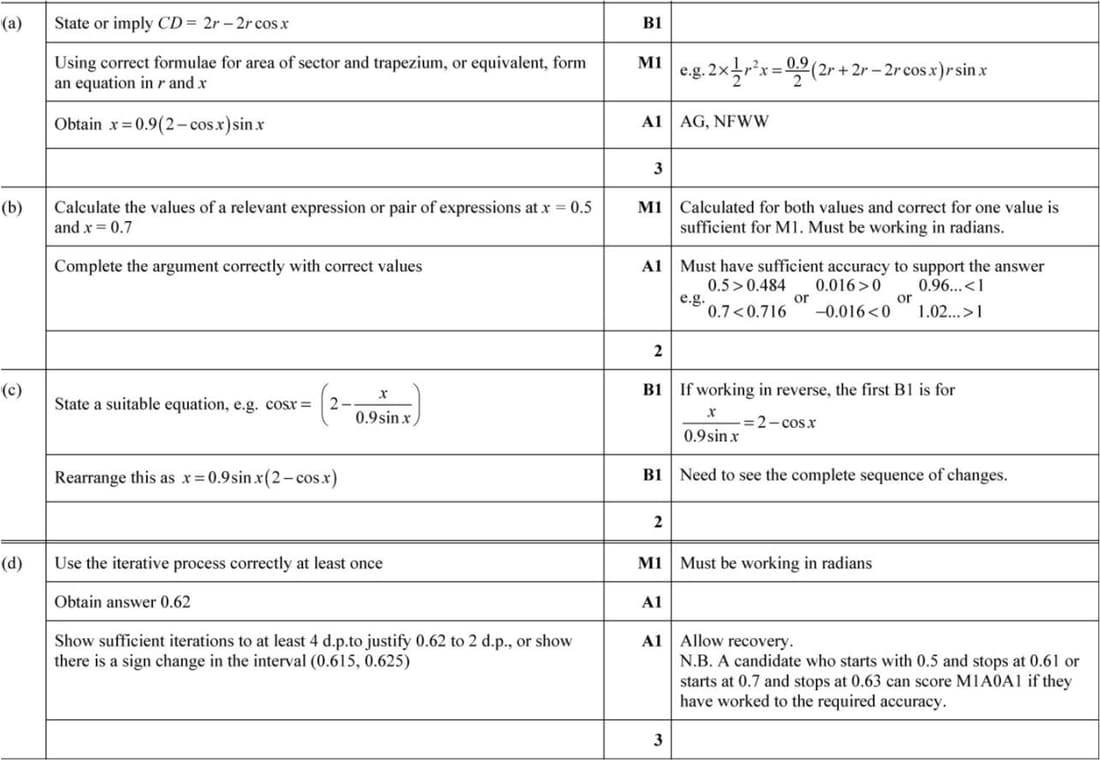
The diagram shows a trapezium ABCD in which AD = BC = r and AB = 2r. The acute angles BAD and ABC are both equal to x radians. Circular arcs of radius r with centres A and B meet at M, the midpoint of AB.
(a) Given that the sum of the areas of the shaded sectors is 90% of the area of the trapezium, show that x satisfies the equation x = 0.9(2 - \cos x) \sin x.
(b) Verify by calculation that x lies between 0.5 and 0.7.
(c) Show that if a sequence of values in the interval 0 < x < \frac{1}{2}\pi given by the iterative formula \(x_{n+1} = \cos^{-1} \left( \frac{2 - x_n}{0.9 \sin x_n} \right)\) converges, then it converges to the root of the equation in part (a).
(d) Use this iterative formula to determine x correct to 2 decimal places. Give the result of each iteration to 4 decimal places.
9709 P31 - Jun 2020 - Q6
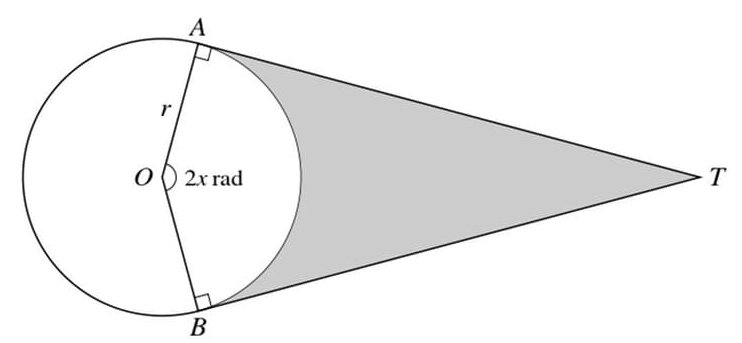
The diagram shows a circle with centre O and radius r. The tangents to the circle at the points A and B meet at T, and angle AOB is 2x radians. The shaded region is bounded by the tangents AT and BT, and by the minor arc AB. The area of the shaded region is equal to the area of the circle.
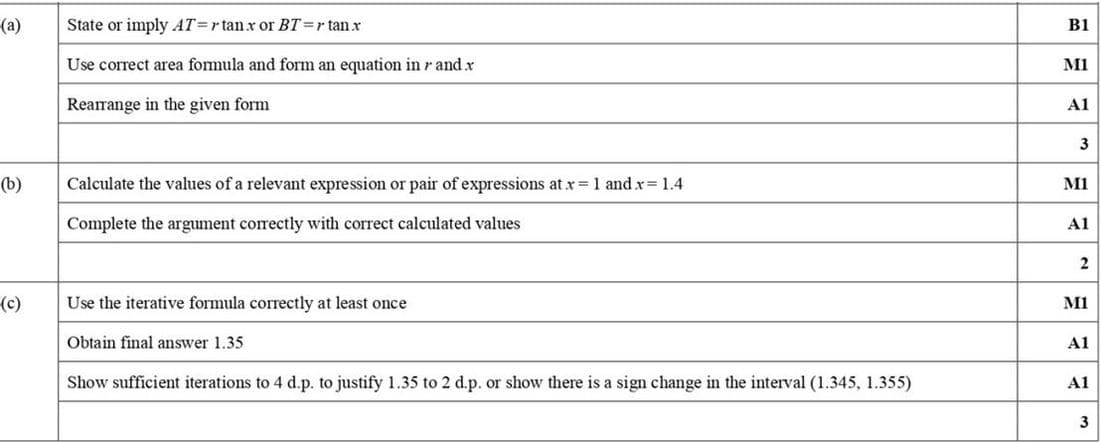
(a) Show that x satisfies the equation \(\tan x = \pi + x\).
(b) This equation has one root in the interval \(0 < x < \frac{1}{2}\pi\). Verify by calculation that this root lies between 1 and 1.4.
(c) Use the iterative formula \(x_{n+1} = \arctan(\pi + x_n)\) to determine the root correct to 2 decimal places. Give the result of each iteration to 4 decimal places.
9709 P32 - Jun 2019 - Q6
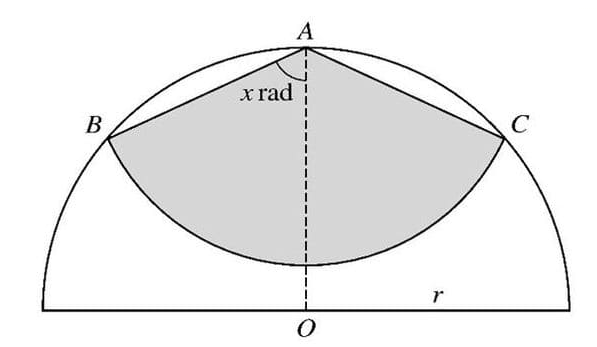
In the diagram, A is the mid-point of the semicircle with centre O and radius r. A circular arc with centre A meets the semicircle at B and C. The angle OAB is equal to x radians. The area of the shaded region bounded by AB, AC and the arc with centre A is equal to half the area of the semicircle.
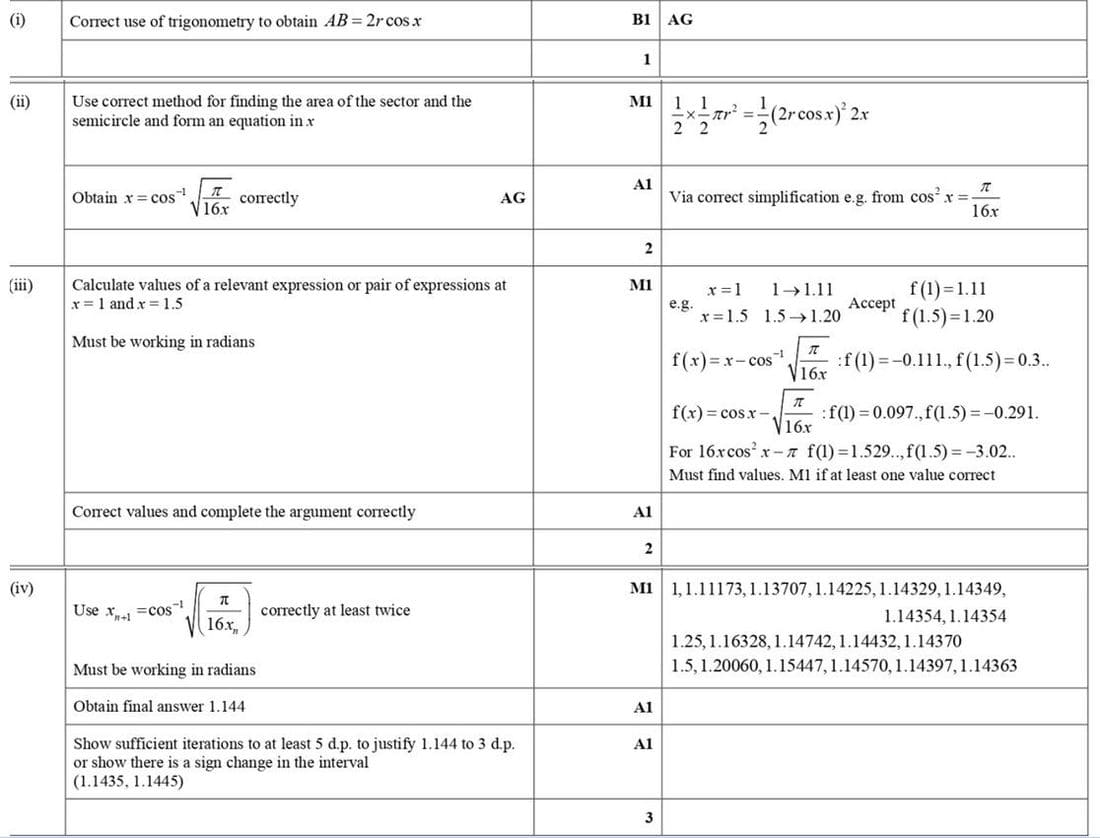
- Use triangle OAB to show that AB = 2r \cos x. [1]
- Hence show that x = \cos^{-1}\left(\sqrt{\frac{\pi}{16x}}\right). [2]
- Verify by calculation that x lies between 1 and 1.5. [2]
- Use an iterative formula based on the equation in part (ii) to determine x correct to 3 decimal places. Give the result of each iteration to 5 decimal places. [3]
Question #1875
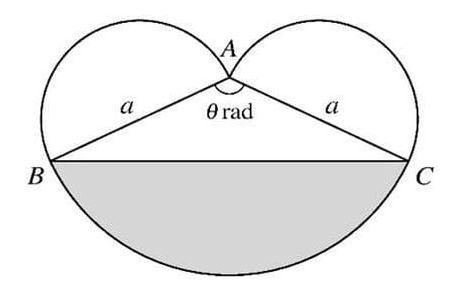
The diagram shows a triangle ABC in which AB = AC = a and angle BAC = \theta radians. Semicircles are drawn outside the triangle with AB and AC as diameters. A circular arc with centre A joins B and C. The area of the shaded segment is equal to the sum of the areas of the semicircles.
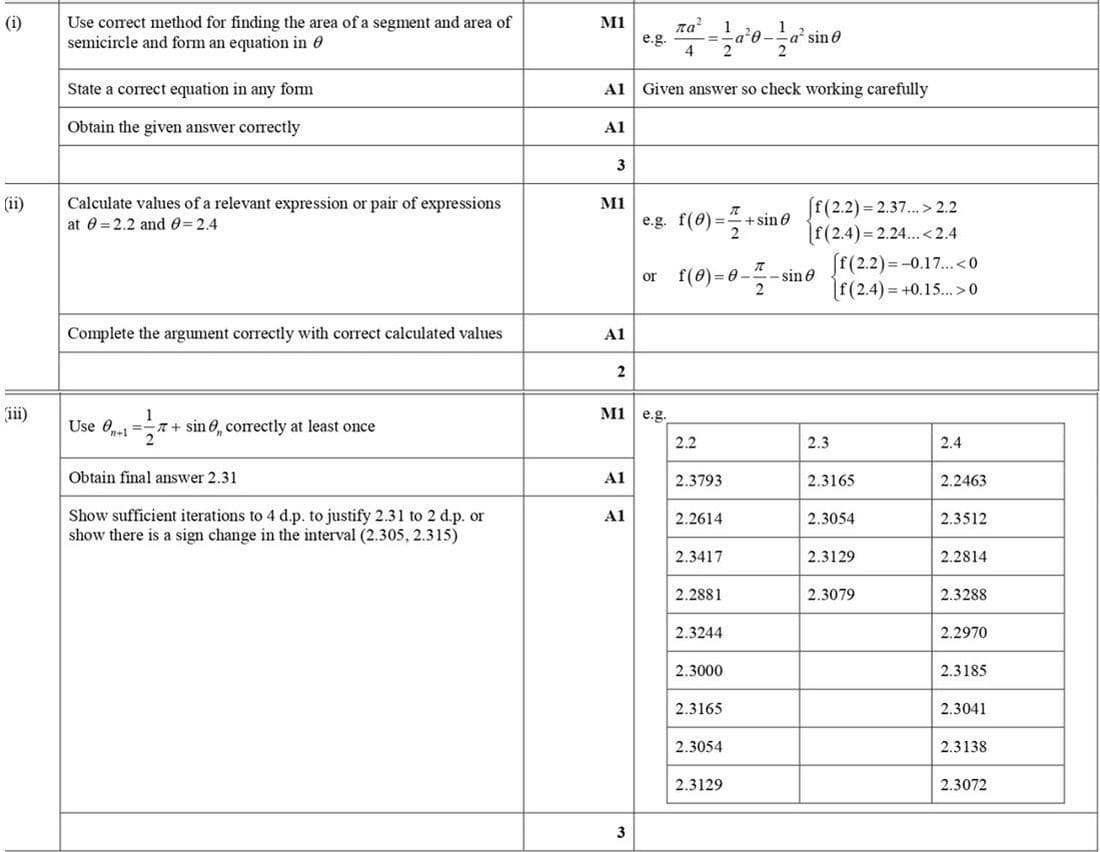
- Show that \(\theta = \frac{1}{2}\pi + \sin \theta\).
- Verify by calculation that \(\theta\) lies between 2.2 and 2.4.
- Use an iterative formula based on the equation in part (i) to determine \(\theta\) correct to 2 decimal places. Give the result of each iteration to 4 decimal places.
9709 P31 - Jun 2017 - Q5
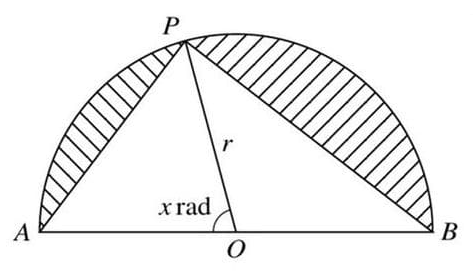
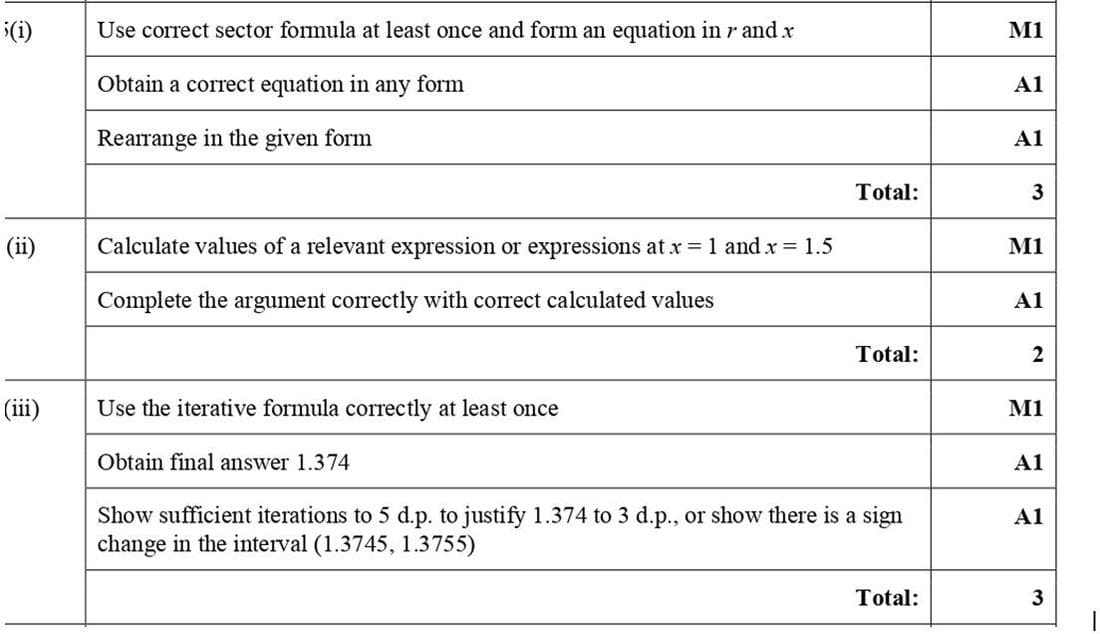
The diagram shows a semicircle with centre O, radius r and diameter AB. The point P on its circumference is such that the area of the minor segment on AP is equal to half the area of the minor segment on BP. The angle AOP is x radians.
- Show that x satisfies the equation x = \frac{1}{3}(\pi + \sin x).
- Verify by calculation that x lies between 1 and 1.5.
- Use an iterative formula based on the equation in part (i) to determine x correct to 3 decimal places. Give the result of each iteration to 5 decimal places.
9709 P32 - Jun 2015 - Q5
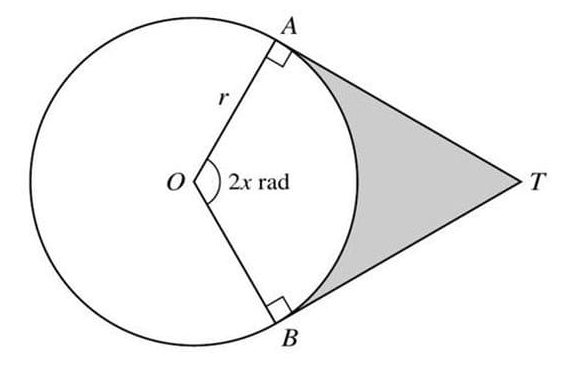
The diagram shows a circle with centre O and radius r. The tangents to the circle at the points A and B meet at T, and the angle AOB is 2x radians. The shaded region is bounded by the tangents AT and BT, and by the minor arc AB. The perimeter of the shaded region is equal to the circumference of the circle.
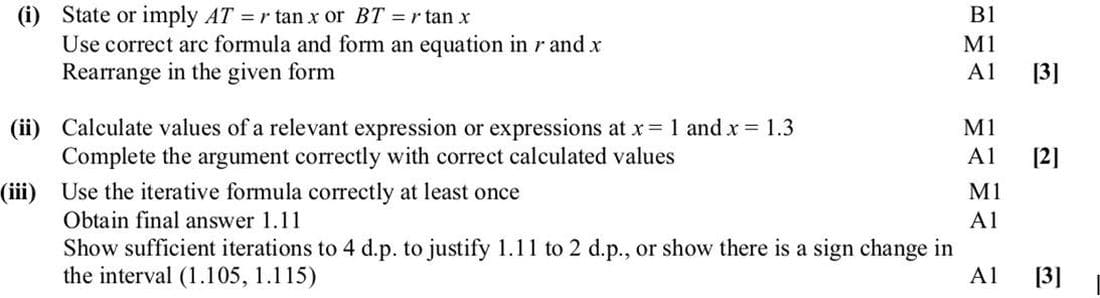
(i) Show that x satisfies the equation \(\tan x = \pi - x\).
(ii) This equation has one root in the interval \(0 < x < \frac{1}{2}\pi\). Verify by calculation that this root lies between 1 and 1.3.
(iii) Use the iterative formula \(x_{n+1} = \arctan(\pi - x_n)\) to determine the root correct to 2 decimal places. Give the result of each iteration to 4 decimal places.
9709 P32 - Jun 2014 - Q6
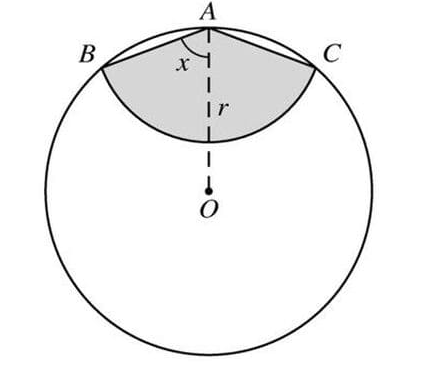
In the diagram, A is a point on the circumference of a circle with centre O and radius r. A circular arc with centre A meets the circumference at B and C. The angle OAB is equal to x radians. The shaded region is bounded by AB, AC and the circular arc with centre A joining B and C. The perimeter of the shaded region is equal to half the circumference of the circle.
- Show that \(x = \cos^{-1} \left( \frac{\pi}{4 + 4x} \right)\).
- Verify by calculation that x lies between 1 and 1.5.
- Use the iterative formula \(x_{n+1} = \cos^{-1} \left( \frac{\pi}{4 + 4x_n} \right)\) to determine the value of x correct to 2 decimal places. Give the result of each iteration to 4 decimal places.
9709 P32 - Nov 2023 - Q6
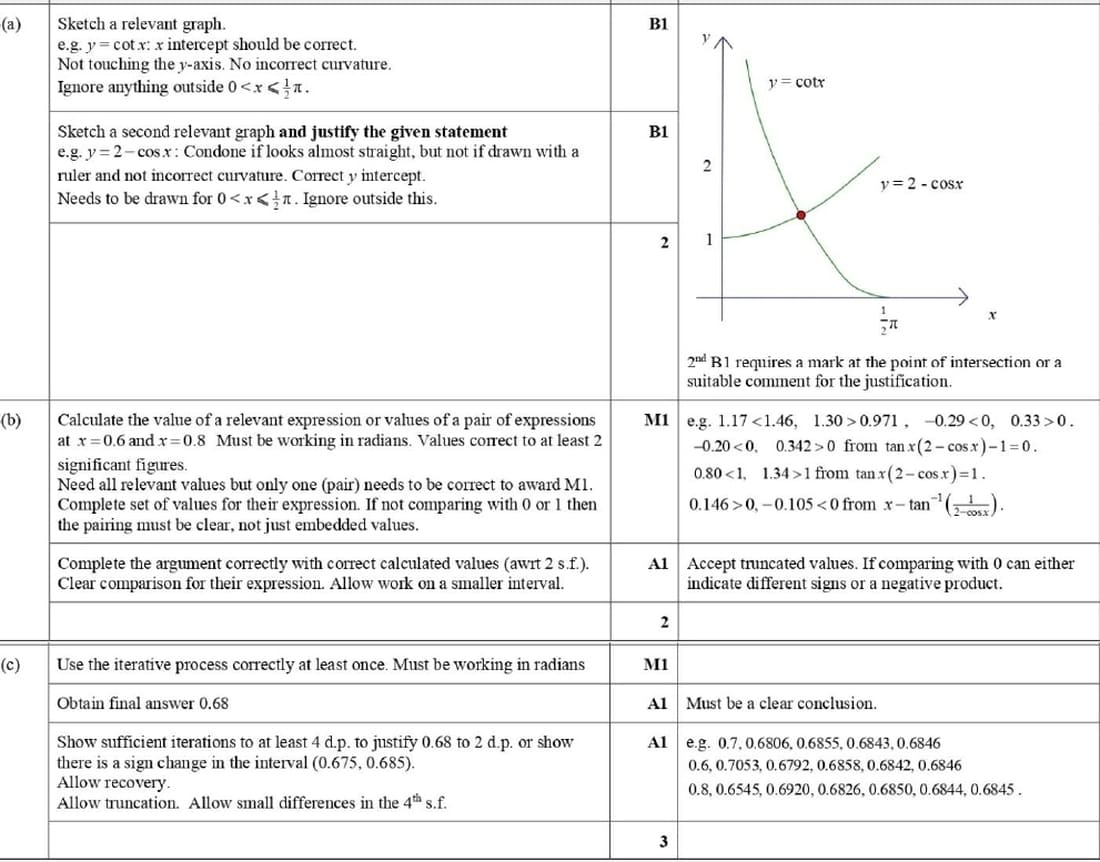
(a) By sketching a suitable pair of graphs, show that the equation \(\cot x = 2 - \cos x\) has one root in the interval \(0 < x \leq \frac{1}{2}\pi\).
(b) Show by calculation that this root lies between 0.6 and 0.8.
(c) Use the iterative formula \(x_{n+1} = \arctan\left( \frac{1}{2 - \cos x_n} \right)\) to determine the root correct to 2 decimal places. Give the result of each iteration to 4 decimal places.
9709 P31 - Nov 2018 - Q3
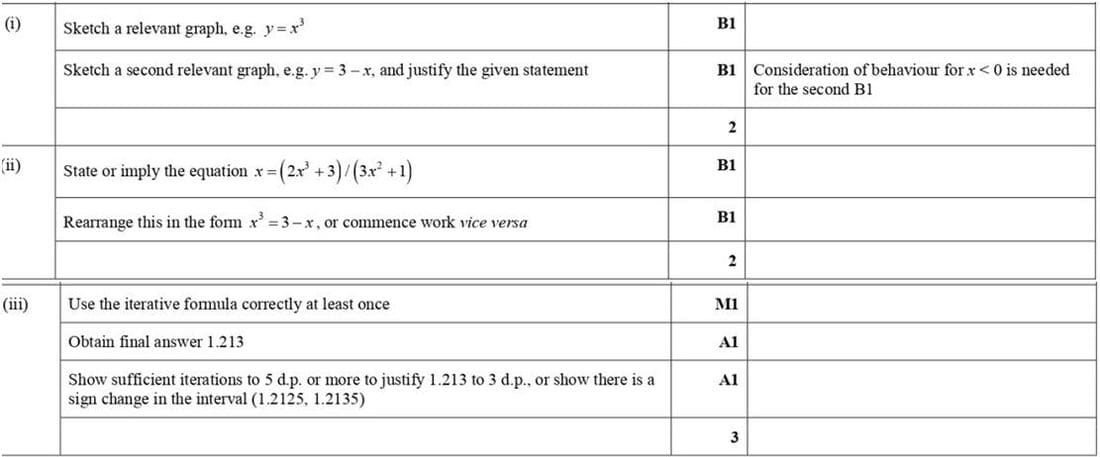
(i) By sketching a suitable pair of graphs, show that the equation \(x^3 = 3 - x\) has exactly one real root.
(ii) Show that if a sequence of real values given by the iterative formula \(x_{n+1} = \frac{2x_n^3 + 3}{3x_n^2 + 1}\) converges, then it converges to the root of the equation in part (i).
(iii) Use this iterative formula to determine the root correct to 3 decimal places. Give the result of each iteration to 5 decimal places.
9709 P33 - Jun 2018 - Q4
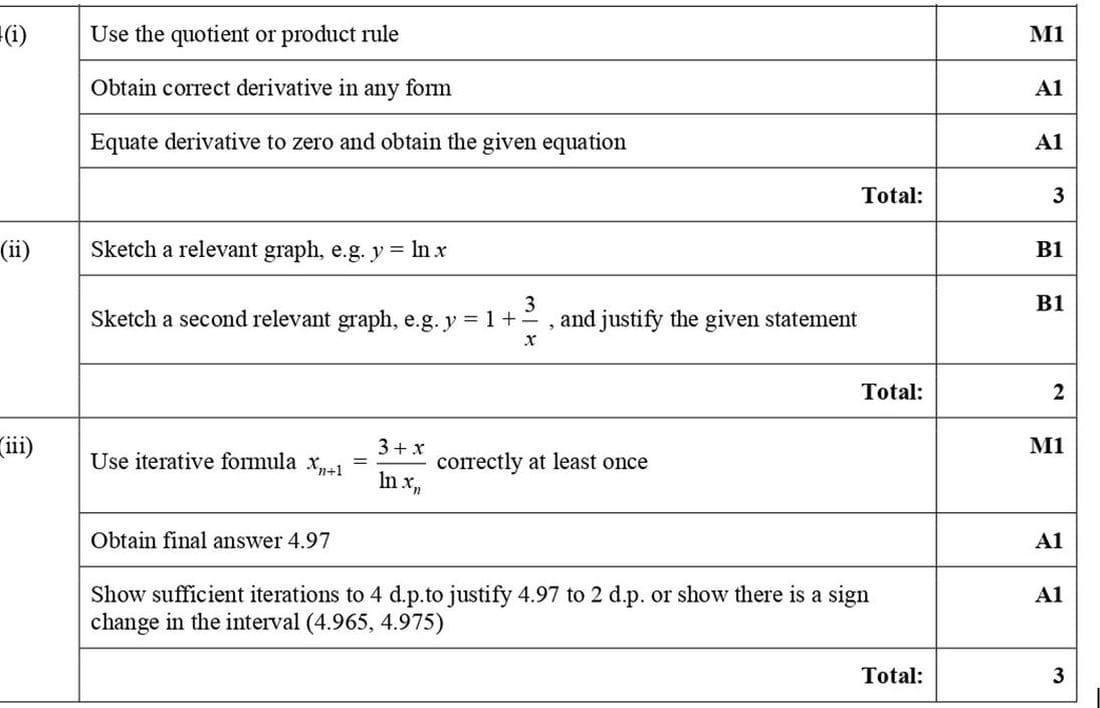
The curve with equation \(y = \frac{\ln x}{3 + x}\) has a stationary point at \(x = p\).
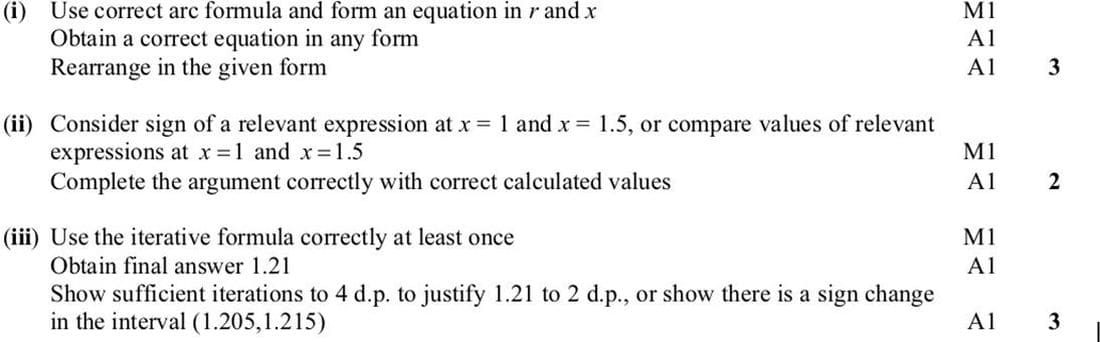
- Show that \(p\) satisfies the equation \(\ln x = 1 + \frac{3}{x}\).
- By sketching suitable graphs, show that the equation in part (i) has only one root.
- It is given that the equation in part (i) can be written in the form \(x = \frac{3 + x}{\ln x}\). Use an iterative formula based on this rearrangement to determine the value of \(p\) correct to 2 decimal places. Give the result of each iteration to 4 decimal places.
Question #1882
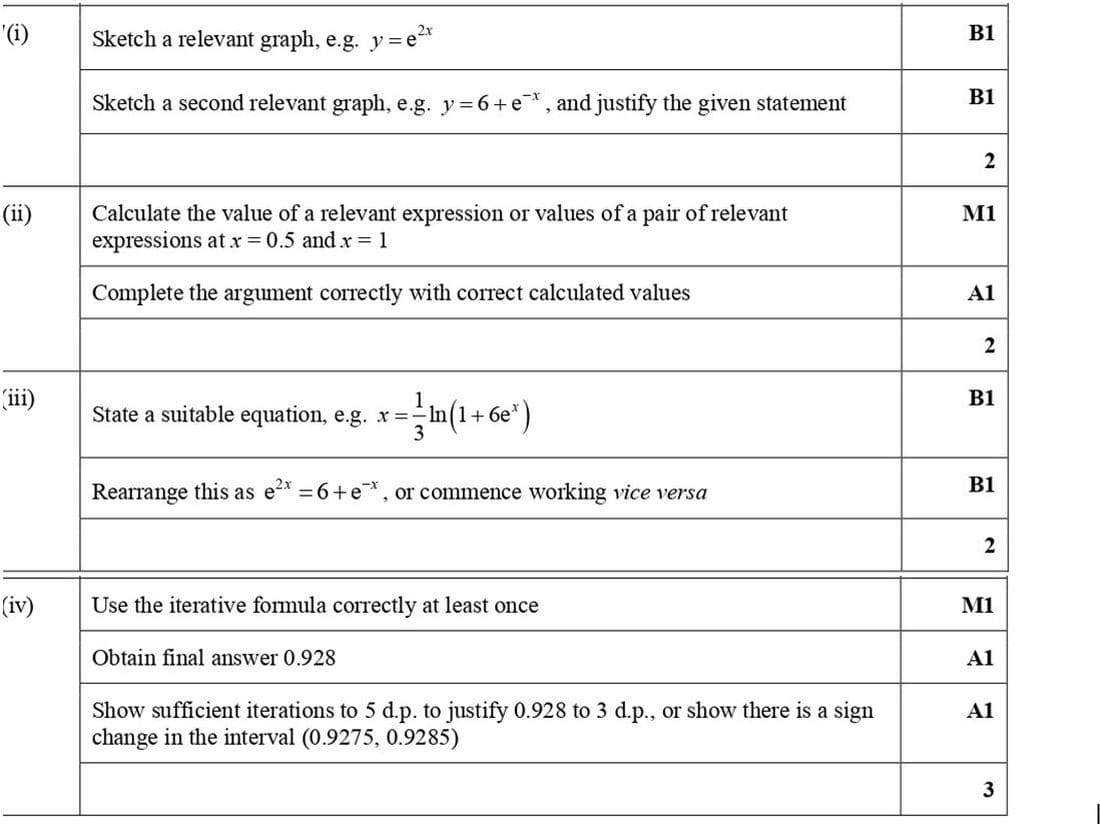
(i) By sketching suitable graphs, show that the equation \(e^{2x} = 6 + e^{-x}\) has exactly one real root.
(ii) Verify by calculation that this root lies between 0.5 and 1.
(iii) Show that if a sequence of values given by the iterative formula \(x_{n+1} = \frac{1}{3} \ln(1 + 6e^{x_n})\) converges, then it converges to the root of the equation in part (i).
(iv) Use this iterative formula to calculate the root correct to 3 decimal places. Give the result of each iteration to 5 decimal places.
9709 P32 - Mar 2017 - Q3
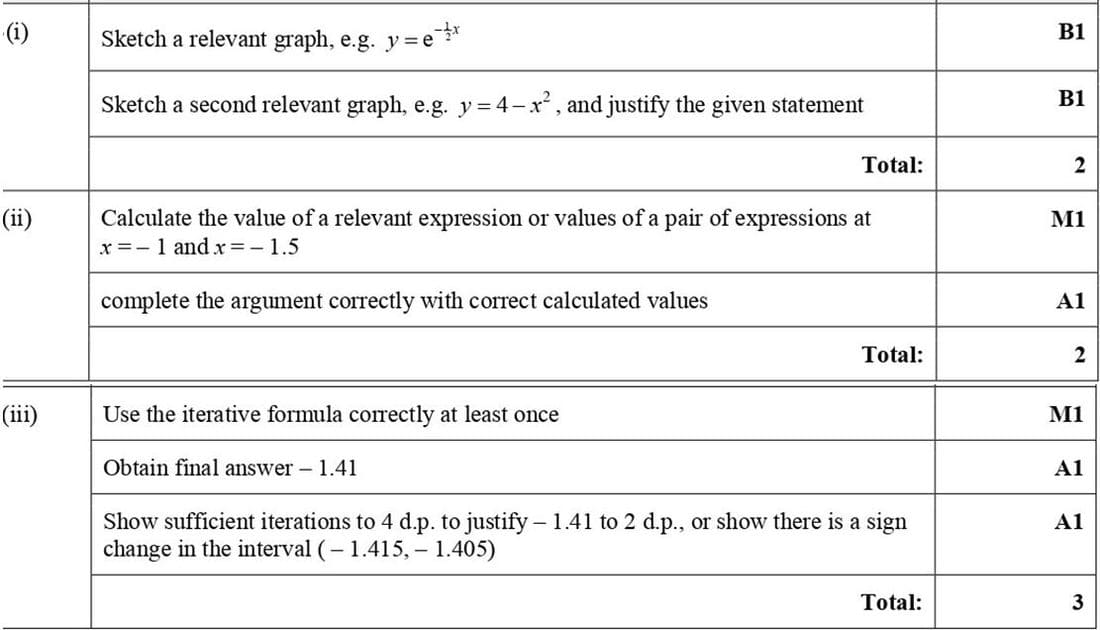
(i) By sketching suitable graphs, show that the equation \(e^{-\frac{1}{2}x} = 4 - x^2\) has one positive root and one negative root.
(ii) Verify by calculation that the negative root lies between \(-1\) and \(-1.5\).
(iii) Use the iterative formula \(x_{n+1} = -\sqrt{4 - e^{-\frac{1}{2}x_n}}\) to determine this root correct to 2 decimal places. Give the result of each iteration to 4 decimal places.
9709 P31 - Nov 2016 - Q6
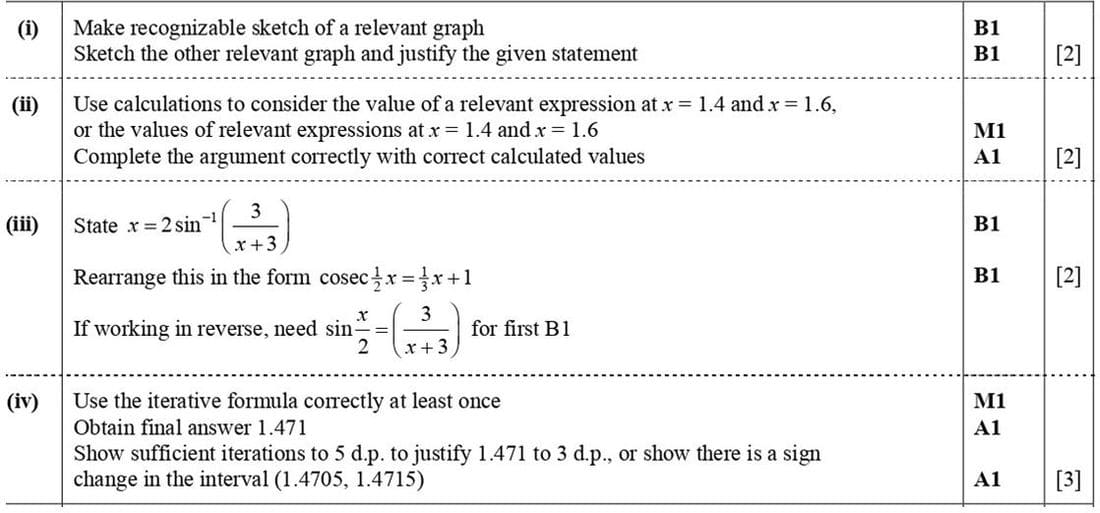
(i) By sketching a suitable pair of graphs, show that the equation \(\csc \frac{1}{2}x = \frac{1}{3}x + 1\) has one root in the interval \(0 < x \leq \pi\).
(ii) Show by calculation that this root lies between 1.4 and 1.6.
(iii) Show that, if a sequence of values in the interval \(0 < x \leq \pi\) given by the iterative formula \(x_{n+1} = 2 \sin^{-1} \left( \frac{3}{x_n + 3} \right)\) converges, then it converges to the root of the equation in part (i).
(iv) Use this iterative formula to calculate the root correct to 3 decimal places. Give the result of each iteration to 5 decimal places.
9709 P31 - Jun 2016 - Q6
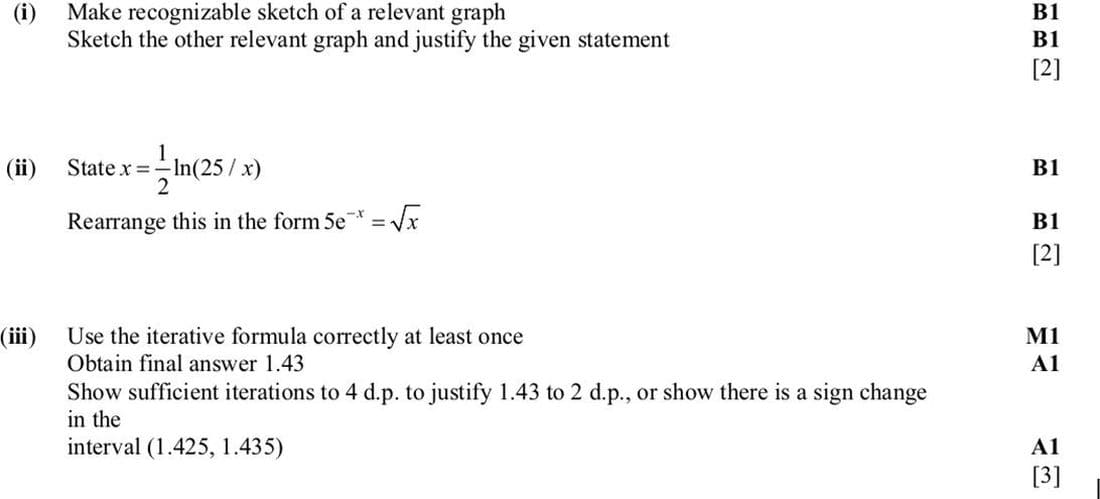
(i) By sketching a suitable pair of graphs, show that the equation \(5e^{-x} = \sqrt{x}\) has one root.
(ii) Show that, if a sequence of values given by the iterative formula \(x_{n+1} = \frac{1}{2} \ln\left(\frac{25}{x_n}\right)\) converges, then it converges to the root of the equation in part (i).
(iii) Use this iterative formula, with initial value \(x_1 = 1\), to calculate the root correct to 2 decimal places. Give the result of each iteration to 4 decimal places.
9709 P33 - Nov 2014 - Q9
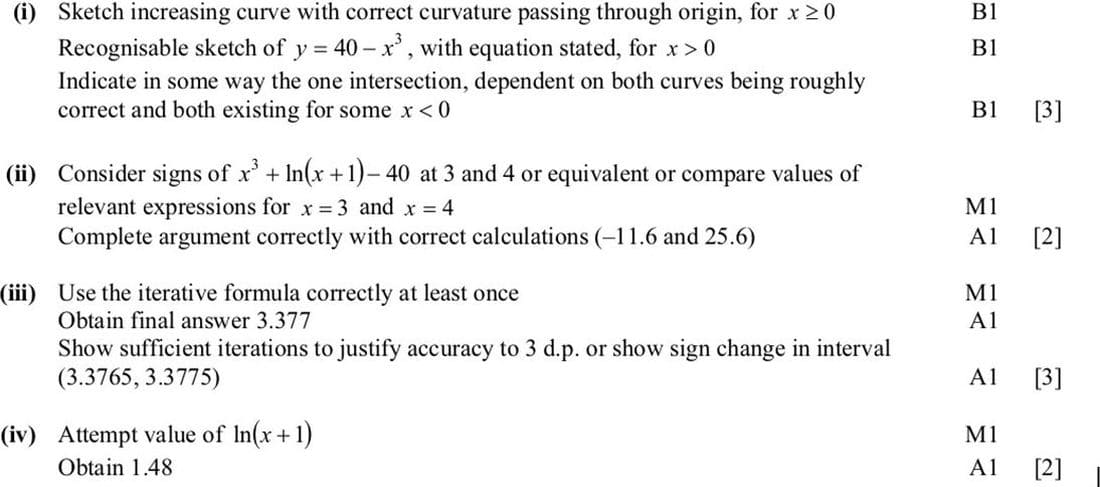
(i) Sketch the curve \(y = \ln(x + 1)\) and hence, by sketching a second curve, show that the equation \(x^3 + \ln(x + 1) = 40\) has exactly one real root. State the equation of the second curve.
(ii) Verify by calculation that the root lies between 3 and 4.
(iii) Use the iterative formula \(x_{n+1} = \sqrt[3]{40 - \ln(x_n + 1)}\), with a suitable starting value, to find the root correct to 3 decimal places. Give the result of each iteration to 5 decimal places.
(iv) Deduce the root of the equation \((e^y - 1)^3 + y = 40\), giving the answer correct to 2 decimal places.
9709 P31 - Jun 2014 - Q8
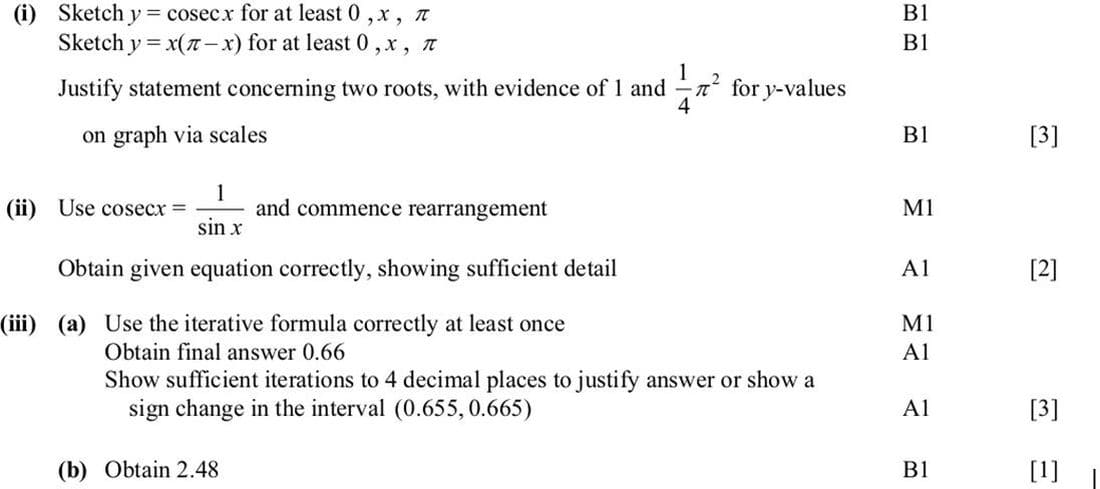
(i) By sketching each of the graphs \(y = \csc x\) and \(y = x(\pi - x)\) for \(0 < x < \pi\), show that the equation \(\csc x = x(\pi - x)\) has exactly two real roots in the interval \(0 < x < \pi\).
(ii) Show that the equation \(\csc x = x(\pi - x)\) can be written in the form \(x = \frac{1 + x^2 \sin x}{\pi \sin x}\).
(iii) The two real roots of the equation \(\csc x = x(\pi - x)\) in the interval \(0 < x < \pi\) are denoted by \(\alpha\) and \(\beta\), where \(\alpha < \beta\).
(a) Use the iterative formula \(x_{n+1} = \frac{1 + x_n^2 \sin x_n}{\pi \sin x_n}\) to find \(\alpha\) correct to 2 decimal places. Give the result of each iteration to 4 decimal places.
(b) Deduce the value of \(\beta\) correct to 2 decimal places.
9709 P31 - Nov 2011 - Q5
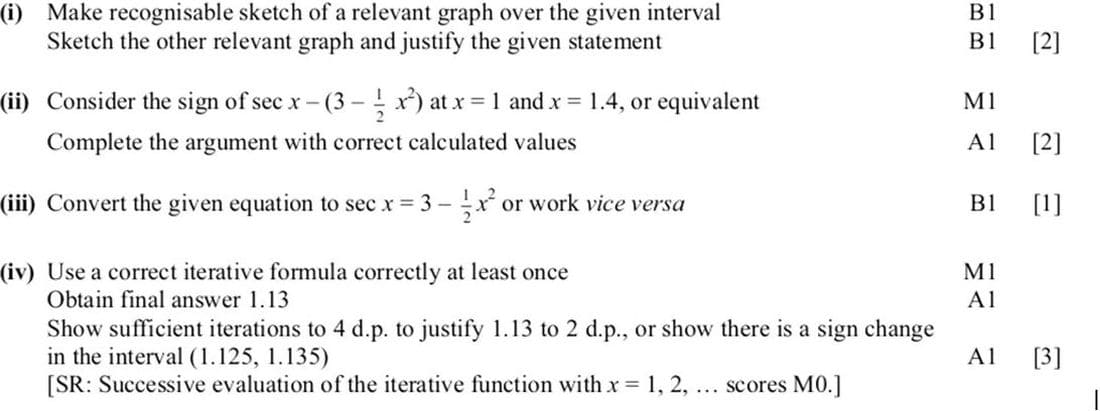
(i) By sketching a suitable pair of graphs, show that the equation \(\sec x = 3 - \frac{1}{2}x^2\), where \(x\) is in radians, has a root in the interval \(0 < x < \frac{1}{2}\pi\).
(ii) Verify by calculation that this root lies between 1 and 1.4.
(iii) Show that this root also satisfies the equation \(x = \cos^{-1}\left( \frac{2}{6 - x^2} \right)\).
(iv) Use an iterative formula based on the equation in part (iii) to determine the root correct to 2 decimal places. Give the result of each iteration to 4 decimal places.