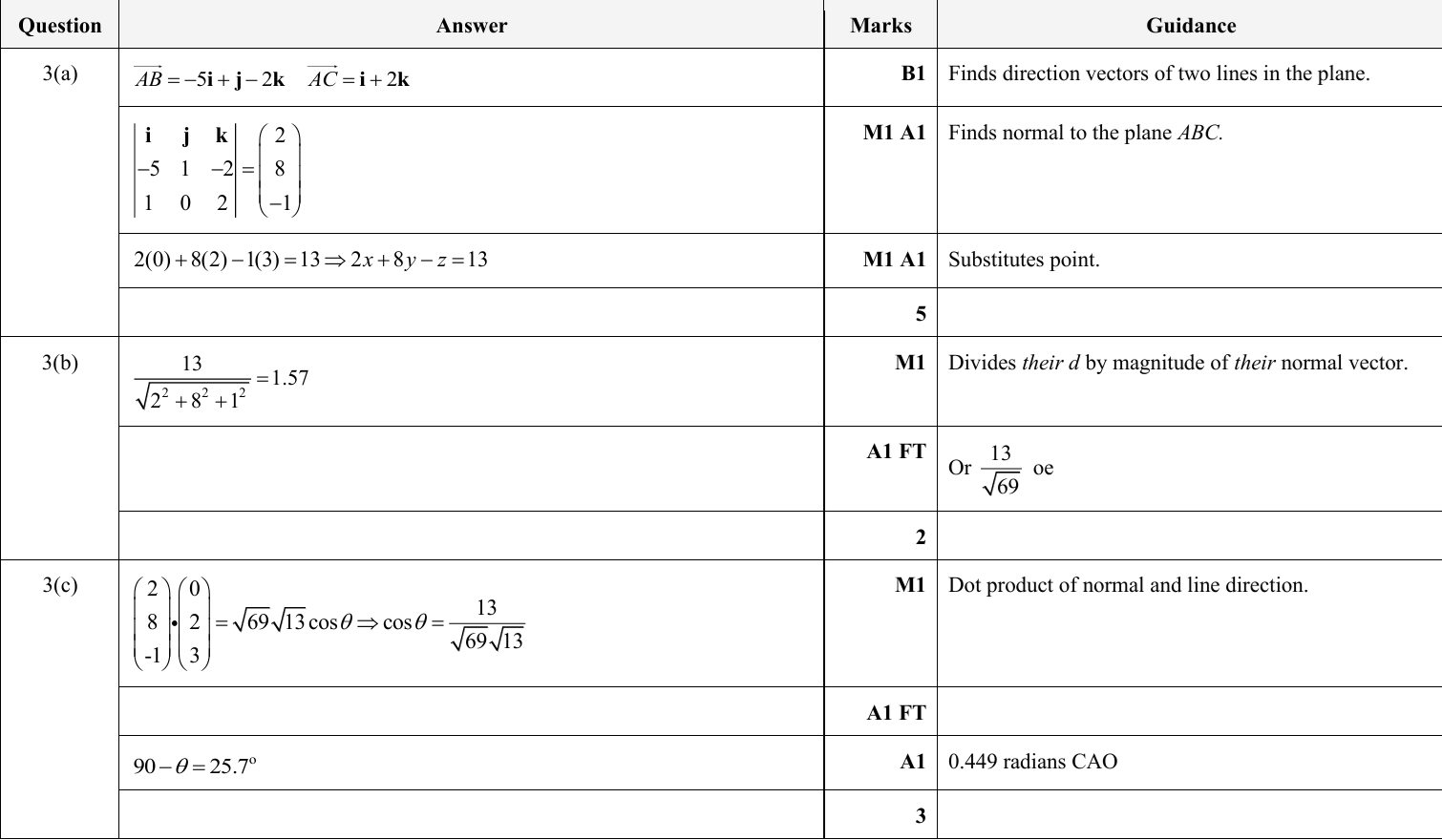
(a) To find the equation of the plane, we first determine the direction vectors \(\overrightarrow{AB}\) and \(\overrightarrow{AC}\):
\(\overrightarrow{AB} = (-5\mathbf{i} + 3\mathbf{j} + \mathbf{k}) - (2\mathbf{j} + 3\mathbf{k}) = -5\mathbf{i} + \mathbf{j} - 2\mathbf{k}\)
\(\overrightarrow{AC} = (\mathbf{i} + 2\mathbf{j} + 5\mathbf{k}) - (2\mathbf{j} + 3\mathbf{k}) = \mathbf{i} + 2\mathbf{k}\)
The normal vector \(\mathbf{n}\) to the plane is given by the cross product \(\overrightarrow{AB} \times \overrightarrow{AC}\):
\(\mathbf{n} = \begin{vmatrix} \mathbf{i} & \mathbf{j} & \mathbf{k} \\ -5 & 1 & -2 \\ 1 & 0 & 2 \end{vmatrix} = 2\mathbf{i} + 8\mathbf{j} - \mathbf{k}\)
Using point \(A(0, 2, 3)\), the equation of the plane is:
\(2(0) + 8(2) - 1(3) = 13 \Rightarrow 2x + 8y - z = 13\)
(b) The perpendicular distance from the origin \(O(0, 0, 0)\) to the plane is:
\(\frac{|2(0) + 8(0) - 1(0) - 13|}{\sqrt{2^2 + 8^2 + (-1)^2}} = \frac{13}{\sqrt{69}} = 1.57\)
(c) The acute angle \(\theta\) between the line \(OA\) and the plane is found using the dot product:
\(\cos \theta = \frac{\mathbf{n} \cdot \overrightarrow{OA}}{\|\mathbf{n}\| \|\overrightarrow{OA}\|}\)
\(\overrightarrow{OA} = 2\mathbf{j} + 3\mathbf{k}\)
\(\mathbf{n} \cdot \overrightarrow{OA} = 2(0) + 8(2) - 1(3) = 13\)
\(\|\mathbf{n}\| = \sqrt{69}, \quad \|\overrightarrow{OA}\| = \sqrt{13}\)
\(\cos \theta = \frac{13}{\sqrt{69} \sqrt{13}}\)
\(\theta = \cos^{-1}\left(\frac{13}{\sqrt{69} \sqrt{13}}\right) = 0.449\) radians