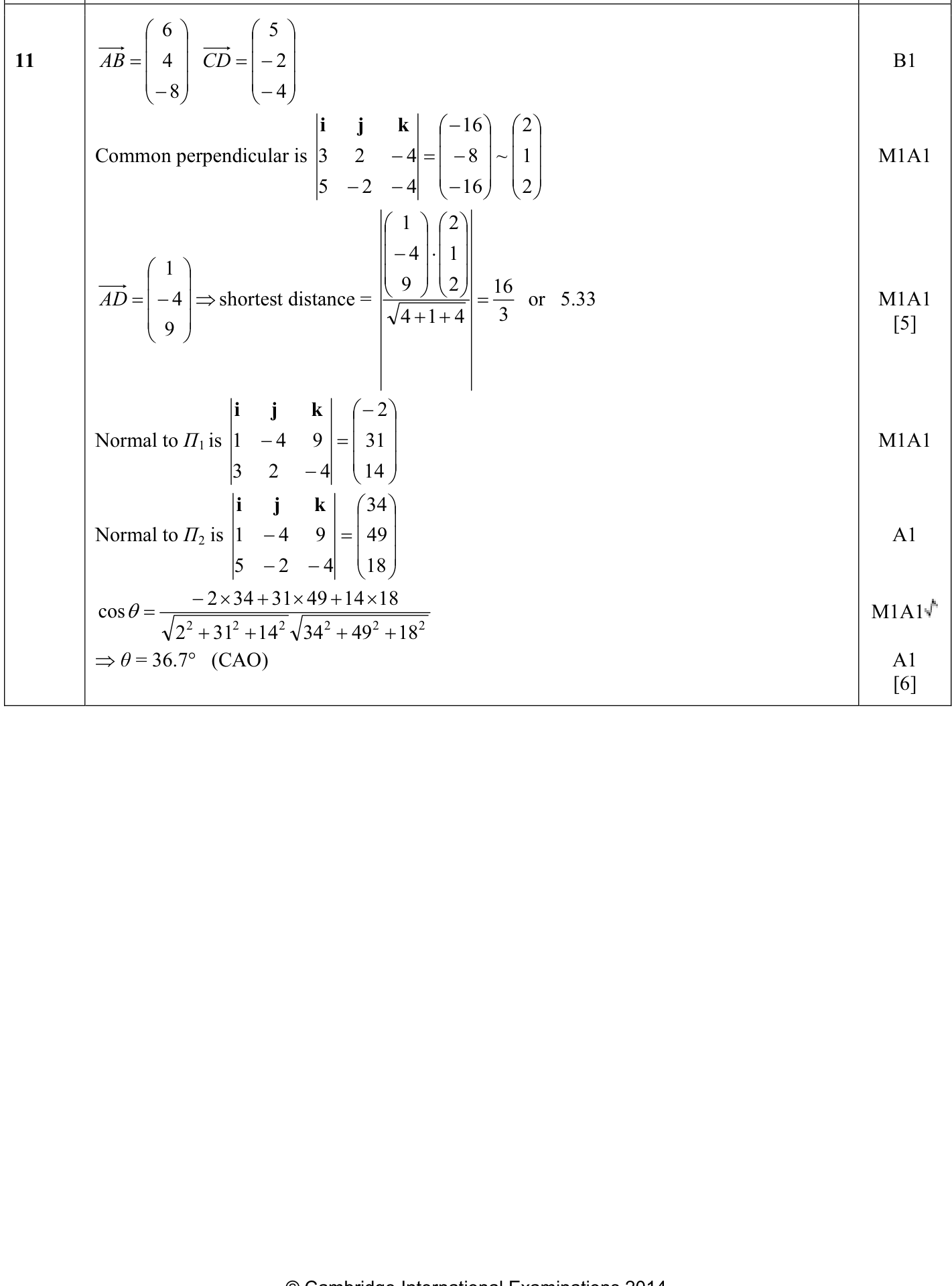
Answer: The shortest distance between the lines is \(\frac{16}{3}\).
The acute angle between the planes is \(36.7^\circ\).
First find direction vectors for the two lines.
For \(l_1\), \(\overrightarrow{AB}=(8-2,\,7-3,\,-13-(-5))=(6,4,-8)\), so a direction vector is \((3,2,-4)\).
For \(l_2\), \(\overrightarrow{CD}=(3-(-2),\,-1-1,\,4-8)=(5,-2,-4)\).
The common perpendicular to both lines is perpendicular to both direction vectors, so it is parallel to \((3,2,-4)\times(5,-2,-4)\).
Now \((3,2,-4)\times(5,-2,-4)=(-16,-8,-16)\), which is parallel to \((2,1,2)\).
Take a vector joining a point on \(l_1\) to a point on \(l_2\), for example \(\overrightarrow{AD}=(3-2,\,-1-3,\,4-(-5))=(1,-4,9)\).
The shortest distance between the skew lines is the component of \(\overrightarrow{AD}\) in the direction of the common perpendicular:
\(d=\frac{|\overrightarrow{AD}\cdot(2,1,2)|}{\sqrt{2^2+1^2+2^2}}=\frac{|(1,-4,9)\cdot(2,1,2)|}{3}.\)
Since \((1,-4,9)\cdot(2,1,2)=2-4+18=16\), we get
\(d=\frac{16}{3}.\)
Now for the angle between the planes.
For \(\Pi_1\), use vectors \(\overrightarrow{AD}=(1,-4,9)\) and \(\overrightarrow{AB}=(3,2,-4)\). A normal vector is
\(\mathbf{n}_1=\overrightarrow{AD}\times\overrightarrow{AB}=(-2,31,14).\)
For \(\Pi_2\), use \(\overrightarrow{AD}=(1,-4,9)\) and \(\overrightarrow{CD}=(5,-2,-4)\). A normal vector is
\(\mathbf{n}_2=\overrightarrow{AD}\times\overrightarrow{CD}=(34,49,18).\)
The acute angle \(\theta\) between the planes is the acute angle between their normals, so
\(\cos\theta=\frac{|\mathbf{n}_1\cdot\mathbf{n}_2|}{|\mathbf{n}_1||\mathbf{n}_2|}.\)
Now
\(\mathbf{n}_1\cdot\mathbf{n}_2=(-2)(34)+31(49)+14(18)=1563,\)
\(|\mathbf{n}_1|=\sqrt{(-2)^2+31^2+14^2}=\sqrt{1173},\qquad |\mathbf{n}_2|=\sqrt{34^2+49^2+18^2}=\sqrt{3921}.\)
Hence
\(\cos\theta=\frac{1563}{\sqrt{1173}\sqrt{3921}},\)
so
\(\theta\approx 36.7^\circ.\)