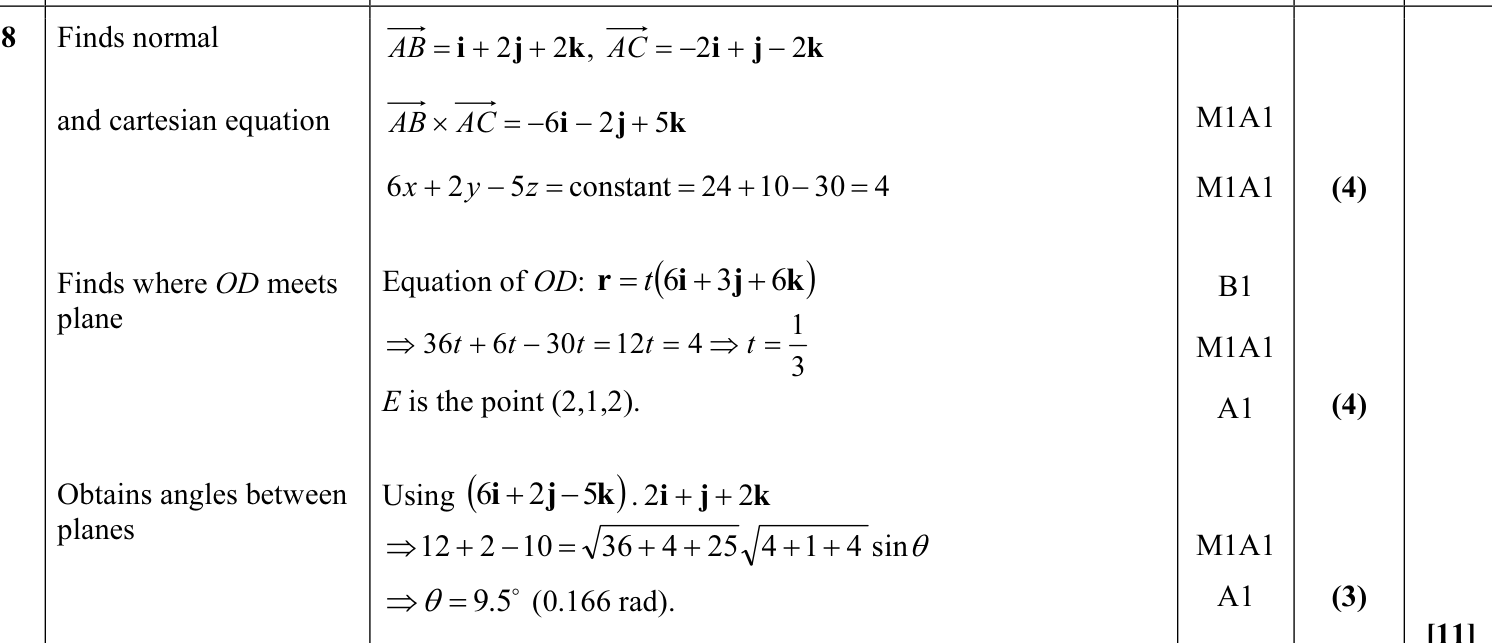
Answer: (a) The points are \(A(4,5,6)\), \(B(5,7,8)\) and \(C(2,6,4)\).
A normal to the plane is found from \(\overrightarrow{AB}\times\overrightarrow{AC}\).
\(\overrightarrow{AB}=(1,2,2)\), \(\overrightarrow{AC}=(-2,1,-2)\).
So a normal vector is \(( -6,-2,5)\), or equivalently \((6,2,-5)\).
Hence the plane has equation \(6x+2y-5z=d\).
Substituting point \(A(4,5,6)\):
\(d=6(4)+2(5)-5(6)=24+10-30=4\).
Therefore the plane is \(6x+2y-5z=4\).
(b) The line \(OD\) passes through the origin and \(D(6,3,6)\), so its vector equation is \(\mathbf{r}=t(6,3,6)\). Thus points on the line have coordinates \((6t,3t,6t)\).
At the intersection with the plane, these satisfy
\(6(6t)+2(3t)-5(6t)=4\).
So \(36t+6t-30t=4\), giving \(12t=4\) and \(t=\frac13\).
Hence \(E=(2,1,2)\).
(c) The line \(ED\) has direction vector
\((6,3,6)-(2,1,2)=(4,2,4)=2(2,1,2)\).
A normal to the plane is \((6,2,-5)\). If \(\theta\) is the acute angle between the line and the plane, then
\(\sin\theta=\dfrac{|\mathbf{n}\cdot\mathbf{d}|}{|\mathbf{n}||\mathbf{d}|}\), where \(\mathbf{d}=(2,1,2)\).
Now \(\mathbf{n}\cdot\mathbf{d}=6\cdot2+2\cdot1-5\cdot2=12+2-10=4\),
\(|\mathbf{n}|=\sqrt{6^2+2^2+(-5)^2}=\sqrt{65}\), and \(|\mathbf{d}|=\sqrt{2^2+1^2+2^2}=3\).
So
\(\sin\theta=\dfrac{4}{3\sqrt{65}}\).
Therefore \(\theta\approx 9.5^\circ\).
(a) Let the position vectors of \(A,B,C\) be treated as coordinates:
\(A(4,5,6)\), \(B(5,7,8)\), \(C(2,6,4)\).
Two direction vectors in the plane are
\(\overrightarrow{AB}=(5-4,7-5,8-6)=(1,2,2)\),
\(\overrightarrow{AC}=(2-4,6-5,4-6)=(-2,1,-2)\).
A normal vector is their cross product:
\(\overrightarrow{AB}\times\overrightarrow{AC}= \begin{vmatrix} \mathbf{i}&\mathbf{j}&\mathbf{k}\\ 1&2&2\\ -2&1&-2 \end{vmatrix}=( -6,-2,5)\).
Any non-zero multiple is acceptable, so we may use \((6,2,-5)\).
Hence the plane has equation \(6x+2y-5z=d\).
Substitute \(A(4,5,6)\):
\(d=6\cdot4+2\cdot5-5\cdot6=24+10-30=4\).
So the cartesian equation of plane \(ABC\) is \(6x+2y-5z=4\).
(b) The line \(OD\) goes through the origin and \(D(6,3,6)\), so a vector equation is
\(\mathbf{r}=t(6,3,6)\).
Therefore points on \(OD\) have coordinates \((6t,3t,6t)\).
Since \(E\) lies on the plane \(6x+2y-5z=4\), substitute these coordinates:
\(6(6t)+2(3t)-5(6t)=4\).
Thus \(36t+6t-30t=4\), so \(12t=4\) and \(t=\frac13\).
Hence
\(E=(6\cdot\frac13,3\cdot\frac13,6\cdot\frac13)=(2,1,2)\).
(c) The direction vector of \(ED\) is
\(\overrightarrow{ED}=D-E=(6,3,6)-(2,1,2)=(4,2,4)\), which is proportional to \((2,1,2)\).
A normal to the plane is \(\mathbf{n}=(6,2,-5)\).
If \(\theta\) is the acute angle between the line and the plane, then the angle between the line and the normal is \(90^\circ-\theta\), so
\(\sin\theta=\dfrac{|\mathbf{n}\cdot\mathbf{d}|}{|\mathbf{n}||\mathbf{d}|}\), where \(\mathbf{d}=(2,1,2)\).
Calculate
\(\mathbf{n}\cdot\mathbf{d}=6\cdot2+2\cdot1-5\cdot2=4\),
\(|\mathbf{n}|=\sqrt{6^2+2^2+(-5)^2}=\sqrt{65}\),
\(|\mathbf{d}|=\sqrt{2^2+1^2+2^2}=3\).
So
\(\sin\theta=\dfrac{4}{3\sqrt{65}}\).
Therefore
\(\theta=\sin^{-1}\!\left(\dfrac{4}{3\sqrt{65}}\right)\approx 9.5^\circ\).