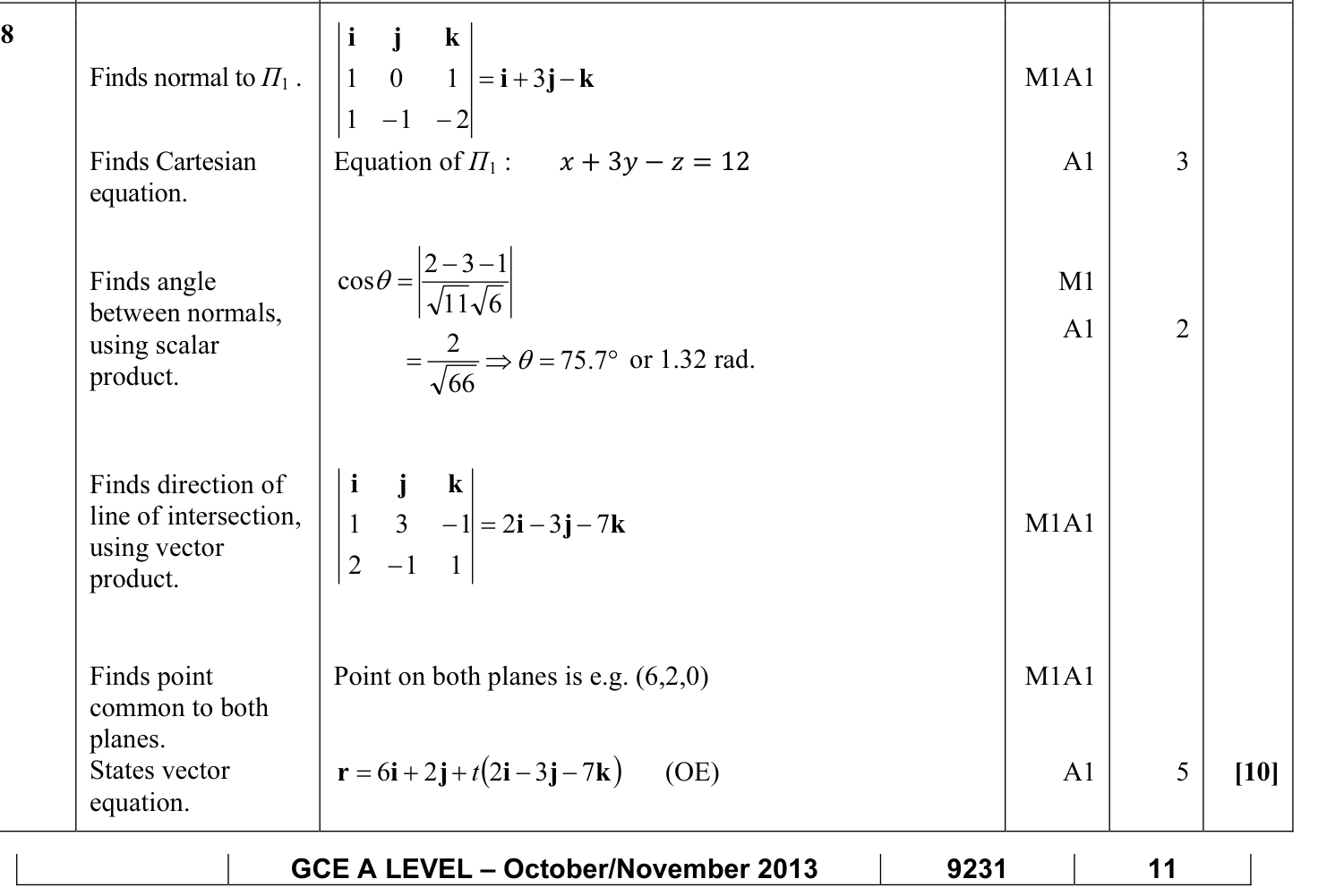
Answer: The cartesian equation of \(\Pi_1\) is \(x+3y-z=12\).
The acute angle between \(\Pi_1\) and \(\Pi_2\) is \(75.7^\circ\) (to 1 d.p.).
An equation of the line of intersection is \(\mathbf{r}=\begin{pmatrix}6\\2\\0\end{pmatrix}+\lambda\begin{pmatrix}2\\-3\\-7\end{pmatrix}\).
For \(\Pi_1\), the direction vectors are \(\begin{pmatrix}1\\0\\1\end{pmatrix}\) and \(\begin{pmatrix}1\\-1\\-2\end{pmatrix}\). A normal vector is their cross product:
\(\begin{pmatrix}1\\0\\1\end{pmatrix}\times\begin{pmatrix}1\\-1\\-2\end{pmatrix}=\begin{pmatrix}1\\3\\-1\end{pmatrix}\).
So a cartesian equation of \(\Pi_1\) is found using the point \((2,3,-1)\):
\(\begin{pmatrix}1\\3\\-1\end{pmatrix}\cdot\begin{pmatrix}x-2\\y-3\\z+1\end{pmatrix}=0\).
This gives \(x-2+3(y-3)-(z+1)=0\), hence \(x+3y-z=12\).
For the angle between the planes, use the angle between their normal vectors. A normal to \(\Pi_1\) is \(\mathbf{n}_1=(1,3,-1)\), and a normal to \(\Pi_2\) is \(\mathbf{n}_2=(2,-1,1)\).
Then
\(\cos\theta=\left|\dfrac{\mathbf{n}_1\cdot\mathbf{n}_2}{|\mathbf{n}_1||\mathbf{n}_2|}\right|=\left|\dfrac{2-3-1}{\sqrt{11}\sqrt{6}}\right|=\dfrac{2}{\sqrt{66}}\).
So \(\theta=75.7^\circ\) to 1 d.p. This is the acute angle between the planes.
For the line of intersection, its direction vector is the cross product of the normals:
\(\mathbf{n}_1\times\mathbf{n}_2=\begin{pmatrix}1\\3\\-1\end{pmatrix}\times\begin{pmatrix}2\\-1\\1\end{pmatrix}=\begin{pmatrix}2\\-3\\-7\end{pmatrix}\).
Now find a point on both planes. Let \(z=0\). Then from \(\Pi_2\), \(2x-y=10\), and from \(\Pi_1\), \(x+3y=12\).
Solving gives \(y=2\) and \(x=6\). So \((6,2,0)\) lies on both planes.
Therefore the line of intersection is
\(\mathbf{r}=\begin{pmatrix}6\\2\\0\end{pmatrix}+\lambda\begin{pmatrix}2\\-3\\-7\end{pmatrix}\).