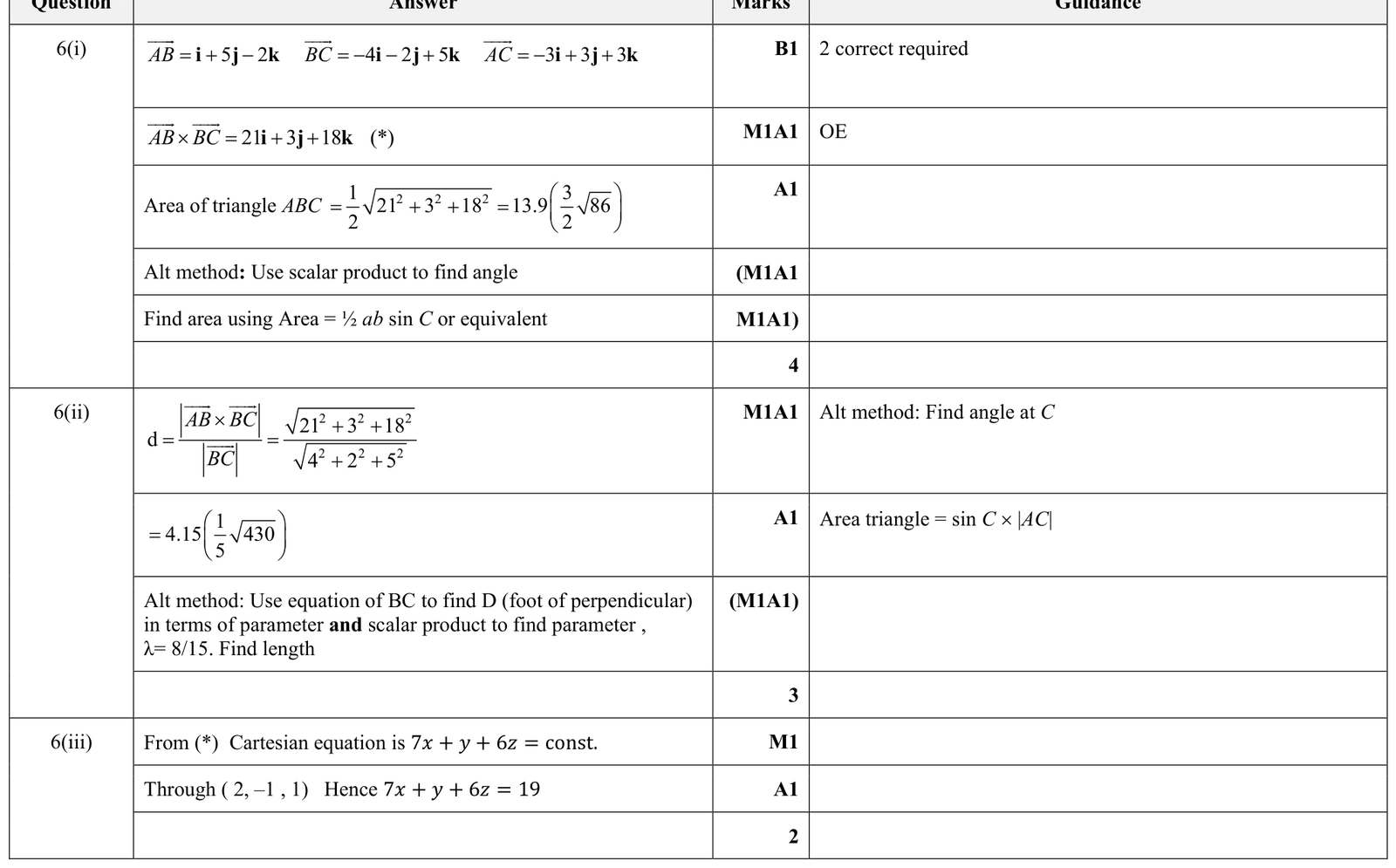
Answer: (i) The area of triangle \(ABC\) is \(\frac{3}{2}\sqrt{86}\), which is approximately \(13.9\).
(ii) The perpendicular distance of \(A\) from the line \(BC\) is \(\frac{1}{5}\sqrt{430}\), which is approximately \(4.15\).
(iii) The cartesian equation of the plane through \(A\), \(B\) and \(C\) is \(7x+y+6z=19\).
Let \(A=(2,-1,1)\), \(B=(3,4,-1)\) and \(C=(-1,2,4)\).
(i) First find two side vectors of the triangle:
\(\overrightarrow{AB}=B-A=(1,5,-2)\), and \(\overrightarrow{BC}=C-B=(-4,-2,5)\).
The area of triangle \(ABC\) is half the magnitude of the cross product \(\overrightarrow{AB}\times\overrightarrow{BC}\).
\(\overrightarrow{AB}\times\overrightarrow{BC}=\begin{vmatrix} \mathbf{i}&\mathbf{j}&\mathbf{k}\\ 1&5&-2\\ -4&-2&5\end{vmatrix}=(21,3,18).\)
So
\(\text{Area}=\frac12\sqrt{21^2+3^2+18^2}=\frac12\sqrt{774}=\frac32\sqrt{86}.\)
This is approximately \(13.9\).
(ii) The distance from \(A\) to the line \(BC\) can be found from
\(d=\dfrac{|\overrightarrow{AB}\times\overrightarrow{BC}|}{|\overrightarrow{BC}|}.\)
We already have \(|\overrightarrow{AB}\times\overrightarrow{BC}|=\sqrt{774}\), and
\(|\overrightarrow{BC}|=\sqrt{(-4)^2+(-2)^2+5^2}=\sqrt{45}=3\sqrt{5}.\)
Hence
\(d=\dfrac{\sqrt{774}}{\sqrt{45}}=\sqrt{\frac{86}{5}}=\frac15\sqrt{430}.\)
So the perpendicular distance is approximately \(4.15\).
(iii) A normal vector to the plane through \(A\), \(B\), and \(C\) is given by \(\overrightarrow{AB}\times\overrightarrow{BC}=(21,3,18)\). Dividing by 3 gives a simpler normal vector \((7,1,6)\).
Therefore the plane has equation \(7x+y+6z=\text{constant}\).
Substituting the point \(A=(2,-1,1)\):
\(7(2)+(-1)+6(1)=14-1+6=19.\)
So the plane is \(7x+y+6z=19\).