Past Exam Questions
← Back9709 P42 - Jun 2018 - Q6
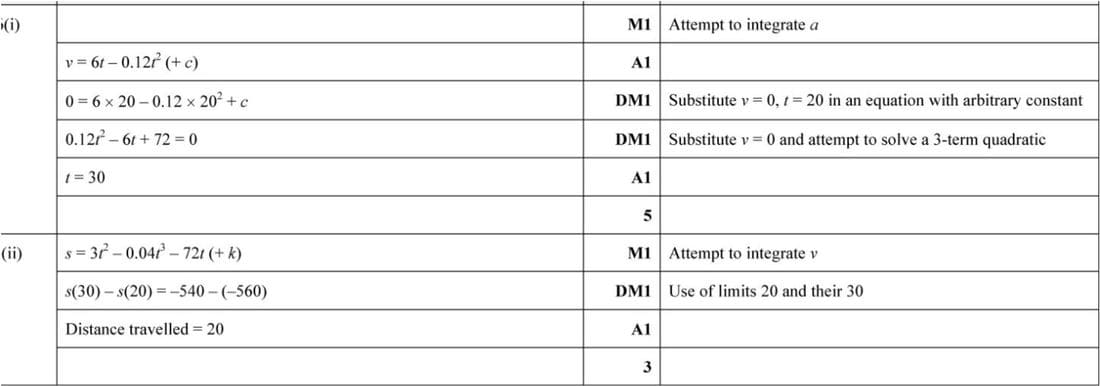
A particle P moves in a straight line passing through a point O. At time t s, the acceleration, a m s-2, of P is given by a = 6 - 0.24t. The particle comes to instantaneous rest at time t = 20.
- Find the value of t at which the particle is again at instantaneous rest.
- Find the distance the particle travels between the times of instantaneous rest.
9709 P43 - Jun 2023 - Q5
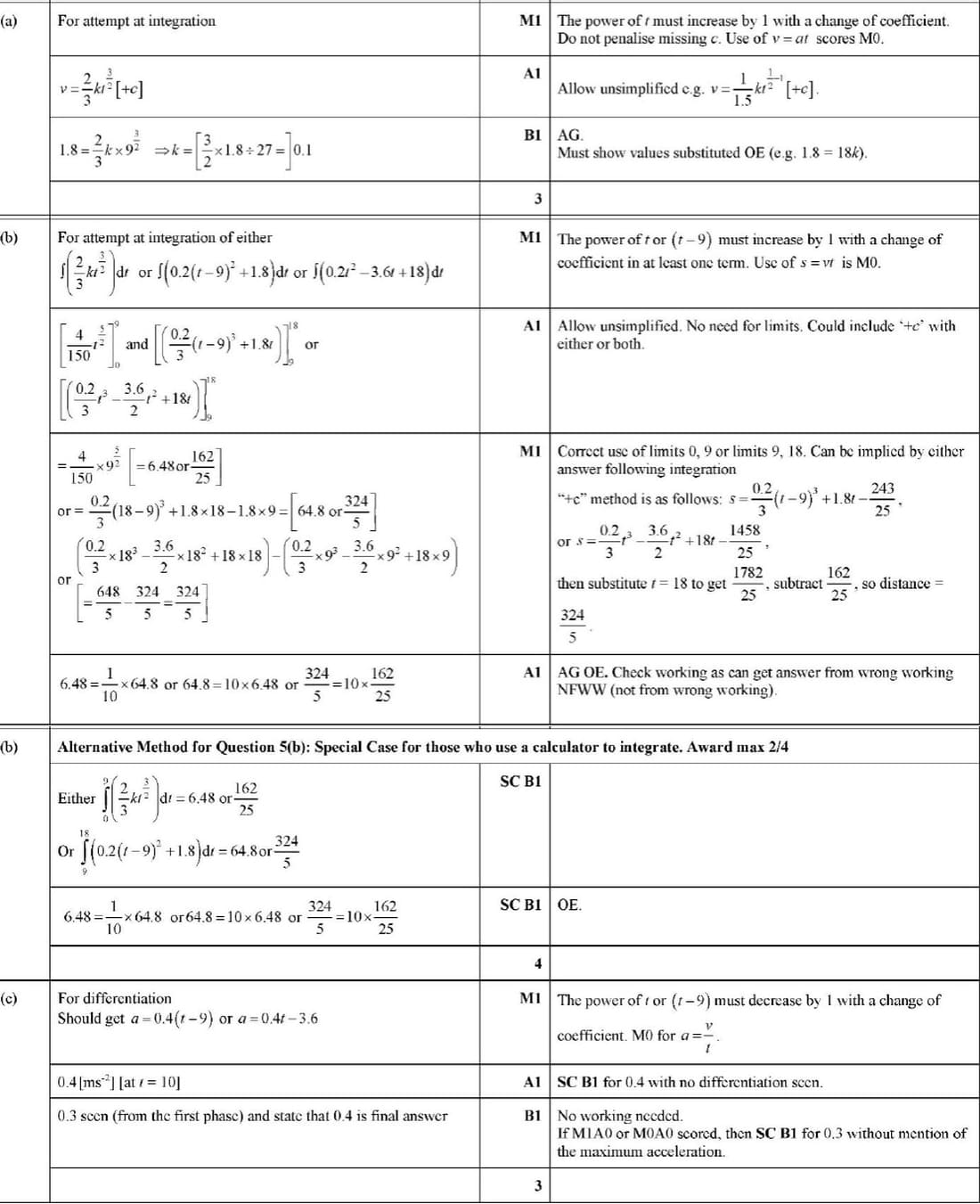
A particle starts from rest from a point O and moves in a straight line. The acceleration of the particle at time t after leaving O is a m s-2, where a = kt^{1/2} for 0 \leq t \leq 9 and where k is a constant. The velocity of the particle at t = 9 is 1.8 m s-1.
- Show that k = 0.1.
- For t > 9, the velocity v m s-1 of the particle is given by v = 0.2(t - 9)^2 + 1.8.
- Show that the distance travelled in the first 9 seconds is one tenth of the distance travelled between t = 9 and t = 18.
- Find the greatest acceleration of the particle during the first 10 seconds of its motion.
9709 P41 - Jun 2018 - Q4
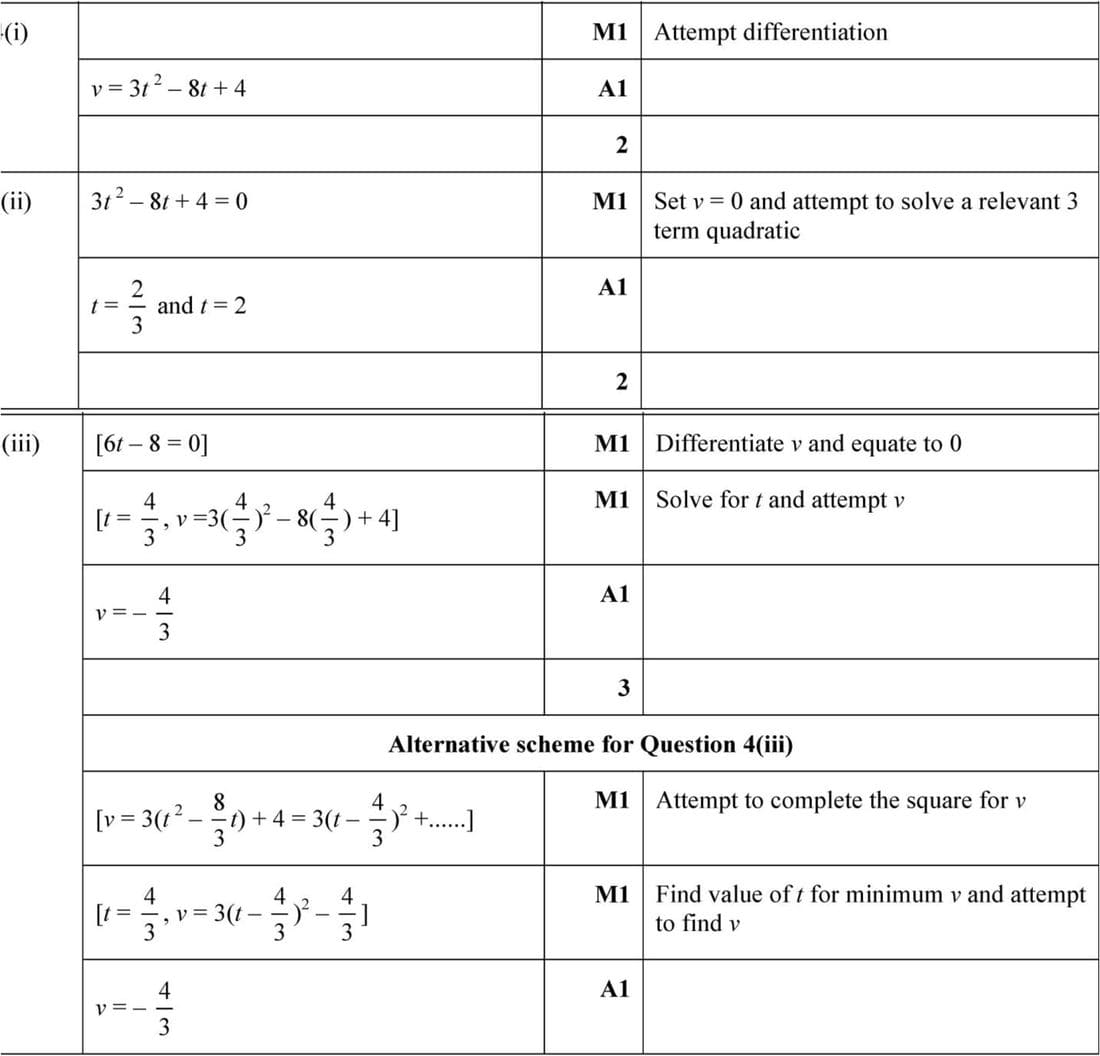
A particle P moves in a straight line starting from a point O. At time t s after leaving O, the displacement s m from O is given by \(s = t^3 - 4t^2 + 4t\) and the velocity is \(v\) m s-1.
- Find an expression for \(v\) in terms of \(t\).
- Find the two values of \(t\) for which P is at instantaneous rest.
- Find the minimum velocity of P.
9709 P43 - Nov 2017 - Q5
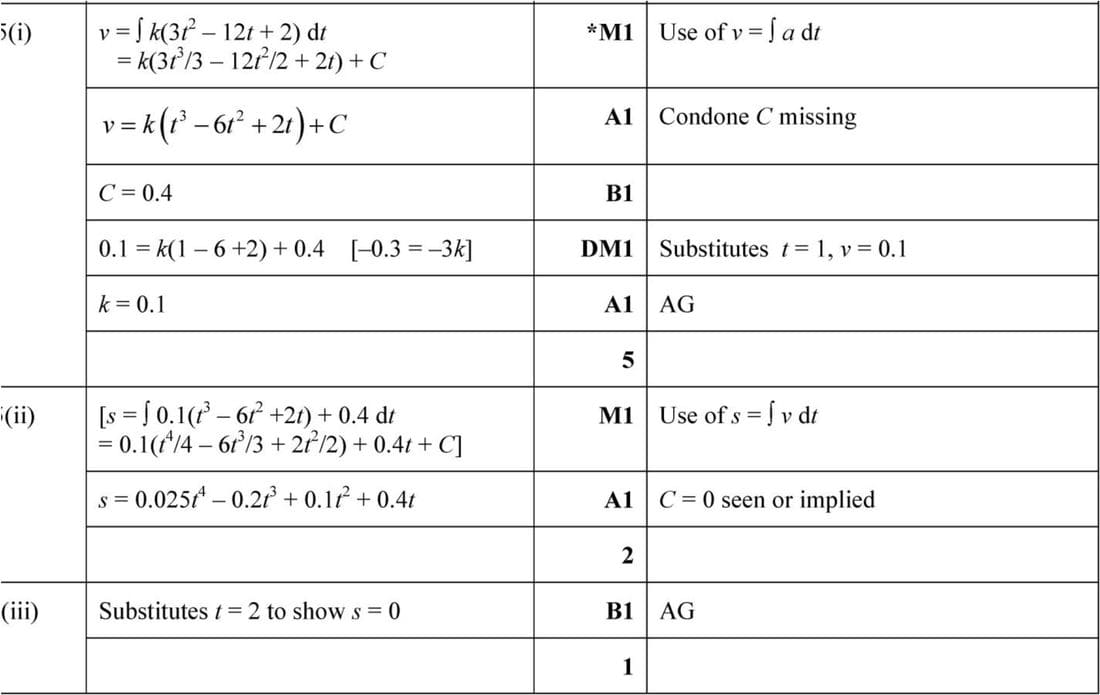
A particle starts from a fixed origin with velocity 0.4 m s-1 and moves in a straight line. The acceleration a m s-2 of the particle t s after it leaves the origin is given by a = k(3t2 - 12t + 2), where k is a constant. When t = 1, the velocity of P is 0.1 m s-1.
- Show that the value of k is 0.1.
- Find an expression for the displacement of the particle from the origin in terms of t.
- Hence verify that the particle is again at the origin at t = 2.
9709 P42 - Nov 2017 - Q7
A particle starts from rest and moves in a straight line. The velocity of the particle at time t s after the start is v m s-1, where
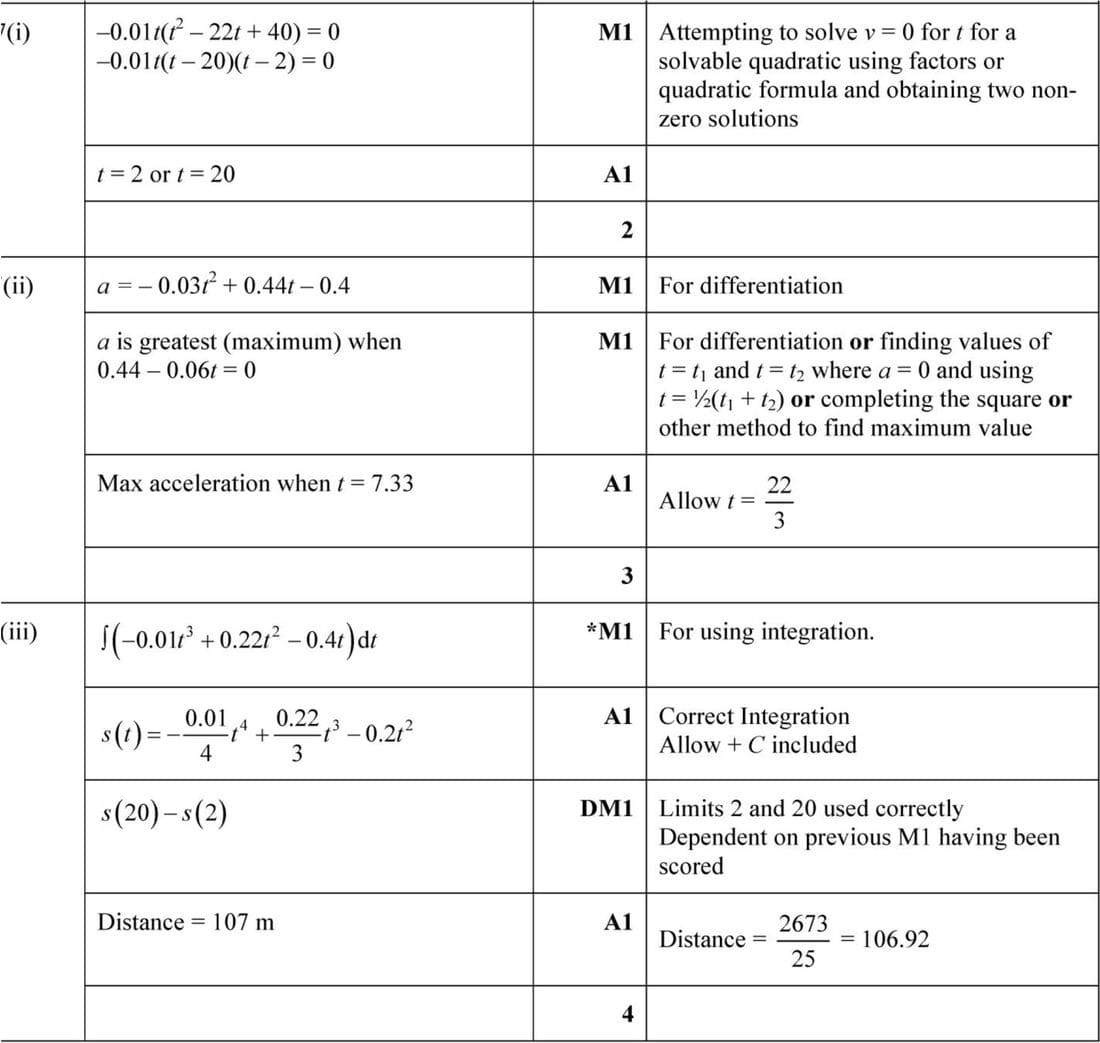
\(v = -0.01t^3 + 0.22t^2 - 0.4t\).
- Find the two positive values of t for which the particle is instantaneously at rest.
- Find the time at which the acceleration of the particle is greatest.
- Find the distance travelled by the particle while its velocity is positive.
9709 P41 - Nov 2017 - Q5
A particle starts from a point O and moves in a straight line. The velocity of the particle at time t s after leaving O is v m s-1, where
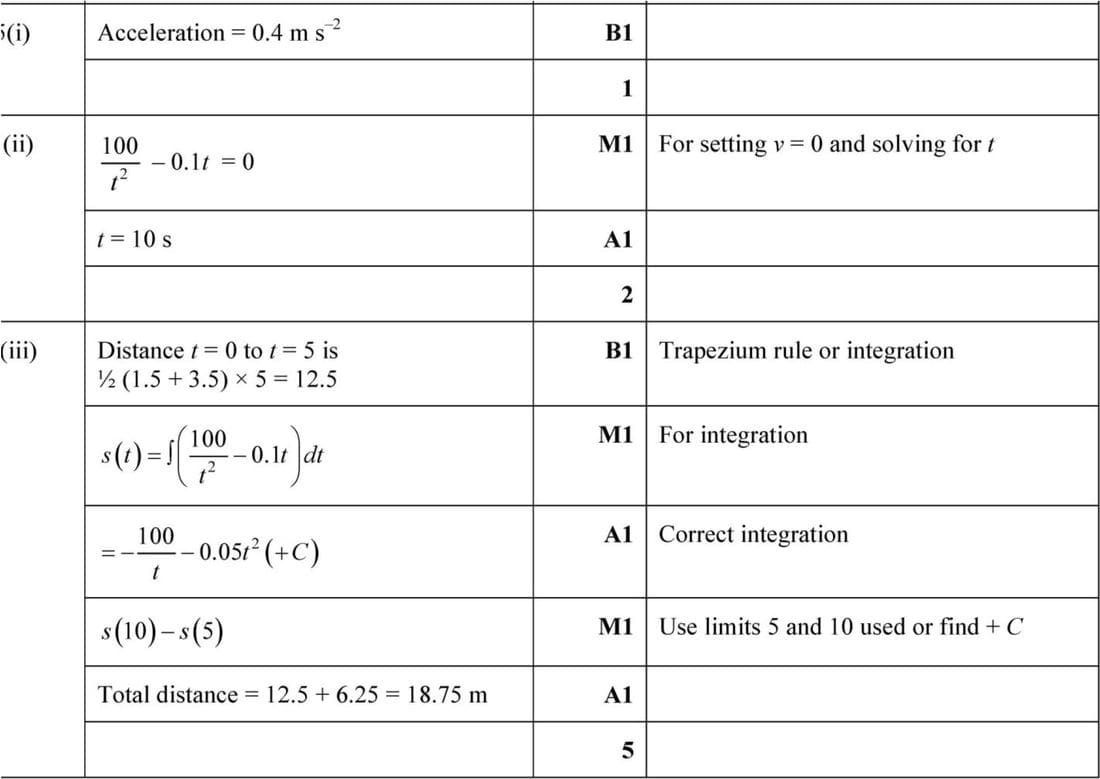
\(v = 1.5 + 0.4t \quad \text{for} \quad 0 \leq t \leq 5,\)
\(v = \frac{100}{t^2} - 0.1t \quad \text{for} \quad t \geq 5.\)
- Find the acceleration of the particle during the first 5 seconds of motion.
- Find the value of t when the particle is instantaneously at rest.
- Find the total distance travelled by the particle in the first 10 seconds of motion.
9709 P43 - Jun 2017 - Q4
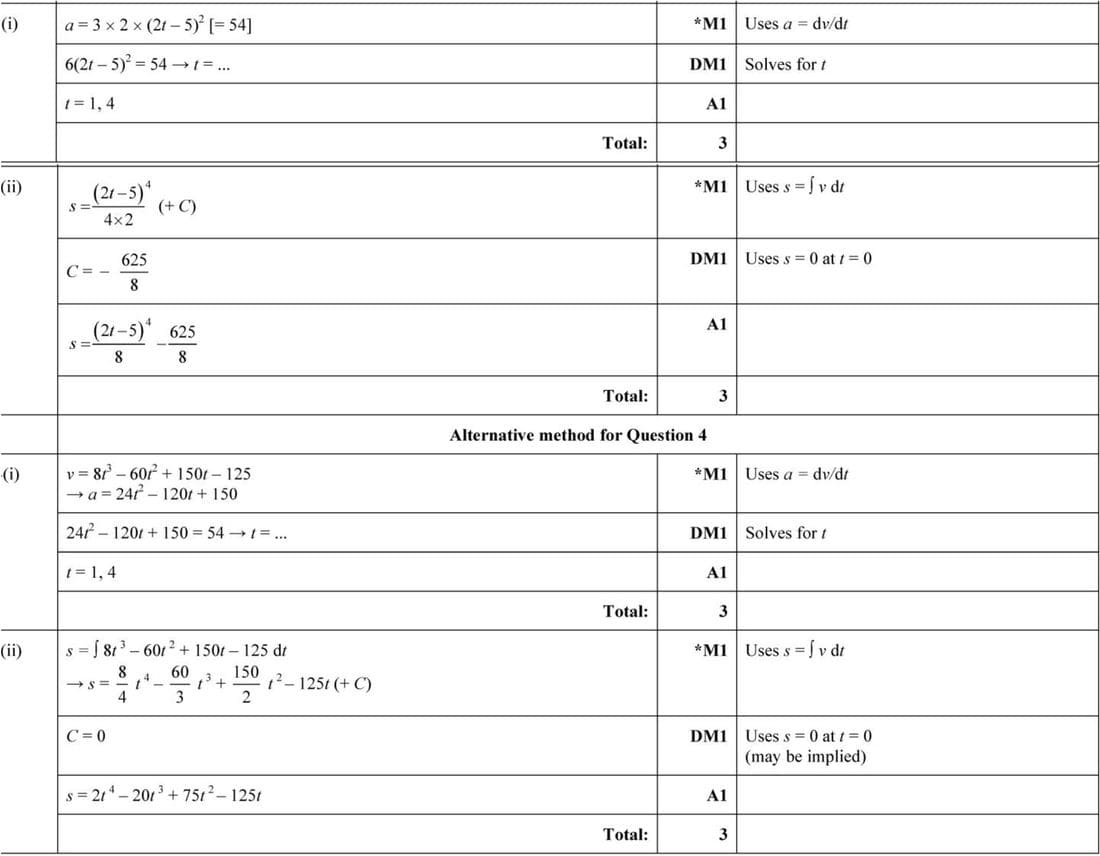
A particle P moves in a straight line starting from a point O. At time t s after leaving O, the velocity, v m s-1, of P is given by v = (2t - 5)^3.
- Find the values of t when the acceleration of P is 54 m s-2.
- Find an expression for the displacement of P from O at time t s.
9709 P41 - Jun 2017 - Q6
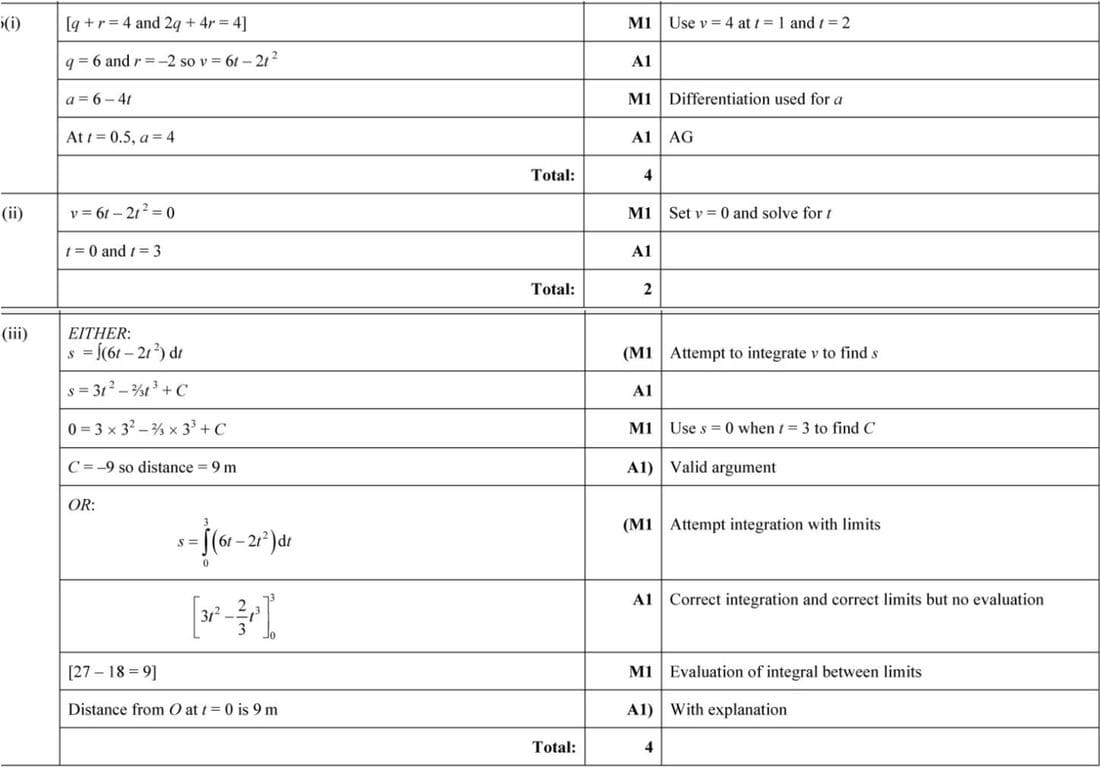
A particle P moves in a straight line passing through a point O. At time t s, the velocity of P, v m s-1, is given by v = qt + rt2, where q and r are constants. The particle has velocity 4 m s-1 when t = 1 and when t = 2.
- Show that, when t = 0.5, the acceleration of P is 4 m s-2.
- Find the values of t when P is at instantaneous rest.
- The particle is at O when t = 3. Find the distance of P from O when t = 0.
9709 P42 - Nov 2016 - Q2
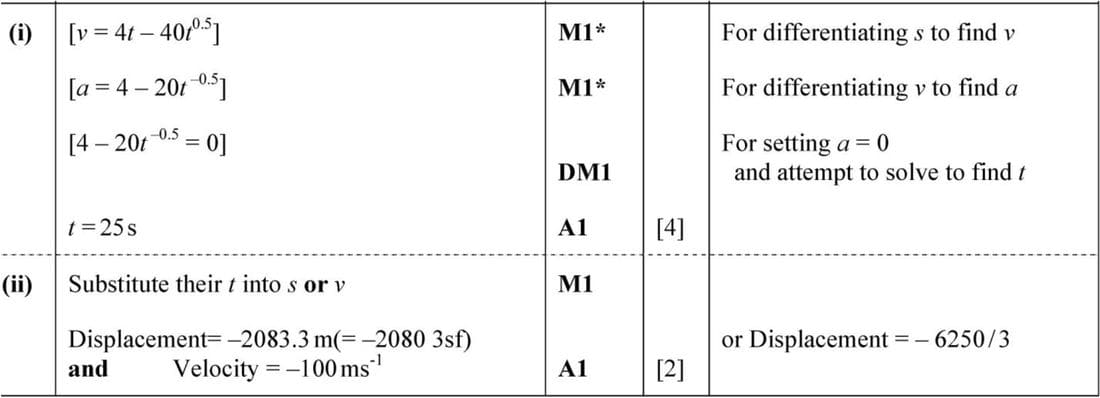
A particle moves in a straight line. Its displacement t s after leaving a fixed point O on the line is s m, where \(s = 2t^2 - \frac{80}{3}t^{3/2}\).
- Find the time at which the acceleration of the particle is zero.
- Find the displacement and velocity of the particle at this instant.
9709 P41 - Nov 2016 - Q7
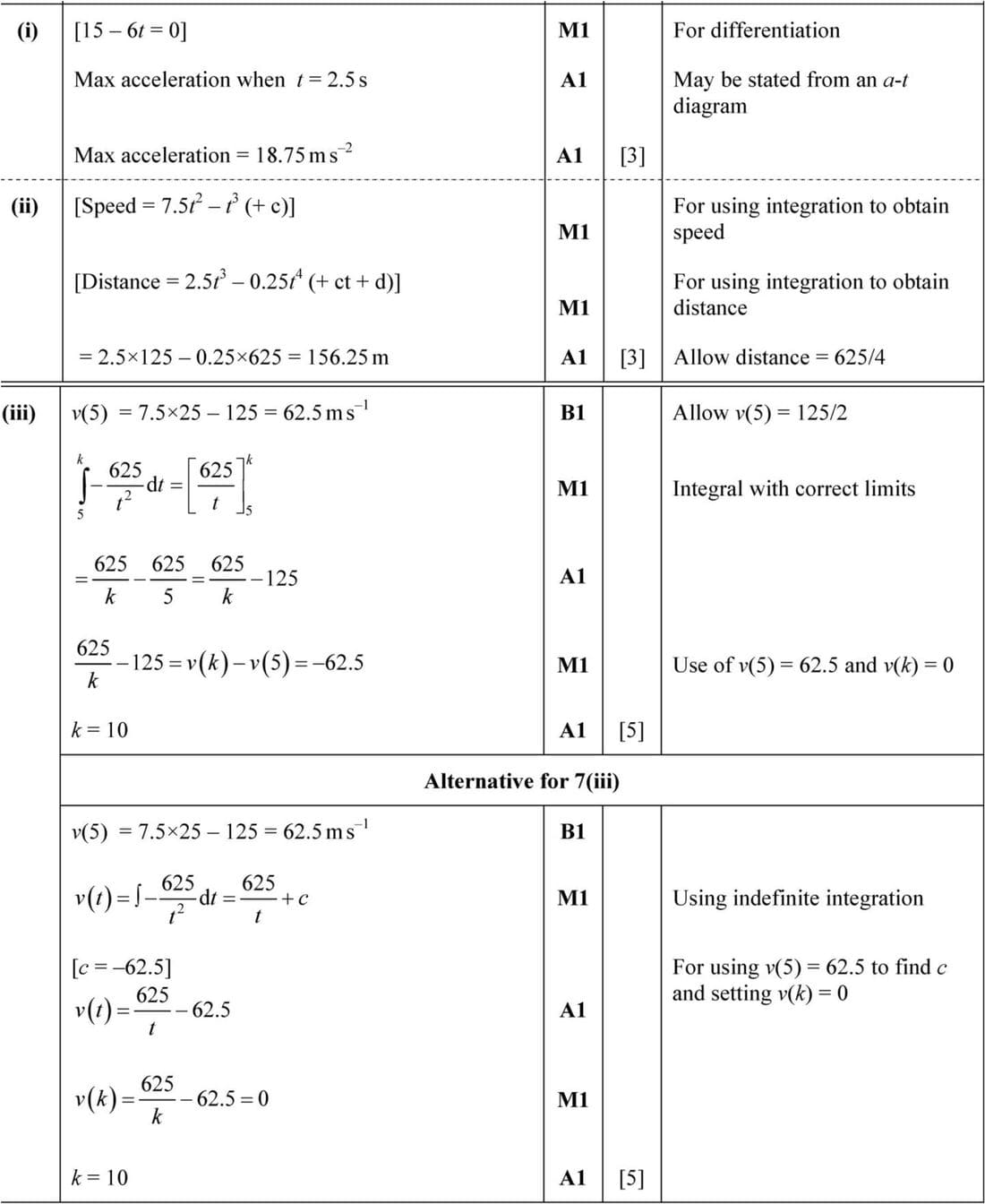
A racing car is moving in a straight line. The acceleration \(a\) m s\(^{-2}\) at time \(t\) s after the car starts from rest is given by
\(a = 15t - 3t^2 \quad \text{for} \; 0 \leq t \leq 5,\)
\(a = -\frac{625}{t^2} \quad \text{for} \; 5 < t \leq k,\)
where \(k\) is a constant.
- Find the maximum acceleration of the car in the first five seconds of its motion. [3]
- Find the distance of the car from its starting point when \(t = 5\). [3]
- The car comes to rest when \(t = k\). Find the value of \(k\). [5]
9709 P43 - Jun 2016 - Q7
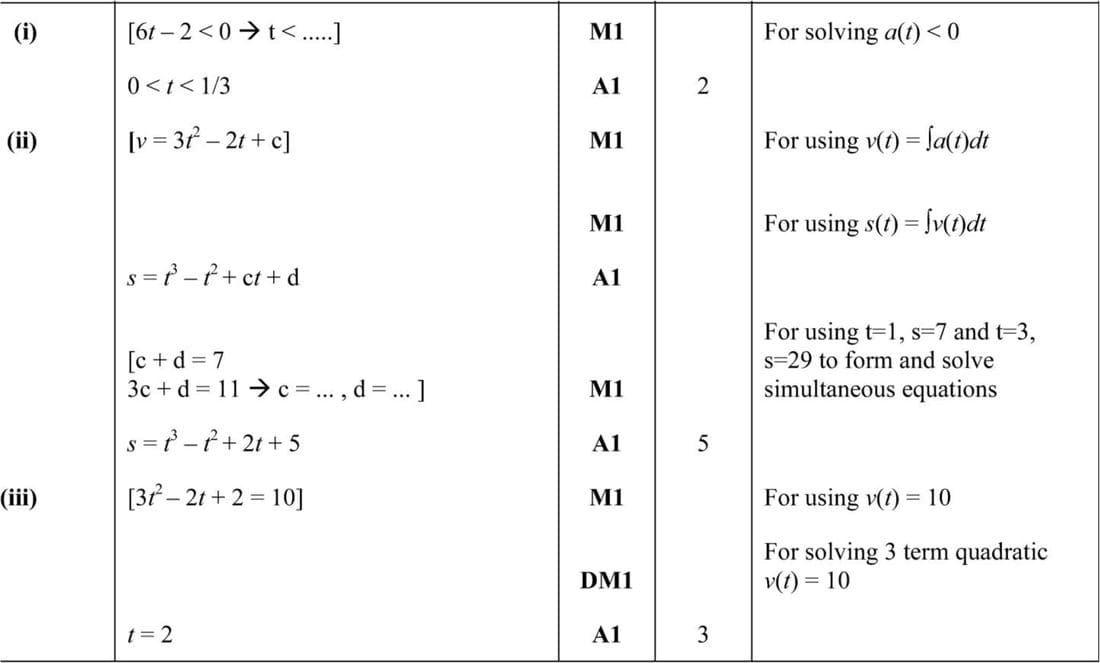
A particle P moves in a straight line. At time t s, the displacement of P from O is s m and the acceleration of P is a m s-2, where a = 6t - 2. When t = 1, s = 7 and when t = 3, s = 29.
- Find the set of values of t for which the particle is decelerating.
- Find s in terms of t.
- Find the time when the velocity of the particle is 10 m s-1.
9709 P42 - Jun 2016 - Q2
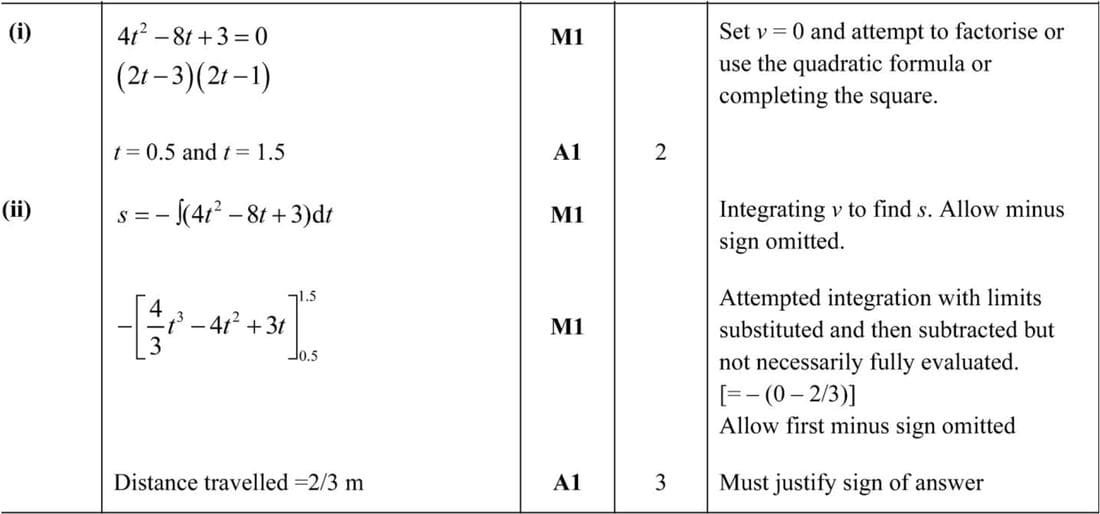
A particle P moves in a straight line, starting from a point O. At time t s after leaving O, the velocity of P, v m s-1, is given by v = 4t2 - 8t + 3.
- Find the two values of t at which P is at instantaneous rest.
- Find the distance travelled by P between these two times.
9709 P42 - Jun 2023 - Q6
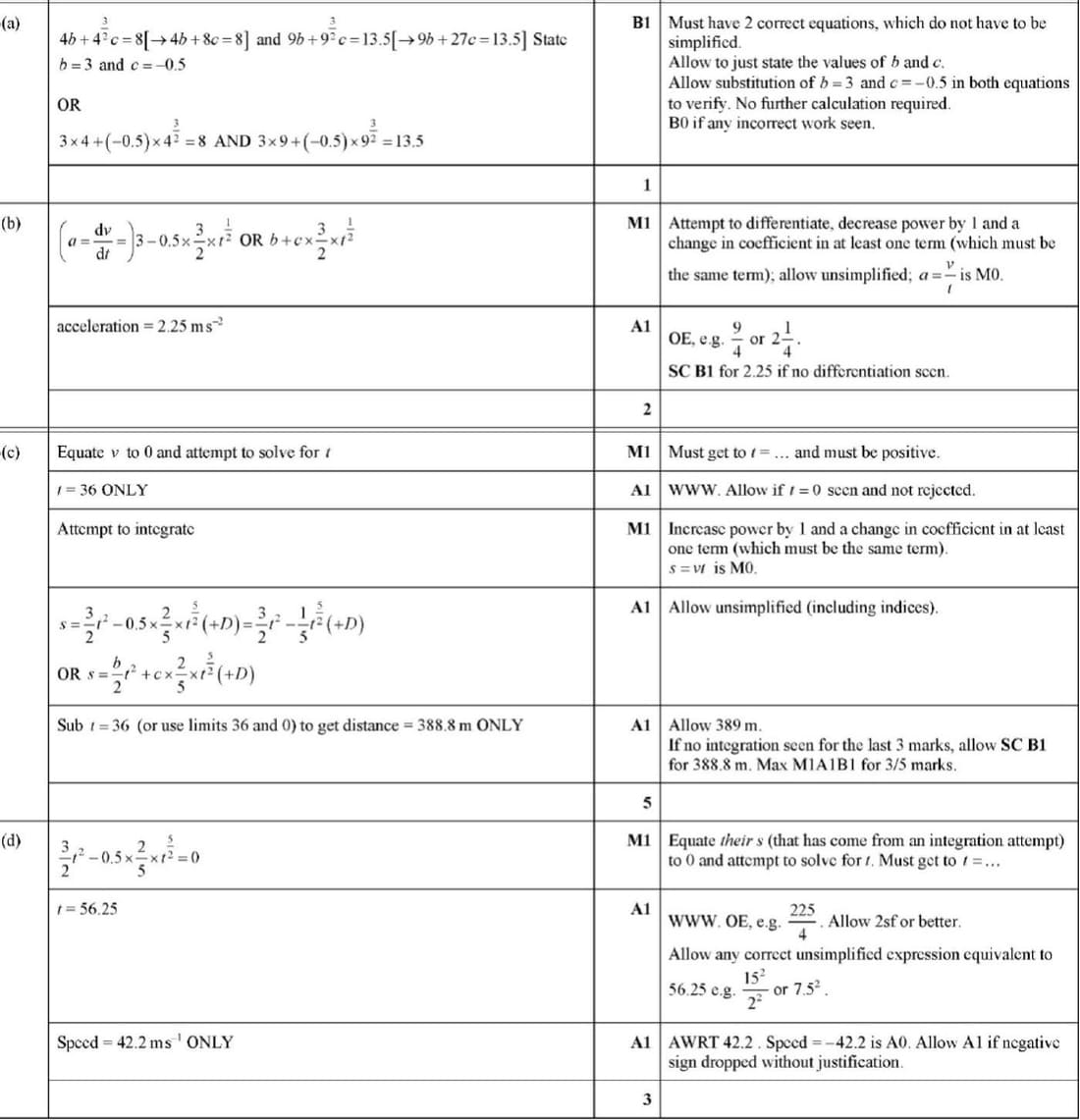
A particle P starts at rest and moves in a straight line from a point O. At time t s after leaving O, the velocity of P, v m/s, is given by \(v = bt + ct^{\frac{3}{2}}\), where b and c are constants. P has velocity 8 m/s when \(t = 4\) and has velocity 13.5 m/s when \(t = 9\).
- Show that \(b = 3\) and \(c = -0.5\).
- Find the acceleration of P when \(t = 1\).
- Find the positive value of t when P is at instantaneous rest and find the distance of P from O at this instant.
- Find the speed of P at the instant it returns to O.
9709 P41 - Jun 2016 - Q6
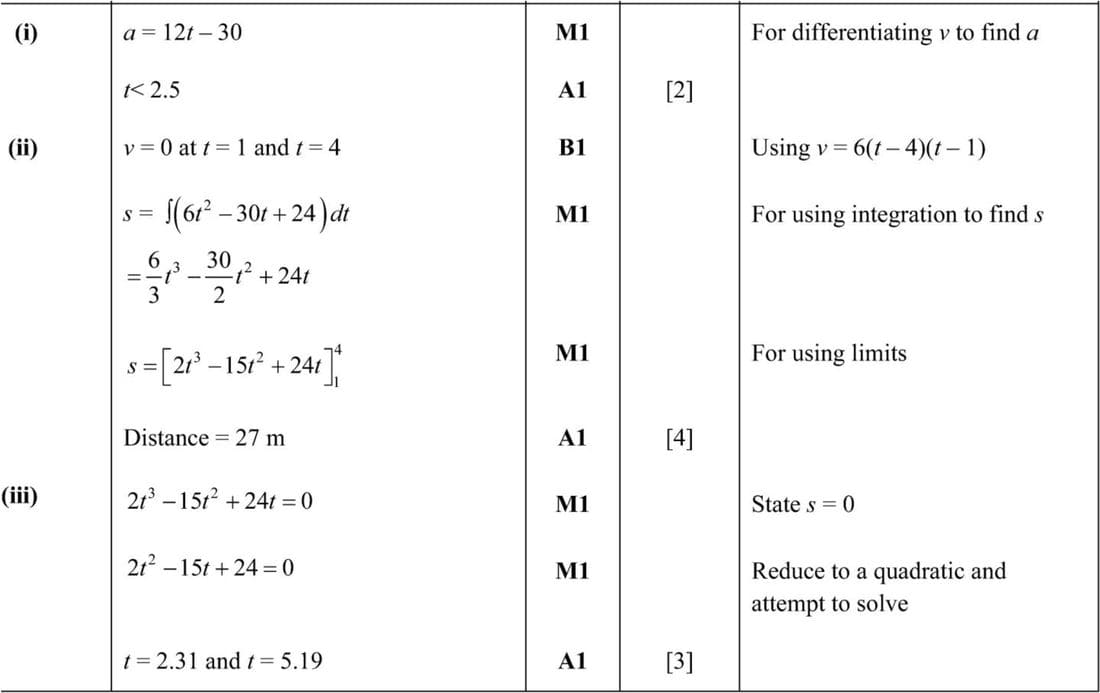
A particle P moves in a straight line. It starts at a point O on the line and at time t s after leaving O it has a velocity v m s-1, where v = 6t^2 - 30t + 24.
- Find the set of values of t for which the acceleration of the particle is negative.
- Find the distance between the two positions at which P is at instantaneous rest.
- Find the two positive values of t at which P passes through O.
9709 P43 - Nov 2015 - Q6
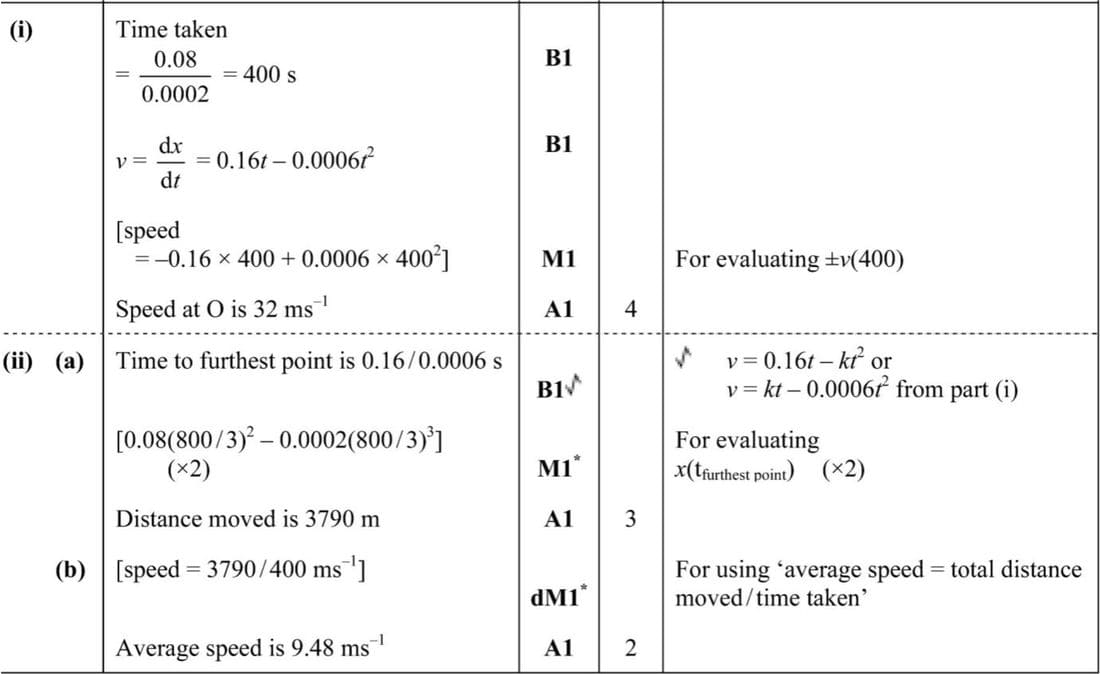
A particle P starts from rest at a point O of a straight line and moves along the line. The displacement of the particle at time t s after leaving O is x m, where
\(x = 0.08t^2 - 0.0002t^3\).
- Find the value of t when P returns to O and find the speed of P as it passes through O on its return.
- For the motion of P until the instant it returns to O, find
- the total distance travelled,
- the average speed.
9709 P42 - Nov 2015 - Q3
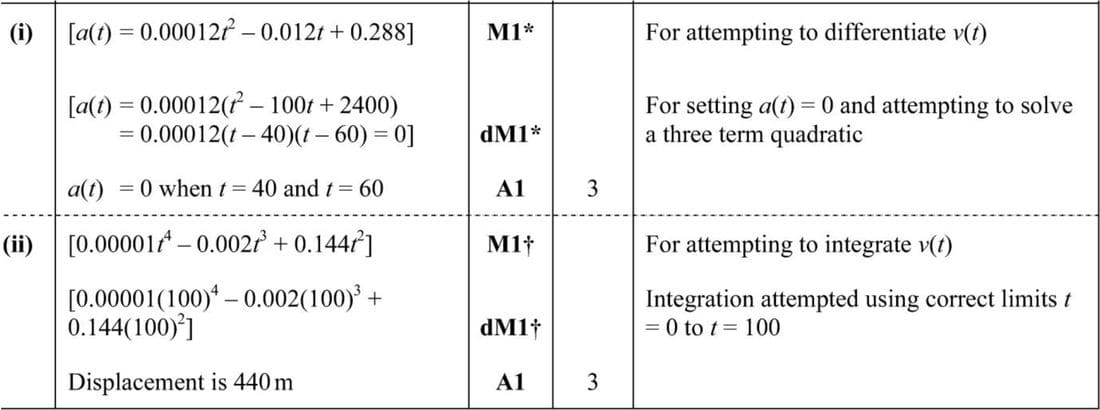
A particle P moves along a straight line for 100 s. It starts at a point O and at time t seconds after leaving O the velocity of P is v m/s, where
\(v = 0.00004t^3 - 0.006t^2 + 0.288t\).
- Find the values of t at which the acceleration of P is zero.
- Find the displacement of P from O when t = 100.
9709 P41 - Nov 2015 - Q6
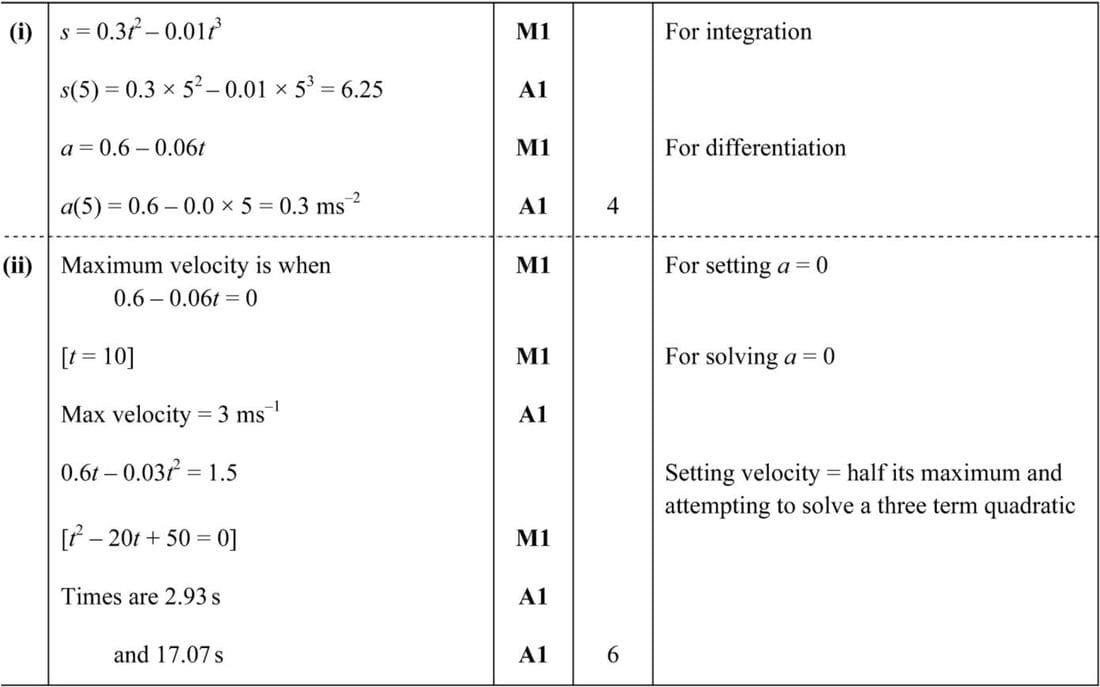
A particle P moves in a straight line, starting from a point O. The velocity of P, measured in m s-1, at time t s after leaving O is given by
\(v = 0.6t - 0.03t^2\).
- Verify that, when \(t = 5\), the particle is 6.25 m from O. Find the acceleration of the particle at this time.
- Find the values of \(t\) at which the particle is travelling at half of its maximum velocity.
9709 P42 - Jun 2015 - Q4
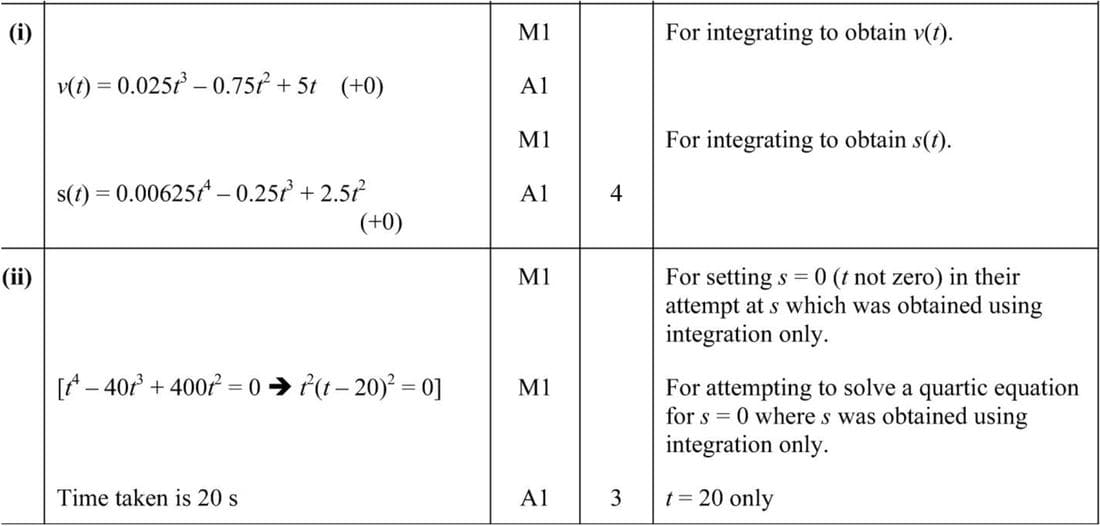
A particle P moves in a straight line. At time t seconds after starting from rest at the point O on the line, the acceleration of P is a m/s2, where a = 0.075t2 - 1.5t + 5.
- Find an expression for the displacement of P from O in terms of t.
- Hence find the time taken for P to return to the point O.
9709 P43 - Nov 2014 - Q4
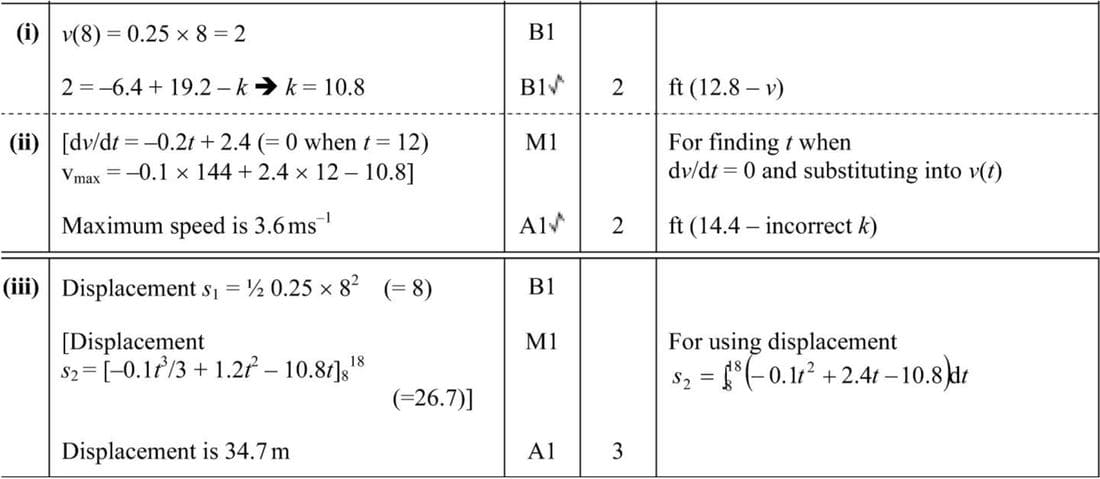
A particle P starts from rest and moves in a straight line for 18 seconds. For the first 8 seconds of the motion P has constant acceleration 0.25 m/s2. Subsequently P's velocity, v m/s-1 at time t seconds after the motion started, is given by
\(v = -0.1t^2 + 2.4t - k\),
where \(8 \leq t \leq 18\) and \(k\) is a constant.
- Find the value of \(v\) when \(t = 8\) and hence find the value of \(k\).
- Find the maximum velocity of P.
- Find the displacement of P from its initial position when \(t = 18\).
9709 P42 - Nov 2014 - Q7
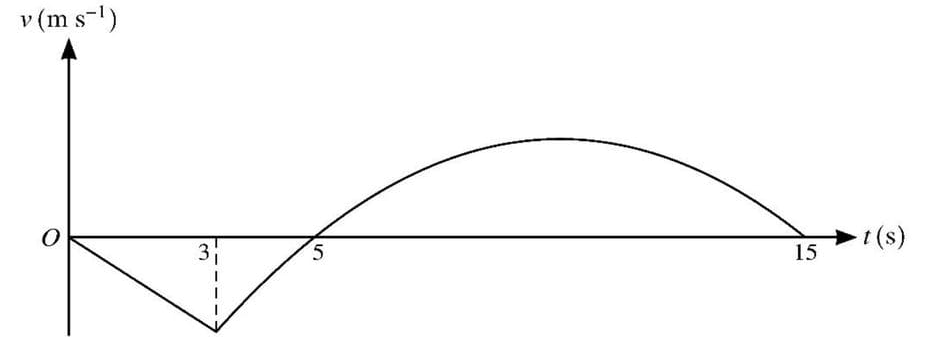
The diagram shows the velocity-time graph for the motion of a particle P which moves on a straight line BAC. It starts at A and travels to B taking 5 s. It then reverses direction and travels from B to C taking 10 s. For the first 3 s of P's motion its acceleration is constant. For the remaining 12 s the velocity of P is v m s-1 at time t s after leaving A, where
\(v = -0.2t^2 + 4t - 15\) for \(3 \leq t \leq 15\).
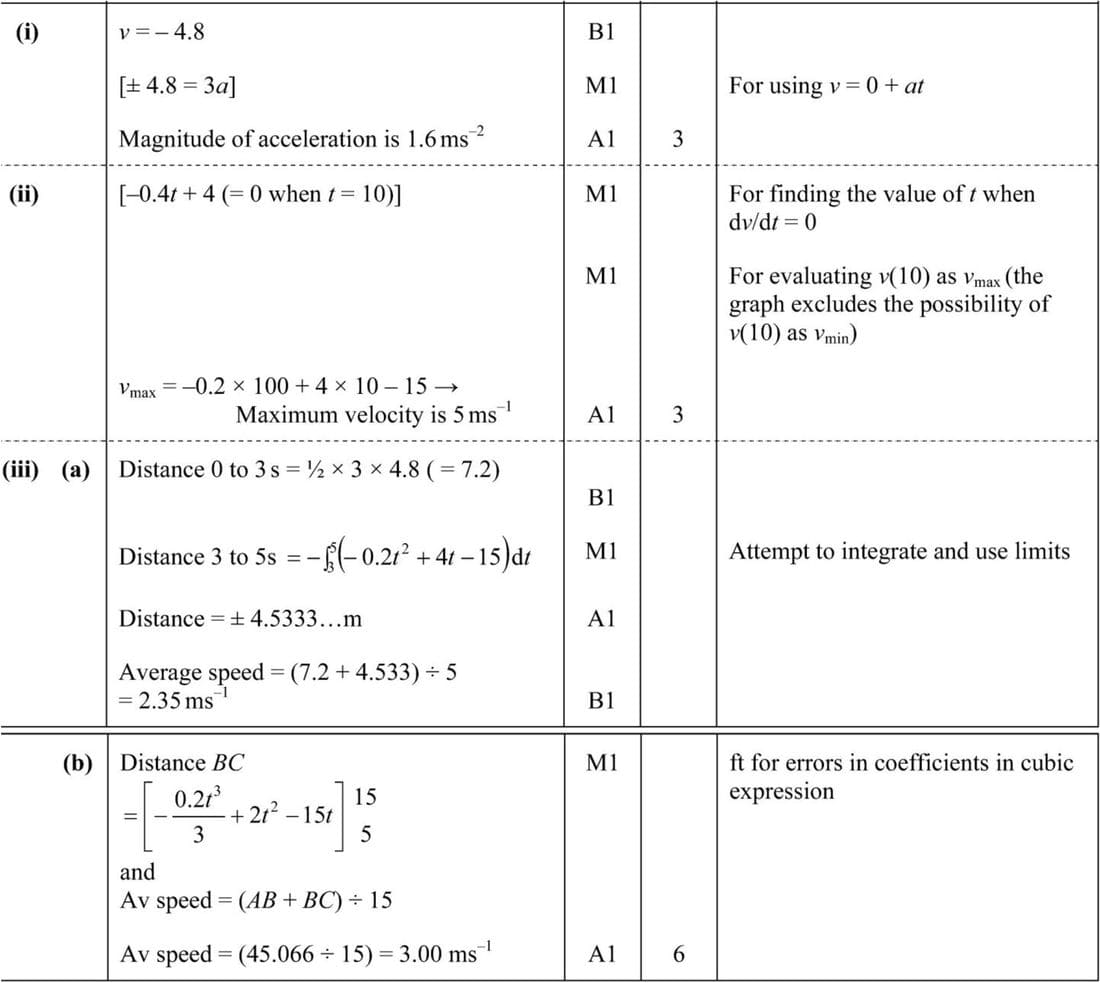
- Find the value of v when t = 3 and the magnitude of the acceleration of P for the first 3 s of its motion.
- Find the maximum velocity of P while it is moving from B to C.
- Find the average speed of P,
- while moving from A to B,
- for the whole journey.