Browsing as Guest. Progress, bookmarks and attempts are disabled.
Log in to track your work.
FM June 2021 p12 q05
4264
The curve C has polar equation \(r = a \cot\left(\frac{1}{3}\pi - \theta\right)\), where \(a\) is a positive constant and \(0 \leq \theta \leq \frac{1}{6}\pi\).
It is given that the greatest distance of a point on C from the pole is \(2\sqrt{3}\).
Sketch C and show that \(a = 2\). [3]
Find the exact value of the area of the region bounded by C, the initial line and the half-line \(\theta = \frac{1}{6}\pi\). [4]
Show that C has Cartesian equation \(2(x + y\sqrt{3}) = (x\sqrt{3} - y)\sqrt{x^2 + y^2}\). [3]
Solution
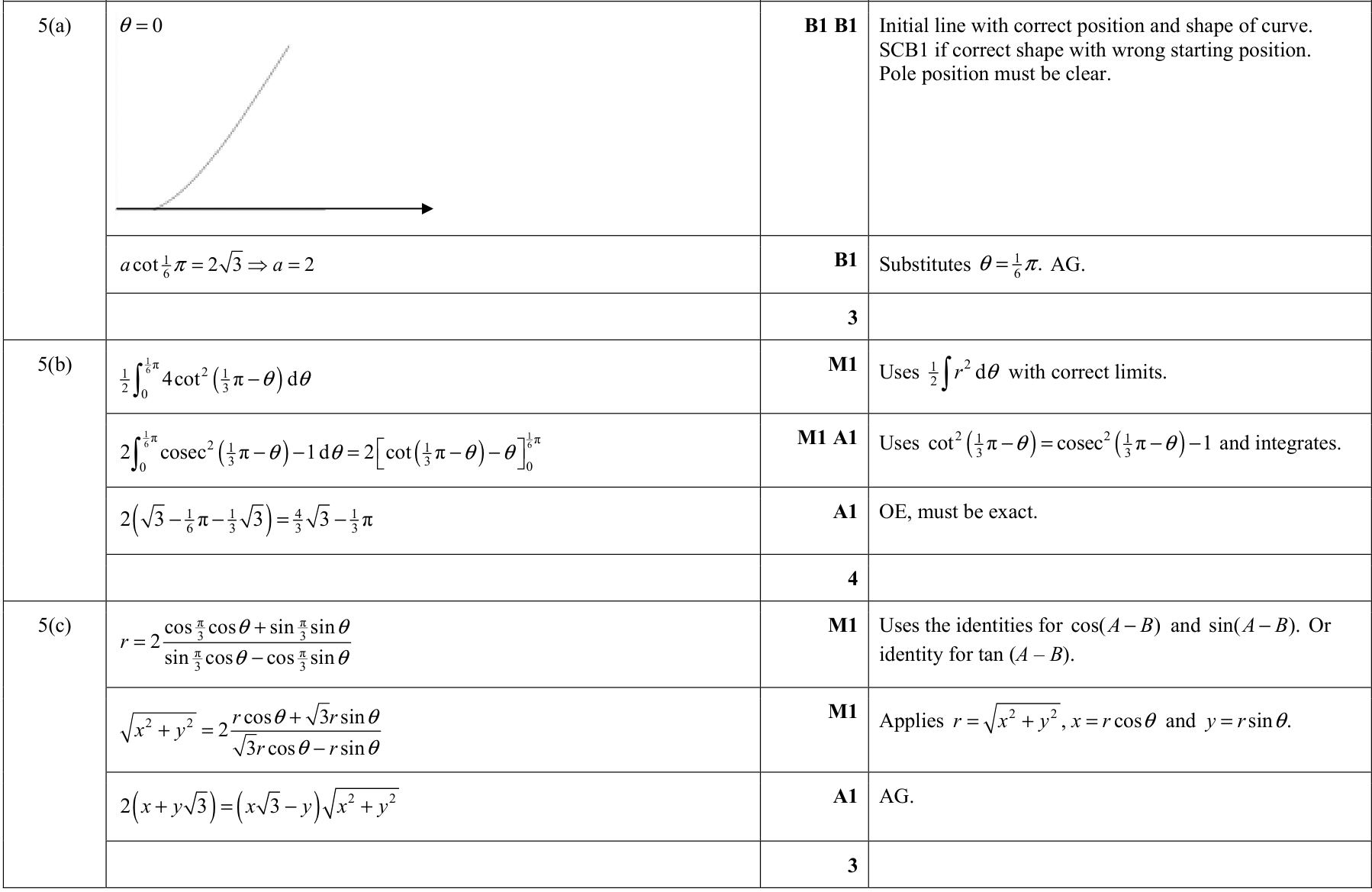
(a) At \(\theta = 0\), \(r = a \cot\left(\frac{1}{3}\pi\right) = 2\sqrt{3}\). Solving gives \(a = 2\).
(b) The area is given by \(\frac{1}{2} \int_{0}^{\frac{1}{6}\pi} 4\cot^2\left(\frac{1}{3}\pi - \theta\right) \, d\theta\). This simplifies to \(2 \left[ \cot\left(\frac{1}{3}\pi - \theta\right) - \theta \right]_{0}^{\frac{1}{6}\pi}\), resulting in \(\frac{4}{3}\sqrt{3} - \frac{1}{3}\sqrt{3}\pi\).
(c) Using identities for \(\cos(A-B)\) and \(\sin(A-B)\), and substituting \(r = \sqrt{x^2 + y^2}\), \(x = r \cos \theta\), \(y = r \sin \theta\), the Cartesian equation is shown as \(2(x + y\sqrt{3}) = (x\sqrt{3} - y)\sqrt{x^2 + y^2}\).