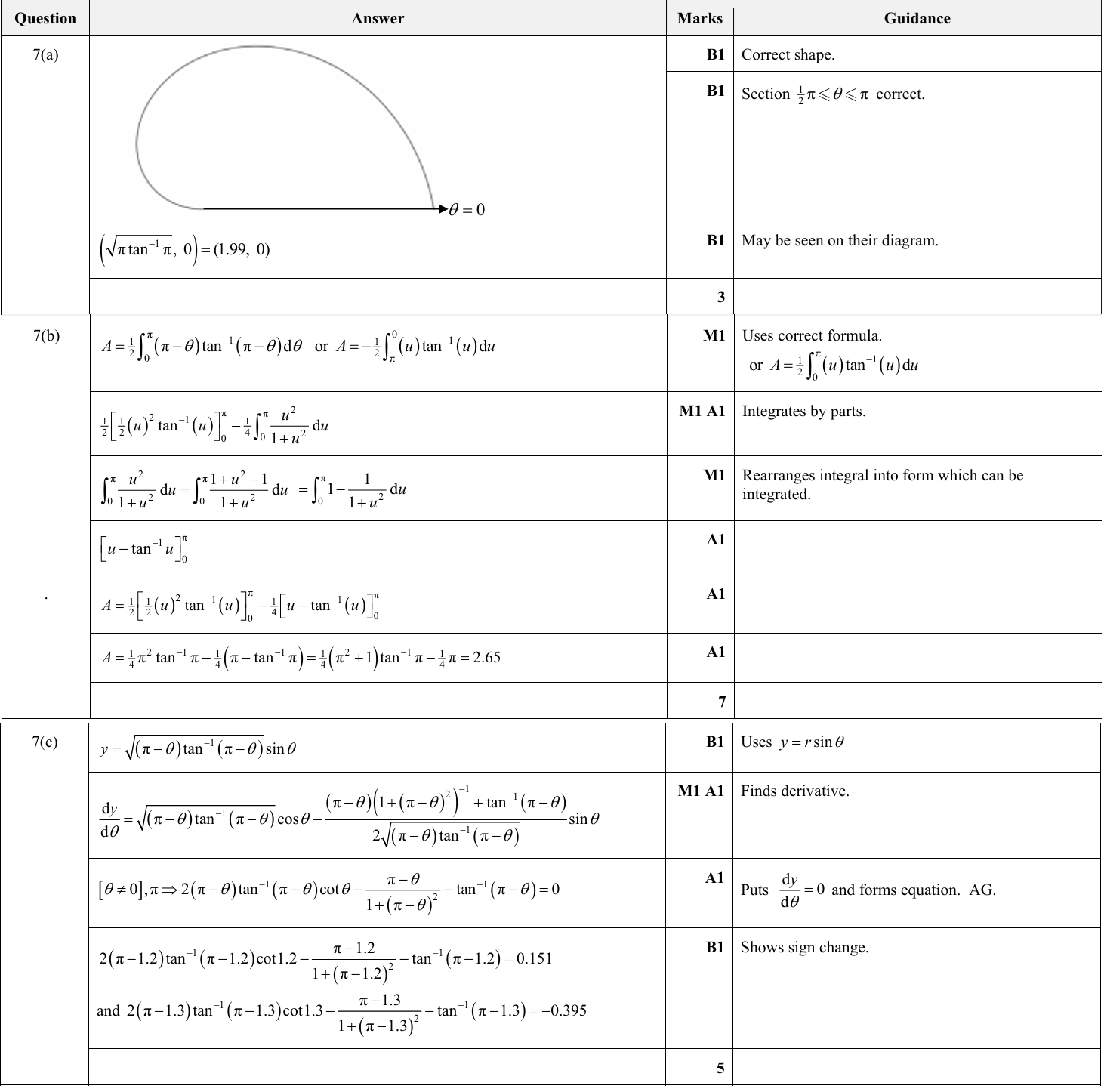
(a) The polar coordinates of the point of C furthest from the pole are \((\sqrt{\pi \arctan \pi}, 0) = (1.99, 0)\).
(b) Using the substitution \(u = \pi - \theta\), the area \(A\) is given by:
\(A = \frac{1}{2} \int_0^\pi (\pi - \theta) \arctan(\pi - \theta) \, d\theta\)
or
\(A = \frac{1}{2} \int_0^\pi u \arctan(u) \, du\)
Integrating by parts:
\(\frac{1}{2} \left[ \frac{1}{2} (u^2) \arctan(u) \right]_0^\pi - \frac{1}{2} \int_0^\pi \frac{u^2}{1 + u^2} \, du\)
\(\int_0^\pi \frac{u^2}{1 + u^2} \, du = \left[ u - \arctan(u) \right]_0^\pi\)
\(A = \frac{1}{4} \pi^2 \arctan \pi - \frac{1}{4} (\pi^2 + 1) \arctan \pi - \frac{1}{4} \pi = 2.65\)
(c) Let \(y = r \sin \theta\), then:
\(\frac{dy}{d\theta} = \frac{d}{d\theta} \left( \sqrt{(\pi - \theta) \arctan(\pi - \theta)} \sin \theta \right)\)
\(= \frac{(\pi - \theta) \arctan(\pi - \theta) \cos \theta}{\sqrt{(\pi - \theta) \arctan(\pi - \theta)}} + \arctan(\pi - \theta) \sin \theta\)
Setting \(\frac{dy}{d\theta} = 0\) gives:
\(2(\pi - \theta) \arctan(\pi - \theta) \cot \theta - \frac{\pi - \theta}{1 + (\pi - \theta)^2} - \arctan(\pi - \theta) = 0\)
For \(\theta = 1.2\),
\(2(\pi - 1.2) \arctan(\pi - 1.2) \cot 1.2 - \frac{\pi - 1.2}{1 + (\pi - 1.2)^2} - \arctan(\pi - 1.2) = 0.151\)
For \(\theta = 1.3\),
\(2(\pi - 1.3) \arctan(\pi - 1.3) \cot 1.3 - \frac{\pi - 1.3}{1 + (\pi - 1.3)^2} - \arctan(\pi - 1.3) = -0.395\)
There is a sign change, confirming a root exists between \(\theta = 1.2\) and \(\theta = 1.3\).