9231 P11 - Jun 2023 - Q05 - 12 marks
4203
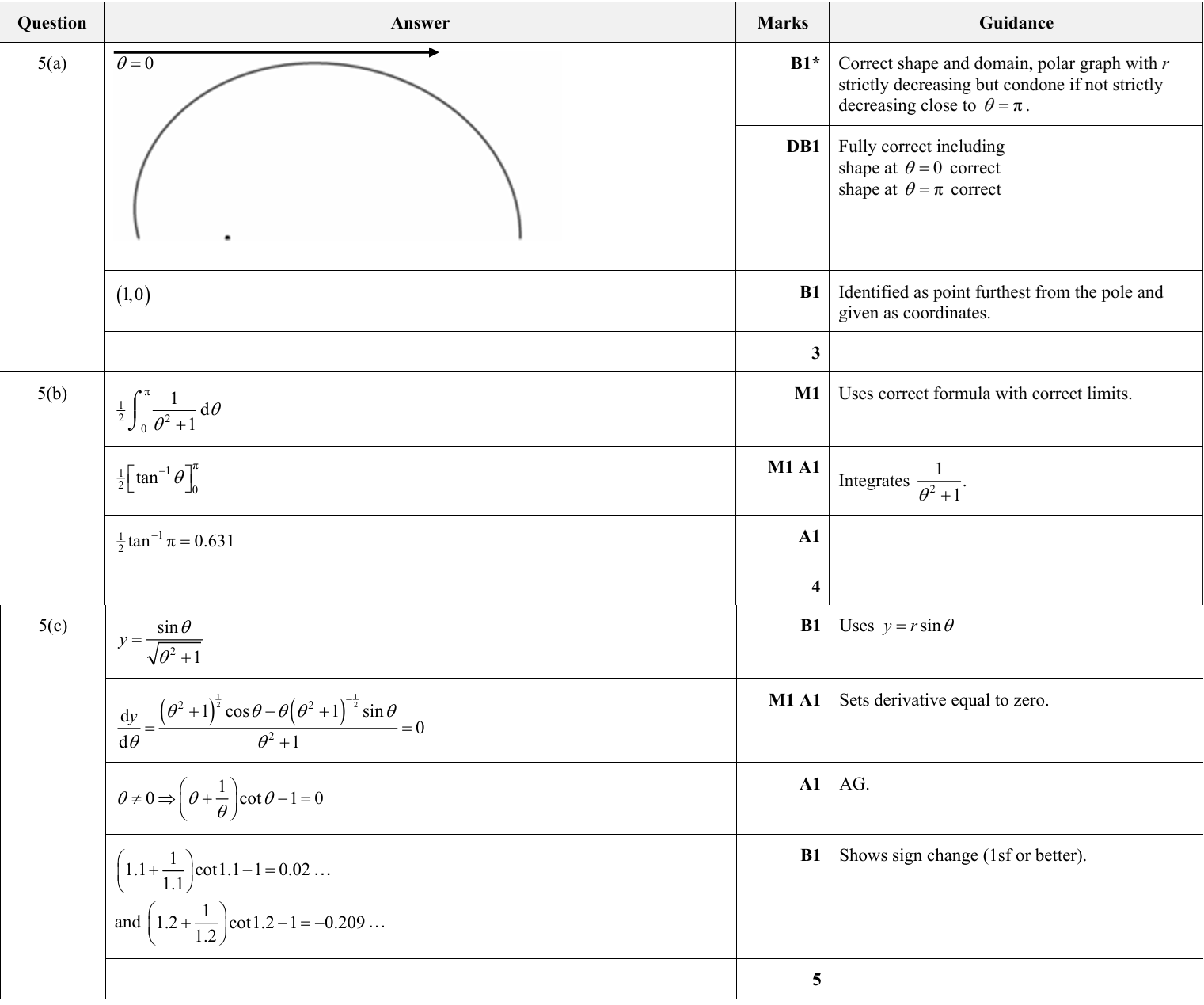
The curve \(C\) has polar equation \(r^2 = \frac{1}{\theta^2 + 1}\), for \(0 \leq \theta \leq \pi\).
- Sketch \(C\) and state the polar coordinates of the point of \(C\) furthest from the pole.
- Find the area of the region enclosed by \(C\), the initial line, and the half-line \(\theta = \pi\).
- Show that, at the point of \(C\) furthest from the initial line, \(\left( \theta + \frac{1}{\theta} \right) \cot \theta - 1 = 0\) and verify that this equation has a root between 1.1 and 1.2.