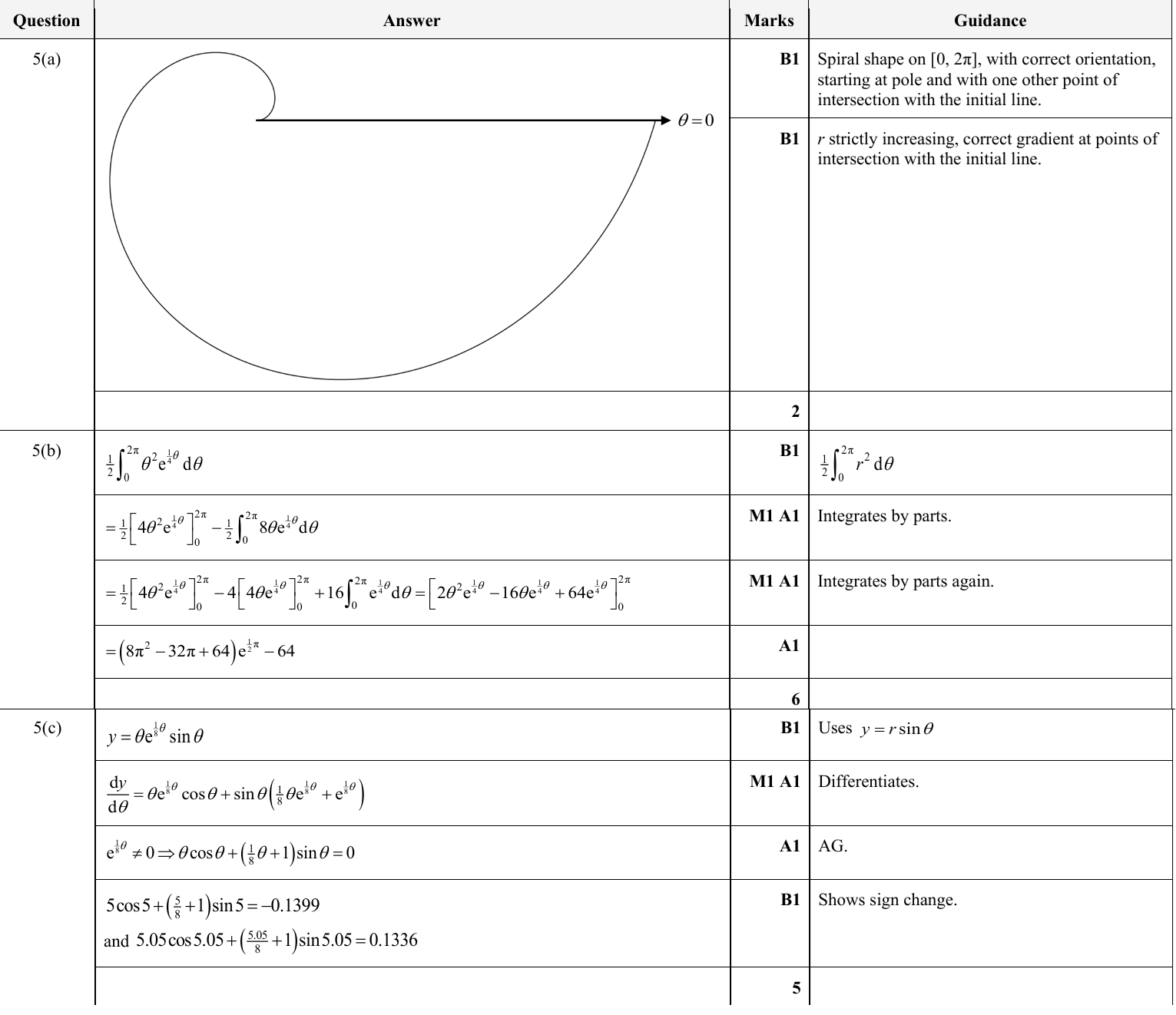
(a) The curve is a spiral starting at the pole \(\theta = 0\) and spiraling outward as \(\theta\) increases to \(2\pi\). The radius \(r\) is strictly increasing, and the gradient is correct at points of intersection with the initial line.
(b) The area \(A\) is given by:
\(A = \frac{1}{2} \int_{0}^{2\pi} \theta^2 e^{\frac{1}{4} \theta} d\theta\)
Integrate by parts:
\(= \frac{1}{2} \left[ 4\theta^2 e^{\frac{1}{4} \theta} \right]_{0}^{2\pi} - \int_{0}^{2\pi} 8\theta e^{\frac{1}{4} \theta} d\theta\)
Integrate by parts again:
\(= \frac{1}{2} \left[ 4\theta^2 e^{\frac{1}{4} \theta} - 4(4\theta e^{\frac{1}{4} \theta} + 16)e^{\frac{1}{4} \theta} \right]_{0}^{2\pi}\)
\(= \left[ 2\theta^2 e^{\frac{1}{4} \theta} - 16\theta e^{\frac{1}{4} \theta} + 64e^{\frac{1}{4} \theta} \right]_{0}^{2\pi}\)
\(= (8\pi^2 - 32\pi + 64)e^{\frac{1}{2}\pi} - 64\)
(c) Let \(y = \theta e^{\frac{1}{8} \theta} \sin \theta\). Differentiate:
\(\frac{dy}{d\theta} = e^{\frac{1}{8} \theta} \cos \theta + \sin \theta \left( \frac{1}{8} \theta e^{\frac{1}{8} \theta} + e^{\frac{1}{8} \theta} \right)\)
Set \(\frac{dy}{d\theta} = 0\):
\(e^{\frac{1}{8} \theta} (\theta \cos \theta + (\frac{1}{8} \theta + 1) \sin \theta) = 0\)
Check sign change:
\(5 \cos 5 + (\frac{5}{8} + 1) \sin 5 = -0.1399\)
\(5.05 \cos 5.05 + (\frac{5.05}{8} + 1) \sin 5.05 = 0.1336\)
There is a sign change between 5 and 5.05, confirming a root exists.