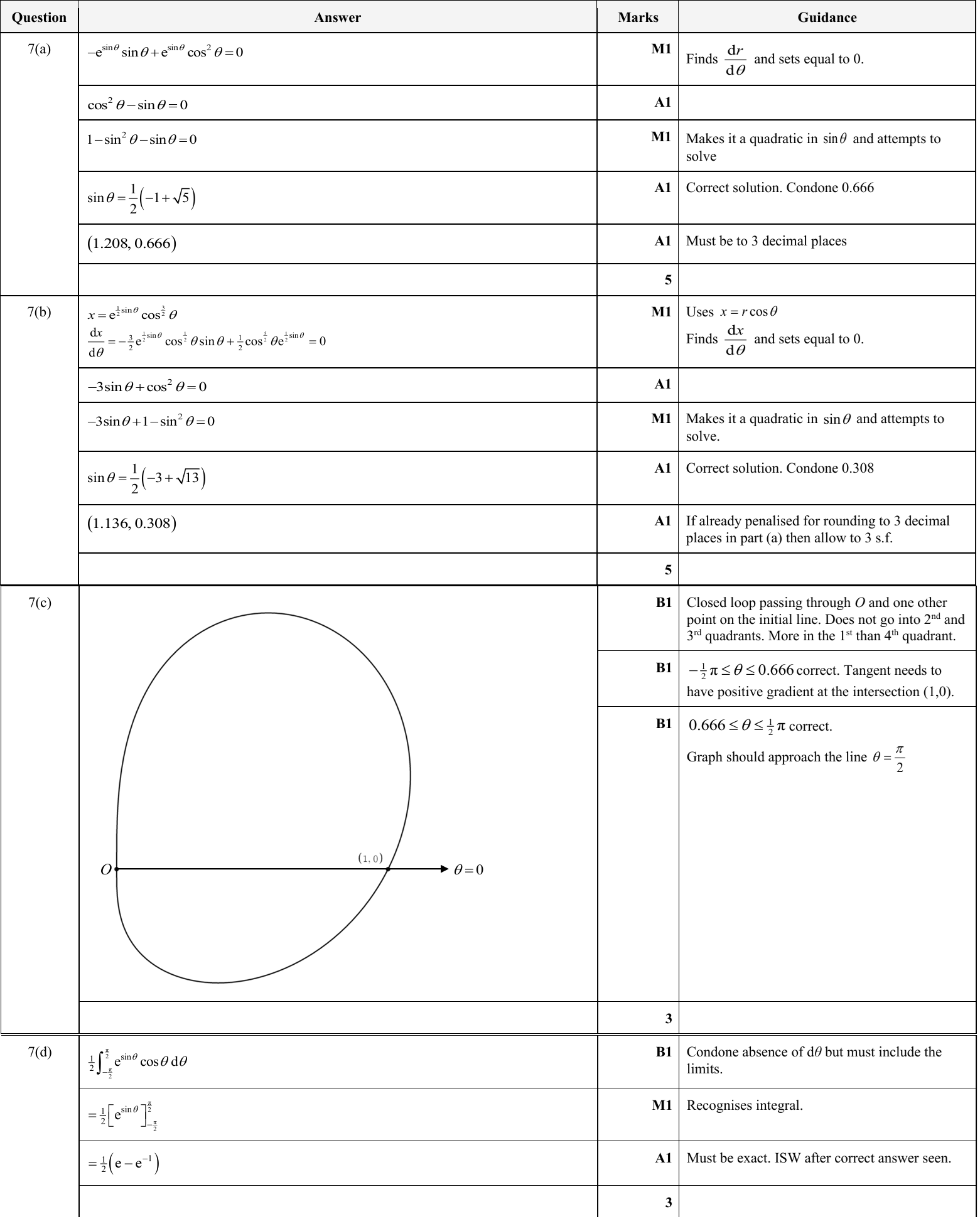
(a) Differentiate \(r^2 = e^{\sin \theta} \cos \theta\) with respect to \(\theta\) and set \(\frac{dr}{d\theta} = 0\). This gives:
\(-e^{\sin \theta} \sin \theta + e^{\sin \theta} \cos^2 \theta = 0\)
\(\cos^2 \theta = \sin \theta\)
\(1 - \sin^2 \theta = \sin \theta\)
\(\sin \theta = \frac{1}{2}(-1 + \sqrt{5})\)
\(\theta = 0.666\)
\(r = \sqrt{e^{\sin(0.666)} \cos(0.666)} = 1.208\)
(b) Use \(x = e^{\sin \theta} \cos \theta\) and differentiate with respect to \(\theta\):
\(\frac{dx}{d\theta} = -\frac{1}{2}e^{\sin \theta} \cos \theta \sin \theta + e^{\sin \theta} \cos \theta \cos \theta - \frac{1}{2}e^{\sin \theta} \sin \theta \cos \theta = 0\)
\(-3\sin \theta + \cos^2 \theta = 0\)
\(-3\sin \theta + 1 - \sin^2 \theta = 0\)
\(\sin \theta = \frac{1}{2}(-3 + \sqrt{13})\)
\(\theta = 0.308\)
\(r = \sqrt{e^{\sin(0.308)} \cos(0.308)} = 1.136\)
(c) The sketch shows a closed loop passing through O and one other point on the initial line. It does not go into the 2nd and 3rd quadrants and is more in the 1st than the 4th quadrant.
(d) The area is given by:
\(\frac{1}{2} \int_{-\frac{1}{2}\pi}^{\frac{1}{2}\pi} e^{\sin \theta} \cos \theta \, d\theta\)
\(= \frac{1}{2} \left[ e^{\sin \theta} \right]_{-\frac{1}{2}\pi}^{\frac{1}{2}\pi}\)
\(= \frac{1}{3}(e - e^{-1})\)