Past Exam Questions
← Back9709 P61 - Jun 2012 - Q6
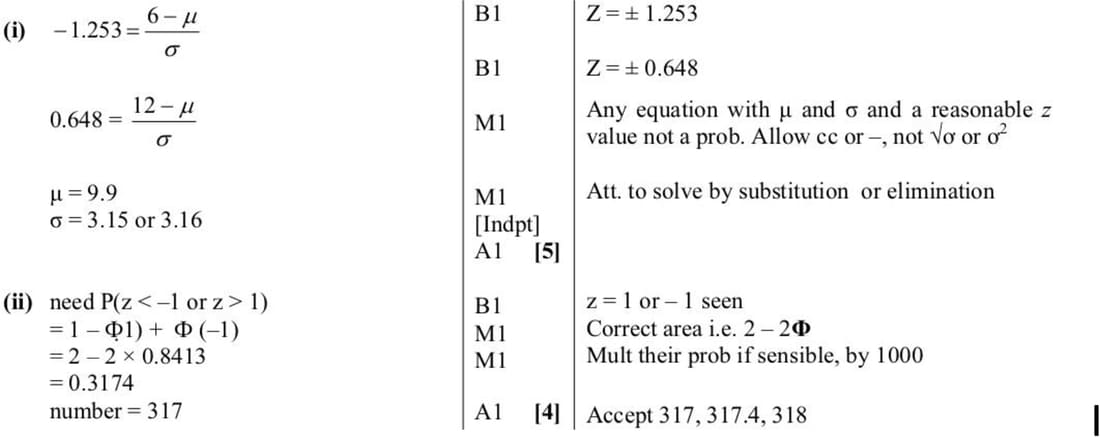
The lengths of body feathers of a particular species of bird are modelled by a normal distribution. A researcher measures the lengths of a random sample of 600 body feathers from birds of this species and finds that 63 are less than 6 cm long and 155 are more than 12 cm long.
(i) Find estimates of the mean and standard deviation of the lengths of body feathers of birds of this species.
(ii) In a random sample of 1000 body feathers from birds of this species, how many would the researcher expect to find with lengths more than 1 standard deviation from the mean?
9709 P63 - Nov 2011 - Q1
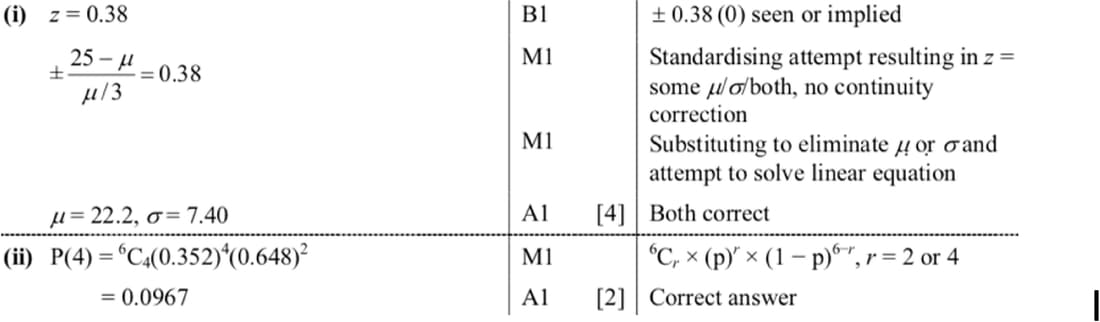
The random variable X is normally distributed and is such that the mean μ is three times the standard deviation σ. It is given that P(X < 25) = 0.648.
- Find the values of μ and σ.
- Find the probability that, from 6 random values of X, exactly 4 are greater than 25.
9709 P62 - Nov 2011 - Q7
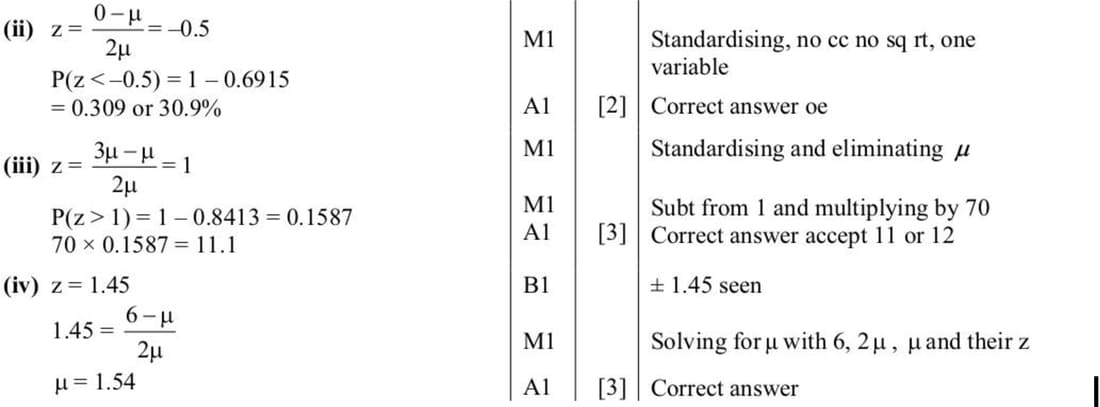
The daily minimum temperature, in °C, in another country in winter has a normal distribution with mean \(\mu\) and standard deviation \(2\mu\).
(ii) Find the proportion of winter days on which the minimum temperature is below zero.
(iii) 70 winter days are chosen at random. Find how many of these would be expected to have a minimum temperature which is more than three times the mean.
(iv) The probability of the minimum temperature being above 6 °C on any winter day is 0.0735. Find the value of \(\mu\).
9709 P61 - Nov 2011 - Q5
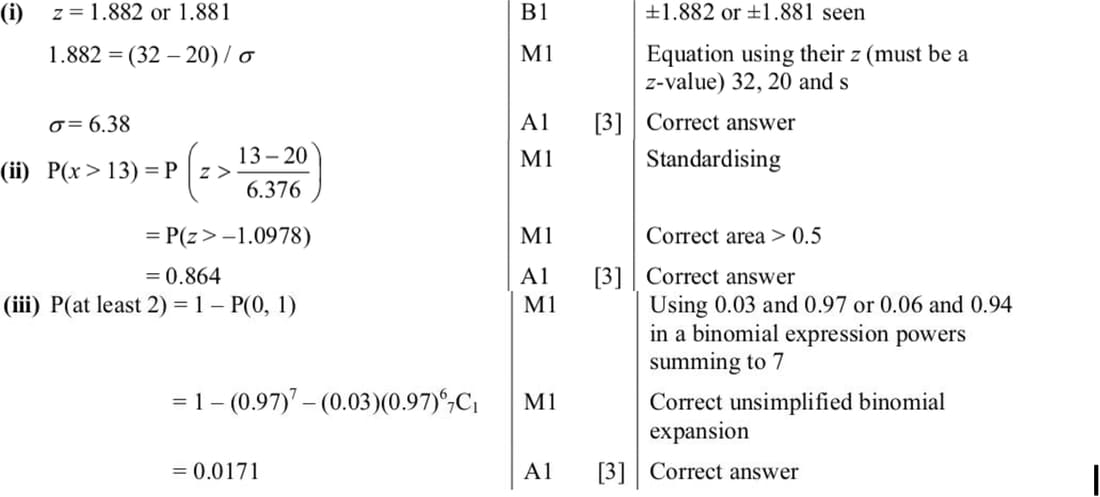
The weights of letters posted by a certain business are normally distributed with mean 20 g. It is found that the weights of 94% of the letters are within 12 g of the mean.
- Find the standard deviation of the weights of the letters.
- Find the probability that a randomly chosen letter weighs more than 13 g.
- Find the probability that at least 2 of a random sample of 7 letters have weights which are more than 12 g above the mean.
9709 P62 - Jun 2011 - Q6
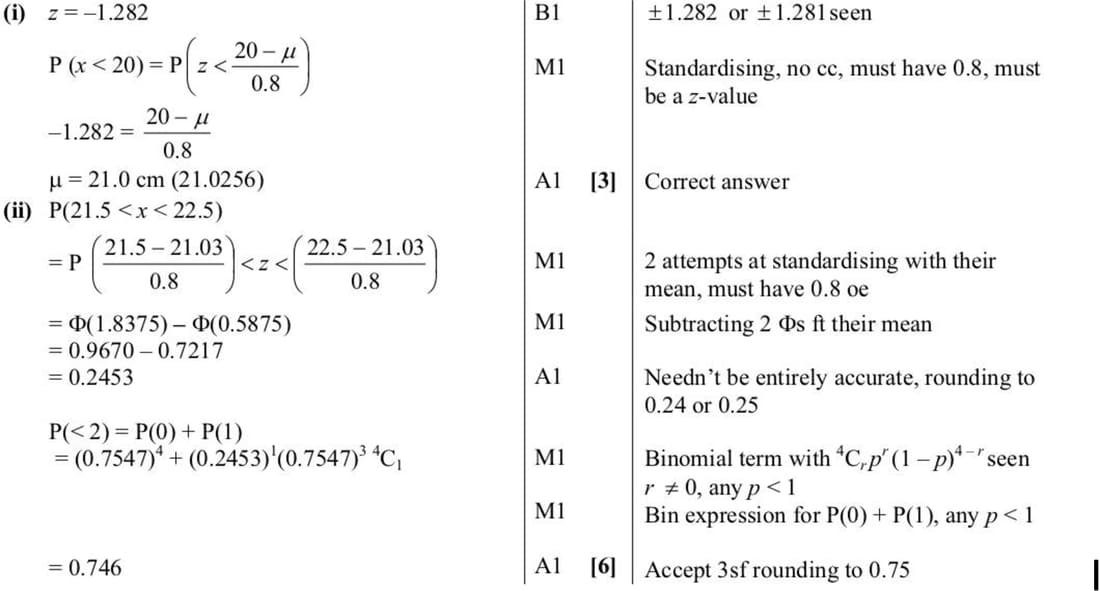
The lengths, in centimetres, of drinking straws produced in a factory have a normal distribution with mean \(\mu\) and variance 0.64. It is given that 10% of the straws are shorter than 20 cm.
- Find the value of \(\mu\).
- Find the probability that, of 4 straws chosen at random, fewer than 2 will have a length between 21.5 cm and 22.5 cm.
9709 P61 - Jun 2011 - Q5
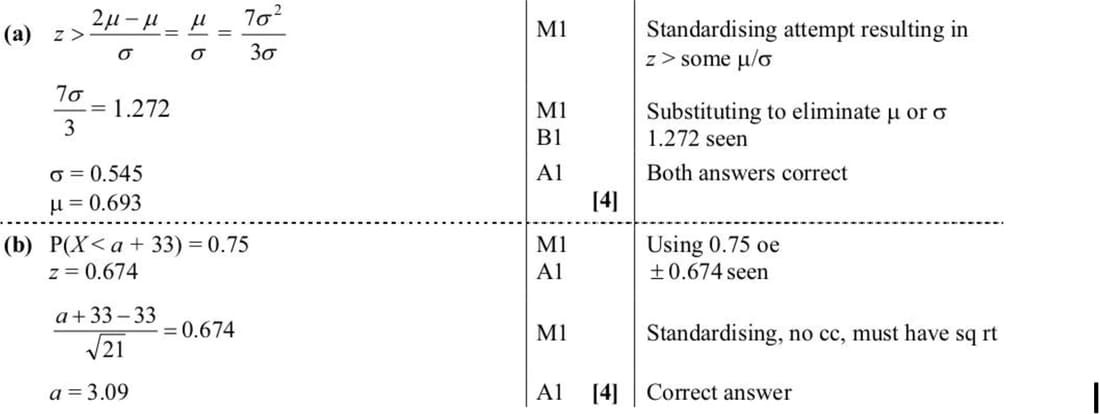
(a) The random variable X is normally distributed with mean μ and standard deviation σ. It is given that 3μ = 7σ2 and that P(X > 2μ) = 0.1016. Find μ and σ.
(b) It is given that Y ~ N(33, 21). Find the value of a given that P(33 − a < Y < 33 + a) = 0.5.
9709 P63 - Nov 2010 - Q7
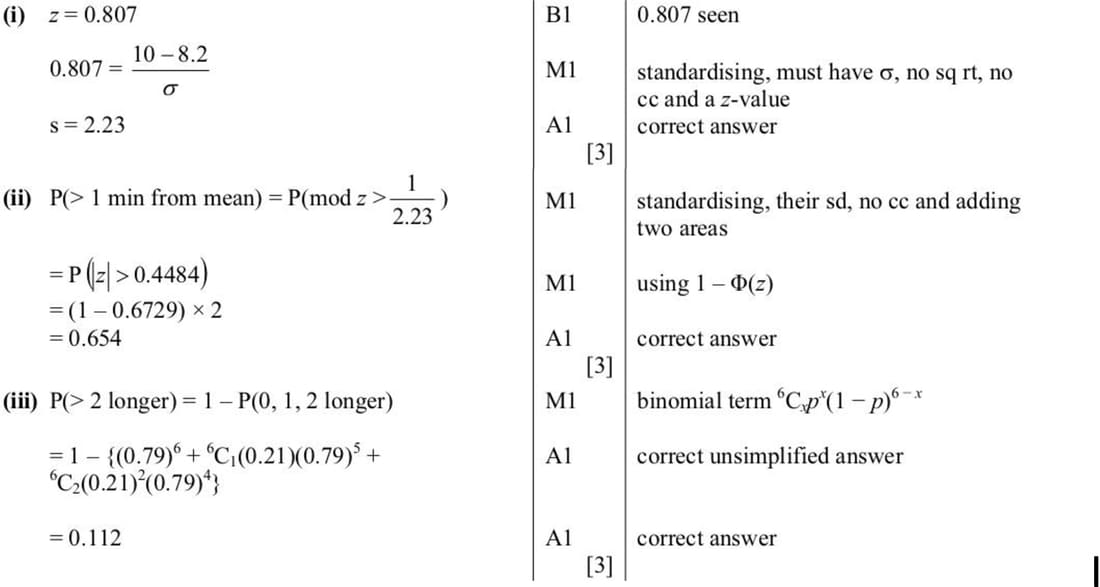
The times spent by people visiting a certain dentist are independent and normally distributed with a mean of 8.2 minutes. 79% of people who visit this dentist have visits lasting less than 10 minutes.
- Find the standard deviation of the times spent by people visiting this dentist.
- Find the probability that the time spent visiting this dentist by a randomly chosen person deviates from the mean by more than 1 minute.
- Find the probability that, of 6 randomly chosen people, more than 2 have visits lasting longer than 10 minutes.
9709 P62 - Nov 2010 - Q5
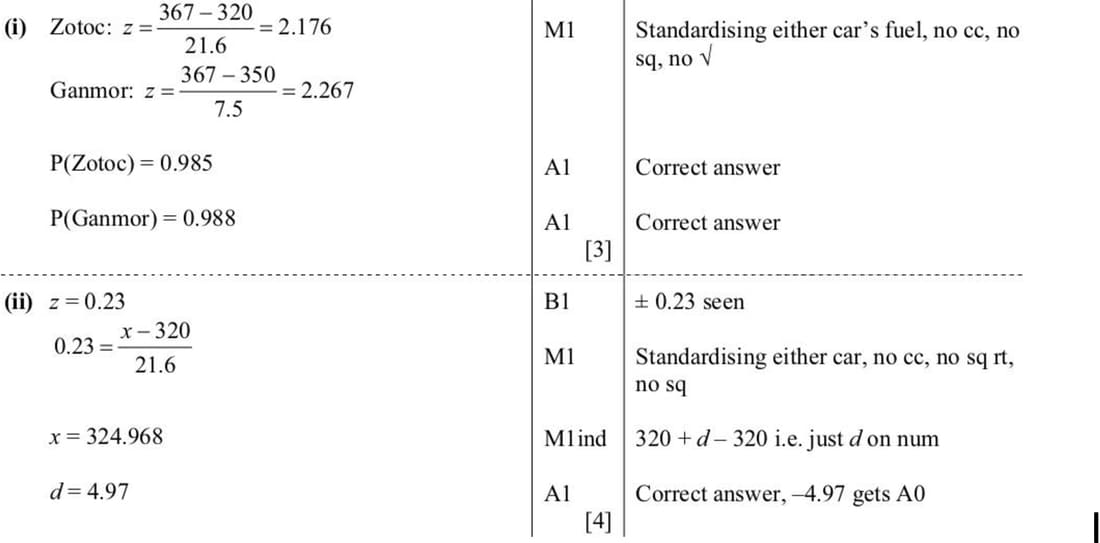
The distance the Zotoc car can travel on 20 litres of fuel is normally distributed with mean 320 km and standard deviation 21.6 km. The distance the Ganmor car can travel on 20 litres of fuel is normally distributed with mean 350 km and standard deviation 7.5 km. Both cars are filled with 20 litres of fuel and are driven towards a place 367 km away.
(i) For each car, find the probability that it runs out of fuel before it has travelled 367 km.
(ii) The probability that a Zotoc car can travel at least \(320 + d\) km on 20 litres of fuel is 0.409. Find the value of \(d\).
9709 P63 - Jun 2010 - Q7
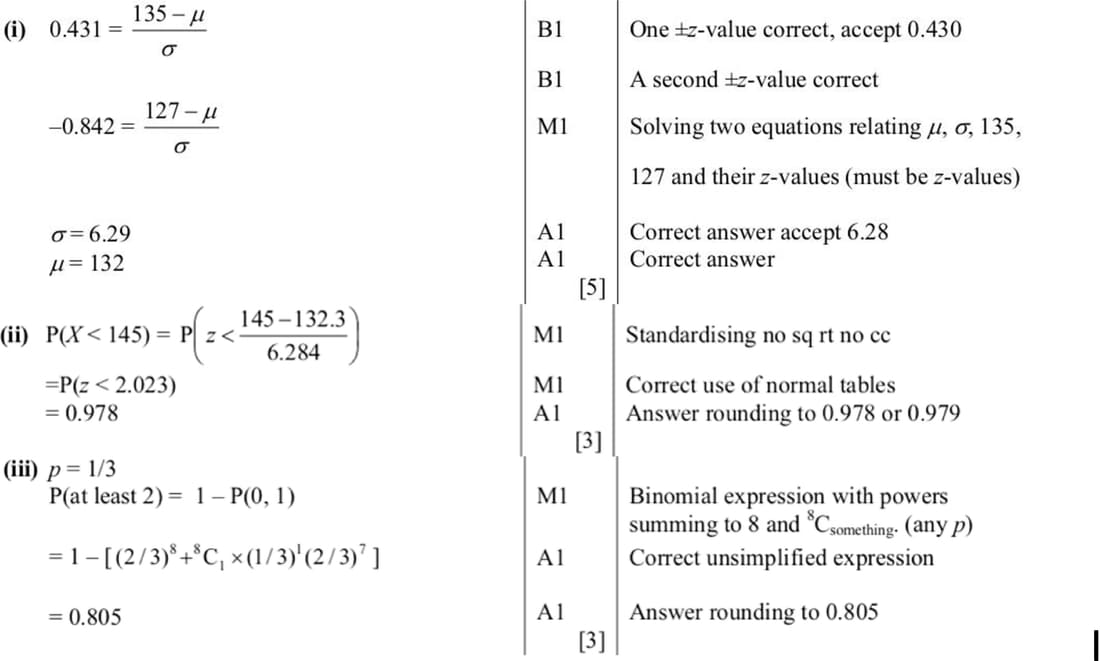
The heights that children of a particular age can jump have a normal distribution. On average, 8 children out of 10 can jump a height of more than 127 cm, and 1 child out of 3 can jump a height of more than 135 cm.
- Find the mean and standard deviation of the heights the children can jump.
- Find the probability that a randomly chosen child will not be able to jump a height of 145 cm.
- Find the probability that, of 8 randomly chosen children, at least 2 will be able to jump a height of more than 135 cm.
9709 P62 - Jun 2010 - Q4
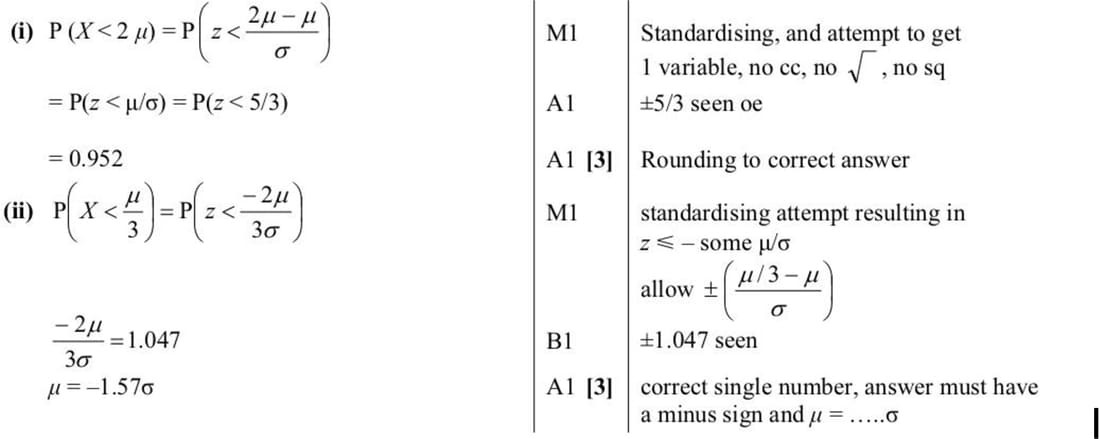
The random variable X is normally distributed with mean μ and standard deviation σ.
- Given that 5σ = 3μ, find P(X < 2μ).
- With a different relationship between μ and σ, it is given that P(X < 1/3μ) = 0.8524. Express μ in terms of σ.
9709 P52 - Jun 2022 - Q4
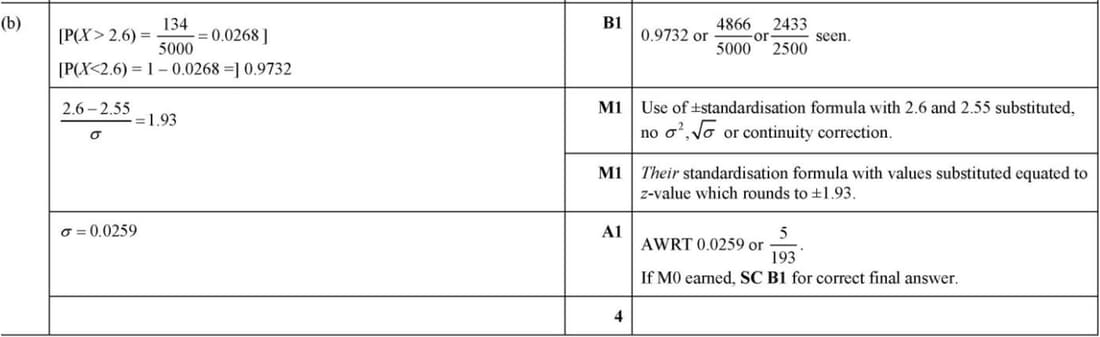
The weights of bags of rice produced by Binders are normally distributed with mean 2.55 kg and standard deviation \(\sigma\) kg. In a random sample of 5000 of these bags, 134 weighed more than 2.6 kg.
Find the value of \(\sigma\).
9709 P61 - Jun 2010 - Q3
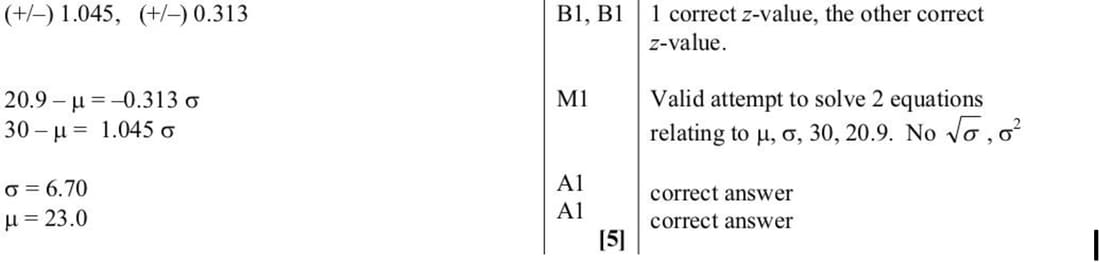
The random variable X is the length of time in minutes that Jannon takes to mend a bicycle puncture. X has a normal distribution with mean \(\mu\) and variance \(\sigma^2\). It is given that \(P(X > 30.0) = 0.1480\) and \(P(X > 20.9) = 0.6228\). Find \(\mu\) and \(\sigma\).
9709 P62 - Nov 2009 - Q7
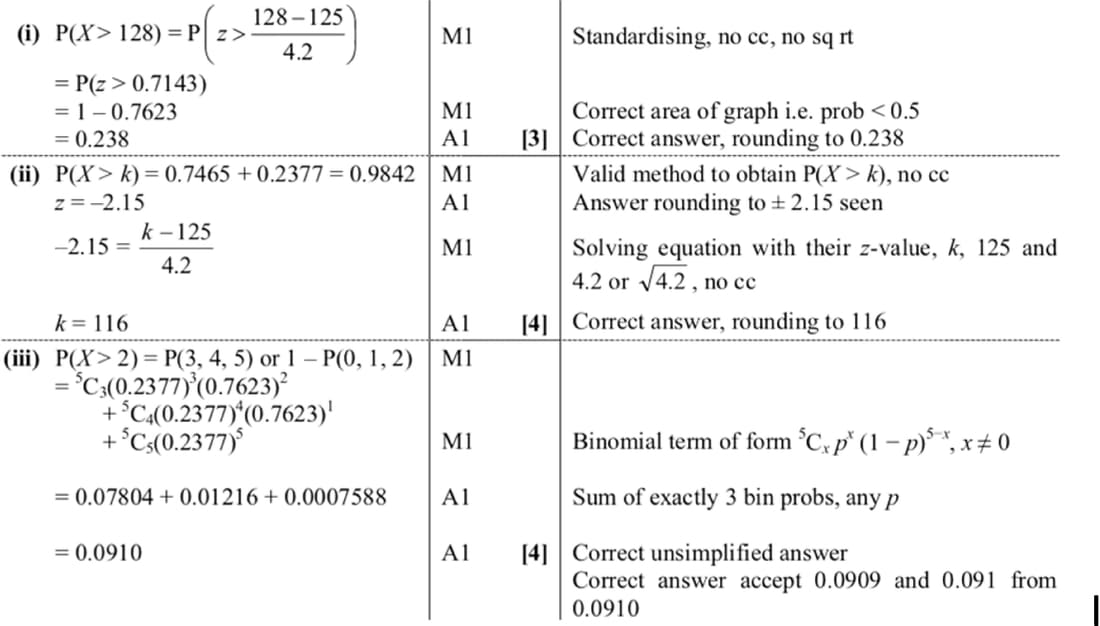
The weights, X grams, of bars of soap are normally distributed with mean 125 grams and standard deviation 4.2 grams.
- Find the probability that a randomly chosen bar of soap weighs more than 128 grams.
- Find the value of k such that P(k < X < 128) = 0.7465.
- Five bars of soap are chosen at random. Find the probability that more than two of the bars each weigh more than 128 grams.
9709 P62 - Nov 2009 - Q1
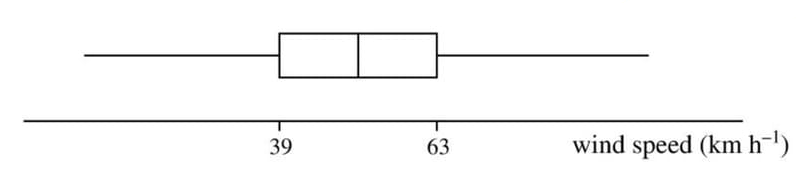
Measurements of wind speed on a certain island were taken over a period of one year. A box-and-whisker plot of the data obtained is displayed above, and the values of the quartiles are as shown. It is suggested that wind speed can be modelled approximately by a normal distribution with mean \(\mu\) km h\(^{-1}\) and standard deviation \(\sigma\) km h\(^{-1}\).
(i) Estimate the value of \(\mu\).
(ii) Estimate the value of \(\sigma\).

9709 P61 - Nov 2009 - Q3
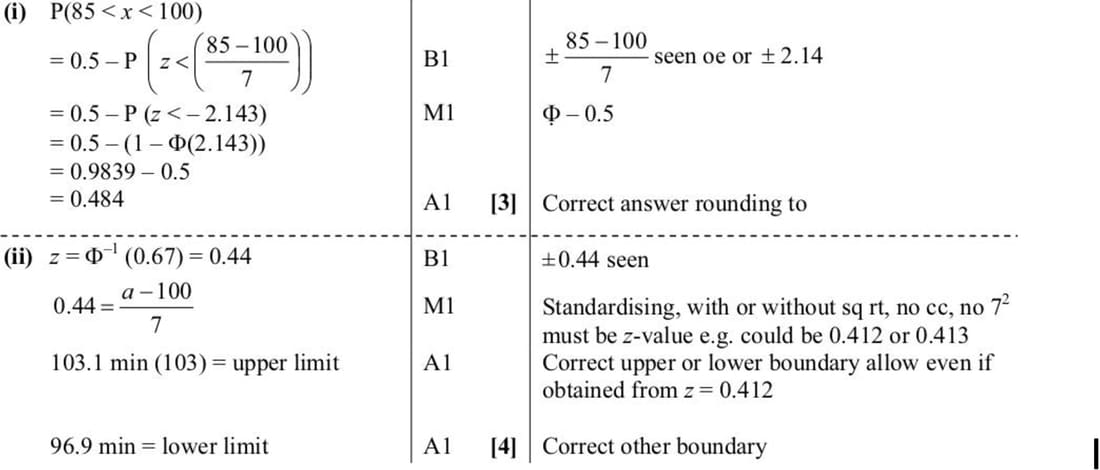
The times for a certain car journey have a normal distribution with mean 100 minutes and standard deviation 7 minutes. Journey times are classified as follows:
- 'short' (the shortest 33% of times),
- 'long' (the longest 33% of times),
- 'standard' (the remaining 34% of times).
(i) Find the probability that a randomly chosen car journey takes between 85 and 100 minutes.
(ii) Find the least and greatest times for 'standard' journeys.
9709 P6 - Jun 2009 - Q1
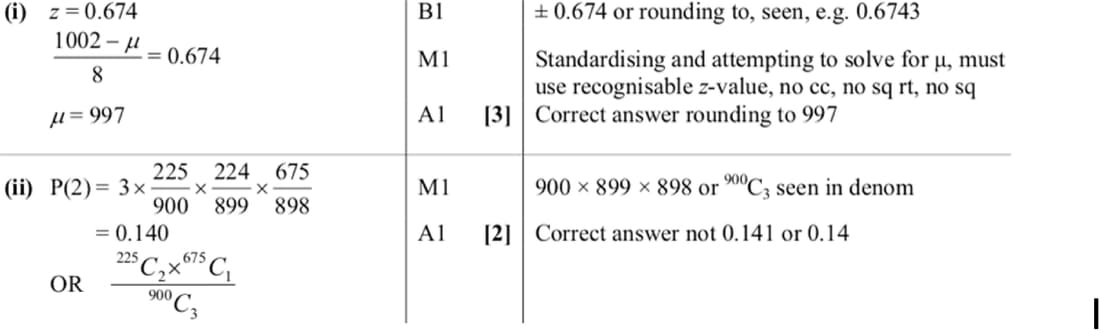
The volume of milk in millilitres in cartons is normally distributed with mean \(\mu\) and standard deviation 8. Measurements were taken of the volume in 900 of these cartons and it was found that 225 of them contained more than 1002 millilitres.
(i) Calculate the value of \(\mu\).
(ii) Three of these 900 cartons are chosen at random. Calculate the probability that exactly 2 of them contain more than 1002 millilitres.
9709 P6 - Nov 2008 - Q3
In another city the daily minimum temperature in °C in January is a random variable with distribution \(N(\mu, 40.0)\). In this city the probability that a randomly chosen day in January has a minimum temperature above 0°C is 0.8888. Find the value of \(\mu\).

9709 P6 - Jun 2008 - Q4
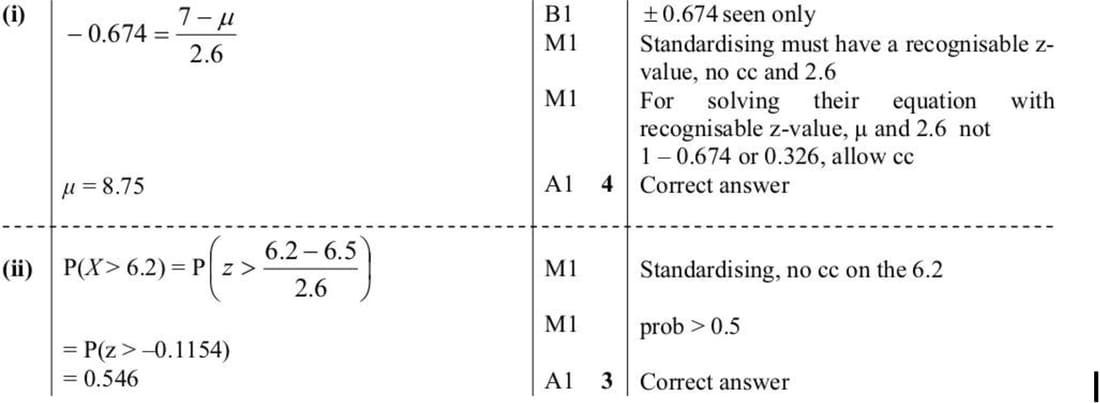
In a certain country the time taken for a common infection to clear up is normally distributed with mean \(\mu\) days and standard deviation 2.6 days. 25% of these infections clear up in less than 7 days.
(i) Find the value of \(\mu\).
In another country the standard deviation of the time taken for the infection to clear up is the same as in part (i), but the mean is 6.5 days. The time taken is normally distributed.
(ii) Find the probability that, in a randomly chosen case from this country, the infection takes longer than 6.2 days to clear up.
9709 P6 - Nov 2007 - Q4
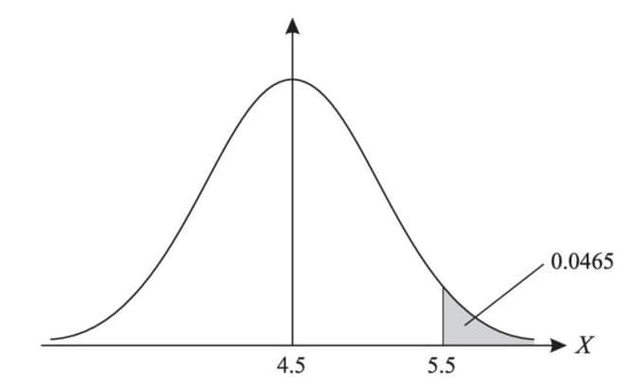
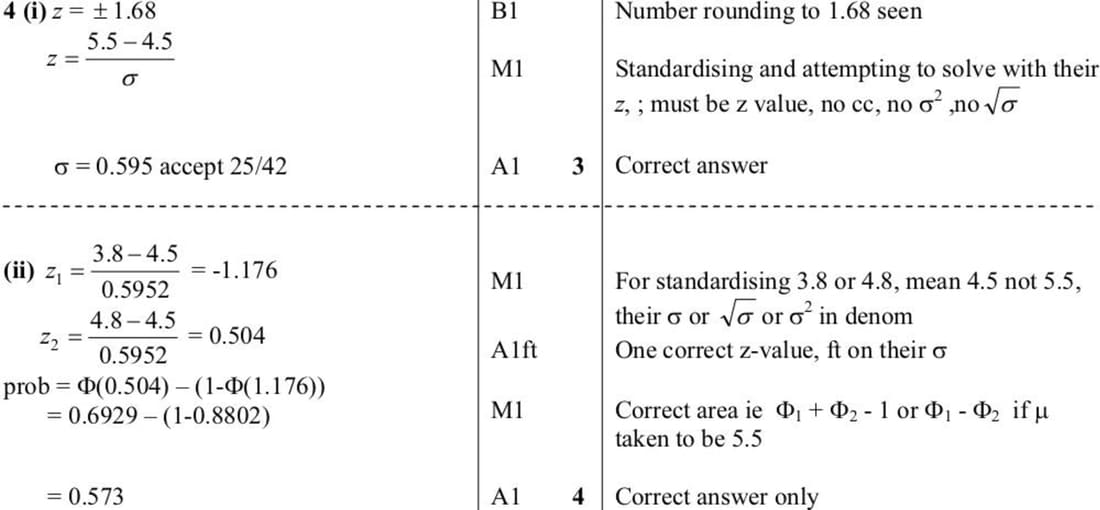
The random variable X has a normal distribution with mean 4.5. It is given that \(P(X > 5.5) = 0.0465\) (see diagram).
- Find the standard deviation of X.
- Find the probability that a random observation of X lies between 3.8 and 4.8.
9709 P6 - Jun 2007 - Q3
(a) The random variable \(X\) is normally distributed. The mean is twice the standard deviation. It is given that \(P(X > 5.2) = 0.9\). Find the standard deviation.
(b) A normal distribution has mean \(\mu\) and standard deviation \(\sigma\). If 800 observations are taken from this distribution, how many would you expect to be between \(\mu - \sigma\) and \(\mu + \sigma\)?