Browsing as Guest. Progress, bookmarks and attempts are disabled.
Log in to track your work.
Nov 2011 p62 q7
3261
The daily minimum temperature, in °C, in another country in winter has a normal distribution with mean \(\mu\) and standard deviation \(2\mu\).
(ii) Find the proportion of winter days on which the minimum temperature is below zero.
(iii) 70 winter days are chosen at random. Find how many of these would be expected to have a minimum temperature which is more than three times the mean.
(iv) The probability of the minimum temperature being above 6 °C on any winter day is 0.0735. Find the value of \(\mu\).
Solution
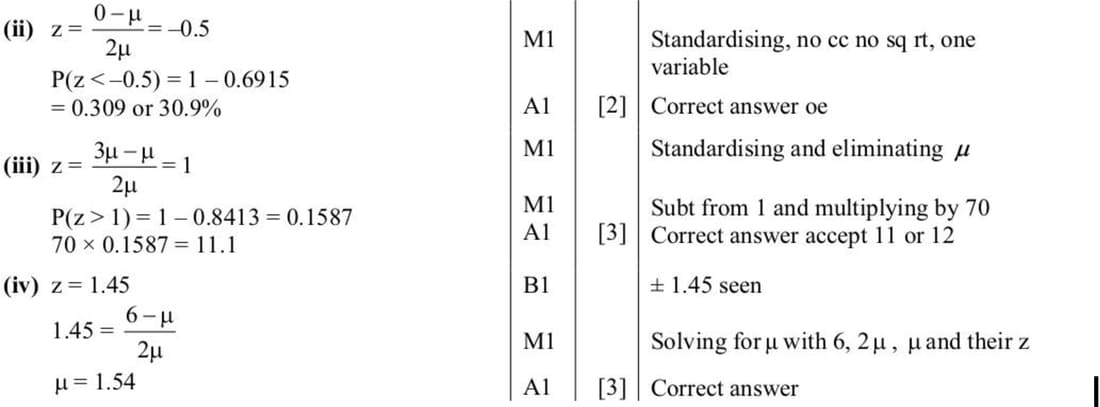
(ii) To find the proportion of winter days with a minimum temperature below zero, we standardize the variable:
\(z = \frac{0 - \mu}{2\mu} = -0.5\)
The probability \(P(z < -0.5) = 1 - 0.6915 = 0.309\) or 30.9%.
(iii) To find how many of the 70 days have a temperature more than three times the mean:
\(z = \frac{3\mu - \mu}{2\mu} = 1\)
The probability \(P(z > 1) = 1 - 0.8413 = 0.1587\).
Thus, the expected number of days is \(70 \times 0.1587 = 11.1\), so approximately 11 or 12 days.
(iv) Given the probability of the temperature being above 6 °C is 0.0735, we find \(\mu\):