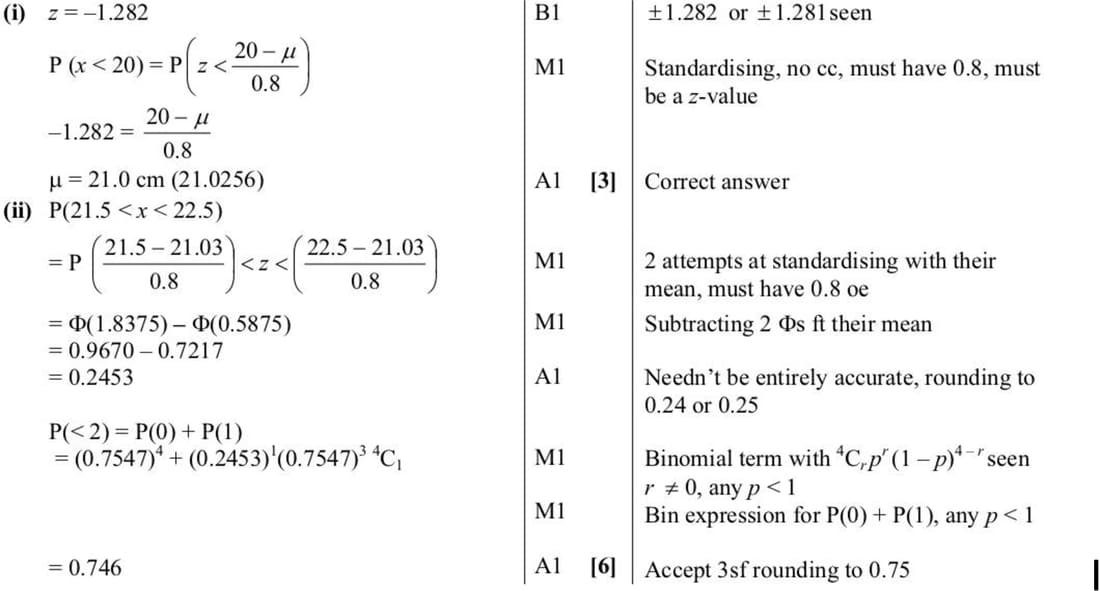
(i) Given that 10% of the straws are shorter than 20 cm, we have \(P(x < 20) = 0.1\). Using the standard normal distribution, this corresponds to a \(z\)-value of approximately \(-1.282\).
Standardizing, \(z = \frac{20 - \mu}{0.8}\).
Thus, \(-1.282 = \frac{20 - \mu}{0.8}\).
Solving for \(\mu\), we get \(\mu = 20 + 1.282 \times 0.8 = 21.0256 \approx 21.0 \text{ cm}\).
(ii) We need to find \(P(21.5 < x < 22.5)\).
Standardizing, \(P\left( \frac{21.5 - 21.03}{0.8} < z < \frac{22.5 - 21.03}{0.8} \right)\).
This simplifies to \(P(0.5875 < z < 1.8375)\).
Using the standard normal distribution table, \(\Phi(1.8375) - \Phi(0.5875) = 0.9670 - 0.7217 = 0.2453\).
Now, we use the binomial distribution for 4 trials with probability \(p = 0.2453\).
We need \(P(X < 2) = P(0) + P(1)\).
\(P(0) = (0.7547)^4\).
\(P(1) = 4 \times (0.2453) \times (0.7547)^3\).
Calculating these gives \(P(0) + P(1) = 0.7547^4 + 4 \times 0.2453 \times 0.7547^3 = 0.746\).