Past Exam Questions
← Back9709 P32 - Jun 2011 - Q6
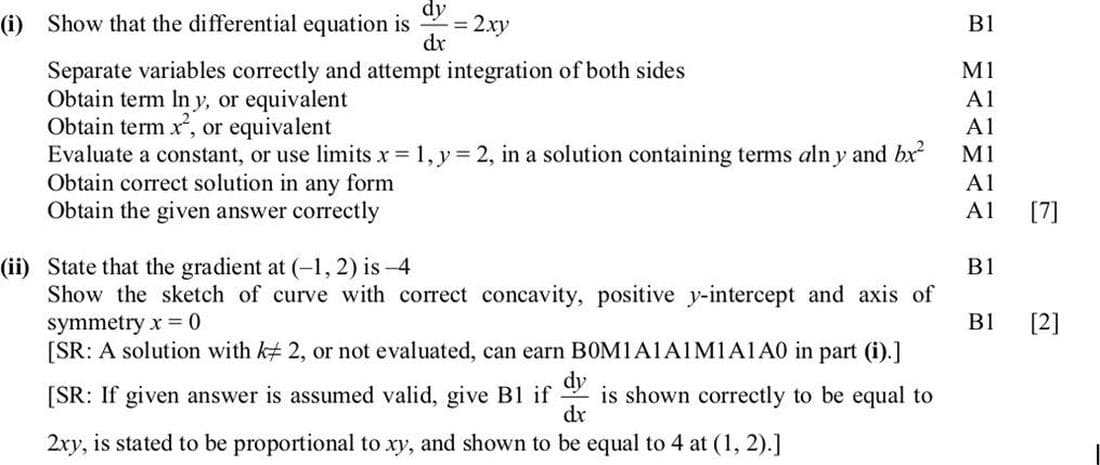
A certain curve is such that its gradient at a point \((x, y)\) is proportional to \(xy\). At the point \((1, 2)\) the gradient is 4.
(i) By setting up and solving a differential equation, show that the equation of the curve is \(y = 2e^{x^2 - 1}\). [7]
(ii) State the gradient of the curve at the point \((-1, 2)\) and sketch the curve. [2]
9709 P33 - Jun 2021 - Q7
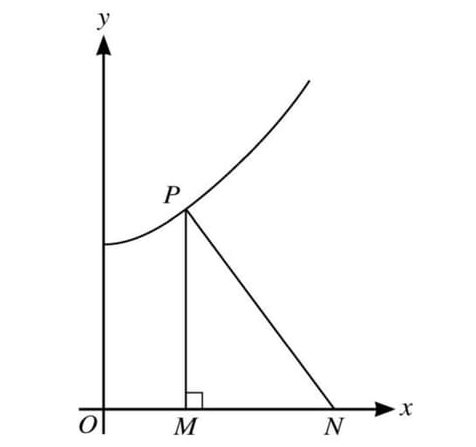
For the curve shown in the diagram, the normal to the curve at the point \(P\) with coordinates \((x, y)\) meets the \(x\)-axis at \(N\). The point \(M\) is the foot of the perpendicular from \(P\) to the \(x\)-axis.
The curve is such that for all values of \(x\) in the interval \(0 \leq x < \frac{1}{2}\pi\), the area of triangle \(PMN\) is equal to \(\tan x\).
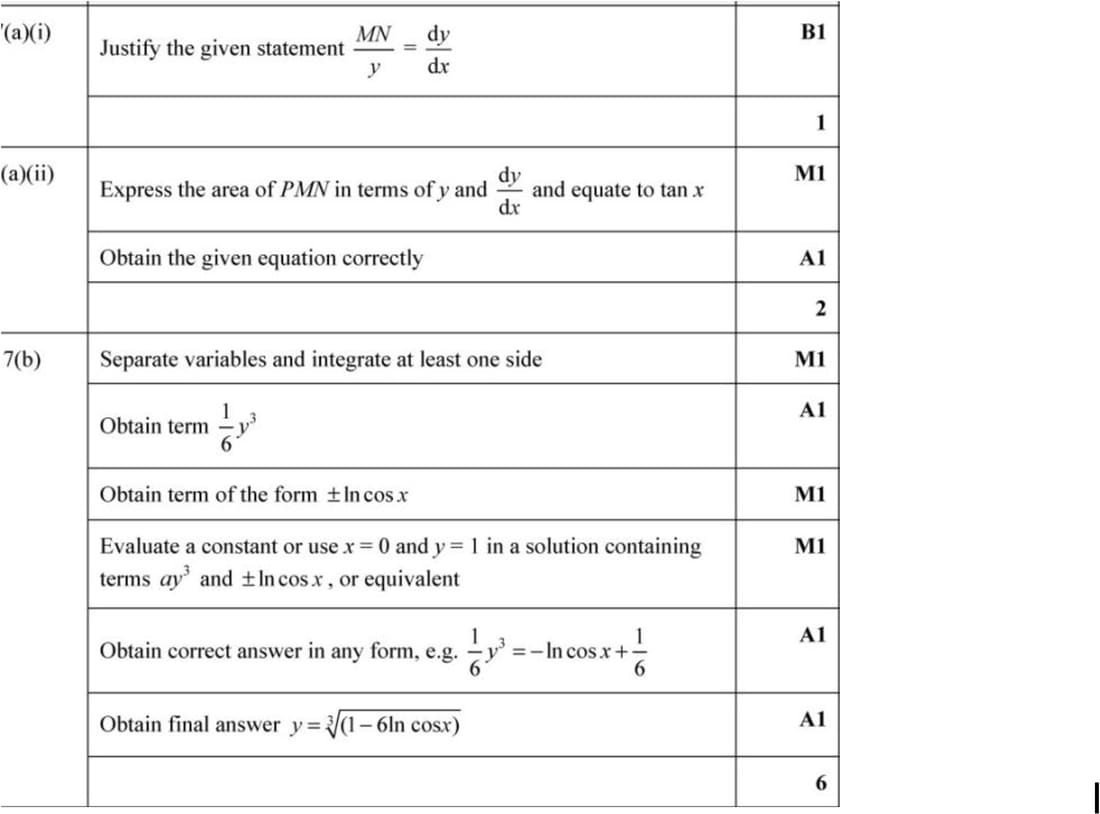
(a) (i) Show that \(\frac{MN}{y} = \frac{dy}{dx}\).
(ii) Hence show that \(x\) and \(y\) satisfy the differential equation \(\frac{1}{2}y^2 \frac{dy}{dx} = \tan x\).
(b) Given that \(y = 1\) when \(x = 0\), solve this differential equation to find the equation of the curve, expressing \(y\) in terms of \(x\).
9709 P33 - Nov 2010 - Q9
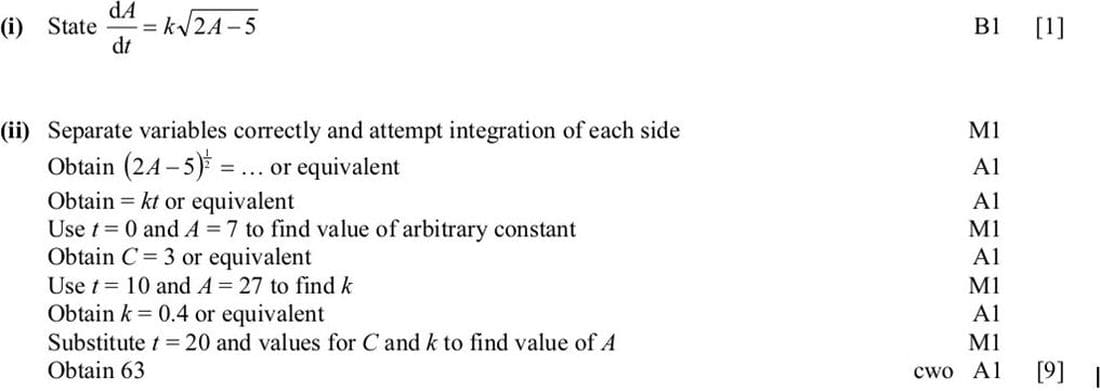
A biologist is investigating the spread of a weed in a particular region. At time \(t\) weeks after the start of the investigation, the area covered by the weed is \(A \text{ m}^2\). The biologist claims that the rate of increase of \(A\) is proportional to \(\sqrt{2A - 5}\).
(i) Write down a differential equation representing the biologist’s claim.
(ii) At the start of the investigation, the area covered by the weed was \(7 \text{ m}^2\) and, 10 weeks later, the area covered was \(27 \text{ m}^2\). Assuming that the biologist’s claim is correct, find the area covered 20 weeks after the start of the investigation.
9709 P31 - Nov 2010 - Q10
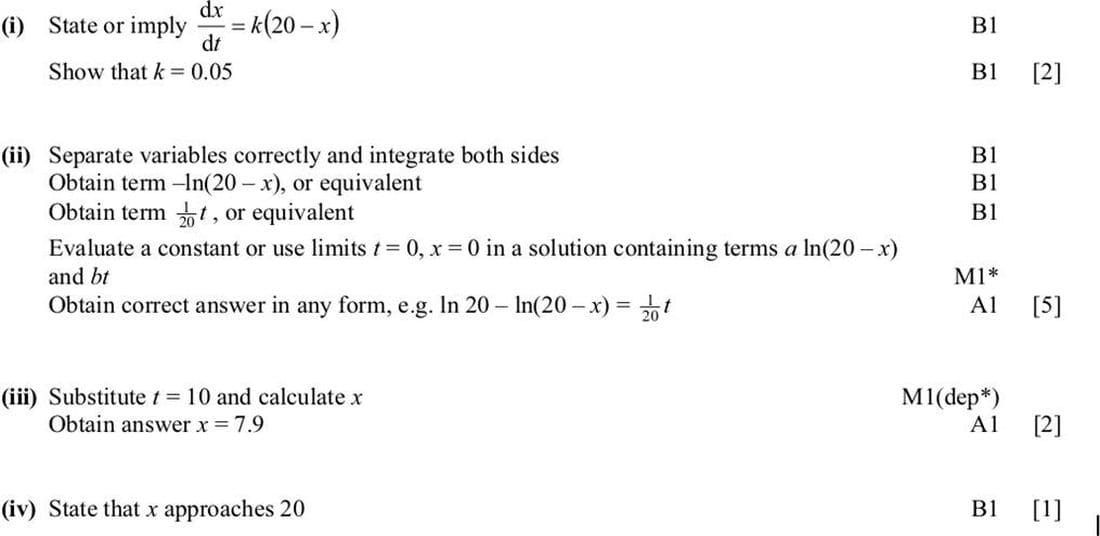
A certain substance is formed in a chemical reaction. The mass of substance formed t seconds after the start of the reaction is x grams. At any time the rate of formation of the substance is proportional to \((20 - x)\). When \(t = 0\), \(x = 0\) and \(\frac{dx}{dt} = 1\).
(i) Show that x and t satisfy the differential equation \(\frac{dx}{dt} = 0.05(20 - x)\). [2]
(ii) Find, in any form, the solution of this differential equation. [5]
(iii) Find x when \(t = 10\), giving your answer correct to 1 decimal place. [2]
(iv) State what happens to the value of x as t becomes very large. [1]
9709 P31 - Nov 2009 - Q10
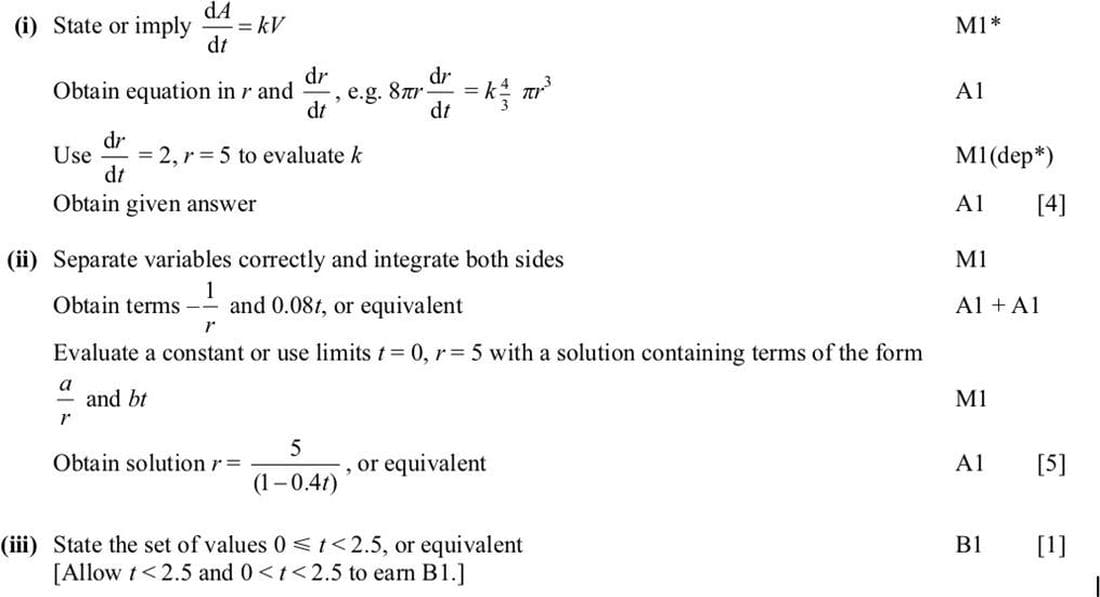
In a model of the expansion of a sphere of radius r cm, it is assumed that, at time t seconds after the start, the rate of increase of the surface area of the sphere is proportional to its volume. When t = 0, r = 5 and \(\frac{dr}{dt} = 2\).
(i) Show that r satisfies the differential equation \(\frac{dr}{dt} = 0.08r^2\).
[The surface area A and volume V of a sphere of radius r are given by the formulae \(A = 4\pi r^2\), \(V = \frac{4}{3}\pi r^3\).]
(ii) Solve this differential equation, obtaining an expression for r in terms of t.
(iii) Deduce from your answer to part (ii) the set of values that t can take, according to this model.
9709 P3 - Nov 2008 - Q8
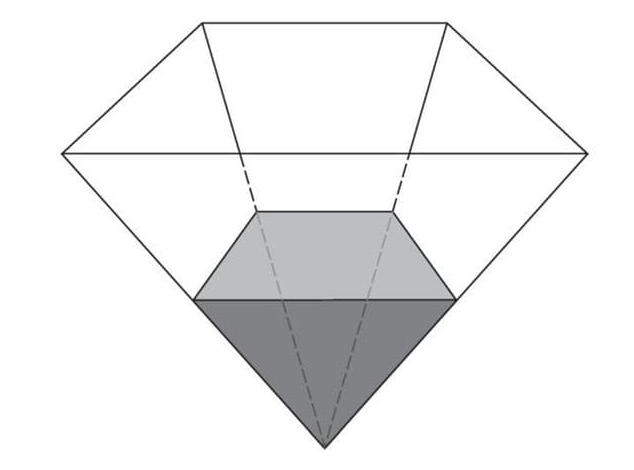
An underground storage tank is being filled with liquid as shown in the diagram. Initially the tank is empty. At time \(t\) hours after filling begins, the volume of liquid is \(V\) m\(^3\) and the depth of liquid is \(h\) m. It is given that \(V = \frac{4}{3}h^3\).
The liquid is poured in at a rate of 20 m\(^3\) per hour, but owing to leakage, liquid is lost at a rate proportional to \(h^2\). When \(h = 1\), \(\frac{dh}{dt} = 4.95\).
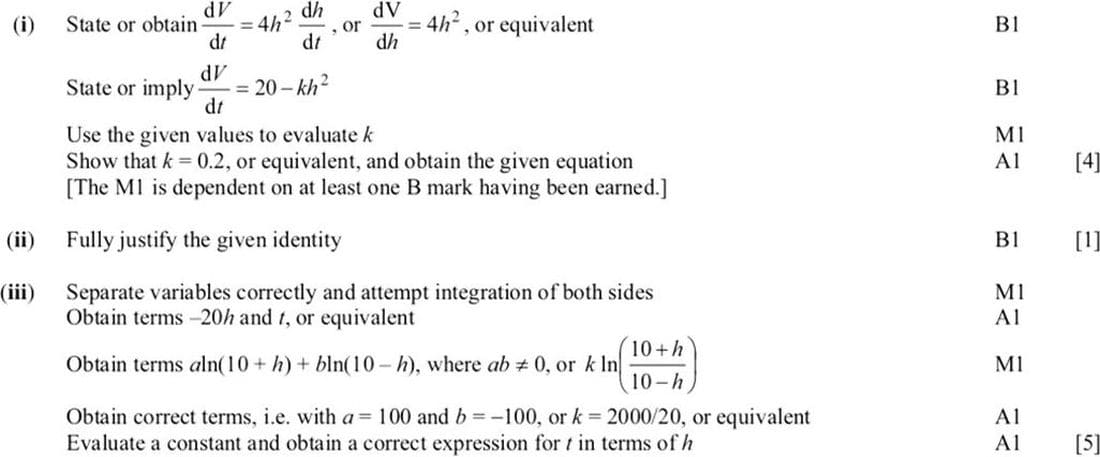
- Show that \(h\) satisfies the differential equation \(\frac{dh}{dt} = \frac{5}{h^2} - \frac{1}{20}\).
- Verify that \(\frac{20h^2}{100-h^2} = -20 + \frac{2000}{(10-h)(10+h)}\).
- Hence solve the differential equation in part (i), obtaining an expression for \(t\) in terms of \(h\).
9709 P3 - Jun 2008 - Q8
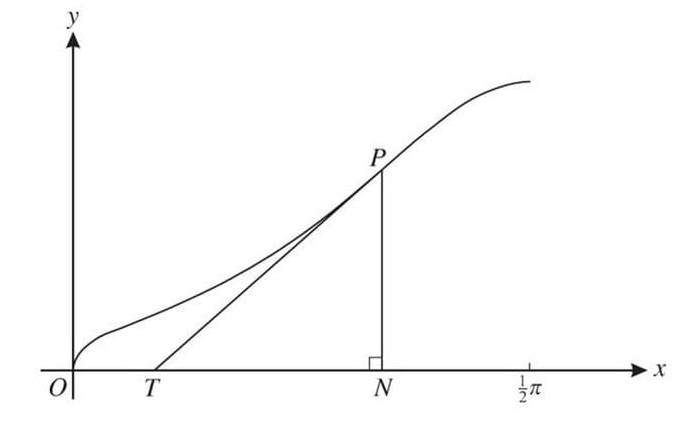
In the diagram the tangent to a curve at a general point \(P\) with coordinates \((x, y)\) meets the \(x\)-axis at \(T\). The point \(N\) on the \(x\)-axis is such that \(PN\) is perpendicular to the \(x\)-axis. The curve is such that, for all values of \(x\) in the interval \(0 < x < \frac{1}{2}\pi\), the area of triangle \(PTN\) is equal to \(\tan x\), where \(x\) is in radians.
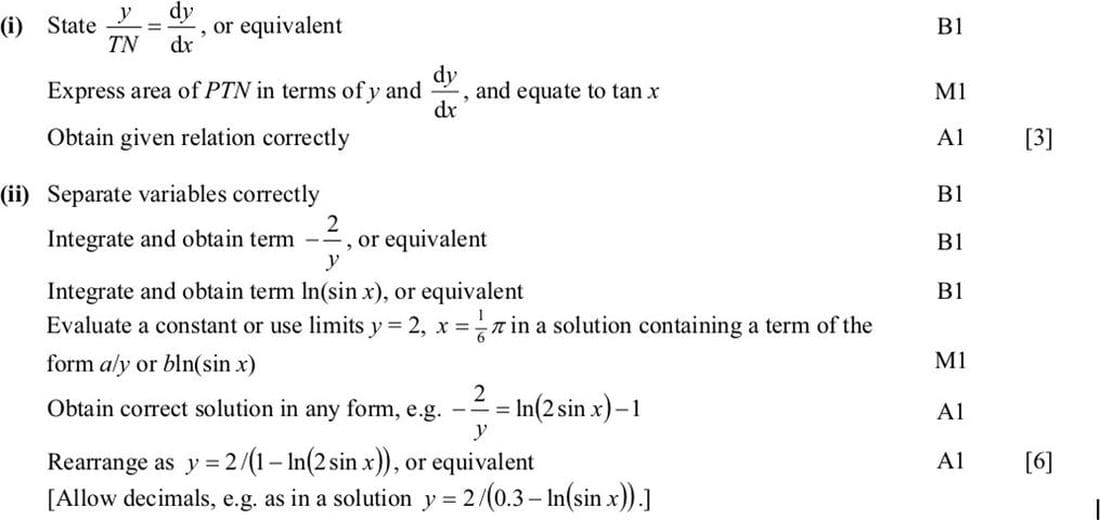
(i) Using the fact that the gradient of the curve at \(P\) is \(\frac{PN}{TN}\), show that \(\frac{dy}{dx} = \frac{1}{2}y^2 \cot x\).
(ii) Given that \(y = 2\) when \(x = \frac{1}{6}\pi\), solve this differential equation to find the equation of the curve, expressing \(y\) in terms of \(x\).
9709 P3 - Jun 2007 - Q10
A model for the height, h metres, of a certain type of tree at time t years after being planted assumes that, while the tree is growing, the rate of increase in height is proportional to \((9 - h)^{\frac{1}{3}}\). It is given that, when t = 0, h = 1 and \(\frac{dh}{dt} = 0.2\).
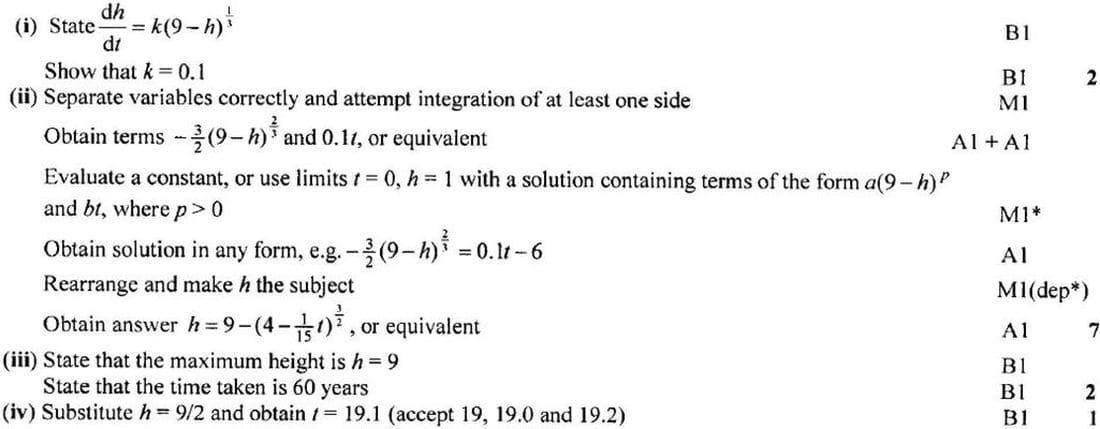
(i) Show that h and t satisfy the differential equation \(\frac{dh}{dt} = 0.1(9 - h)^{\frac{1}{3}}\).
(ii) Solve this differential equation, and obtain an expression for h in terms of t.
(iii) Find the maximum height of the tree and the time taken to reach this height after planting.
(iv) Calculate the time taken to reach half the maximum height.
9709 P3 - Jun 2006 - Q5
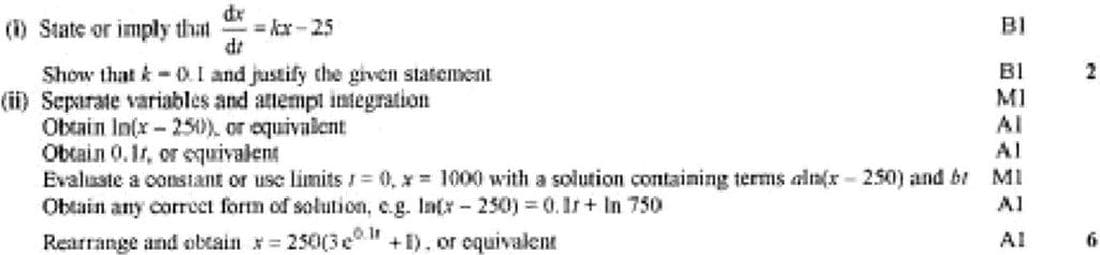
In a certain industrial process, a substance is being produced in a container. The mass of the substance in the container t minutes after the start of the process is x grams. At any time, the rate of formation of the substance is proportional to its mass. Also, throughout the process, the substance is removed from the container at a constant rate of 25 grams per minute. When t = 0, x = 1000 and \(\frac{dx}{dt} = 75\).
(i) Show that x and t satisfy the differential equation \(\frac{dx}{dt} = 0.1(x - 250)\).
(ii) Solve this differential equation, obtaining an expression for x in terms of t.
9709 P3 - Nov 2004 - Q10
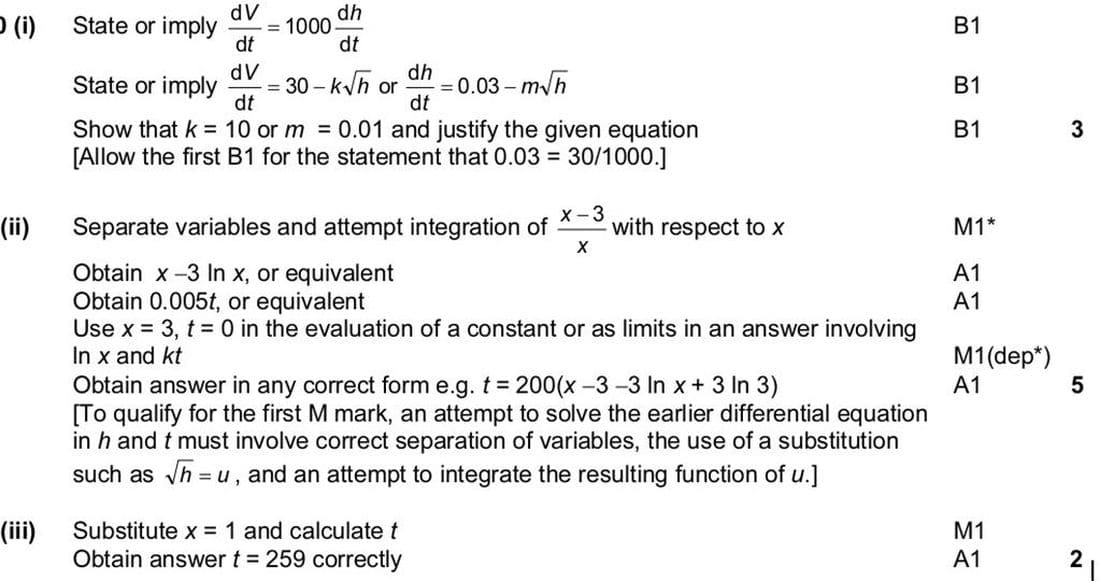
A rectangular reservoir has a horizontal base of area 1000 m2. At time \(t = 0\), it is empty and water begins to flow into it at a constant rate of 30 m3s-1. At the same time, water begins to flow out at a rate proportional to \(\sqrt{h}\), where \(h\) m is the depth of the water at time \(t\) s. When \(h = 1\), \(\frac{dh}{dt} = 0.02\).
(i) Show that \(h\) satisfies the differential equation \(\frac{dh}{dt} = 0.01(3 - \sqrt{h})\).
It is given that, after making the substitution \(x = 3 - \sqrt{h}\), the equation in part (i) becomes \((x - 3) \frac{dx}{dt} = 0.005x\).
(ii) Using the fact that \(x = 3\) when \(t = 0\), solve this differential equation, obtaining an expression for \(t\) in terms of \(x\).
(iii) Find the time at which the depth of water reaches 4 m.
9709 P3 - Jun 2003 - Q7
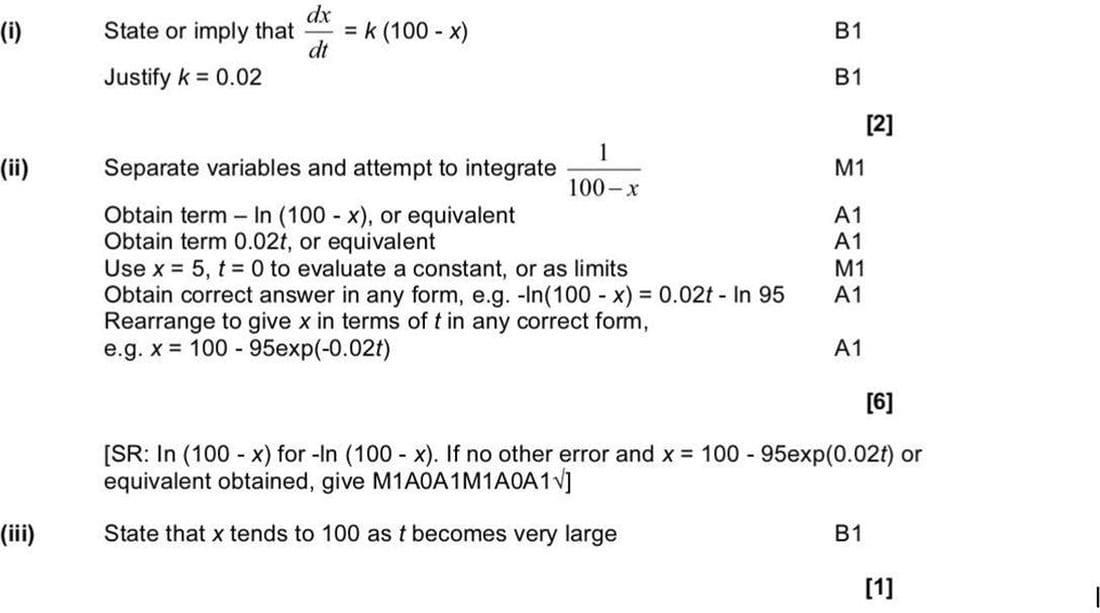
In a chemical reaction a compound X is formed from a compound Y. The masses in grams of X and Y present at time t seconds after the start of the reaction are x and y respectively. The sum of the two masses is equal to 100 grams throughout the reaction. At any time, the rate of formation of X is proportional to the mass of Y at that time. When t = 0, x = 5 and \(\frac{dx}{dt} = 1.9\).
(i) Show that x satisfies the differential equation \(\frac{dx}{dt} = 0.02(100 - x)\). [2]
(ii) Solve this differential equation, obtaining an expression for x in terms of t. [6]
(iii) State what happens to the value of x as t becomes very large. [1]
9709 P3 - Nov 2002 - Q9
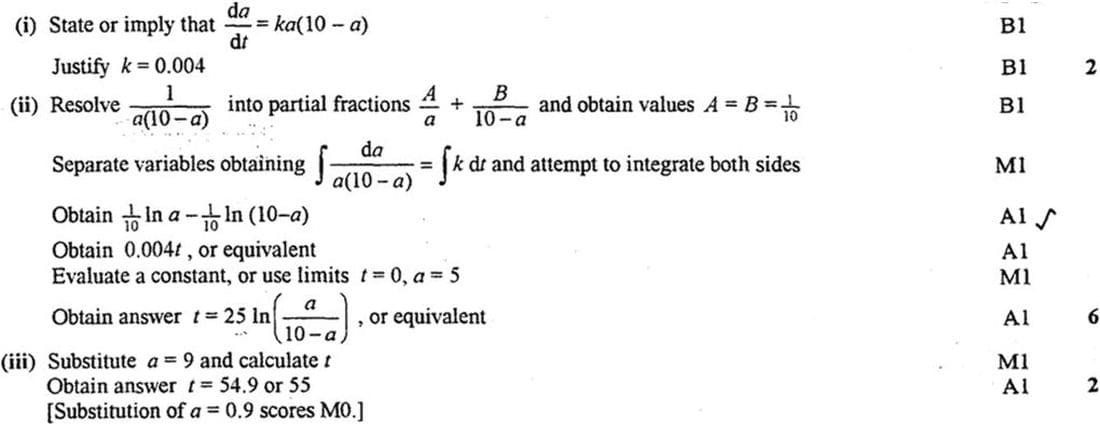
In an experiment to study the spread of a soil disease, an area of 10 m2 of soil was exposed to infection. In a simple model, it is assumed that the infected area grows at a rate which is proportional to the product of the infected area and the uninfected area. Initially, 5 m2 was infected and the rate of growth of the infected area was 0.1 m2 per day. At time t days after the start of the experiment, an area a m2 is infected and an area (10 - a) m2 is uninfected.
- Show that \(\frac{da}{dt} = 0.004a(10 - a)\).
- By first expressing \(\frac{1}{a(10-a)}\) in partial fractions, solve this differential equation, obtaining an expression for t in terms of a.
- Find the time taken for 90% of the soil area to become infected, according to this model.
9709 P33 - Jun 2020 - Q10
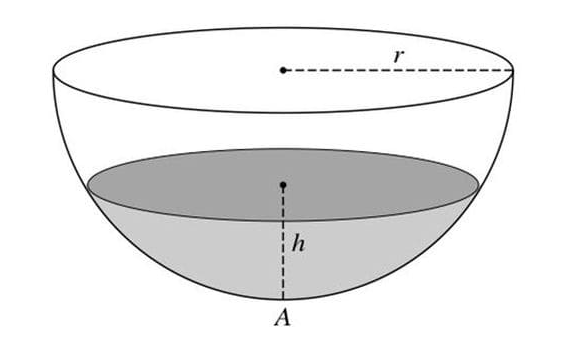
A tank containing water is in the form of a hemisphere. The axis is vertical, the lowest point is A and the radius is r, as shown in the diagram. The depth of water at time t is h. At time t = 0 the tank is full and the depth of the water is r. At this instant a tap at A is opened and water begins to flow out at a rate proportional to \(\sqrt{h}\). The tank becomes empty at time t = 14.
The volume of water in the tank is V when the depth is h. It is given that \(V = \frac{1}{3} \pi (3rh^2 - h^3)\).
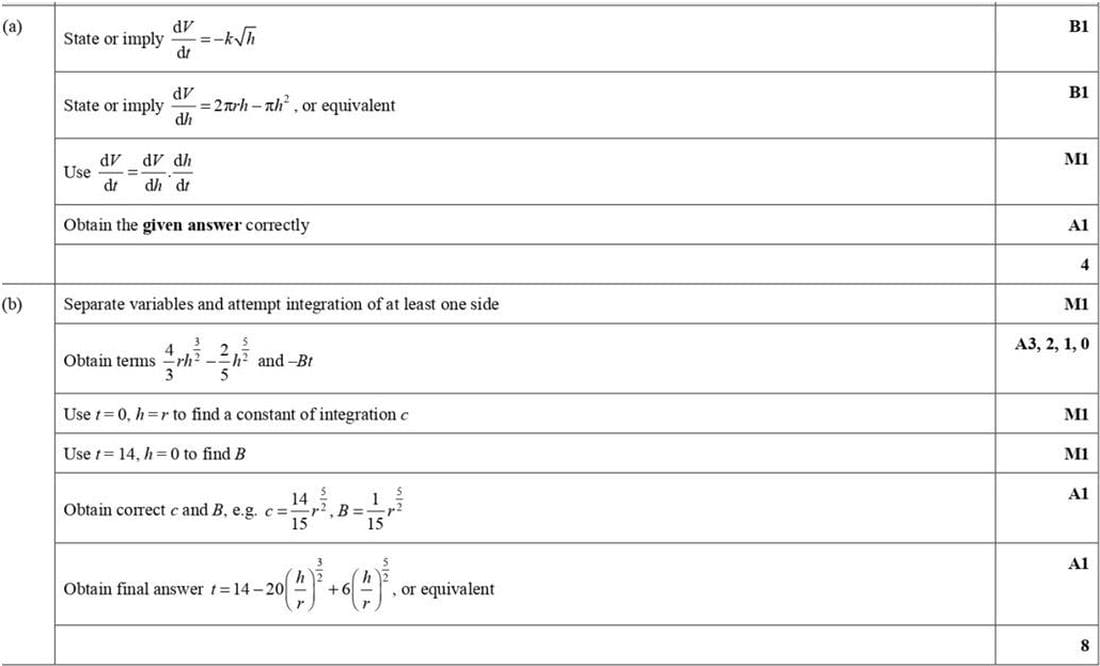
(a) Show that h and t satisfy a differential equation of the form \(\frac{dh}{dt} = -\frac{B}{2rh^2 - h^3}\)
where B is a positive constant.
(b) Solve the differential equation and obtain an expression for t in terms of h and r.
9709 P3 - Jun 2002 - Q7
In a certain chemical process a substance is being formed, and t minutes after the start of the process there are m grams of the substance present. In the process the rate of increase of m is proportional to \((50 - m)^2\). When \(t = 0\), \(m = 0\) and \(\frac{dm}{dt} = 5\).
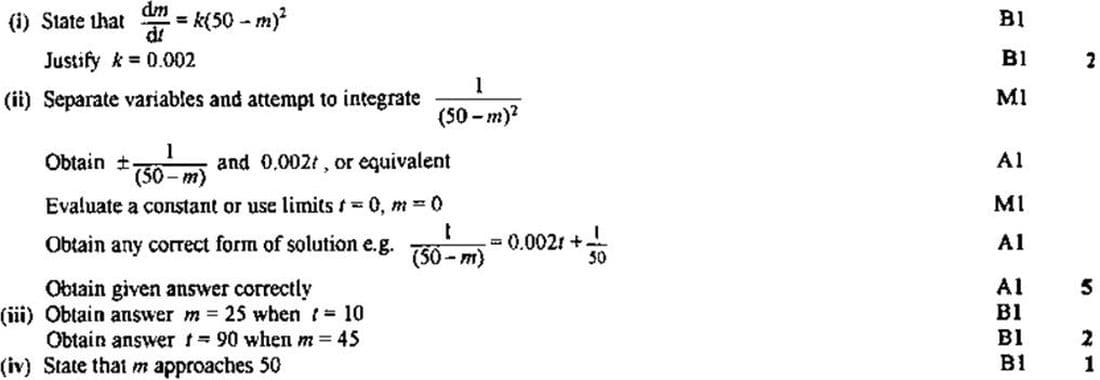
(i) Show that m satisfies the differential equation \(\frac{dm}{dt} = 0.002(50 - m)^2\).
(ii) Solve the differential equation, and show that the solution can be expressed in the form \(m = 50 - \frac{500}{t + 10}\).
(iii) Calculate the mass of the substance when \(t = 10\), and find the time taken for the mass to increase from 0 to 45 grams.
(iv) State what happens to the mass of the substance as t becomes very large.
9709 P31 - Jun 2020 - Q8
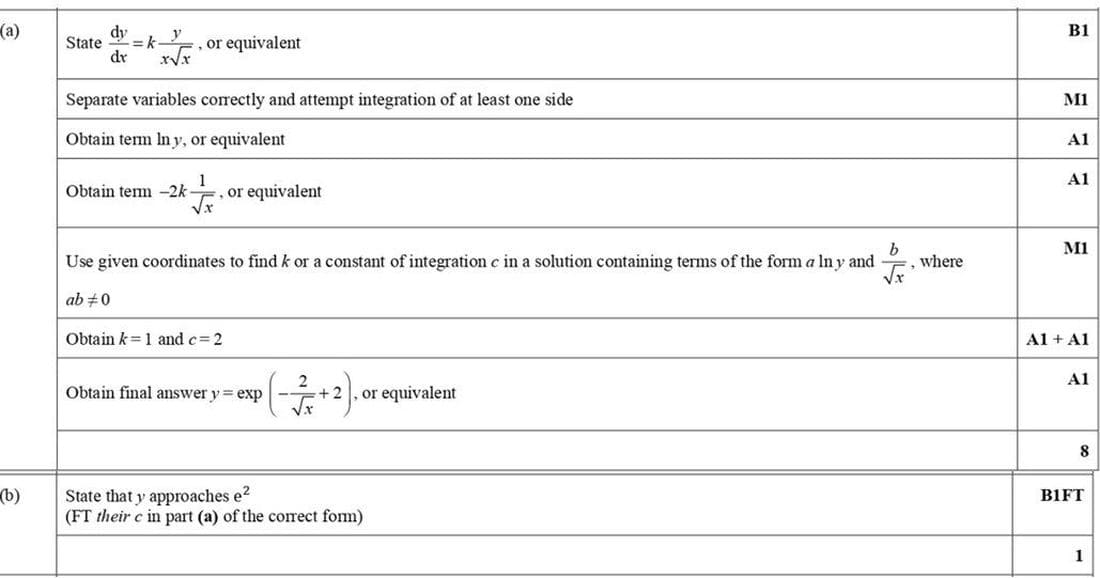
A certain curve is such that its gradient at a point \((x, y)\) is proportional to \(\frac{y}{x\sqrt{x}}\). The curve passes through the points with coordinates \((1, 1)\) and \((4, e)\).
(a) By setting up and solving a differential equation, find the equation of the curve, expressing \(y\) in terms of \(x\). [8]
(b) Describe what happens to \(y\) as \(x\) tends to infinity. [1]
9709 P31 - Nov 2019 - Q4
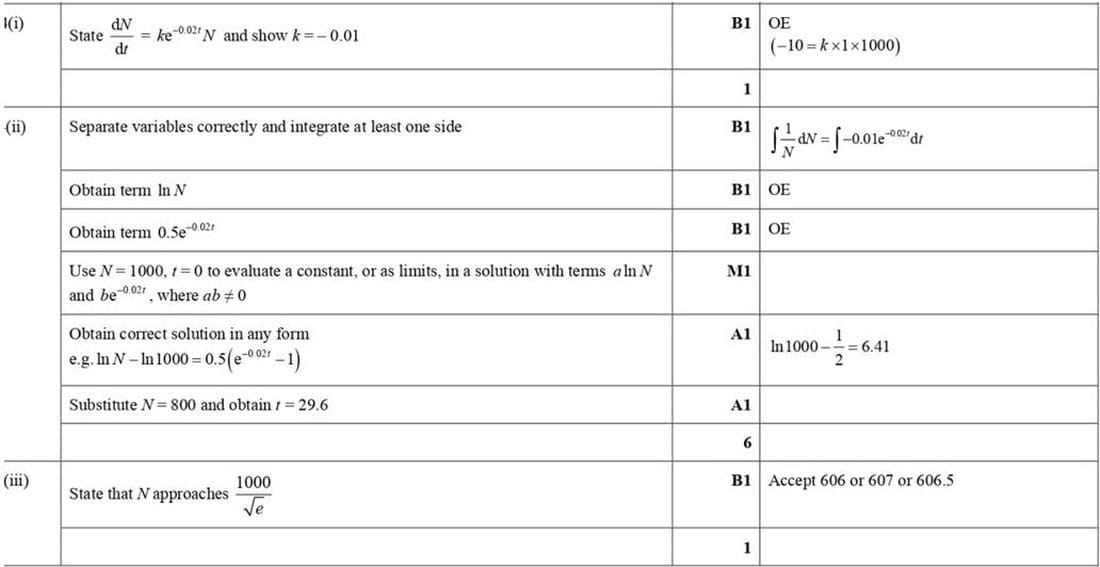
The number of insects in a population \(t\) weeks after the start of observations is denoted by \(N\). The population is decreasing at a rate proportional to \(Ne^{-0.02t}\). The variables \(N\) and \(t\) are treated as continuous, and it is given that when \(t = 0\), \(N = 1000\) and \[ \frac{dN}{dt} = -10. \]
(i) Show that \(N\) and \(t\) satisfy the differential equation \[ \frac{dN}{dt} = -0.01e^{-0.02t}N. \]
(ii) Solve the differential equation and find the value of \(t\) when \(N = 800\).
(iii) State what happens to the value of \(N\) as \(t\) becomes large.
9709 P32 - Nov 2018 - Q6
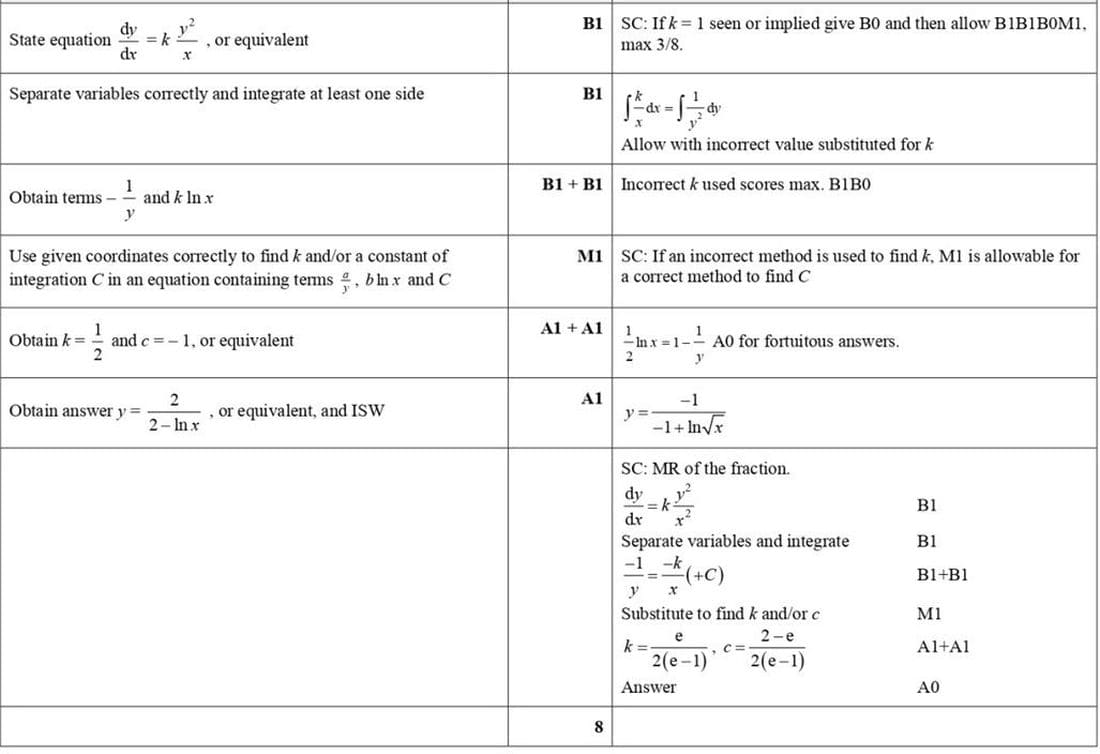
A certain curve is such that its gradient at a general point with coordinates \((x, y)\) is proportional to \(\frac{y^2}{x}\). The curve passes through the points with coordinates \((1, 1)\) and \((e, 2)\). By setting up and solving a differential equation, find the equation of the curve, expressing \(y\) in terms of \(x\).
9709 P32 - Jun 2018 - Q3
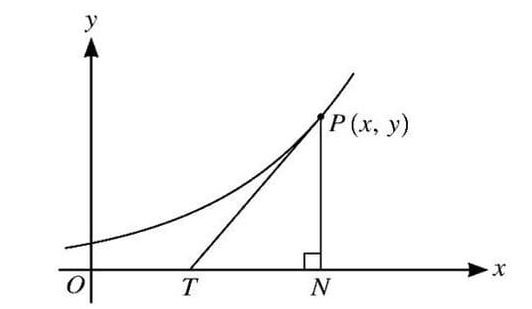
In the diagram, the tangent to a curve at the point \(P\) with coordinates \((x, y)\) meets the \(x\)-axis at \(T\). The point \(N\) is the foot of the perpendicular from \(P\) to the \(x\)-axis. The curve is such that, for all values of \(x\), the gradient of the curve is positive and \(TN = 2\).
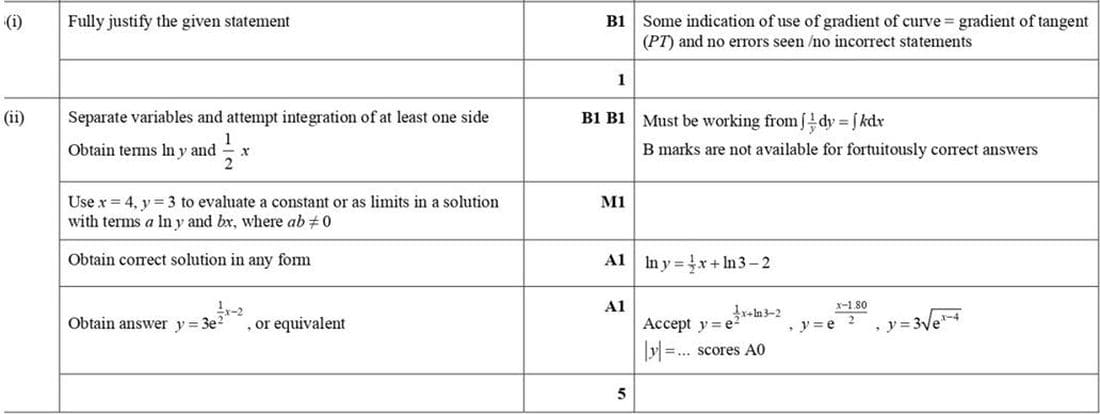
(i) Show that the differential equation satisfied by \(x\) and \(y\) is \(\frac{dy}{dx} = \frac{1}{2}y\).
The point with coordinates \((4, 3)\) lies on the curve.
(ii) Solve the differential equation to obtain the equation of the curve, expressing \(y\) in terms of \(x\).
9709 P33 - Jun 2017 - Q8
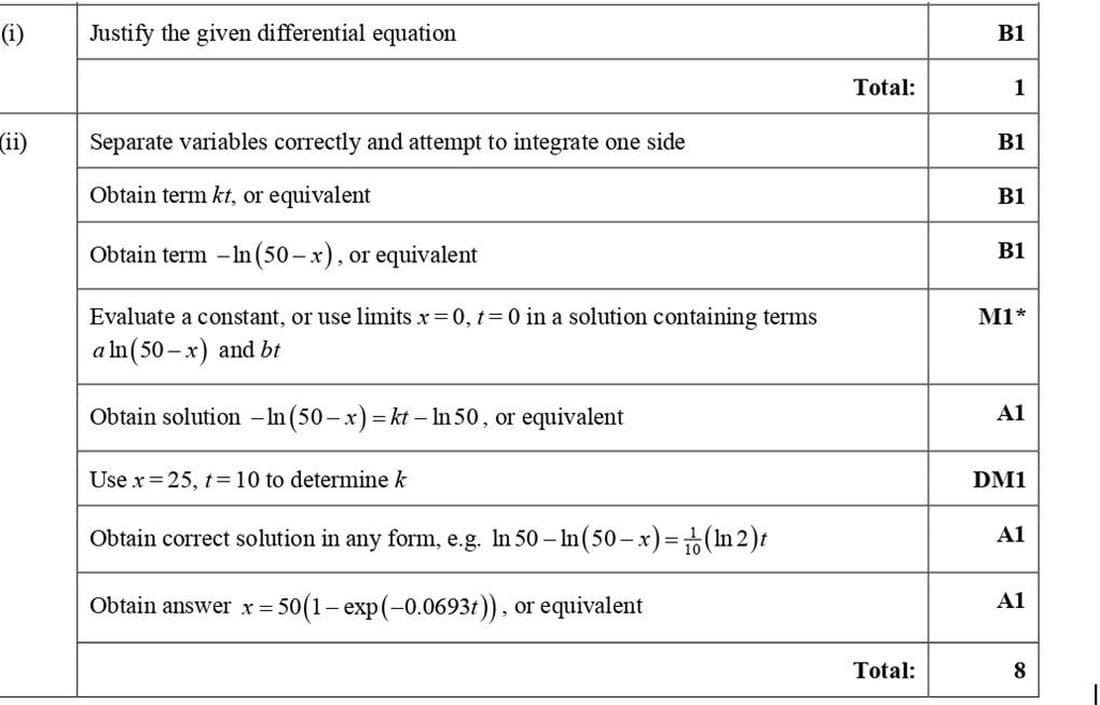
In a certain chemical reaction, a compound A is formed from a compound B. The masses of A and B at time t after the start of the reaction are x and y respectively and the sum of the masses is equal to 50 throughout the reaction. At any time the rate of increase of the mass of A is proportional to the mass of B at that time.
(i) Explain why \(\frac{dx}{dt} = k(50 - x)\), where k is a constant.
It is given that \(x = 0\) when \(t = 0\), and \(x = 25\) when \(t = 10\).
(ii) Solve the differential equation in part (i) and express x in terms of t.
9709 P32 - Jun 2017 - Q5
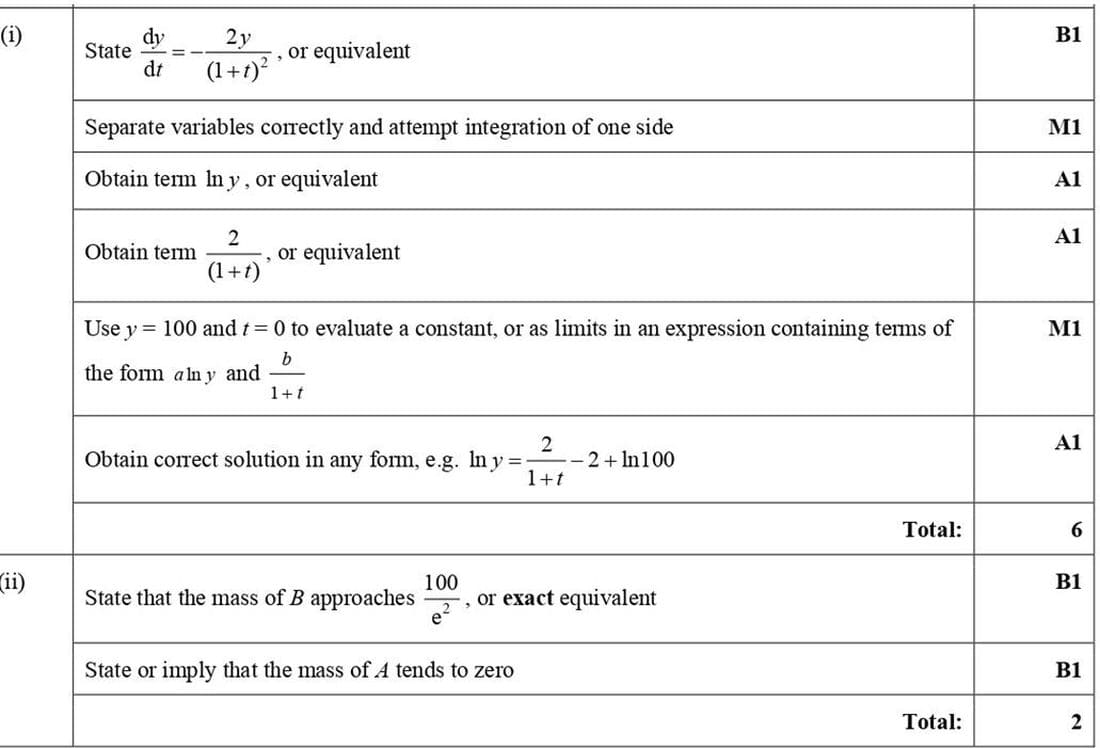
In a certain chemical process a substance A reacts with and reduces a substance B. The masses of A and B at time t after the start of the process are x and y respectively. It is given that \(\frac{dy}{dt} = -0.2xy\) and \(x = \frac{10}{(1+t)^2}\). At the beginning of the process \(y = 100\).
(i) Form a differential equation in y and t, and solve this differential equation.
(ii) Find the exact value approached by the mass of B as t becomes large. State what happens to the mass of A as t becomes large.