P12 June q9
Metadata not filled yet
4307
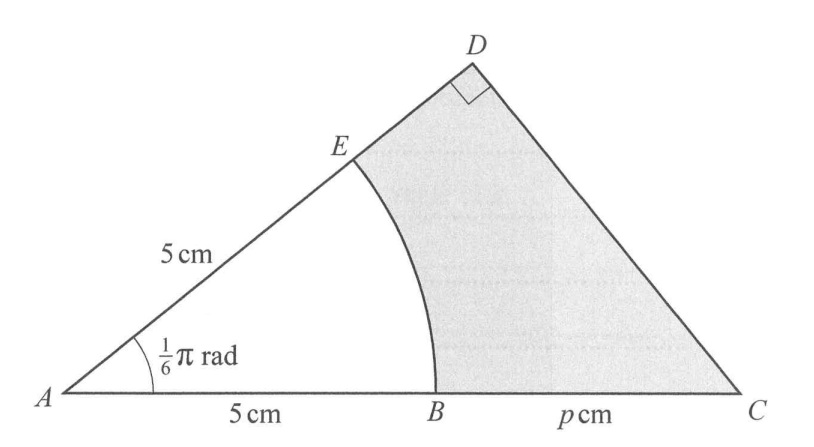
The diagram shows a triangle \(ACD\) in which \(AD\) is perpendicular to \(CD\). The arc \(BE\) of a circle with centre \(A\) and radius \(5\) cm meets \(AC\) at \(B\) and \(AD\) at \(E\). Angle \(BAE\) is \( \frac16\pi \) radians and the length \(BC=p\) cm.
(a) Given that the value of \(p\) is \(4\), find the exact perimeter of the shaded region. Give your answer in terms of \( \pi \) and \( \sqrt3 \).
(b) Given instead that the area of the shaded region is \( 8\sqrt3-\frac{25}{12}\pi \text{ cm}^2 \), find the value of \(p\).