9709 P12 - Jun 2025 - Q8
4105
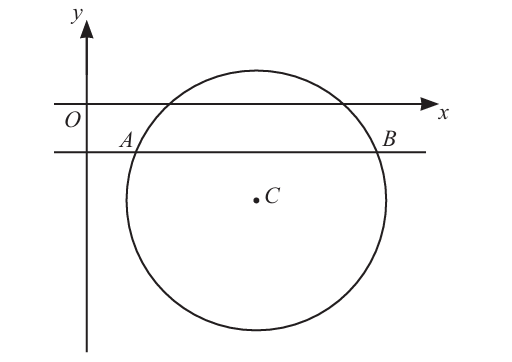
The diagram shows the circle with equation \(x^2 + y^2 - 14x + 8y + 36 = 0\) and the line \(y = -2\). The line intersects the circle at the points \(A\) and \(B\). The centre of the circle is \(C\).
(a) Find the coordinates of \(A\), \(B\) and \(C\).
(b) Find the angle \(ACB\) in radians. Give your answer correct to 3 significant figures.
(c) The chord \(AB\) divides the circle into two segments. Find the area of the larger segment.
Solutions locked. Please sign in with access to view them.