Past Exam Questions
← Back0606 P21 - Nov 2017 - Q2 - 4 marks
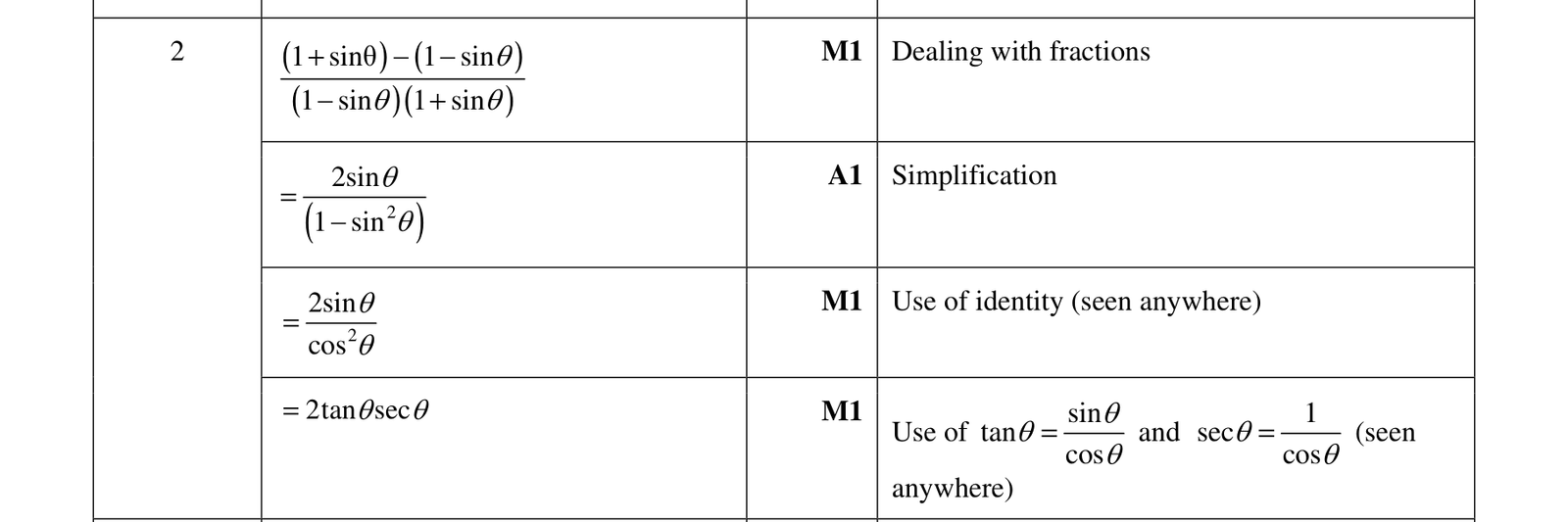
Show that \(\dfrac1{1-\sin\theta}-\dfrac1{1+\sin\theta}=2\tan\theta\operatorname{sec}\theta\).
9709 P33 - Jun 2023 - Q8
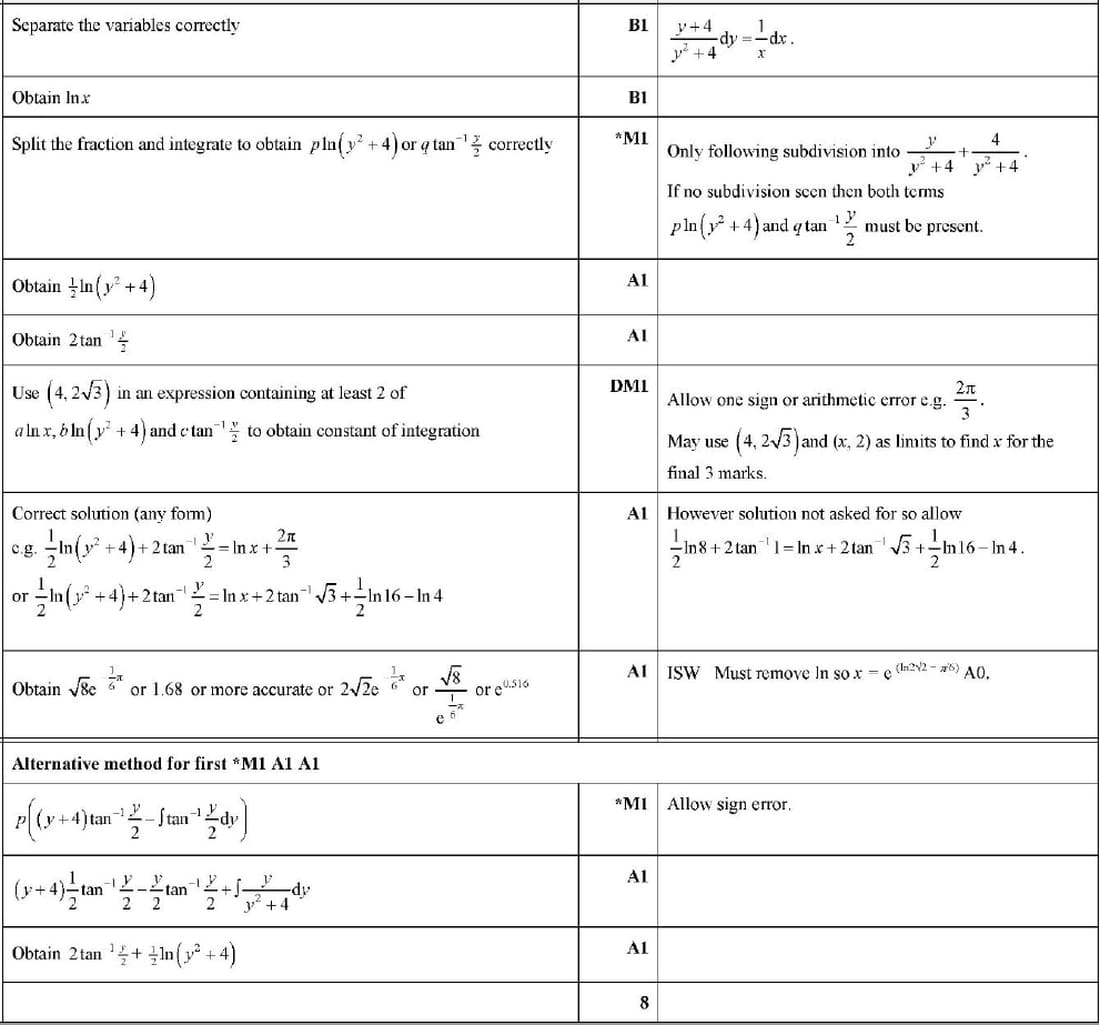
The variables x and y satisfy the differential equation \(\frac{dy}{dx} = \frac{y^2 + 4}{x(y + 4)}\) for \(x > 0\). It is given that \(x = 4\) when \(y = 2\sqrt{3}\). Solve the differential equation to obtain the value of \(x\) when \(y = 2\).
9709 P33 - Nov 2012 - Q4
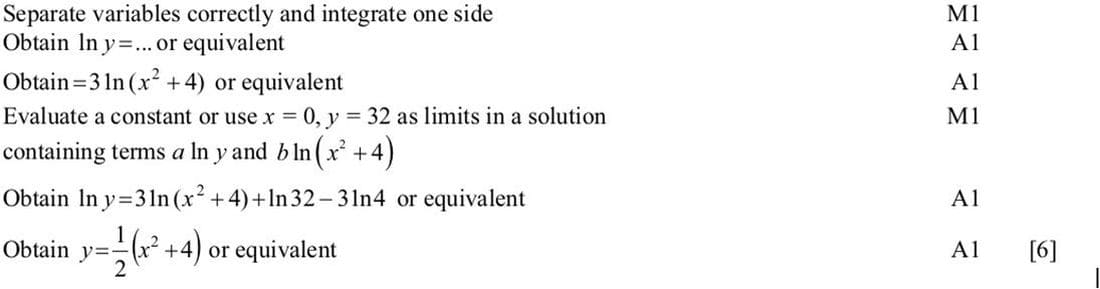
The variables x and y are related by the differential equation \((x^2 + 4) \frac{dy}{dx} = 6xy\).
It is given that \(y = 32\) when \(x = 0\). Find an expression for y in terms of x.
9709 P33 - Jun 2010 - Q4
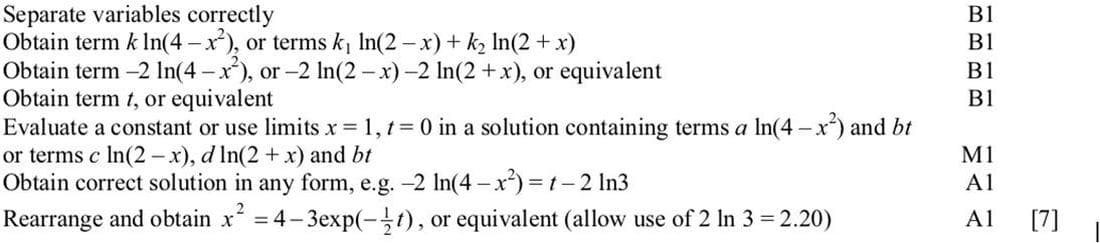
Given that \(x = 1\) when \(t = 0\), solve the differential equation
\(\frac{dx}{dt} = \frac{1}{x} - \frac{x}{4}\)
obtaining an expression for \(x^2\) in terms of \(t\).
9709 P31 - Jun 2010 - Q5
Given that \(y = 0\) when \(x = 1\), solve the differential equation \(xy \frac{dy}{dx} = y^2 + 4\), obtaining an expression for \(y^2\) in terms of \(x\).

9709 P3 - Nov 2006 - Q4
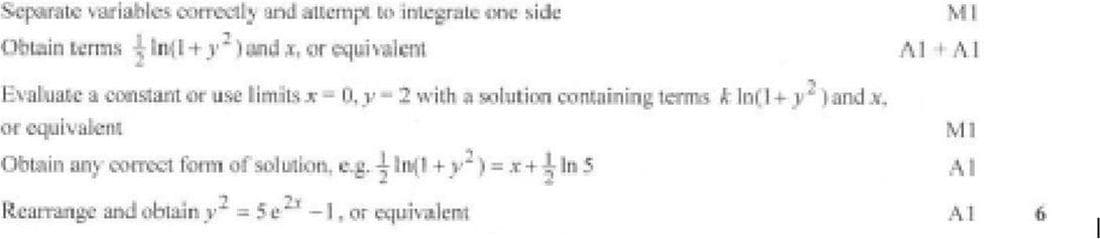
Given that \(y = 2\) when \(x = 0\), solve the differential equation
\(\frac{y}{\frac{dy}{dx}} = 1 + y^2,\)
obtaining an expression for \(y^2\) in terms of \(x\).
9709 P3 - Jun 2004 - Q6
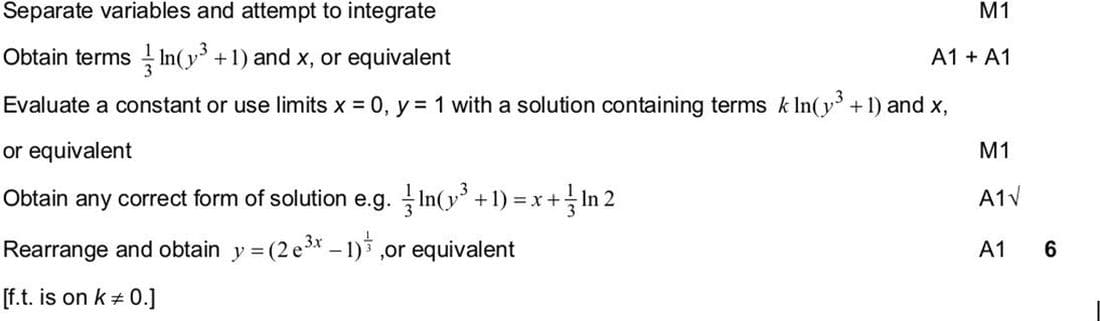
Given that \(y = 1\) when \(x = 0\), solve the differential equation \(\frac{dy}{dx} = \frac{y^3 + 1}{y^2}\), obtaining an expression for \(y\) in terms of \(x\).
9709 P31 - Jun 2022 - Q4
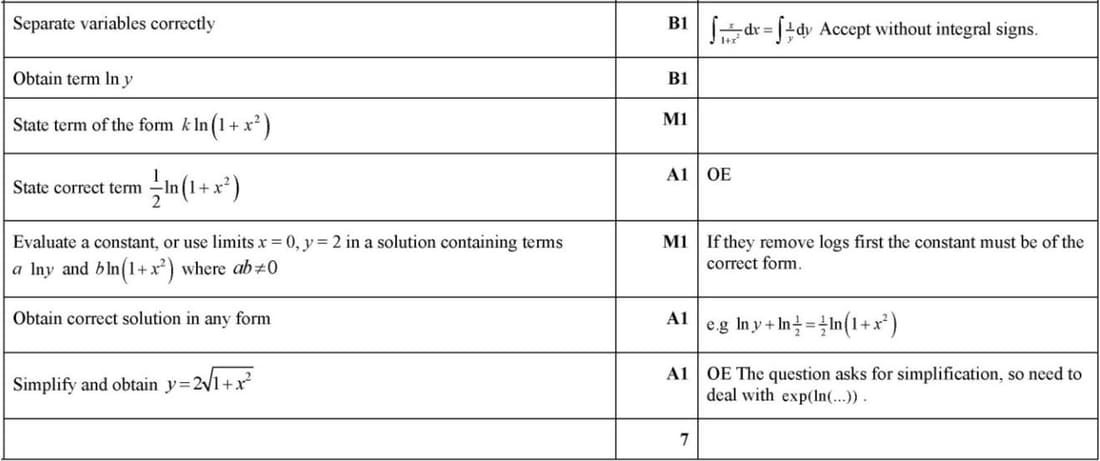
The variables x and y satisfy the differential equation \(\frac{dy}{dx} = \frac{xy}{1+x^2}\), and \(y = 2\) when \(x = 0\). Solve the differential equation, obtaining a simplified expression for y in terms of x.
9709 P32 - Jun 2021 - Q7
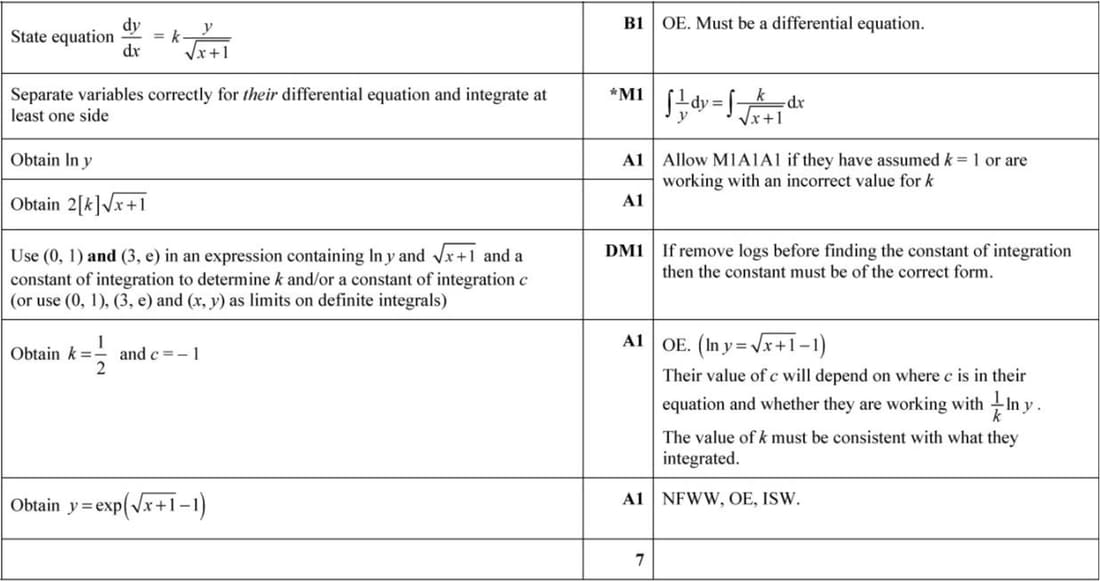
A curve is such that the gradient at a general point with coordinates \((x, y)\) is proportional to \(\frac{y}{\sqrt{x+1}}\).
The curve passes through the points with coordinates \((0, 1)\) and \((3, e)\).
By setting up and solving a differential equation, find the equation of the curve, expressing \(y\) in terms of \(x\).
9709 P31 - Nov 2020 - Q8
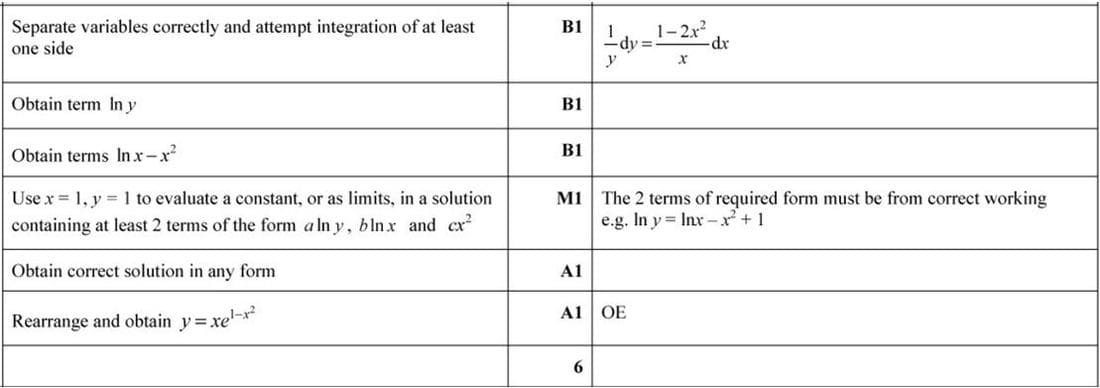
The coordinates (x, y) of a general point of a curve satisfy the differential equation \(x \frac{dy}{dx} = (1 - 2x^2)y\), for \(x > 0\). It is given that \(y = 1\) when \(x = 1\).
Solve the differential equation, obtaining an expression for \(y\) in terms of \(x\).
9709 P33 - Jun 2019 - Q5
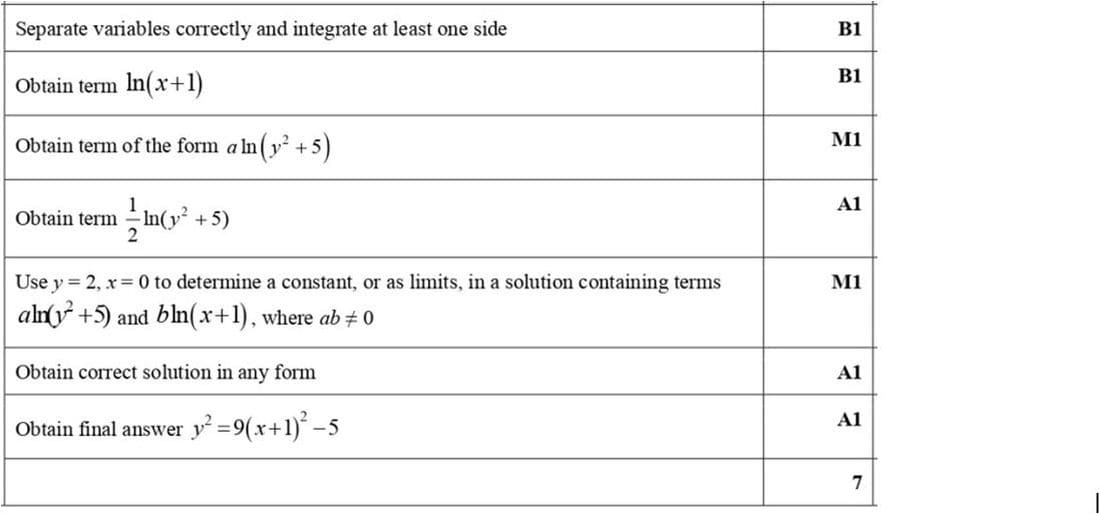
The variables x and y satisfy the differential equation \((x + 1) y \frac{dy}{dx} = y^2 + 5\).
It is given that \(y = 2\) when \(x = 0\). Solve the differential equation obtaining an expression for \(y^2\) in terms of \(x\).
9709 P31 - Nov 2018 - Q5
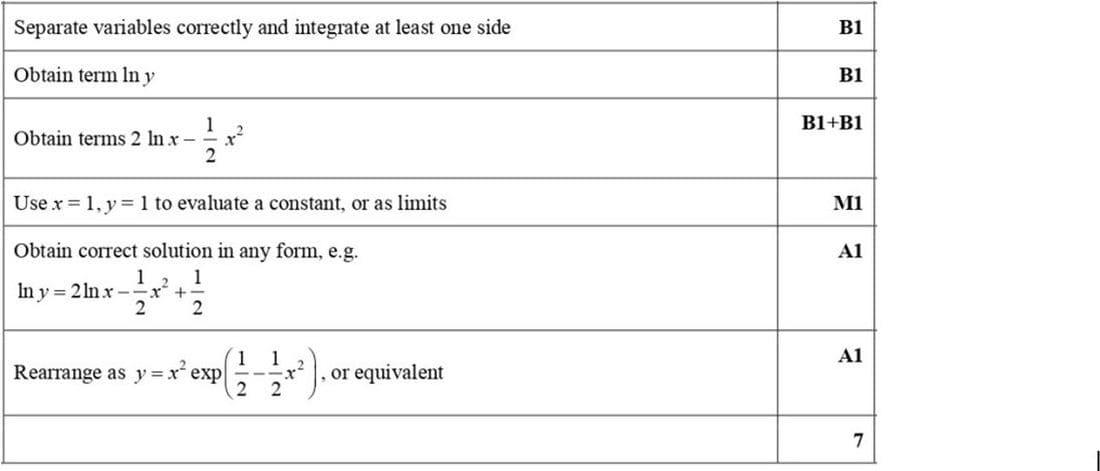
The coordinates \((x, y)\) of a general point on a curve satisfy the differential equation \(x \frac{dy}{dx} = (2 - x^2)y\).
The curve passes through the point \((1, 1)\). Find the equation of the curve, obtaining an expression for \(y\) in terms of \(x\).
9709 P32 - Nov 2017 - Q5
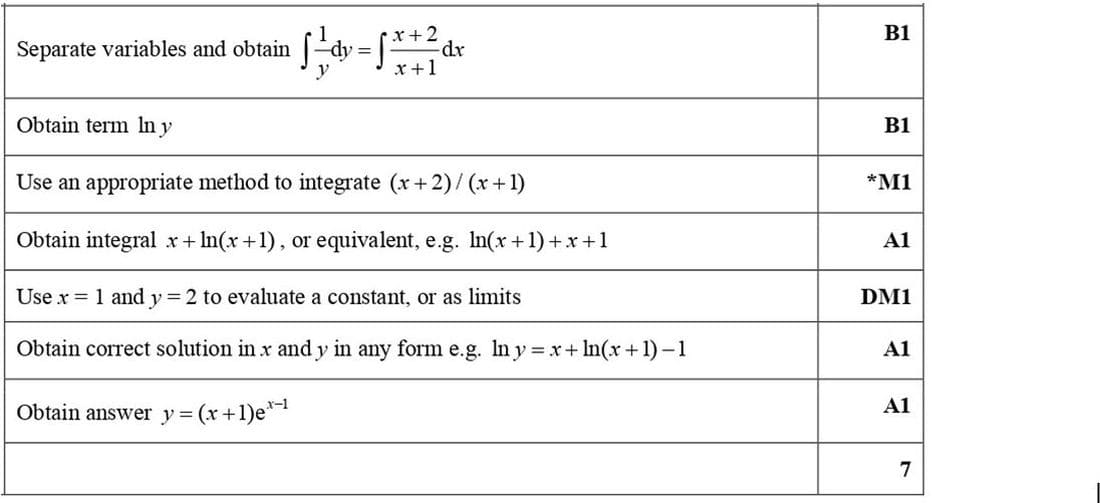
The variables x and y satisfy the differential equation
\((x+1) \frac{dy}{dx} = y(x+2),\)
and it is given that \(y = 2\) when \(x = 1\). Solve the differential equation and obtain an expression for \(y\) in terms of \(x\).
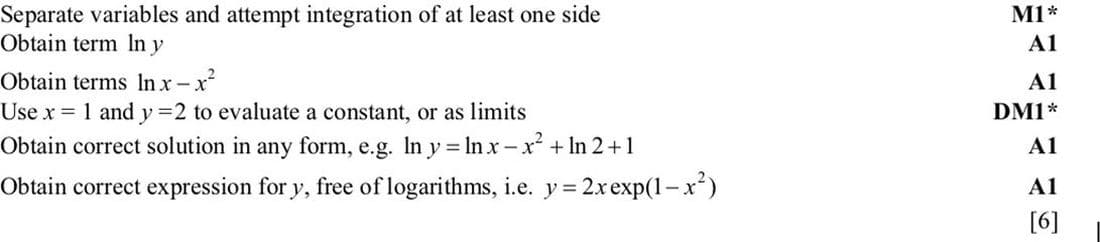
9709 P31 - Jun 2016 - Q4
The variables x and y satisfy the differential equation
\(x \frac{dy}{dx} = y(1 - 2x^2)\),
and it is given that \(y = 2\) when \(x = 1\). Solve the differential equation and obtain an expression for y in terms of x in a form not involving logarithms.
9709 P33 - Jun 2013 - Q8
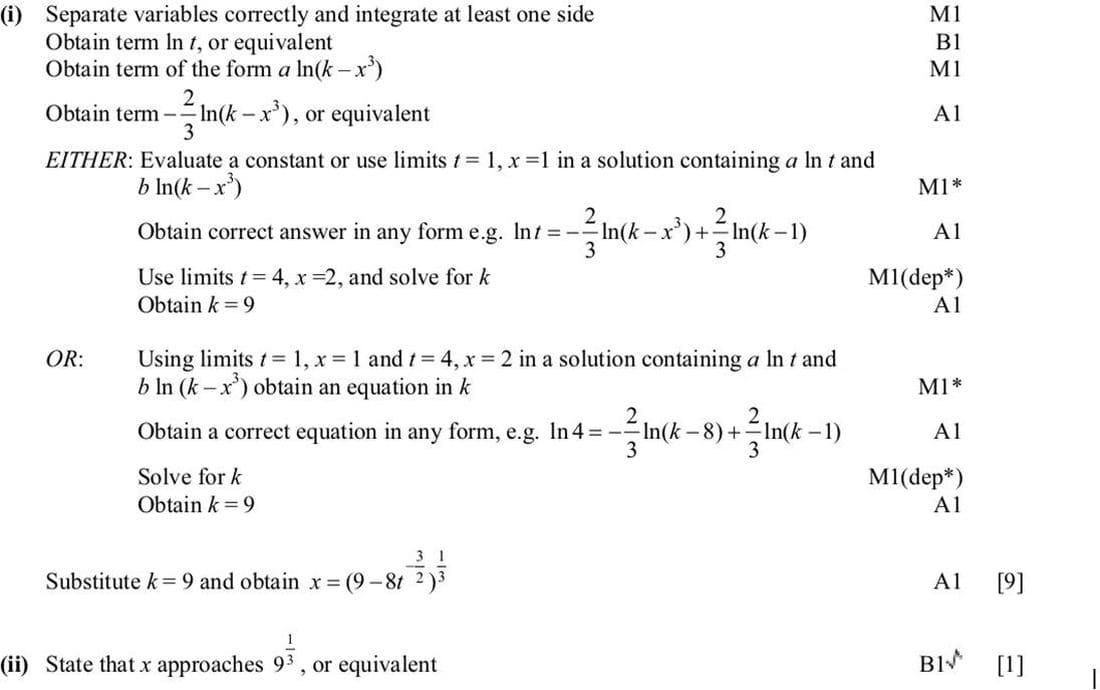
The variables x and t satisfy the differential equation
\(t \frac{dx}{dt} = \frac{k - x^3}{2x^2}\),
for \(t > 0\), where \(k\) is a constant. When \(t = 1, x = 1\) and when \(t = 4, x = 2\).
(i) Solve the differential equation, finding the value of \(k\) and obtaining an expression for \(x\) in terms of \(t\). [9]
(ii) State what happens to the value of \(x\) as \(t\) becomes large. [1]
9709 P33 - Nov 2022 - Q10
A gardener is filling an ornamental pool with water using a hose that delivers 30 litres of water per minute. Initially, the pool is empty. At time t minutes after filling begins, the volume of water in the pool is V litres. The pool has a small leak and loses water at a rate of \(0.01V\) litres per minute.
The differential equation satisfied by V and t is of the form
\[ \frac{dV}{dt} = a - bV \]
(a) Write down the values of the constants a and b.
(b) Solve the differential equation and find the value of t when \(V = 1000\).
(c) Obtain an expression for \(V\) in terms of \(t\) and hence state what happens to \(V\) as \(t\) becomes large.

9709 P33 - Nov 2011 - Q4
During an experiment, the number of organisms present at time t days is denoted by N, where N is treated as a continuous variable. It is given that
\(\frac{dN}{dt} = 1.2e^{-0.02t}N^{0.5}\).
When \(t = 0\), the number of organisms present is 100.
- Find an expression for N in terms of t.
- State what happens to the number of organisms present after a long time.

9709 P31 - Jun 2011 - Q10
The number of birds of a certain species in a forested region is recorded over several years. At time \(t\) years, the number of birds is \(N\), where \(N\) is treated as a continuous variable. The variation in the number of birds is modelled by
\(\frac{dN}{dt} = \frac{N(1800 - N)}{3600}.\)
It is given that \(N = 300\) when \(t = 0\).
(i) Find an expression for \(N\) in terms of \(t\).
(ii) According to the model, how many birds will there be after a long time?

9709 P32 - Nov 2009 - Q9
The temperature of a quantity of liquid at time \(t\) is \(\theta\). The liquid is cooling in an atmosphere whose temperature is constant and equal to \(A\). The rate of decrease of \(\theta\) is proportional to the temperature difference \((\theta - A)\). Thus \(\theta\) and \(t\) satisfy the differential equation
\(\frac{d\theta}{dt} = -k(\theta - A),\)
where \(k\) is a positive constant.
(i) Find, in any form, the solution of this differential equation, given that \(\theta = 4A\) when \(t = 0\). [5]
(ii) Given also that \(\theta = 3A\) when \(t = 1\), show that \(k = \ln \frac{3}{2}\). [1]
(iii) Find \(\theta\) in terms of \(A\) when \(t = 2\), expressing your answer in its simplest form. [3]

9709 P3 - Nov 2007 - Q7
The number of insects in a population \(t\) days after the start of observations is denoted by \(N\). The variation in the number of insects is modelled by the differential equation
\[ \frac{dN}{dt} = kN \cos(0.02t), \]
where \(k\) is a constant and \(N\) is taken to be a continuous variable. It is given that \(N = 125\) when \(t = 0\).
- Solve the differential equation, obtaining a relation between \(N\), \(k\), and \(t\).
- Given also that \(N = 166\) when \(t = 30\), find the value of \(k\).
- Obtain an expression for \(N\) in terms of \(t\), and find the least value of \(N\) predicted by this model.
