Past Exam Questions
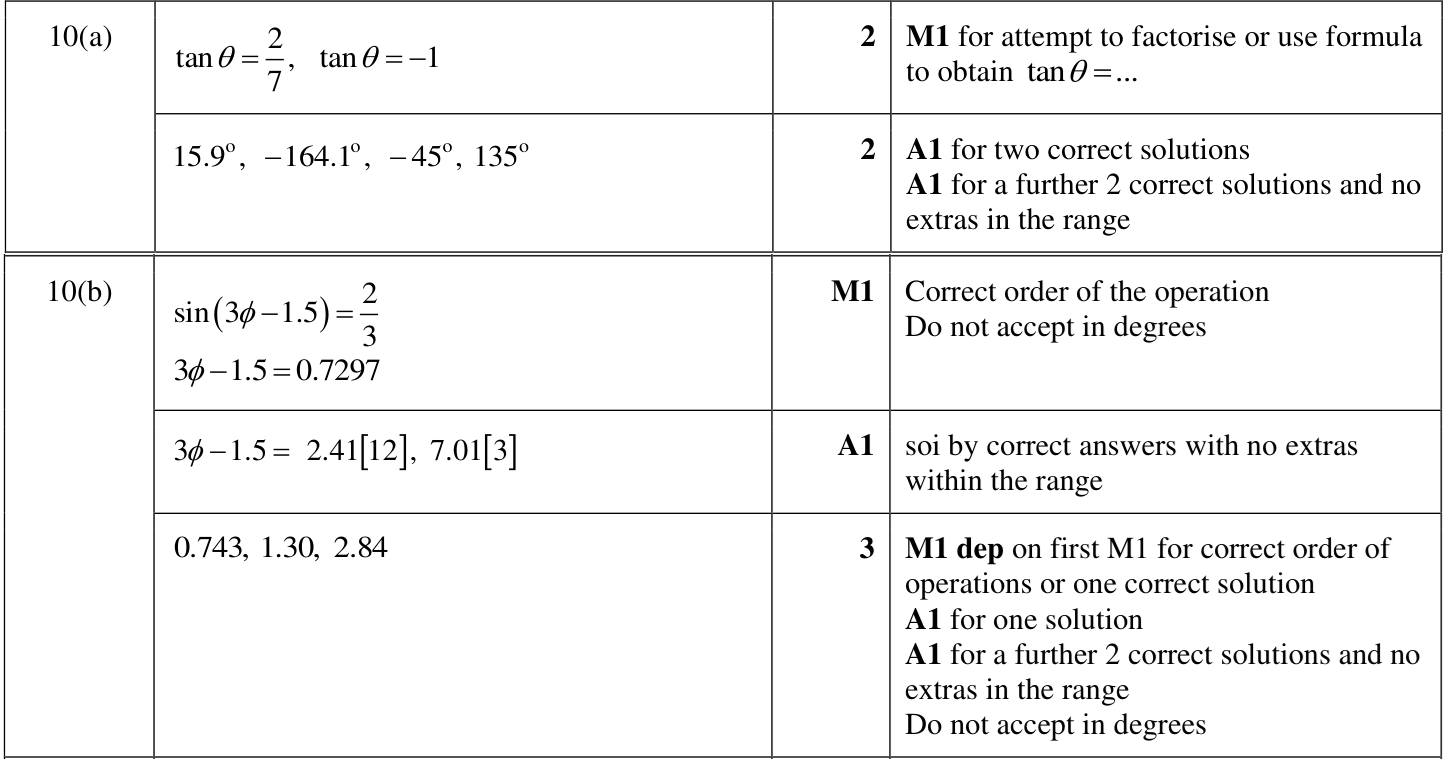
← Back0606 P13 - Nov 2024 - Q10 - 9 marks
(a) Solve the equation \(7 \tan ^{2} \theta+5 \tan \theta-2=0\), for \(-180^{\circ} \leqslant \theta \leqslant 180^{\circ}\). (b) Solve the equation \(3 \sin (3 \phi-1.5)-2=0\), for \(0\lt \phi\lt 3\), where \(\phi\) is in radians.
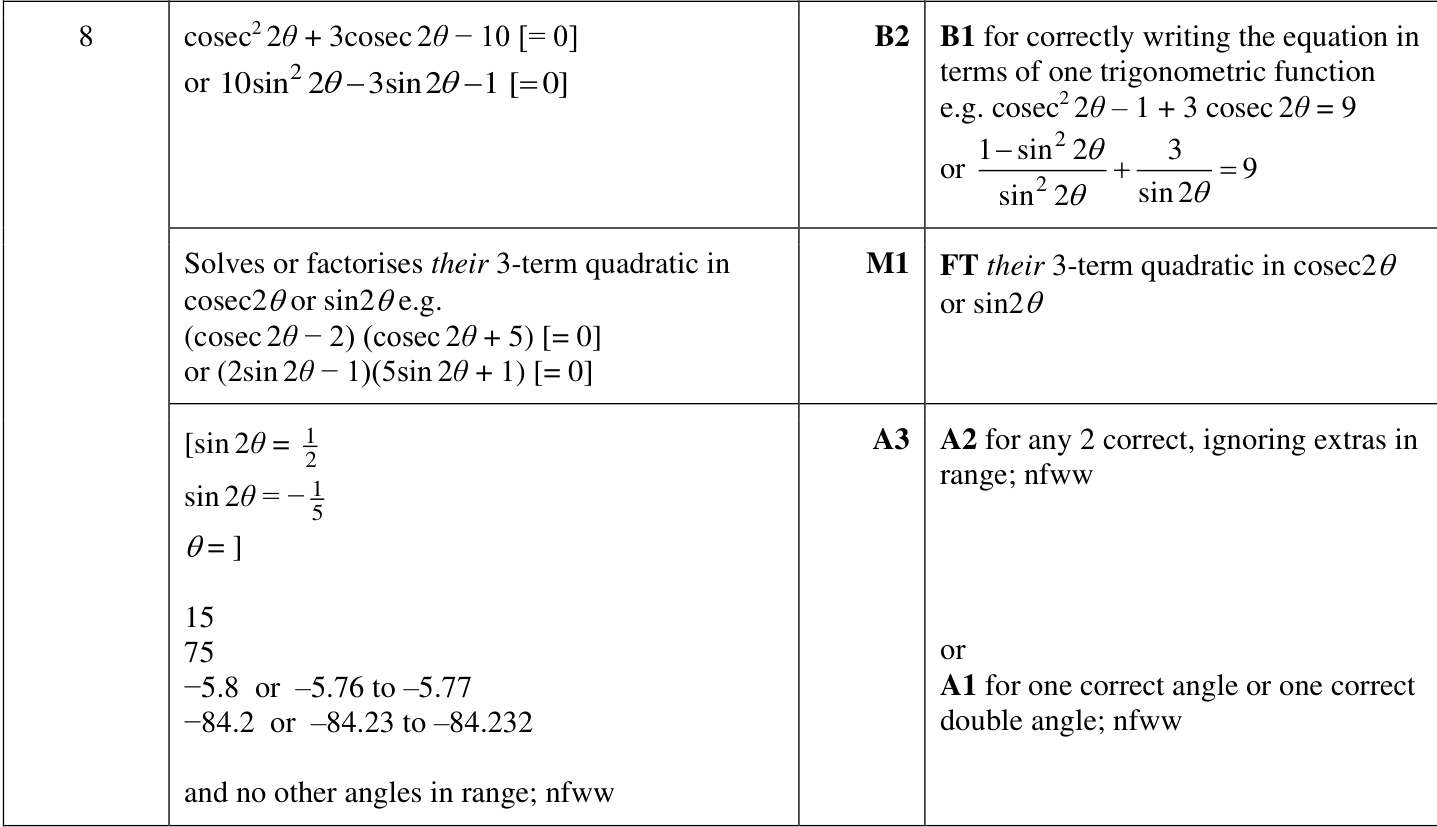
0606 P22 - Nov 2024 - Q8 - 6 marks
Solve the equation \(\cot ^{2} 2 \theta+3 \operatorname{cosec} 2 \theta=9\) for \(-90^{\circ} \leqslant \theta \leqslant 90^{\circ}\).
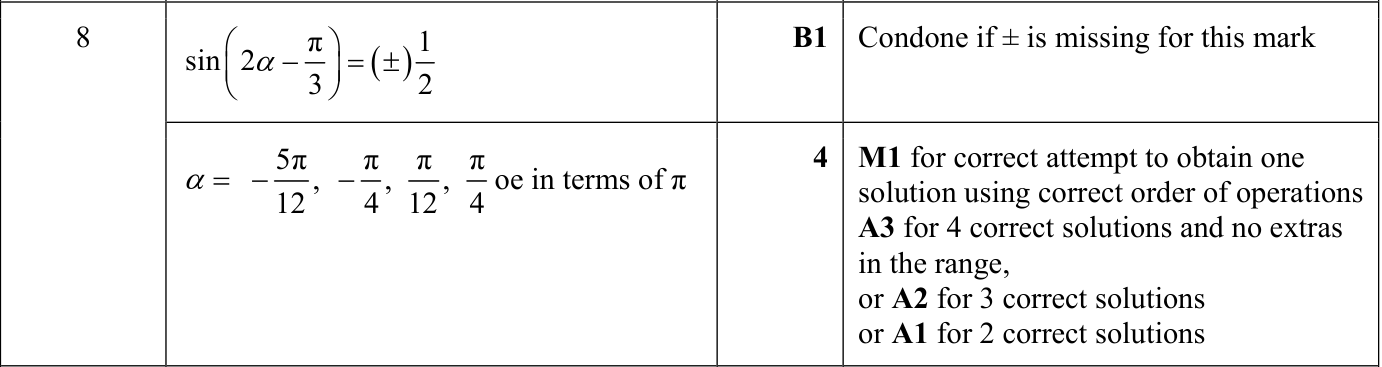
0606 P11 - Jun 2024 - Q8 - 5 marks
Solve the equation \(4 \sin ^{2}\left(2 \alpha-\frac{\pi}{3}\right)=1\) for \(-\frac{\pi}{2} \leqslant \alpha \leqslant \frac{\pi}{2}\). Give your answers in terms of \(\pi\).
0606 P13 - Jun 2024 - Q12 - 5 marks
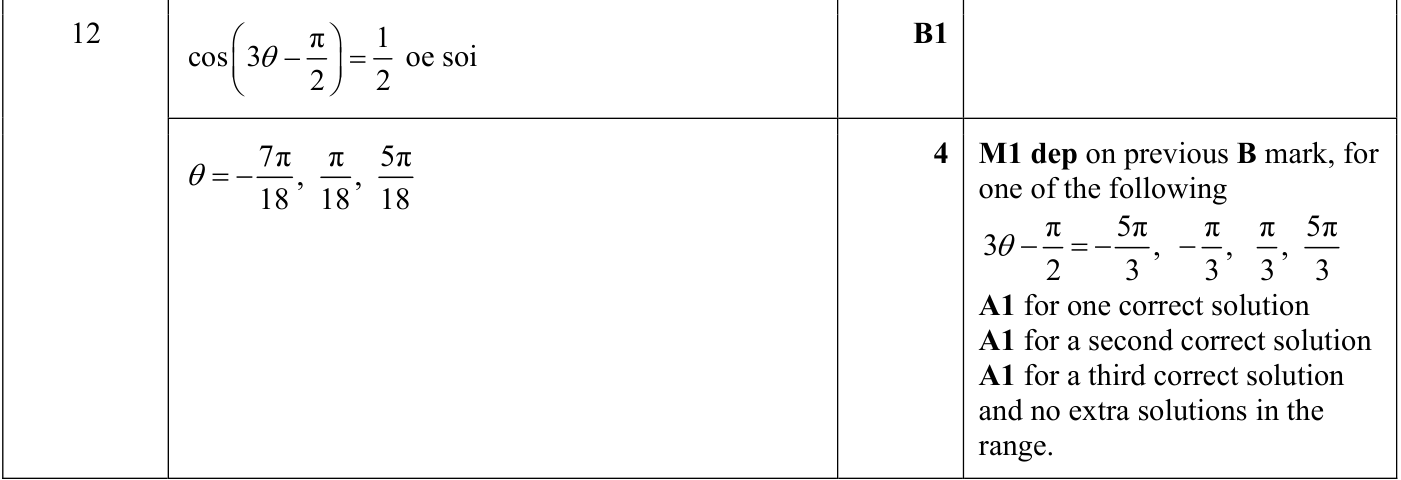
Solve the equation \(\sec \left(3 \theta-\frac{\pi}{2}\right)=2\) for \(-\frac{\pi}{2} \leqslant \theta \leqslant \frac{\pi}{2}\). Give your answers in exact form.
0606 P22 - Jun 2024 - Q6 - 8 marks
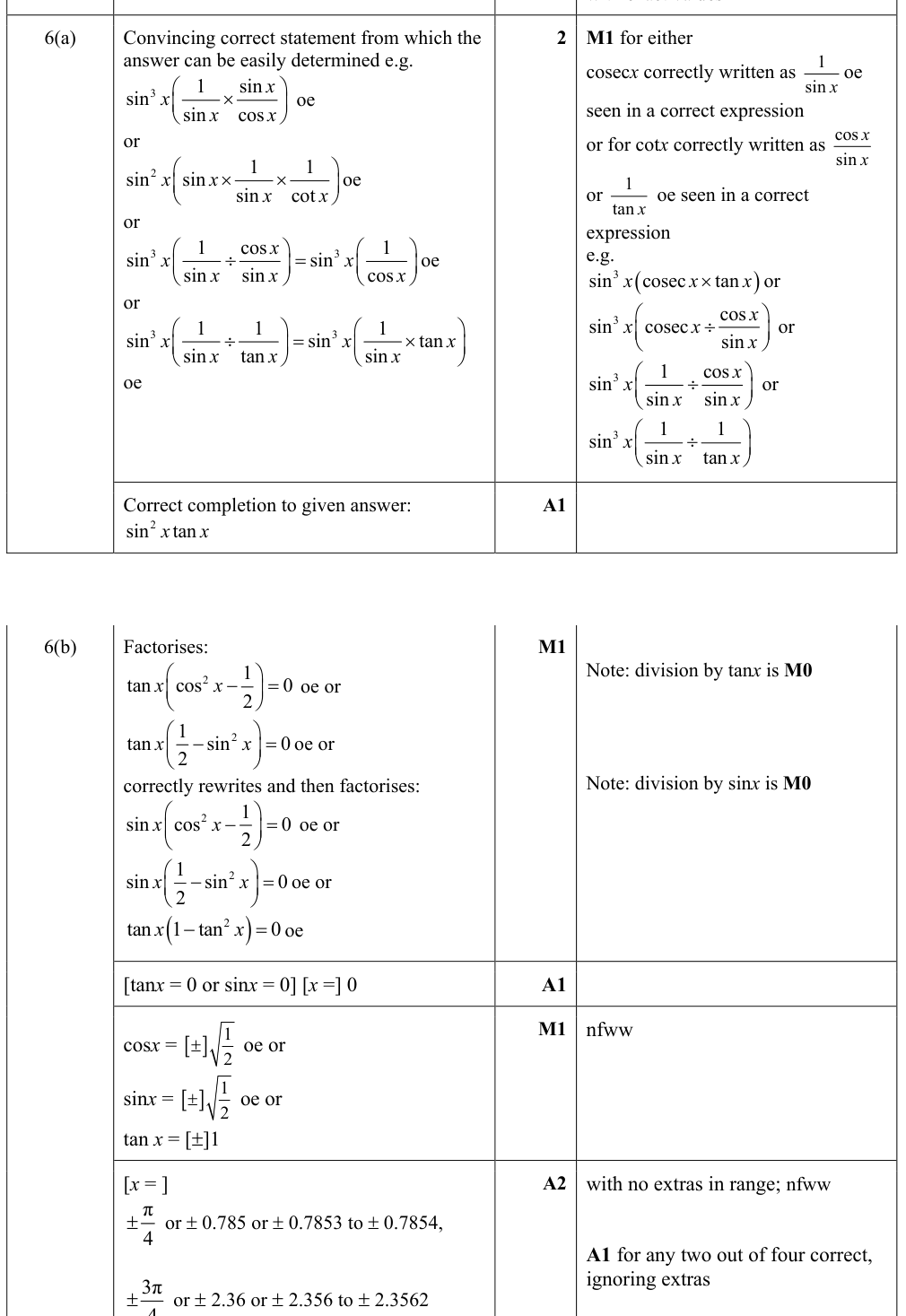
(a) Show that \(\sin ^{3} x\left(\frac{\operatorname{cosec} x}{\cot x}\right)\) can be written as \(\sin ^{2} x \tan x\). (b) Solve the equation \(\cos ^{2} x \tan x-\frac{1}{2} \tan x=0\) for \(-\pi\lt x\lt \pi\).
0606 P12 - Jun 2023 - Q6 - 7 marks
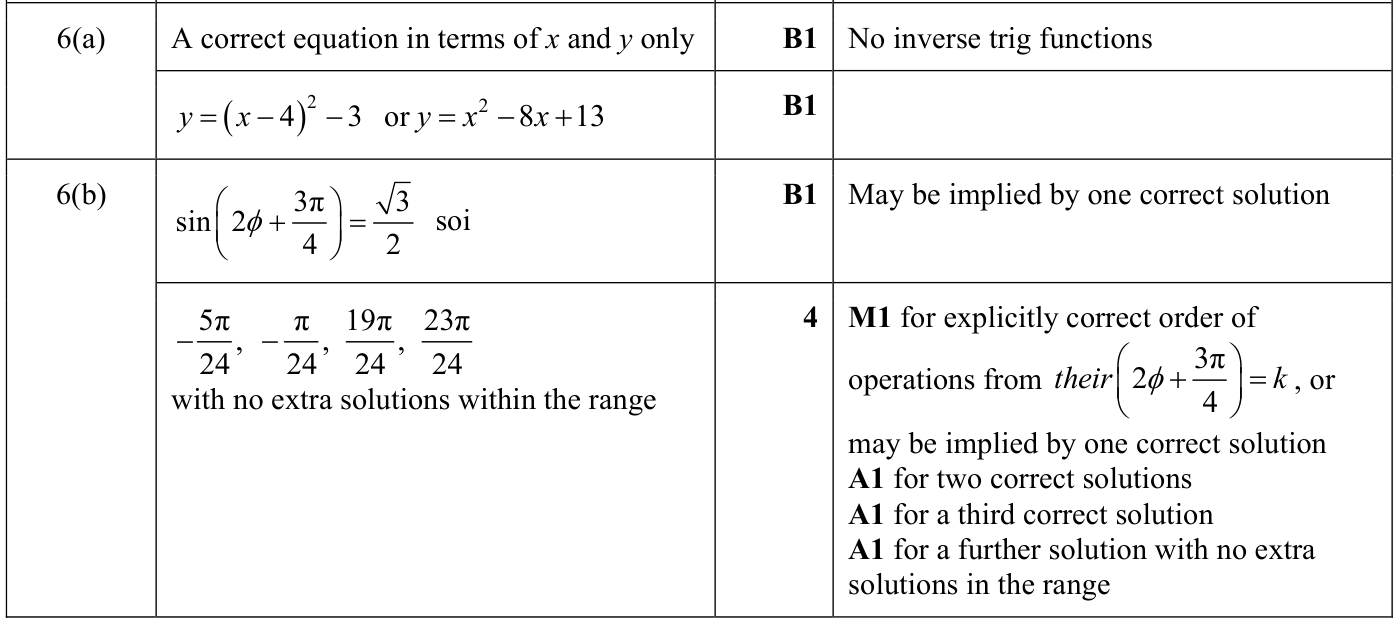
(a) Given that \(\operatorname{cot}^2\theta=\frac{1}{y+2}\) and \(\operatorname{sec}\theta=x-4\), find \(y\) in terms of \(x\).
(b) Solve the equation
\(\sqrt3\,\operatorname{cosec}\left(2\phi+\frac{3\pi}{4}\right)=2,\)
for \(-\pi\lt\phi\lt\pi\), giving your answers in terms of \(\pi\).
0606 P12 - Nov 2023 - Q5 - 5 marks
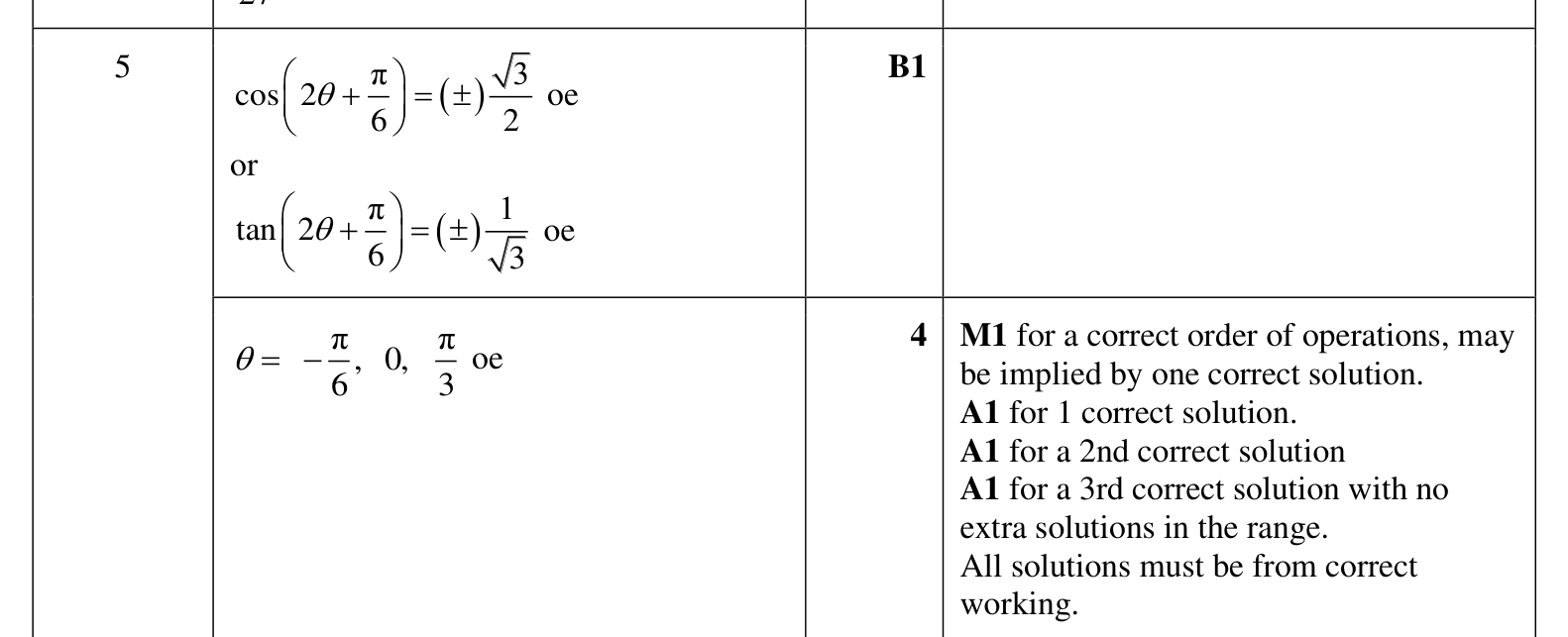
Solve the equation
\(3\operatorname{sec}^2\left(2\theta+\frac{\pi}{6}\right)=4\)
for \(-\frac{\pi}{2}\lt \theta\lt \frac{\pi}{2}\), giving your answers in terms of \(\pi\).
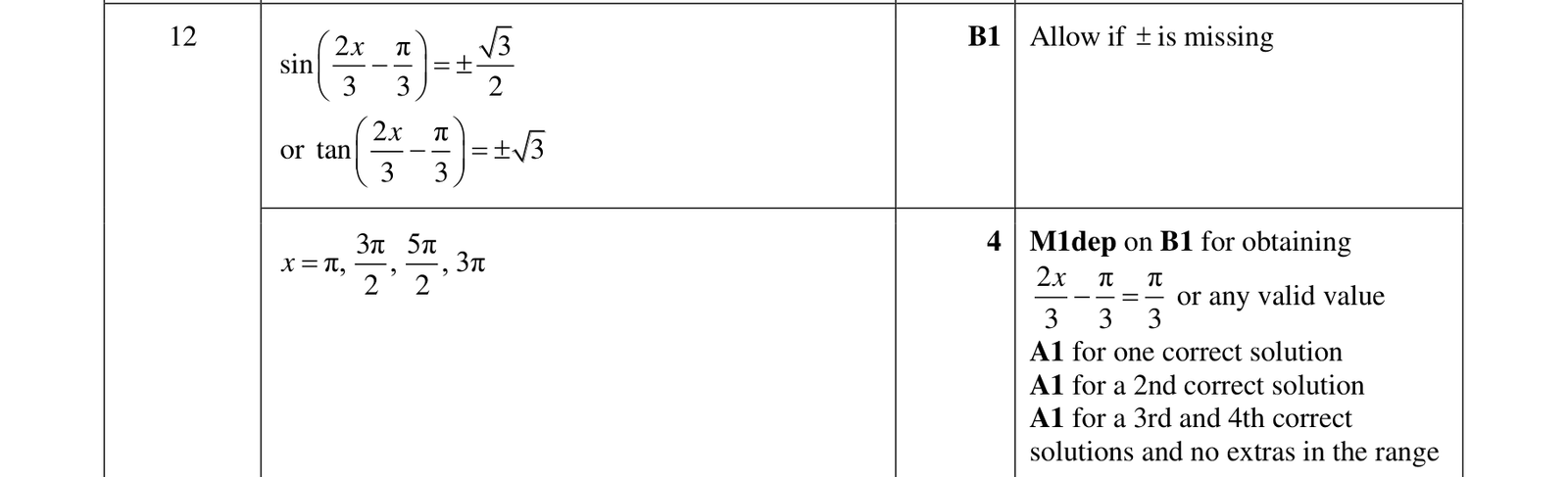
0606 P13 - Nov 2023 - Q12 - 5 marks
Solve the equation
\(\displaystyle 3\operatorname{cosec}^2\left(\frac{2x}{3}-\frac{\pi}{3}\right)=4\)
for \(0\lt x\leq 3\pi\). Give your answers in terms of \(\pi\).
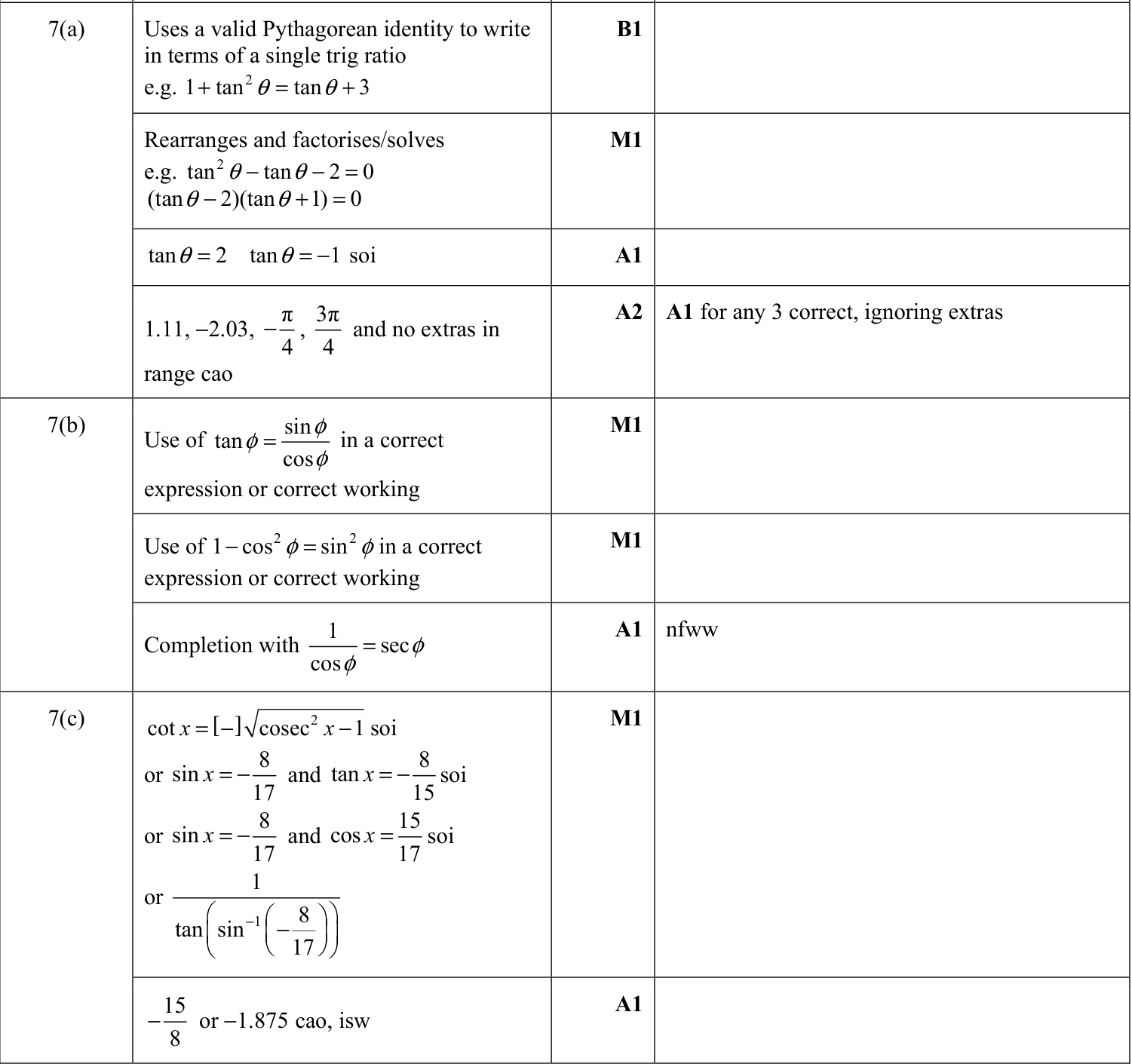
0606 P22 - Mar 2022 - Q7 - 10 marks
In this question, all angles are in radians.
(a) Solve the equation
\(\operatorname{sec}^2\theta=\tan\theta+3\)
for \(-\pi\lt \theta\lt \pi\).
(b) Show that, for \(0\lt \phi\lt \frac{\pi}{2}\),
\(\frac{\tan\phi}{\sqrt{1-\cos^2\phi}}=\operatorname{sec}\phi.\)
(c) Given that \(\operatorname{cosec}x=-\frac{17}{8}\) and that \(\frac{3\pi}{2}\lt x\lt 2\pi\), find the exact value of \(\operatorname{cot}x\).
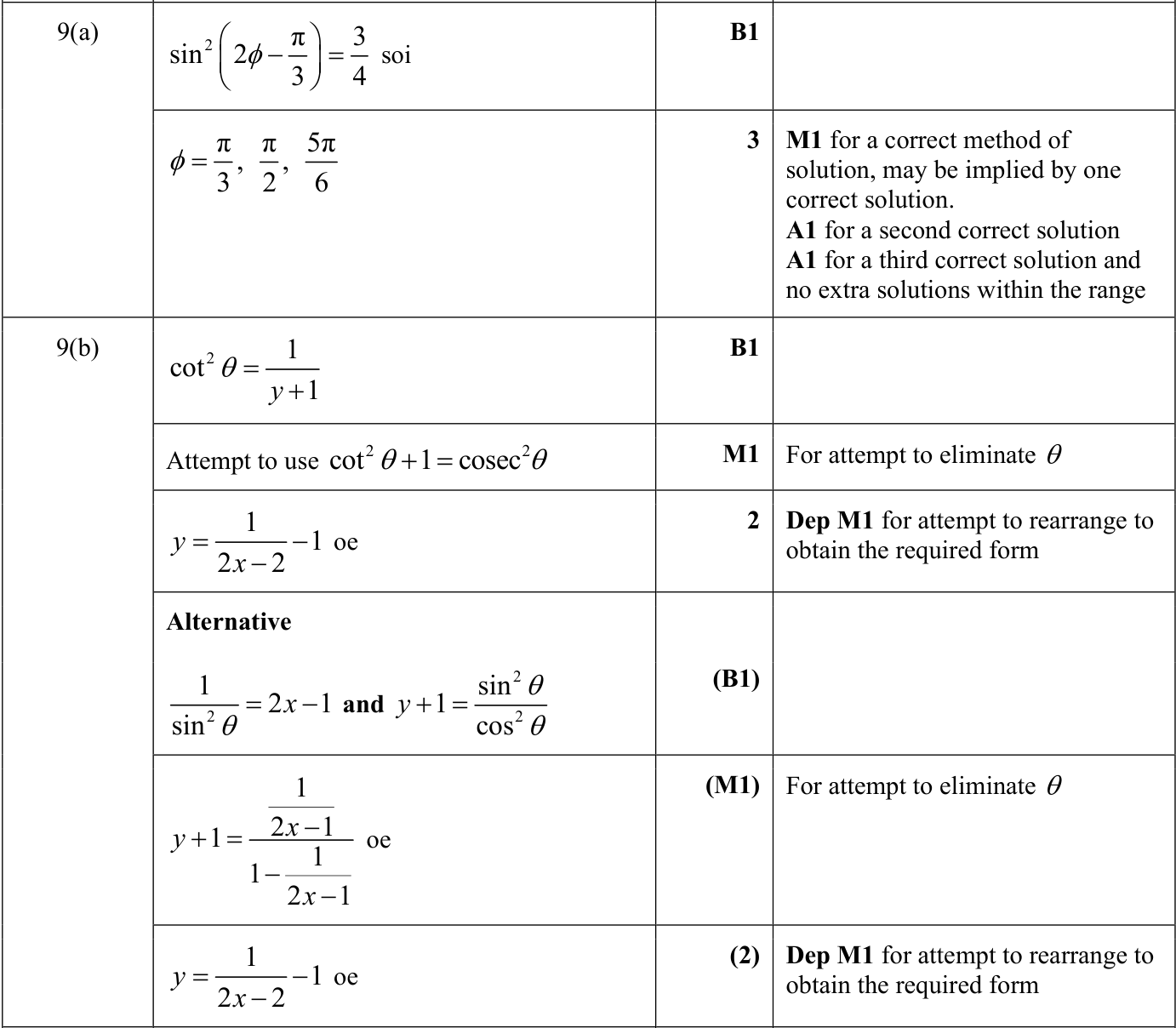
0606 P13 - Jun 2022 - Q9 - 8 marks
(a) Solve the equation
\(3\operatorname{cosec}^{2}\left(2\phi-\frac{\pi}{3}\right)=4,\)
for \(0\lt \phi\lt \pi\). Give your solutions in terms of \(\pi\).
(b) Given that \(2x-1=\operatorname{cosec}^{2}\theta\) and \(y+1=\tan^{2}\theta\), find \(y\) in terms of \(x\).
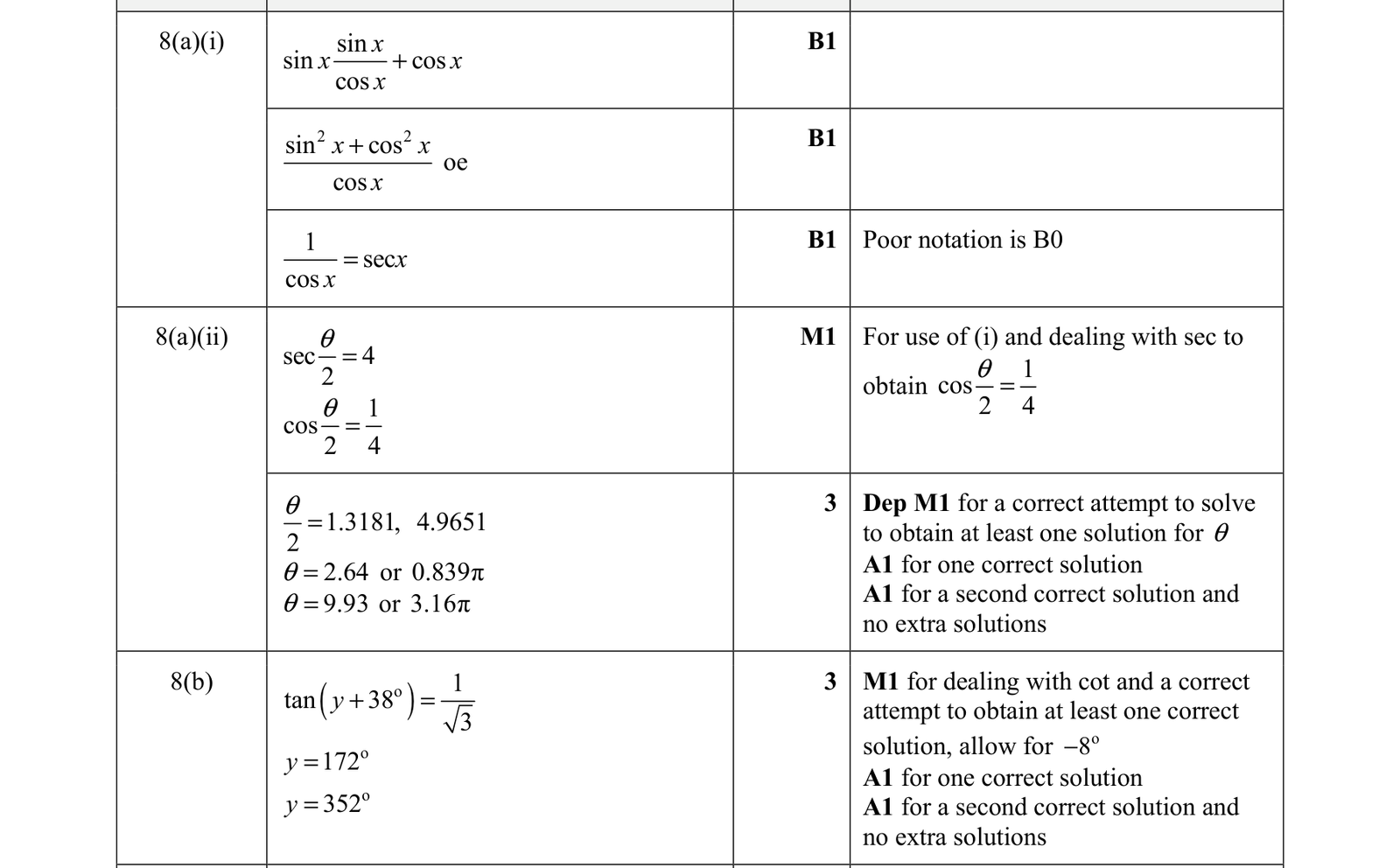
0606 P12 - Mar 2021 - Q8 - 10 marks
(a)
(i) Show that
\(\sin x\tan x+\cos x=\operatorname{sec}x.\)
(ii) Hence solve the equation
\(\sin\frac{\theta}{2}\tan\frac{\theta}{2}+\cos\frac{\theta}{2}=4\)
for \(0\leqslant\theta\leqslant4\pi\), where \(\theta\) is in radians.
(b) Solve the equation
\(\operatorname{cot}(y+38^\circ)=\sqrt3\)
for \(0^\circ\leqslant y\leqslant360^\circ\).
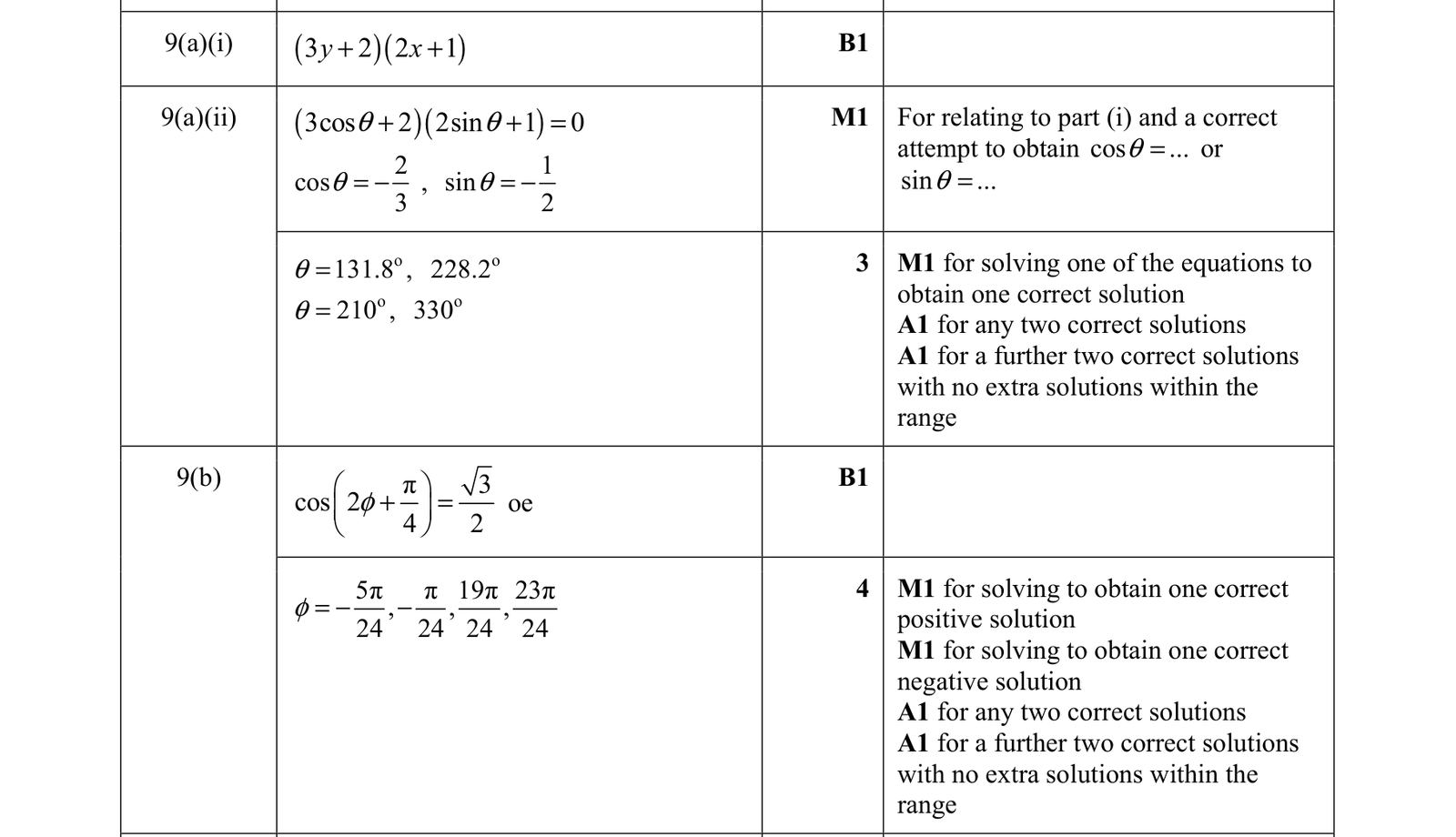
0606 P11 - Jun 2021 - Q9 - 10 marks
(a)
(i) Write
\(6xy+3y+4x+2\)
in the form \((ax+b)(cy+d)\), where \(a,b,c\) and \(d\) are positive integers.
(ii) Hence solve the equation
\(6\sin\theta\cos\theta+3\cos\theta+4\sin\theta+2=0\)
for \(0^\circ\lt\theta\lt360^\circ\).
(b) Solve the equation
\(\frac12\operatorname{sec}\left(2\phi+\frac{\pi}{4}\right)=\frac1{\sqrt3}\)
for \(-\pi\lt\phi\lt\pi\), where \(\phi\) is in radians. Give your answers in terms of \(\pi\).
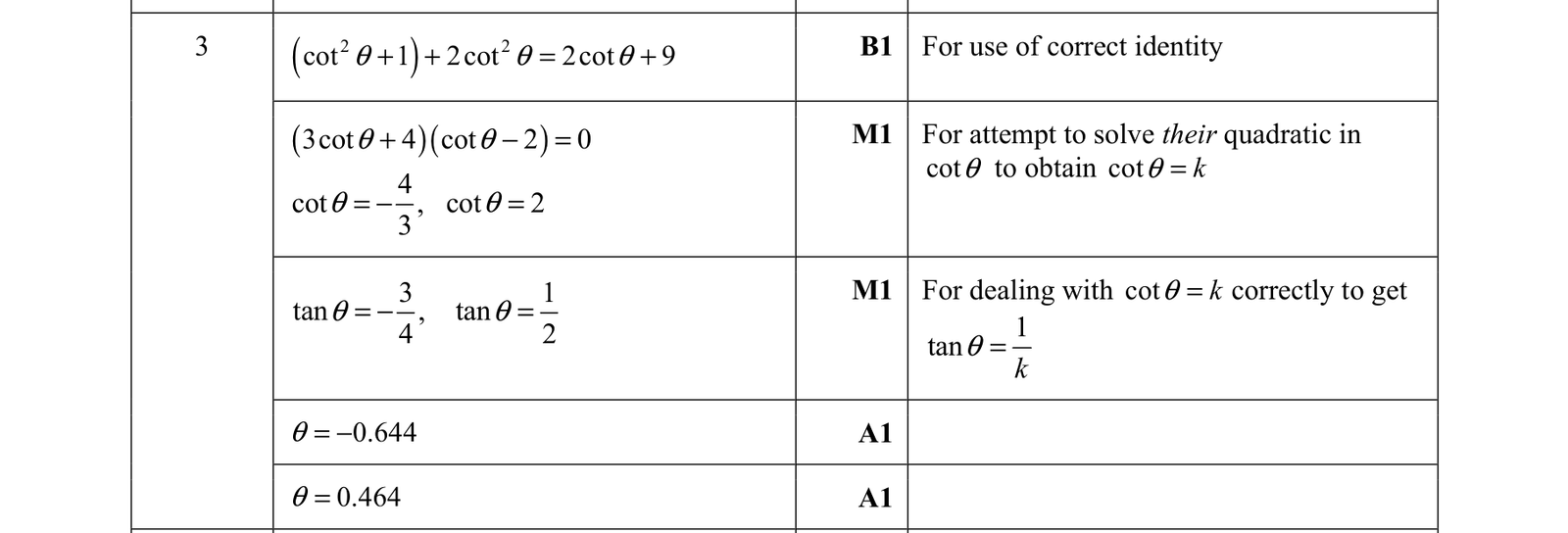
0606 P13 - Jun 2021 - Q3 - 5 marks
Solve the equation
\(\operatorname{cosec}^2\theta+2\operatorname{cot}^2\theta=2\operatorname{cot}\theta+9,\)
where \(\theta\) is in radians and
\(-\frac{\pi}{2}\lt \theta\lt \frac{\pi}{2}.\)
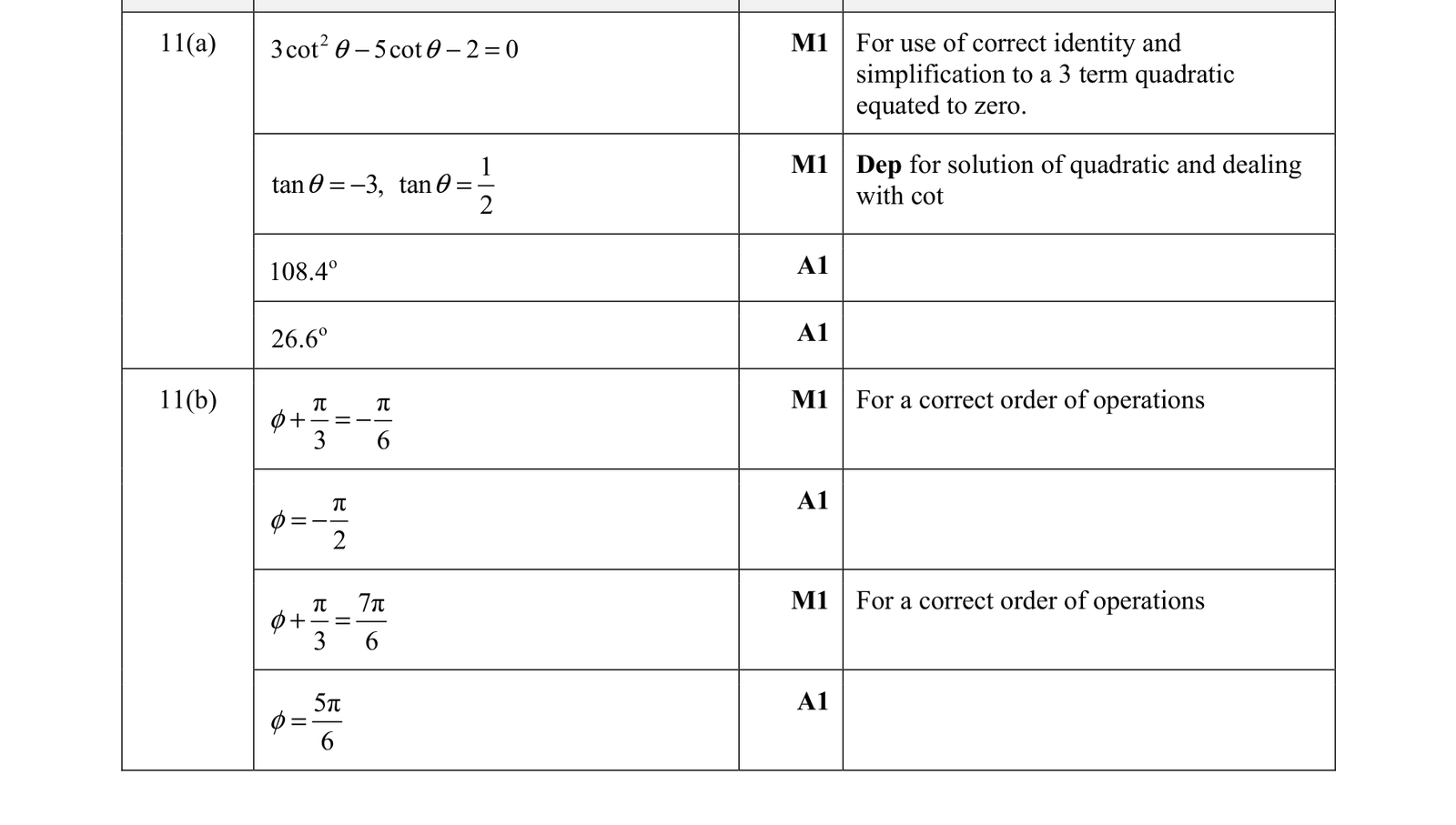
0606 P11 - Nov 2021 - Q11 - 8 marks
(a) Solve the equation \(3\operatorname{cosec}^2\theta-5=5\operatorname{cot}\theta\) for \(0^\circ\leq\theta\leq180^\circ\).
(b) Solve the equation \(\sin\left(\phi+\frac{\pi}{3}\right)=-\frac12\), where \(\phi\) is in radians and \(-\pi\leq\phi\leq\pi\). Give your answers in terms of \(\pi\).
0606 P12 - Mar 2020 - Q10 - 11 marks
(a) Solve
\(\tan(\alpha+45^\circ)=-\frac1{\sqrt2}\)
for \(0^\circ\leq\alpha\leq360^\circ\).
(b)(i) Show that
\(\frac1{\sin\theta-1}-\frac1{\sin\theta+1}=a\operatorname{sec}^2\theta,\)
where \(a\) is a constant to be found.
(b)(ii) Hence solve
\(\frac1{\sin3\phi-1}-\frac1{\sin3\phi+1}=-8\)
for \(-\dfrac{\pi}{3}\leq\phi\leq\dfrac{\pi}{3}\) radians.

0606 P22 - Jun 2020 - Q8 - 9 marks
(a) Solve
\(3\operatorname{cot}^2 x-14\operatorname{cosec}x-2=0\)
for \(0^\circ\lt x\lt 360^\circ\).
(b) Show that
\(\frac{\sin^4y-\cos^4y}{\operatorname{cot} y}=\tan y-2\cos y\sin y.\)

0606 P23 - Jun 2020 - Q10 - 8 marks
Solve the equations
(a) \(5\operatorname{sec}^2 A+14\tan A-8=0\), for \(0^\circ\leq A\leq180^\circ\),
(b) \(5\sin\left(4B-\frac{\pi}{8}\right)+2=0\), for \(-\frac{\pi}{4}\leq B\leq\frac{\pi}{4}\) radians.

0606 P13 - Nov 2020 - Q11 - 7 marks
(a) Given that \(2\cos x=3\tan x\), show that
\(2\sin^2x+3\sin x-2=0.\)
(b) Hence solve
\(2\cos\left(2\alpha+\frac{\pi}{4}\right) =3\tan\left(2\alpha+\frac{\pi}{4}\right)\)
for \(0\lt \alpha\lt \pi\) radians, giving your answers in terms of \(\pi\).

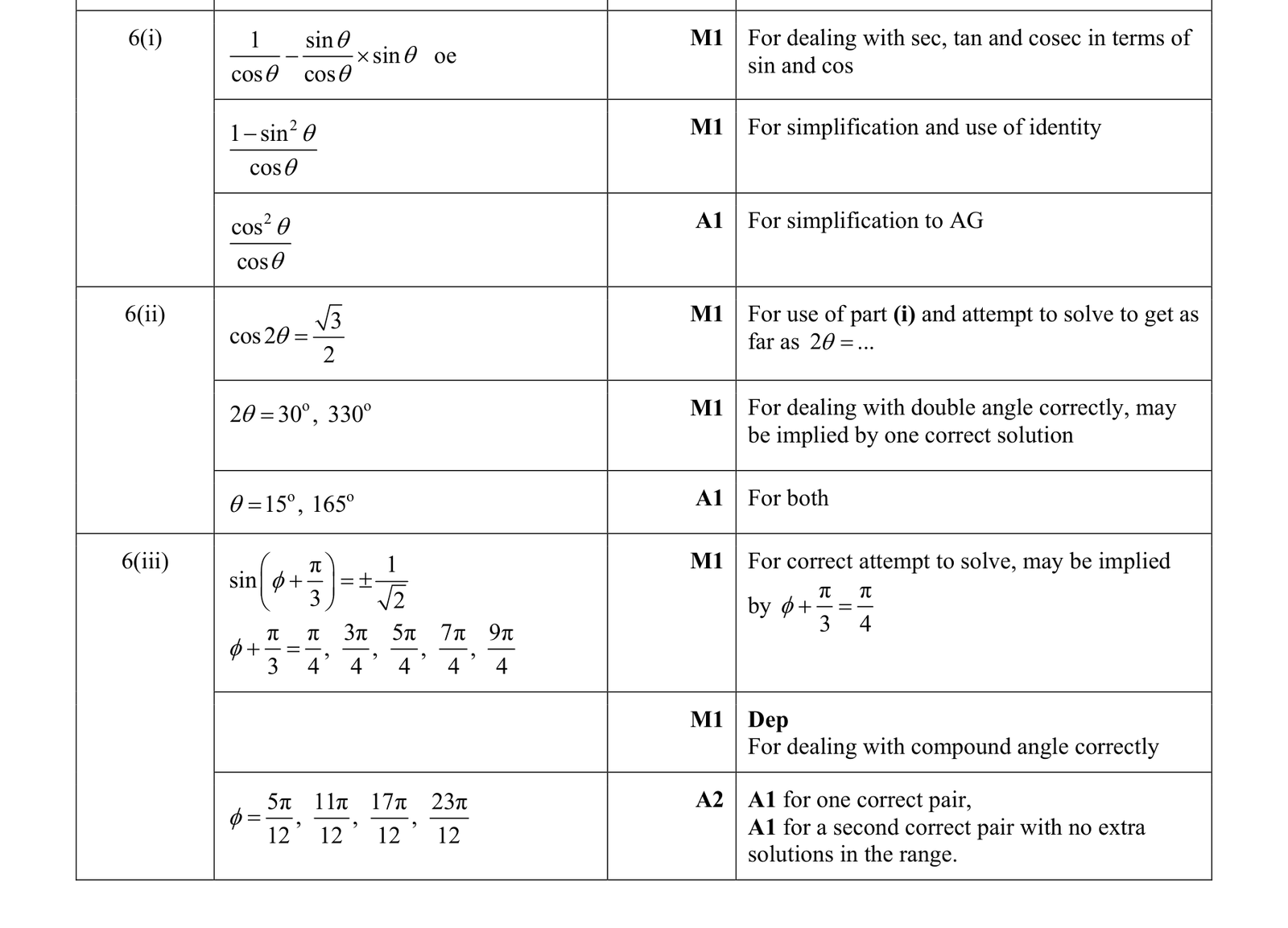
0606 P13 - Jun 2019 - Q6 - 10 marks
(a)(i) Show that \(\operatorname{sec}\theta-\dfrac{\tan\theta}{\operatorname{cosec}\theta}=\cos\theta\).
(a)(ii) Solve \(\operatorname{sec}2\theta-\dfrac{\tan2\theta}{\operatorname{cosec}2\theta}=\dfrac{\sqrt3}{2}\) for \(0^\circ\leq\theta\leq180^\circ\).
(b) Solve \(2\sin^2\left(\phi+\frac{\pi}{3}\right)=1\) for \(0\lt \phi\lt 2\pi\) radians.
0606 P21 - Jun 2019 - Q11 - 9 marks
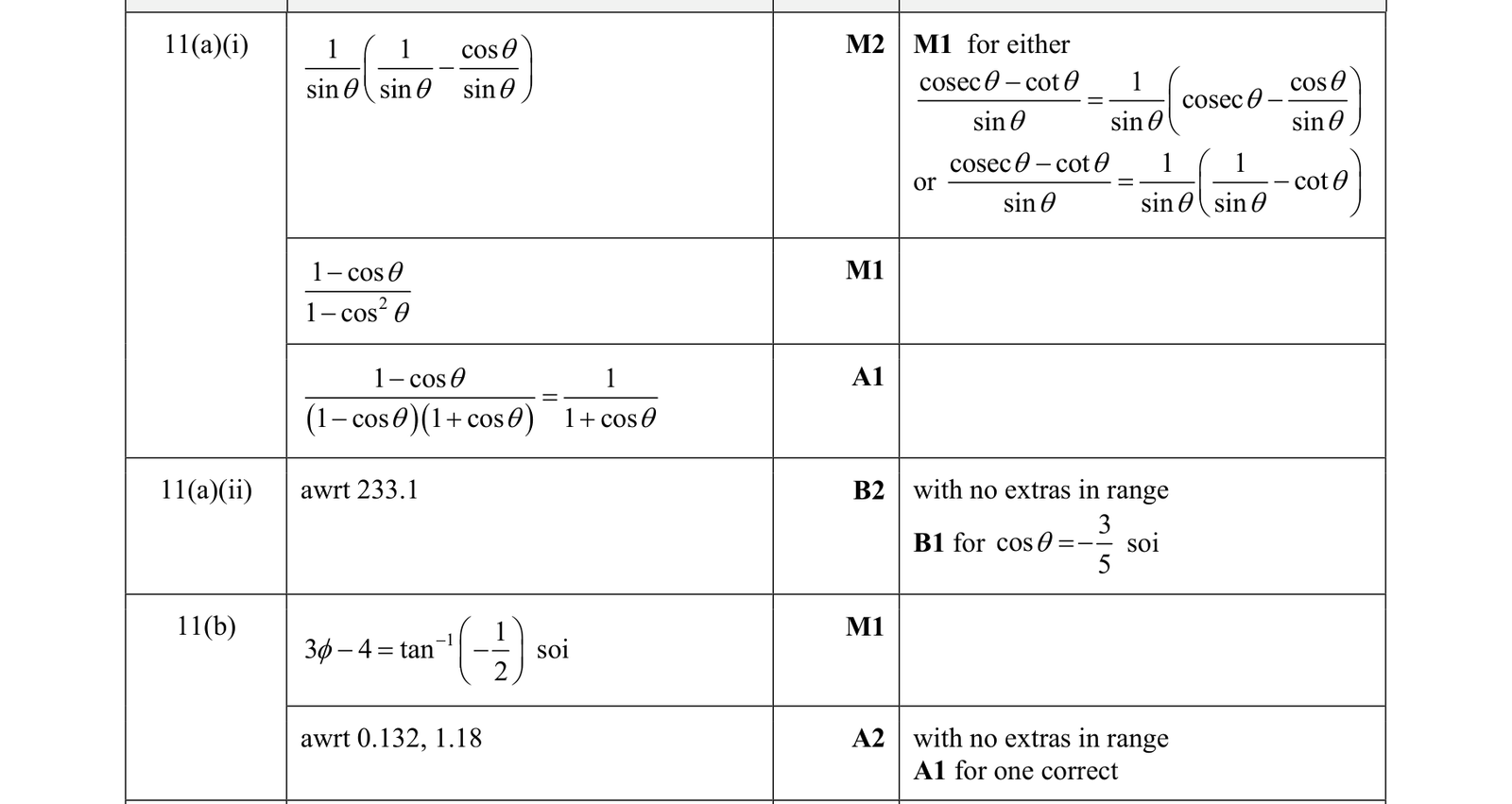
(a)(i) Show that \(\dfrac{\operatorname{cosec}\theta-\operatorname{cot}\theta}{\sin\theta}=\dfrac{1}{1+\cos\theta}\).
(a)(ii) Hence solve \(\dfrac{\operatorname{cosec}\theta-\operatorname{cot}\theta}{\sin\theta}=\dfrac52\) for \(180^\circ\lt \theta\lt 360^\circ\).
(b) Solve \(\tan(3\phi-4)=-\dfrac12\) for \(0\lt \phi\lt \frac{\pi}{2}\) radians.