The coordinates \((x, y)\) of a general point on a curve satisfy the differential equation \(x \frac{dy}{dx} = (2 - x^2)y\).
The curve passes through the point \((1, 1)\). Find the equation of the curve, obtaining an expression for \(y\) in terms of \(x\).
Solution
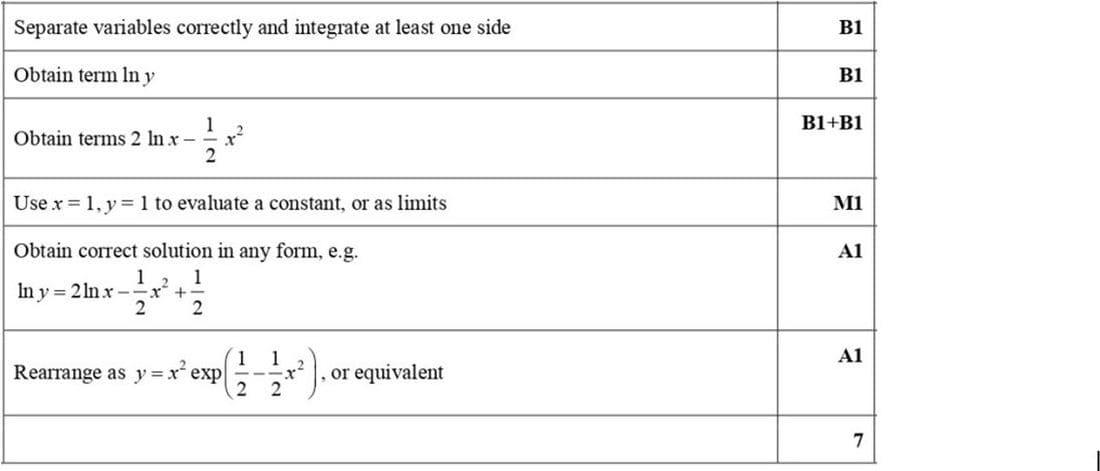
Start by separating variables: \(\frac{dy}{y} = \frac{(2 - x^2)}{x} dx\).
Integrate both sides: \(\int \frac{dy}{y} = \int \left(\frac{2}{x} - x\right) dx\).
This gives \(\ln y = 2 \ln x - \frac{1}{2} x^2 + C\).
Use the initial condition \((x, y) = (1, 1)\) to find \(C\):
\(\ln 1 = 2 \ln 1 - \frac{1}{2} \cdot 1^2 + C\)
\(0 = 0 - \frac{1}{2} + C\)
\(C = \frac{1}{2}\)
Substitute \(C\) back into the equation: \(\ln y = 2 \ln x - \frac{1}{2} x^2 + \frac{1}{2}\).
Rearrange to solve for \(y\):
\(y = e^{2 \ln x - \frac{1}{2} x^2 + \frac{1}{2}}\)
\(y = e^{2 \ln x} \cdot e^{-\frac{1}{2} x^2} \cdot e^{\frac{1}{2}}\)
\(y = x^2 \cdot e^{-\frac{1}{2} x^2} \cdot e^{\frac{1}{2}}\)
\(y = x^{-2} \cdot e^{\frac{1}{2} - \frac{1}{2} x^2}\)
Log in to record attempts.