Answer: \(\dfrac1{1-\sin\theta}-\dfrac1{1+\sin\theta}=2\tan\theta\operatorname{sec}\theta\).
Start with the left-hand side:
\(\dfrac1{1-\sin\theta}-\dfrac1{1+\sin\theta}\).
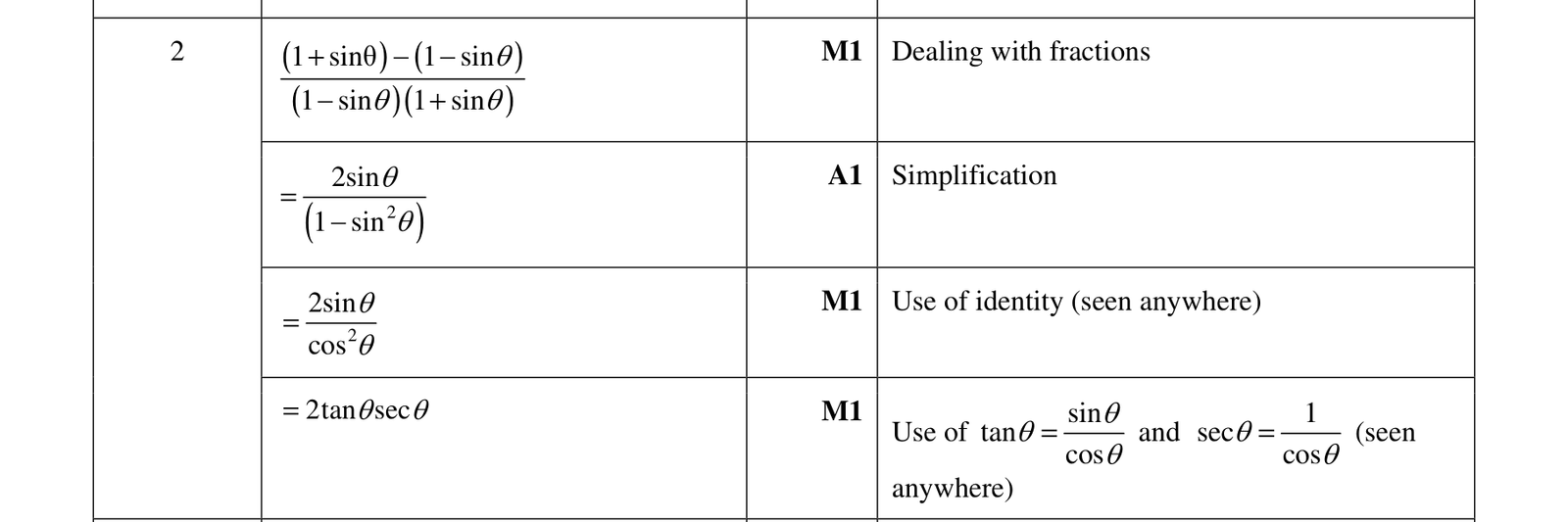
Use the common denominator \((1-\sin\theta)(1+\sin\theta)\):
\(\dfrac{(1+\sin\theta)-(1-\sin\theta)}{(1-\sin\theta)(1+\sin\theta)}\).
The numerator simplifies to \(2\sin\theta\), so
\(\dfrac{2\sin\theta}{1-\sin^2\theta}\).
Using \(1-\sin^2\theta=\cos^2\theta\), this becomes
\(\dfrac{2\sin\theta}{\cos^2\theta}\).
Now
\(\dfrac{\sin\theta}{\cos^2\theta}=\dfrac{\sin\theta}{\cos\theta}\cdot\dfrac1{\cos\theta}=\tan\theta\operatorname{sec}\theta.\)
Therefore
\(\dfrac1{1-\sin\theta}-\dfrac1{1+\sin\theta}=2\tan\theta\operatorname{sec}\theta.\)