Past Exam Questions
← Back9709 P12 - Jun 2023 - Q2
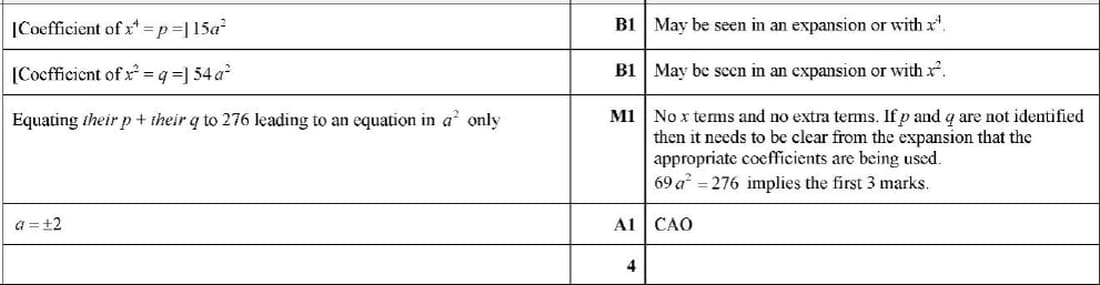
The coefficient of \(x^4\) in the expansion of \((x + a)^6\) is \(p\) and the coefficient of \(x^2\) in the expansion of \((ax + 3)^4\) is \(q\). It is given that \(p + q = 276\).
Find the possible values of the constant \(a\).
9709 P12 - Mar 2023 - Q6 - 6 marks
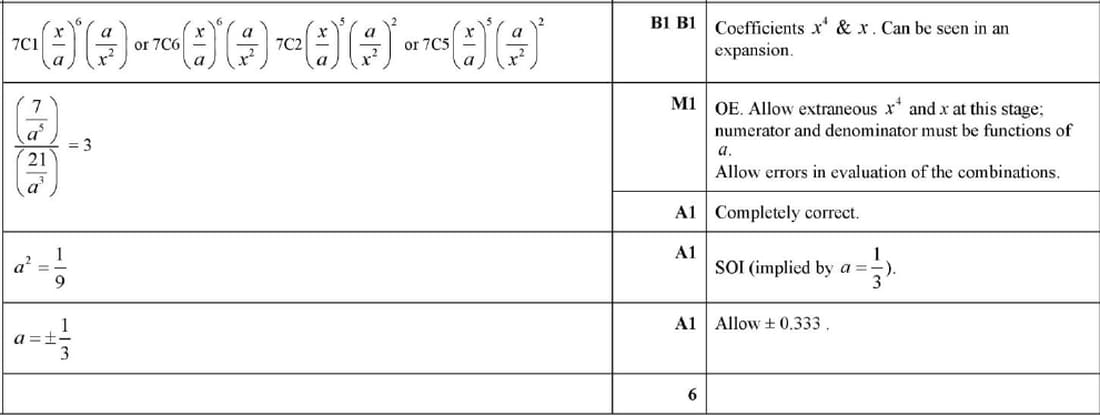
In the expansion of \(\left( \frac{x}{a} + \frac{a}{x^2} \right)^7\), it is given that
\(\frac{\text{the coefficient of } x^4}{\text{the coefficient of } x} = 3.\)
Find the possible values of the constant \(a\).
9709 P11 - Nov 2022 - Q4
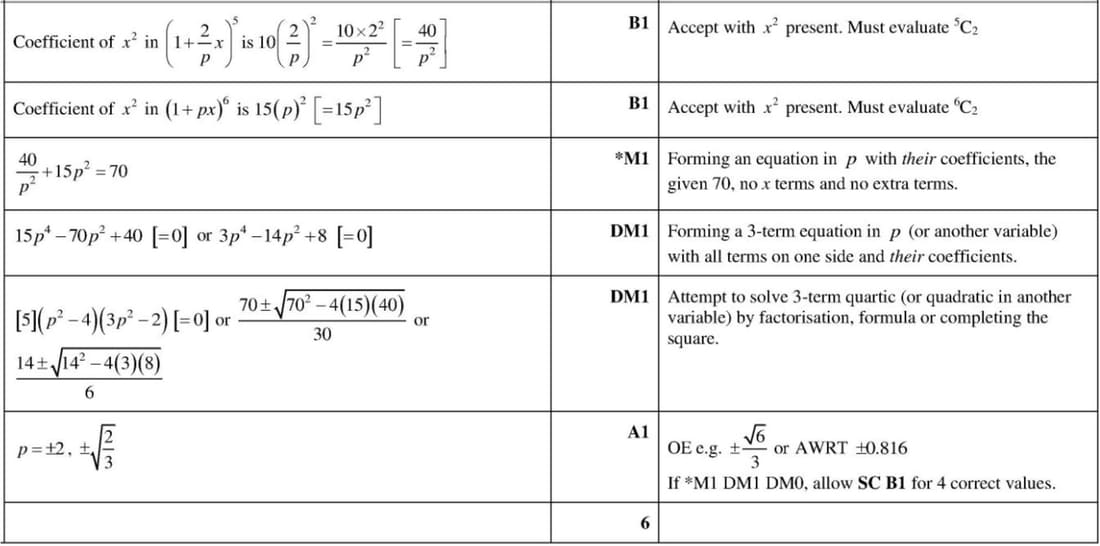
The coefficient of \(x^2\) in the expansion of \(\left( 1 + \frac{2}{p} x \right)^5 + (1 + px)^6\) is 70.
Find the possible values of the constant \(p\).
9709 P13 - Jun 2022 - Q1
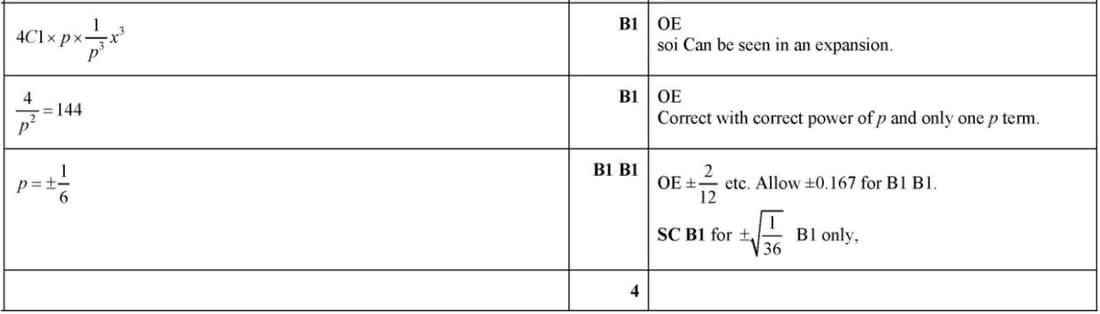
The coefficient of \(x^3\) in the expansion of \(\left(p + \frac{1}{p}x\right)^4\) is 144.
Find the possible values of the constant \(p\).
9709 P12 - Jun 2022 - Q1
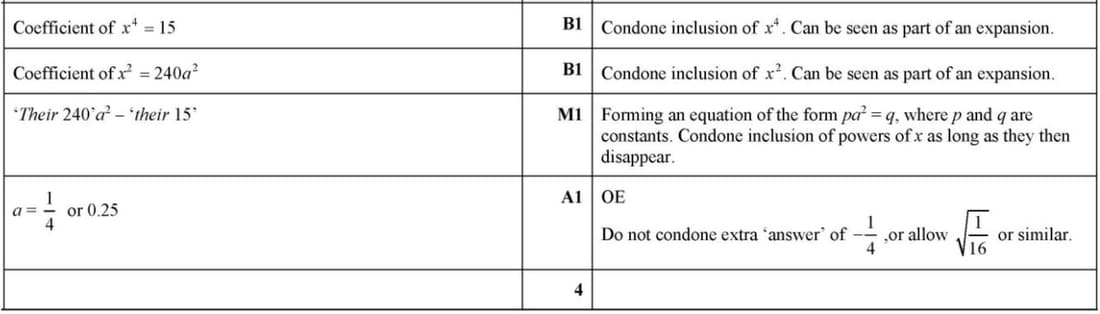
The coefficient of \(x^4\) in the expansion of \((3 + x)^5\) is equal to the coefficient of \(x^2\) in the expansion of \(\left(2x + \frac{a}{x}\right)^6\).
Find the value of the positive constant \(a\).
9709 P11 - Jun 2022 - Q3
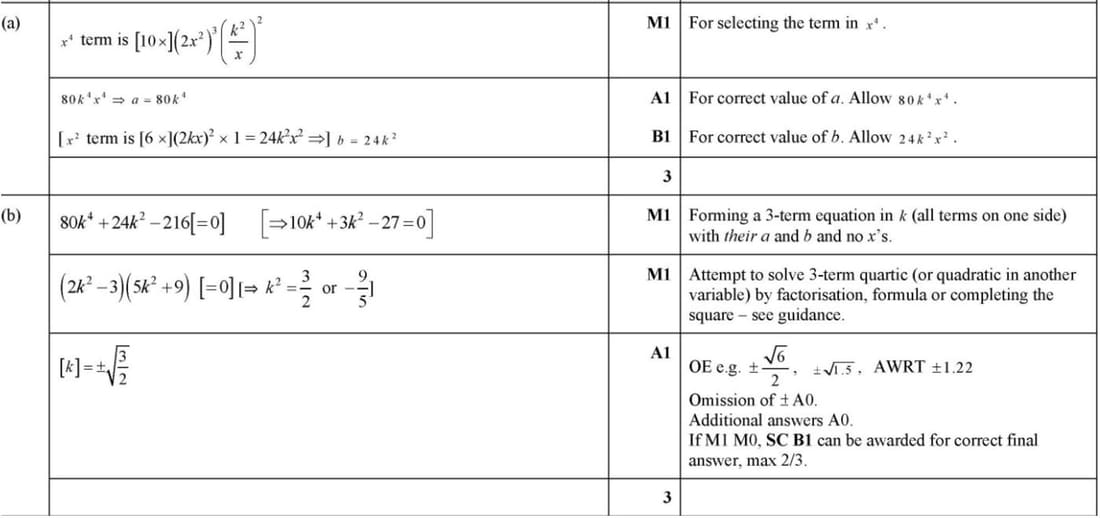
The coefficient of \(x^4\) in the expansion of \(\left( 2x^2 + \frac{k^2}{x} \right)^5\) is \(a\). The coefficient of \(x^2\) in the expansion of \((2kx - 1)^4\) is \(b\).
(a) Find \(a\) and \(b\) in terms of the constant \(k\).
(b) Given that \(a + b = 216\), find the possible values of \(k\).
9709 P12 - Mar 2022 - Q3
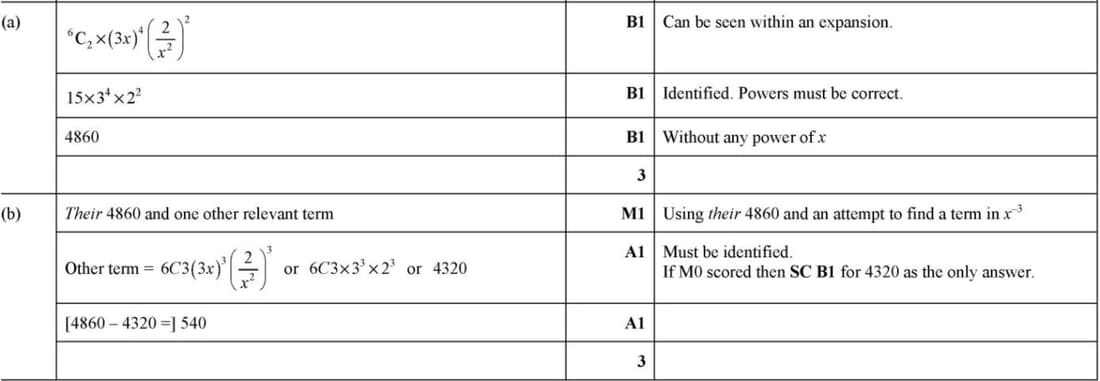
Find the term independent of x in each of the following expansions.
(a) \(\left( 3x + \frac{2}{x^2} \right)^6\)
(b) \(\left( 3x + \frac{2}{x^2} \right)^6 (1 - x^3)\)
9709 P11 - Nov 2019 - Q1
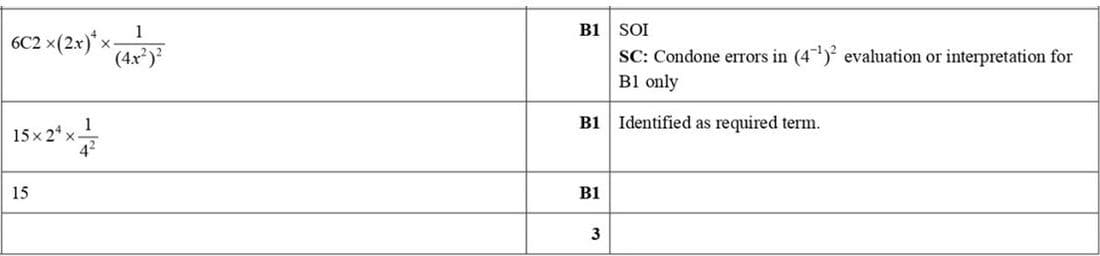
Find the term independent of x in the expansion of \(\left( 2x + \frac{1}{4x^2} \right)^6\).
9709 P12 - Nov 2017 - Q1
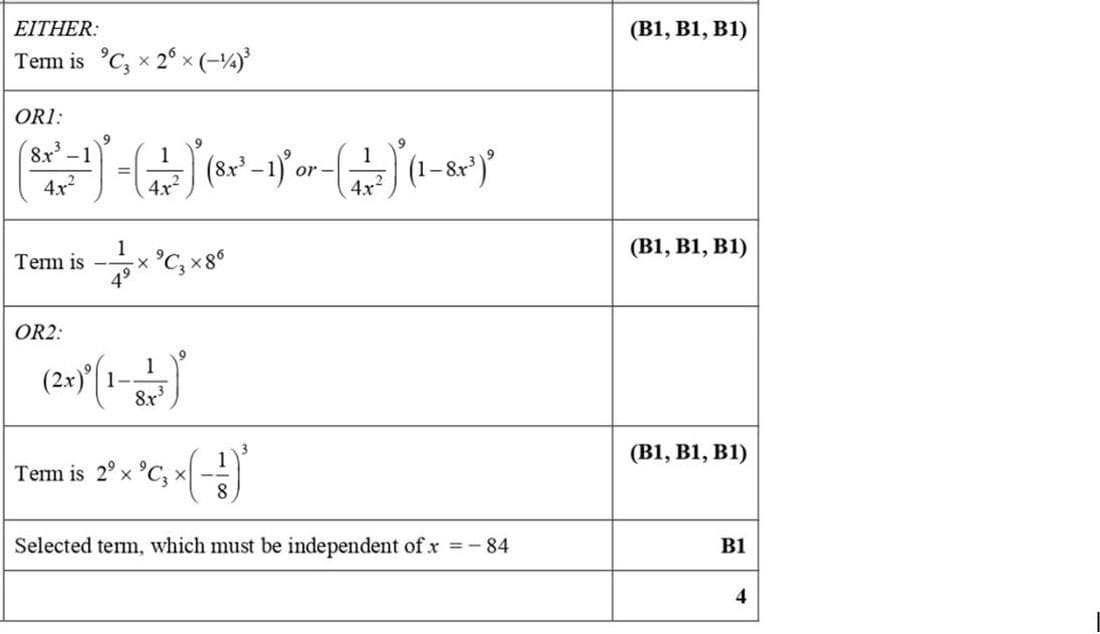
Find the term independent of x in the expansion of \(\left( 2x - \frac{1}{4x^2} \right)^9\).
9709 P11 - Nov 2016 - Q2
Find the term independent of x in the expansion of \(\left( 2x + \frac{1}{2x^3} \right)^8\).

9709 P11 - Jun 2016 - Q1
Find the term independent of x in the expansion of \(\left( x - \frac{3}{2x} \right)^6\).

9709 P11 - Jun 2014 - Q3
Find the term independent of x in the expansion of \(\left( 4x^3 + \frac{1}{2x} \right)^8\).

9709 P11 - Nov 2011 - Q1
Find the term independent of x in the expansion of \(\left( 2x + \frac{1}{x^2} \right)^6\).

9709 P13 - Nov 2010 - Q1
Find the term independent of x in the expansion of \(\left( x - \frac{1}{x^2} \right)^9\).

9709 P1 - Nov 2002 - Q1
Find the value of the term which is independent of x in the expansion of \(\left( x + \frac{3}{x} \right)^4\).

9709 P13 - Jun 2020 - Q4
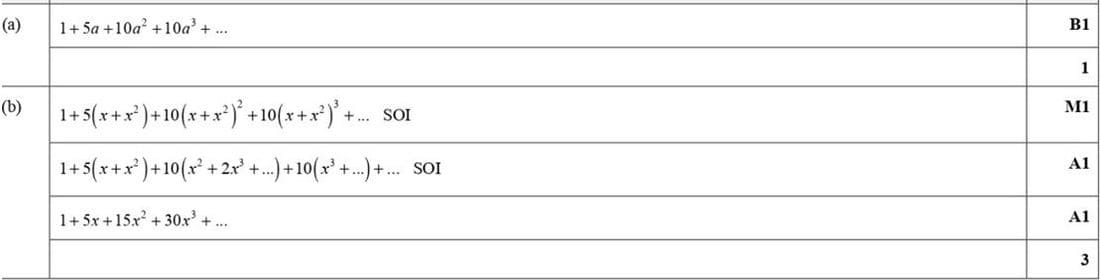
(a) Expand \((1 + a)^5\) in ascending powers of \(a\) up to and including the term in \(a^3\).
(b) Hence expand \([1 + (x + x^2)]^5\) in ascending powers of \(x\) up to and including the term in \(x^3\), simplifying your answer.
9709 P1 - Nov 2007 - Q3
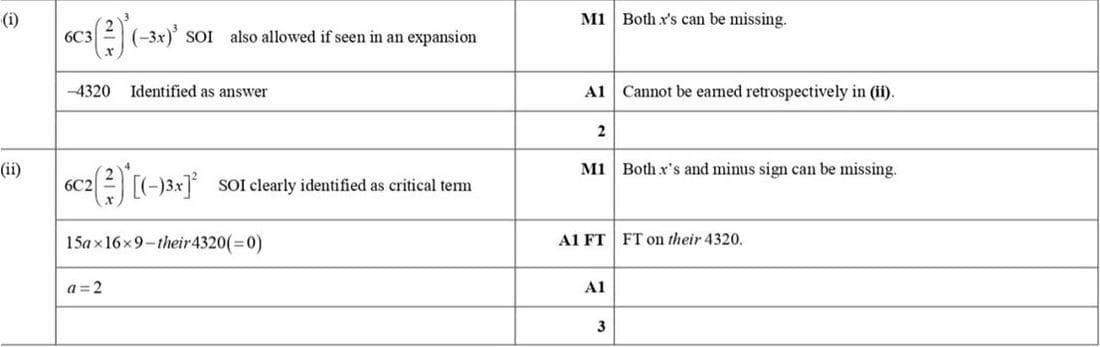
(i) Find the first three terms in the expansion of \((2+u)^5\) in ascending powers of \(u\).
(ii) Use the substitution \(u = x + x^2\) in your answer to part (i) to find the coefficient of \(x^2\) in the expansion of \((2 + x + x^2)^5\).

9709 P13 - Nov 2017 - Q3
(i) Find the term independent of x in the expansion of \(\left( \frac{2}{x} - 3x \right)^6\).
(ii) Find the value of a for which there is no term independent of x in the expansion of \(\left( 1 + ax^2 \right) \left( \frac{2}{x} - 3x \right)^6\).
9709 P12 - Jun 2016 - Q4
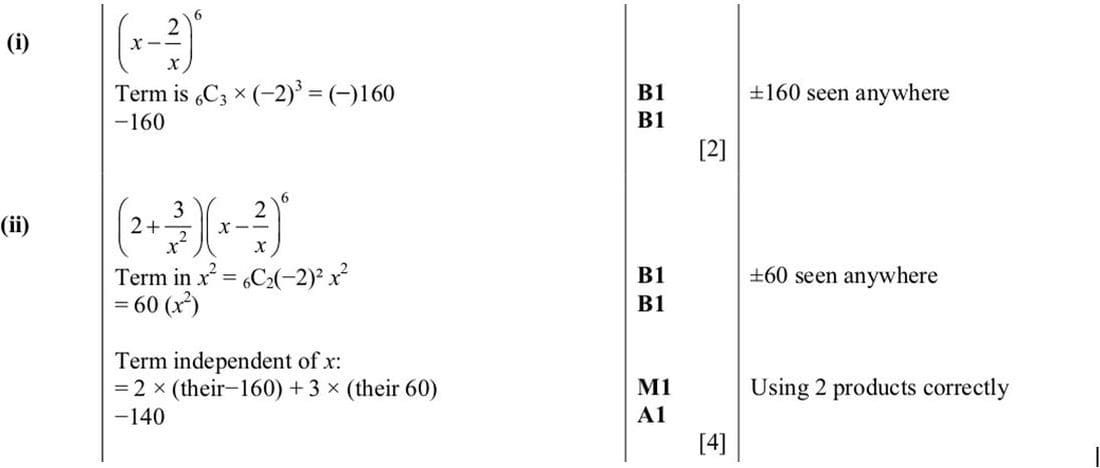
Find the term that is independent of x in the expansion of
(i) \(\left( x - \frac{2}{x} \right)^6\),
(ii) \(\left( 2 + \frac{3}{x^2} \right) \left( x - \frac{2}{x} \right)^6\).
9709 P12 - Mar 2016 - Q1
(i) Find the coefficients of \(x^4\) and \(x^5\) in the expansion of \((1 - 2x)^5\).
(ii) It is given that, when \((1 + px)(1 - 2x)^5\) is expanded, there is no term in \(x^5\). Find the value of the constant \(p\).
