Past Exam Questions
← Back9709 P11 - Jun 2011 - Q1
Find the coefficient of x in the expansion of \(\left( x + \frac{2}{x^2} \right)^7\).

9709 P1 - Nov 2008 - Q1
Find the value of the coefficient of \(x^2\) in the expansion of \(\left( \frac{x}{2} + \frac{2}{x} \right)^6\).

9709 P1 - Nov 2006 - Q1
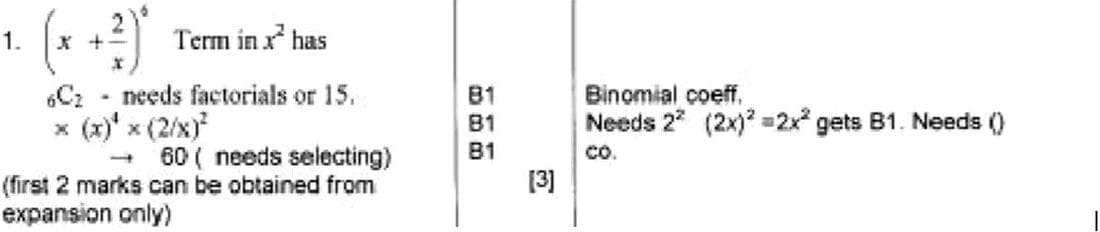
Find the coefficient of \(x^2\) in the expansion of \(\left( x + \frac{2}{x} \right)^6\).
9709 P12 - Jun 2019 - Q1
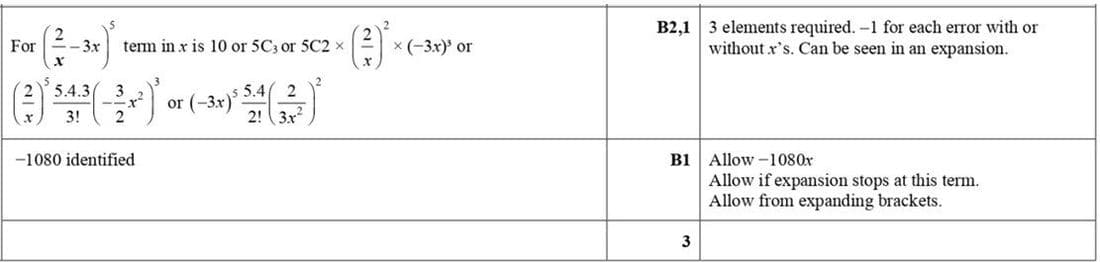
Find the coefficient of \(x\) in the expansion of \(\left( \frac{2}{x} - 3x \right)^5\).
9709 P1 - Nov 2004 - Q1
Find the coefficient of x in the expansion of \(\left( 3x - \frac{2}{x} \right)^5\).

9709 P1 - Jun 2004 - Q4
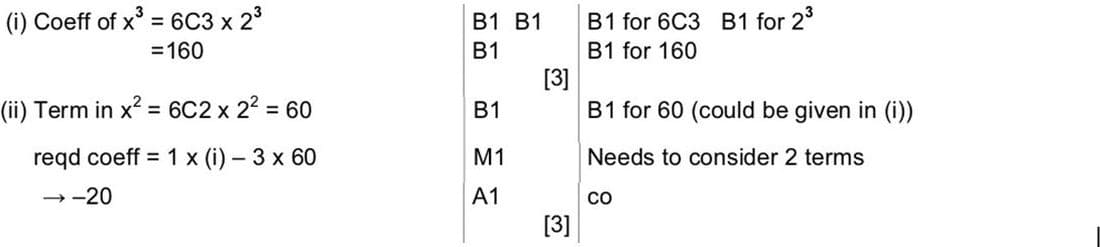
Find the coefficient of \(x^3\) in the expansion of
(i) \((1 + 2x)^6\),
(ii) \((1 - 3x)(1 + 2x)^6\).
9709 P1 - Jun 2003 - Q1
Find the value of the coefficient of \(\frac{1}{x}\) in the expansion of \(\left( 2x - \frac{1}{x} \right)^5\).

9709 P13 - Nov 2018 - Q1
Find the coefficient of \(\frac{1}{x^3}\) in the expansion of \(\left( x - \frac{2}{x} \right)^7\).

9709 P12 - Nov 2018 - Q1
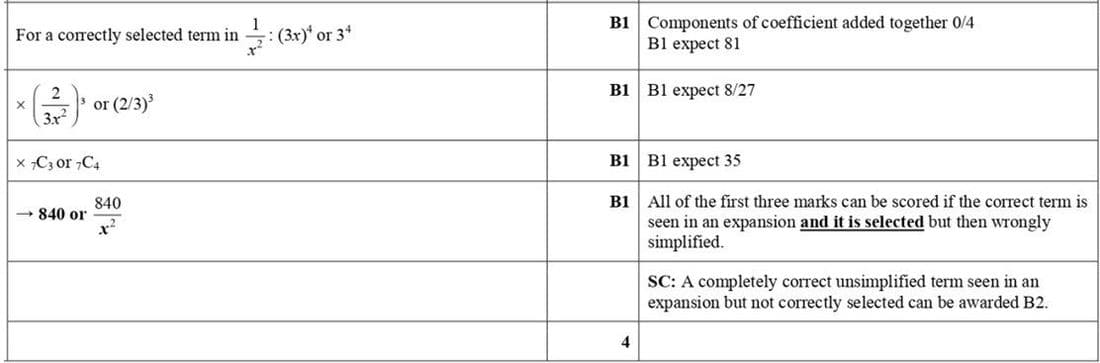
Find the coefficient of \(\frac{1}{x^2}\) in the expansion of \(\left( 3x + \frac{2}{3x^2} \right)^7\).
9709 P13 - Jun 2018 - Q2
Find the coefficient of \(\frac{1}{x}\) in the expansion of \(\left( x - \frac{2}{x} \right)^5\).

9709 P12 - Mar 2018 - Q2
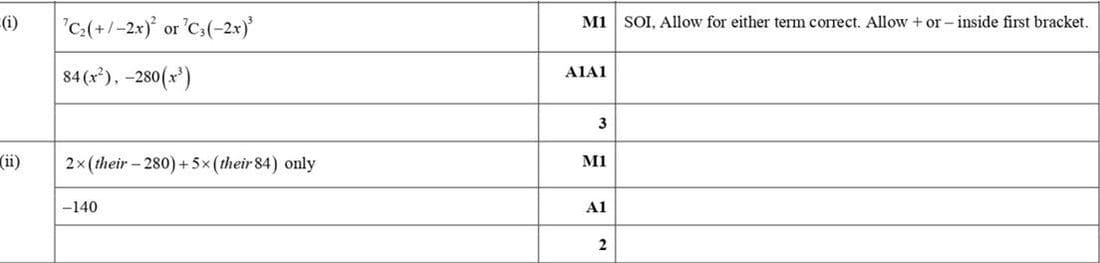
(i) Find the coefficients of \(x^2\) and \(x^3\) in the expansion of \((1 - 2x)^7\).
(ii) Hence find the coefficient of \(x^3\) in the expansion of \((2 + 5x)(1 - 2x)^7\).
9709 P12 - Jun 2017 - Q1
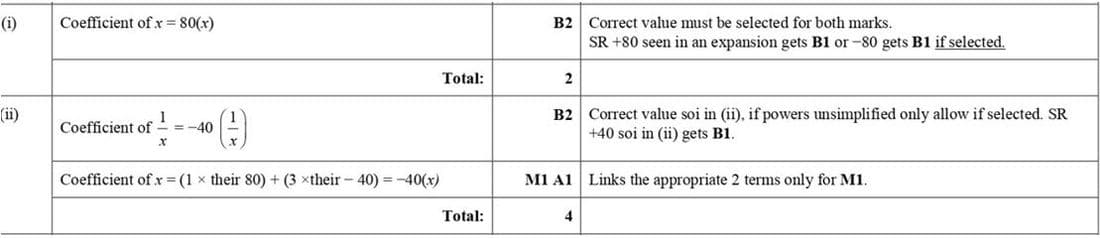
(i) Find the coefficient of \(x\) in the expansion of \(\left(2x - \frac{1}{x}\right)^5\).
(ii) Hence find the coefficient of \(x\) in the expansion of \((1 + 3x^2) \left(2x - \frac{1}{x}\right)^5\).
9709 P13 - Jun 2016 - Q1
Find the coefficient of x in the expansion of \(\left( \frac{1}{x} + 3x^2 \right)^5\).

9709 P13 - Nov 2015 - Q2
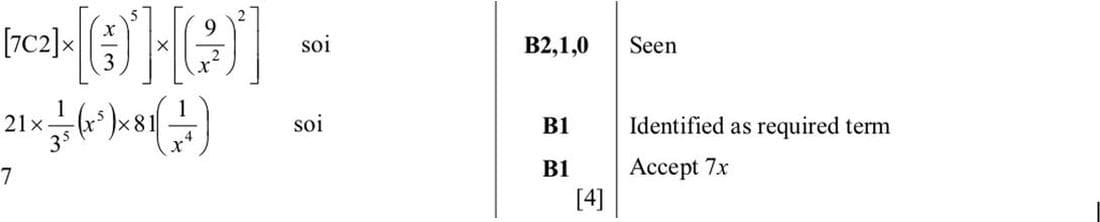
Find the coefficient of x in the expansion of \(\left( \frac{x}{3} + \frac{9}{x^2} \right)^7\).
9709 P13 - Nov 2023 - Q4
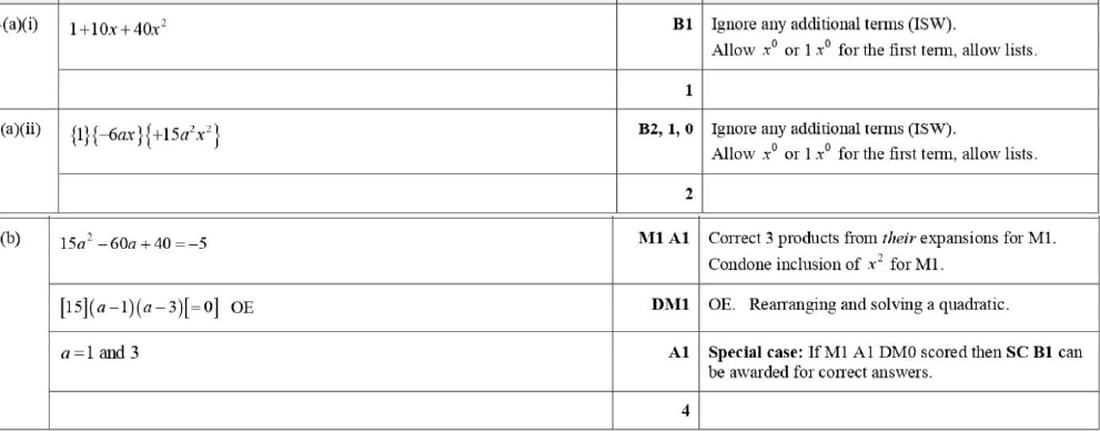
(a) Expand the following in ascending powers of x up to and including the term in x2.
(i) \((1 + 2x)^5\).
(ii) \((1 - ax)^6\), where a is a constant.
In the expansion of \((1 + 2x)^5(1 - ax)^6\), the coefficient of x2 is -5.
(b) Find the possible values of a.
9709 P13 - Nov 2021 - Q2
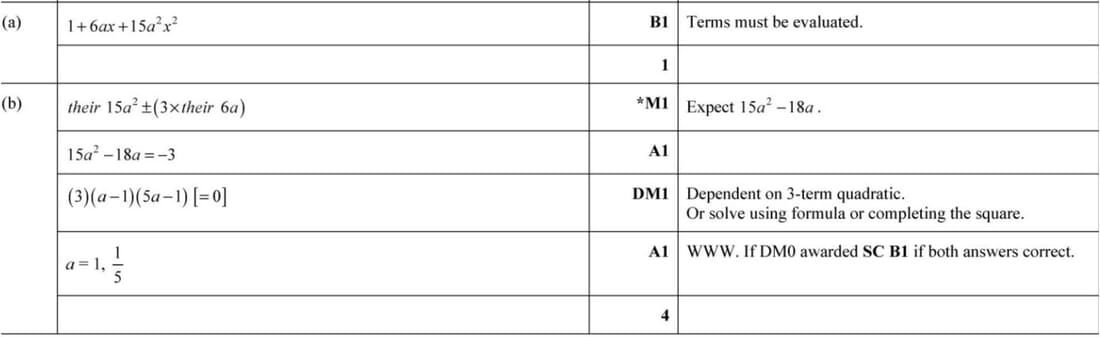
(a) Find the first three terms, in ascending powers of \(x\), in the expansion of \((1 + ax)^6\).
(b) Given that the coefficient of \(x^2\) in the expansion of \((1 - 3x)(1 + ax)^6\) is \(-3\), find the possible values of the constant \(a\).
9709 P12 - Nov 2021 - Q8
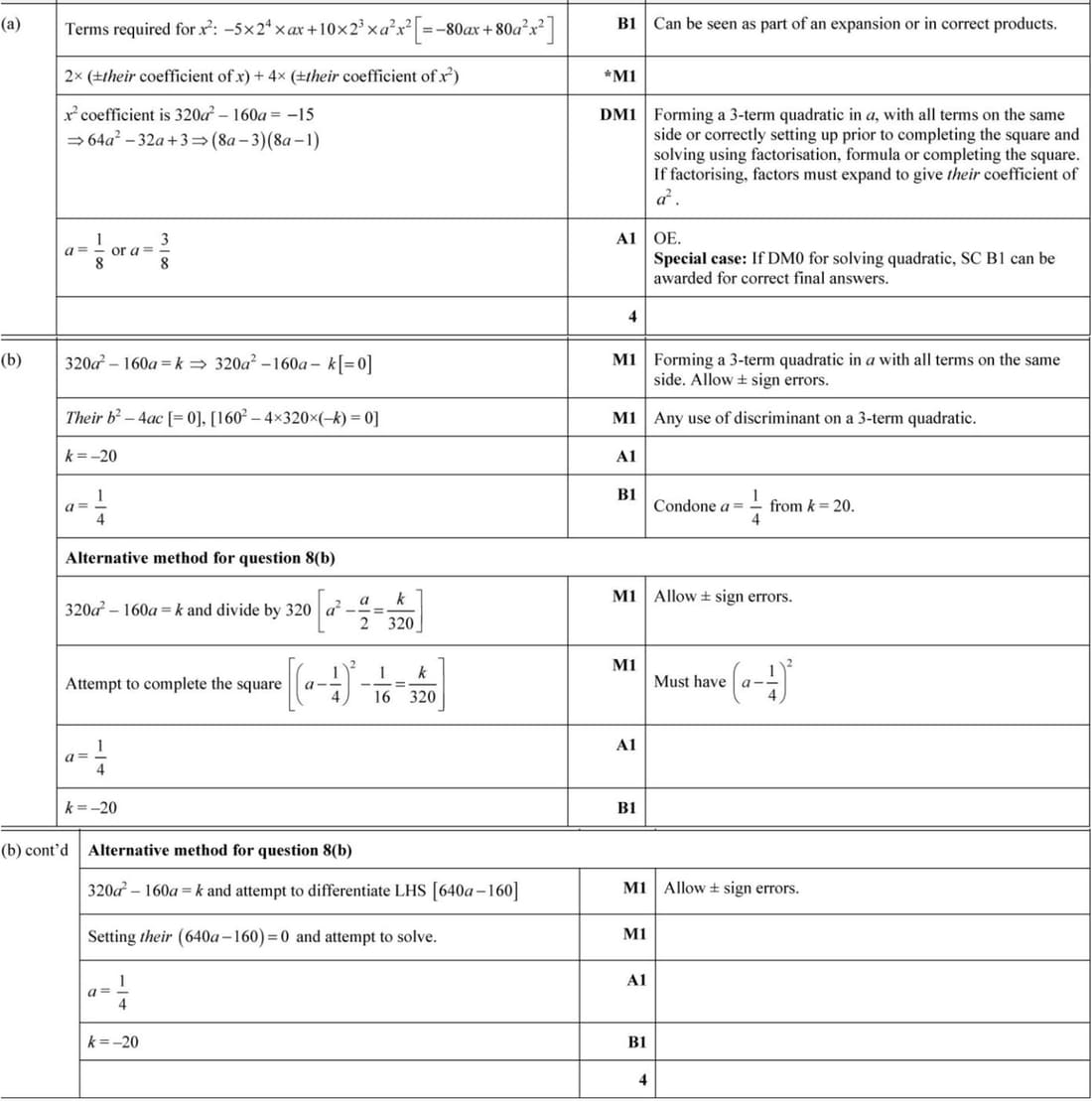
(a) It is given that in the expansion of \((4 + 2x)(2 - ax)^5\), the coefficient of \(x^2\) is \(-15\). Find the possible values of \(a\).
(b) It is given instead that in the expansion of \((4 + 2x)(2 - ax)^5\), the coefficient of \(x^2\) is \(k\). It is also given that there is only one value of \(a\) which leads to this value of \(k\). Find the values of \(k\) and \(a\).
9709 P12 - Jun 2021 - Q4
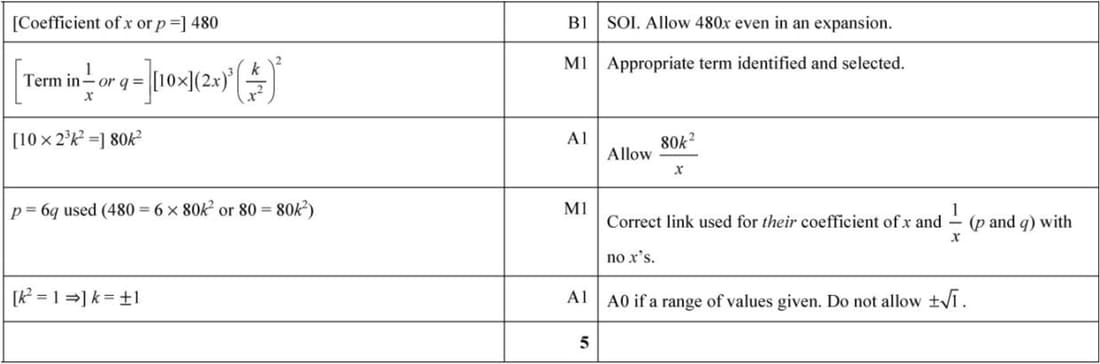
The coefficient of x in the expansion of \(\left(4x + \frac{10}{x}\right)^3\) is p. The coefficient of \(\frac{1}{x}\) in the expansion of \(\left(2x + \frac{k}{x^2}\right)^5\) is q.
\(Given that p = 6q, find the possible values of k.\)
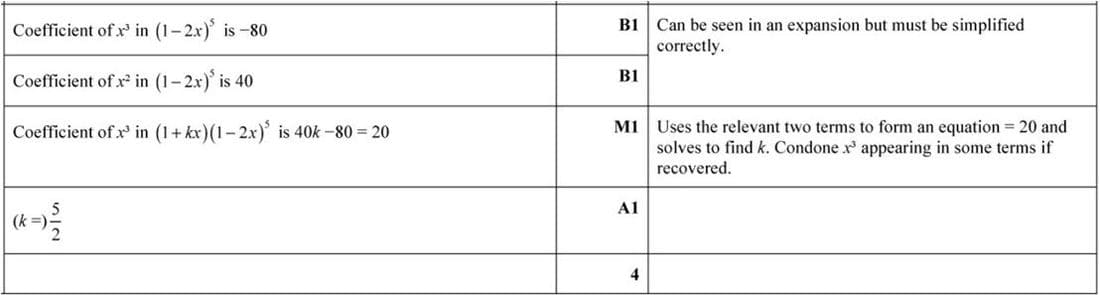
9709 P12 - Nov 2020 - Q1
The coefficient of \(x^3\) in the expansion of \((1 + kx)(1 - 2x)^5\) is 20.
Find the value of the constant \(k\).
9709 P11 - Nov 2020 - Q5
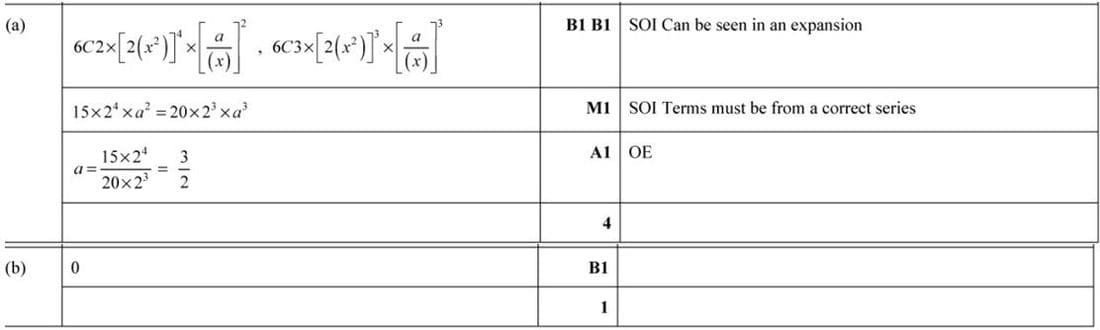
In the expansion of \((2x^2 + \frac{a}{x})^6\), the coefficients of \(x^6\) and \(x^3\) are equal.
(a) Find the value of the non-zero constant \(a\).
(b) Find the coefficient of \(x^6\) in the expansion of \((1-x^3)(2x^2 + \frac{a}{x})^6\).