Past Exam Questions
← Back0606 P21 - Jun 2017 - Q10 - 11 marks
The table shows values of the variables \(t\) and \(P\).
| \(t\) | 1 | 1.5 | 2 | 2.5 |
|---|---|---|---|---|
| \(P\) | 4.39 | 8.33 | 15.8 | 30.0 |
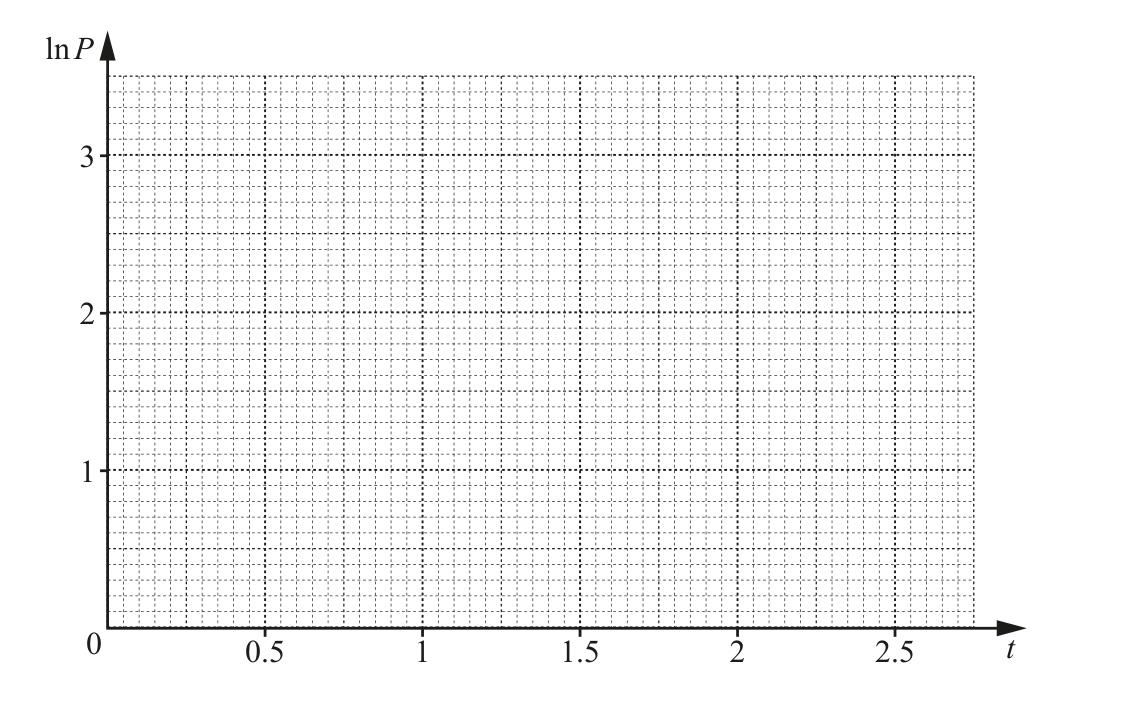
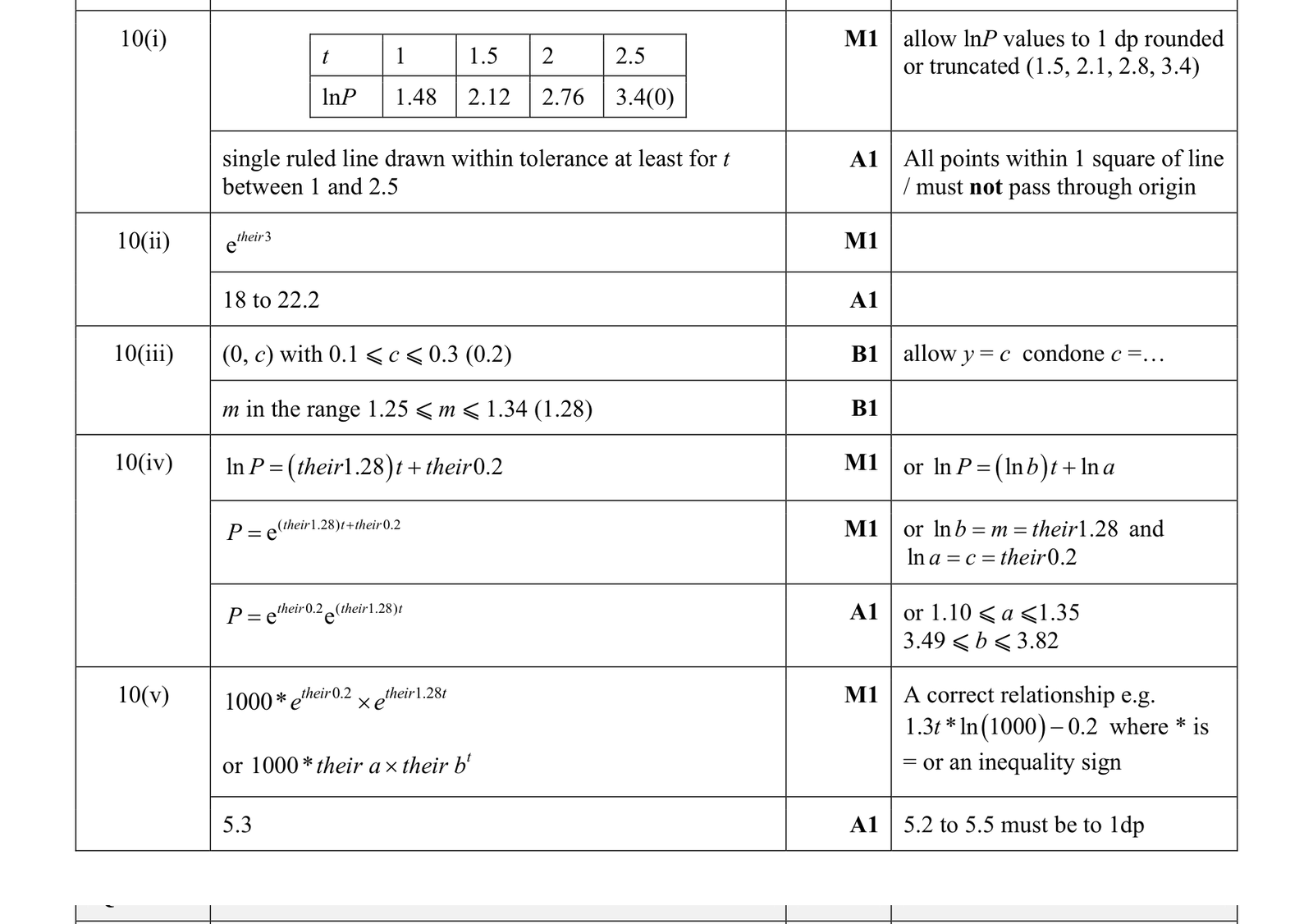
(i) Draw the graph of \(\ln P\) against \(t\) on the grid below.
(ii) Use the graph to estimate the value of \(P\) when \(t=2.2\).
(iii) Find the gradient of the graph and state the coordinates of the point where the graph meets the vertical axis.
(iv) Using your answers to part (iii), show that \(P=ab^t\), where \(a\) and \(b\) are constants to be found.
(v) Given that your equation in part (iv) is valid for values of \(t\) up to \(10\), find the smallest value of \(t\), correct to 1 decimal place, for which \(P\) is at least \(1000\).
0606 P23 - Jun 2017 - Q3 - 4 marks
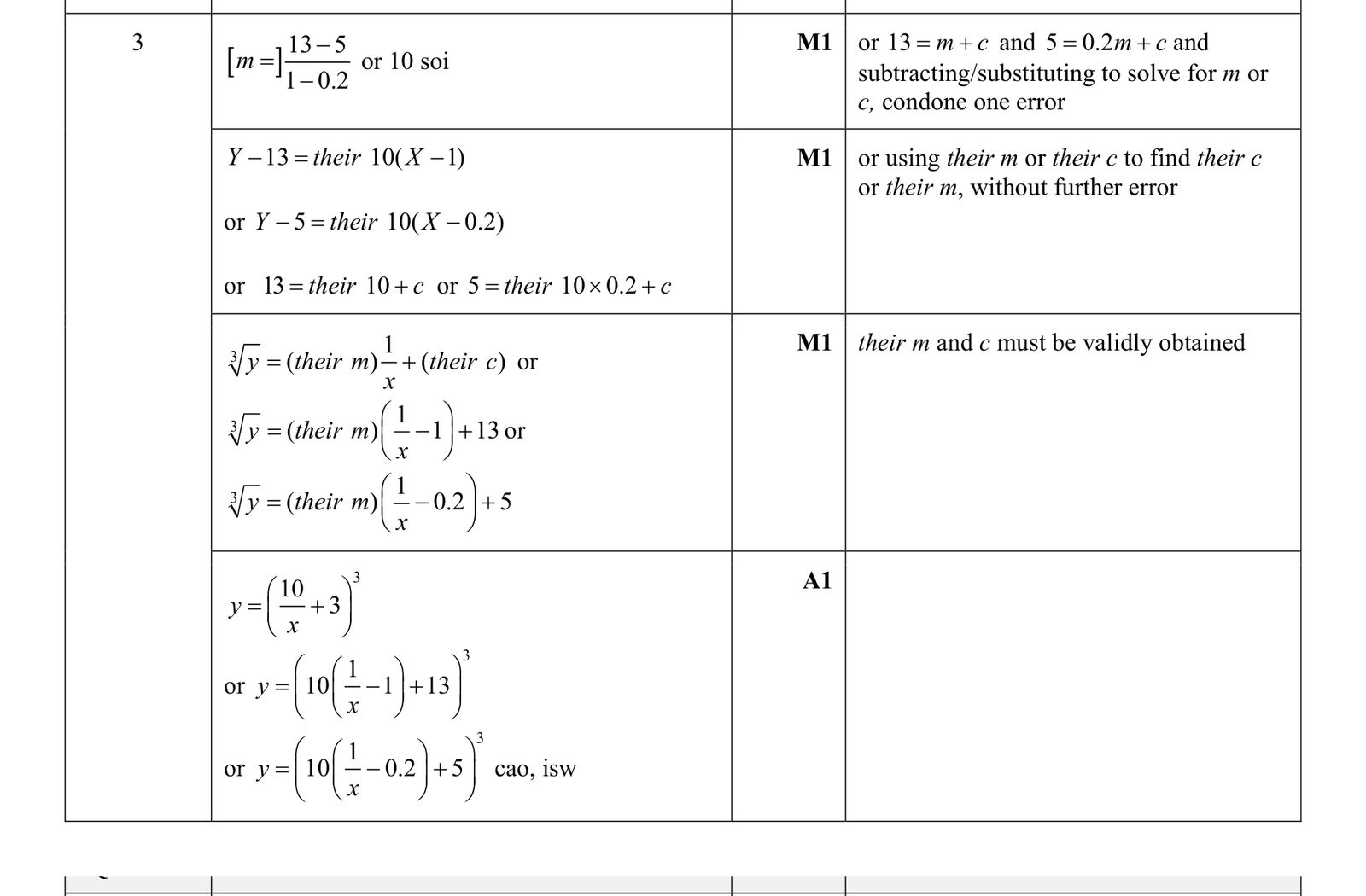
Variables \(x\) and \(y\) are such that when \(\sqrt[3]{y}\) is plotted against \(\dfrac1x\), a straight line graph passing through the points \((0.2,5)\) and \((1,13)\) is obtained.
Express \(y\) in terms of \(x\).
0606 P11 - Nov 2017 - Q4 - 6 marks
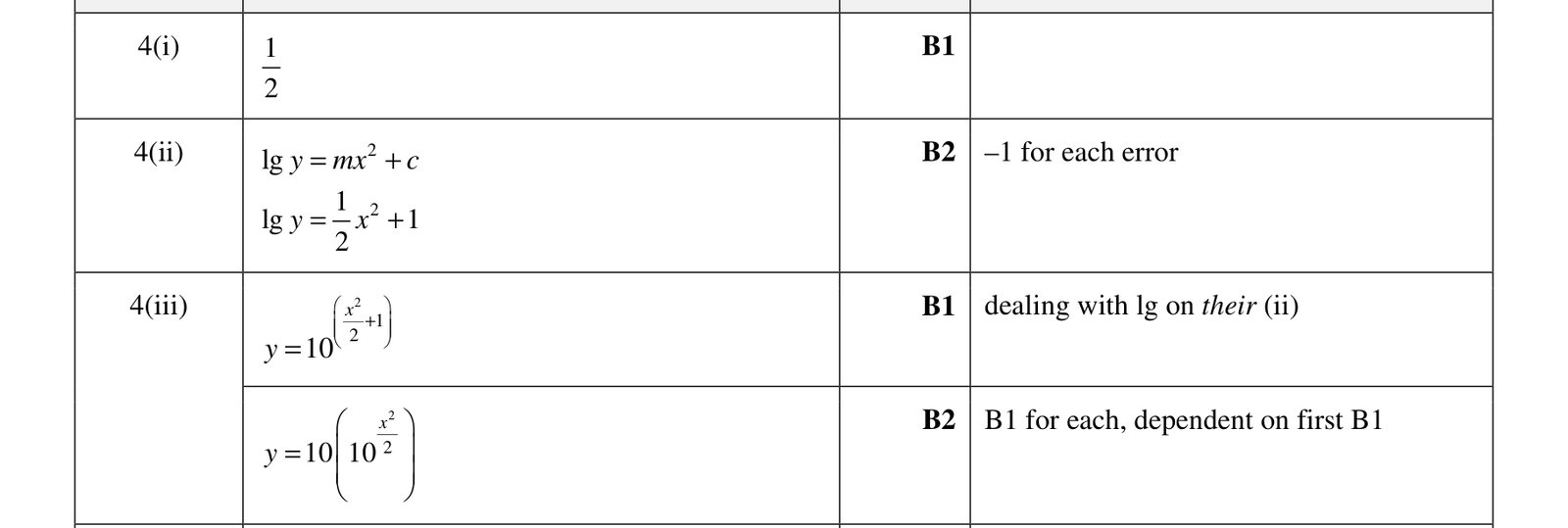
When \(\lg y\) is plotted against \(x^2\), a straight line is obtained which passes through the points \((4,3)\) and \((12,7)\).
(i) Find the gradient of the line.
(ii) Use your answer to part (i) to express \(\lg y\) in terms of \(x\).
(iii) Hence express \(y\) in terms of \(x\), giving your answer in the form \(y=A(10^b)^{x^2}\), where \(A\) and \(b\) are constants.
0606 P12 - Nov 2017 - Q5 - 7 marks
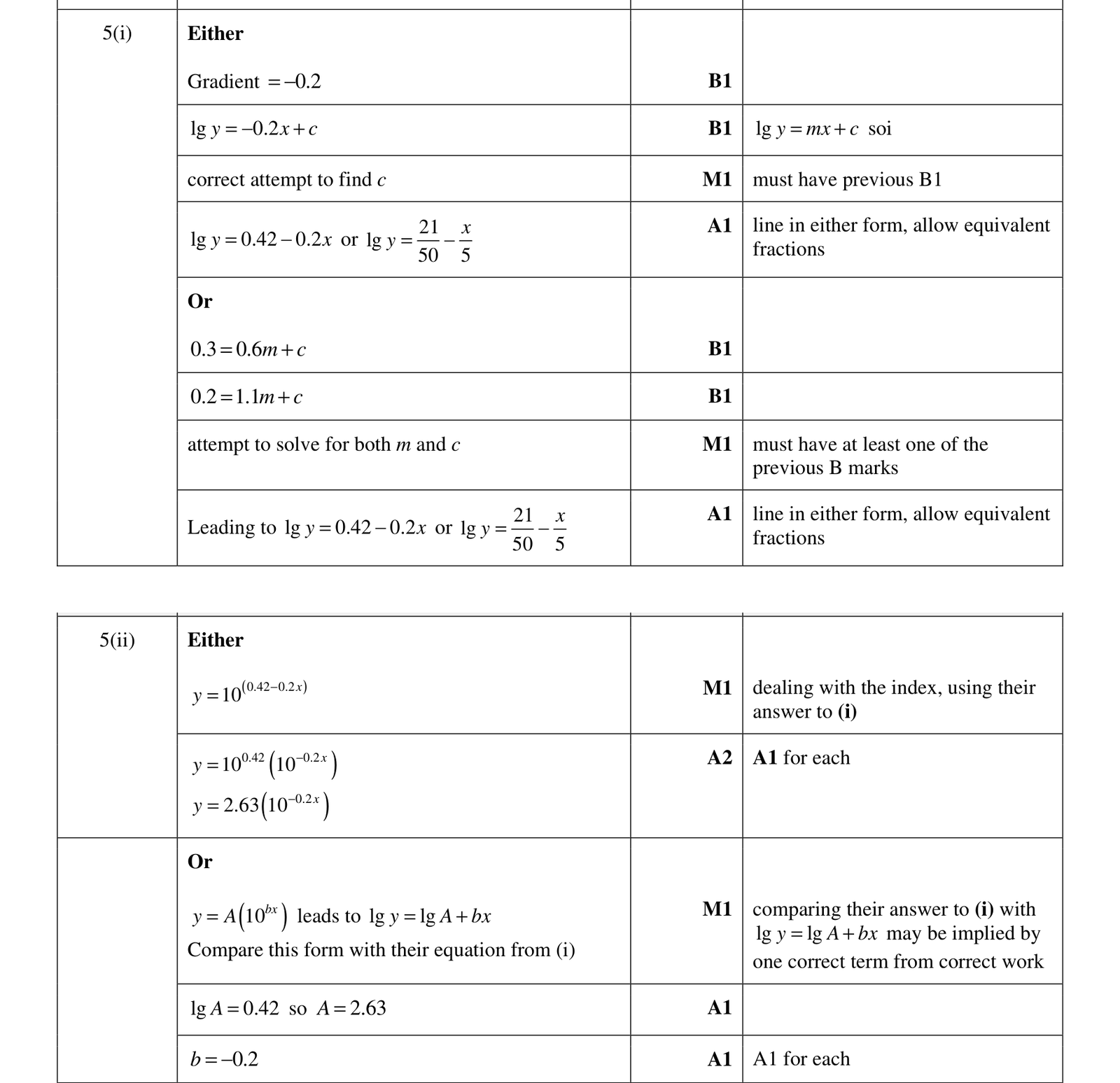
When \(\lg y\) is plotted against \(x\), a straight line is obtained which passes through the points \((0.6,0.3)\) and \((1.1,0.2)\).
(i) Find \(\lg y\) in terms of \(x\).
(ii) Find \(y\) in terms of \(x\), giving your answer in the form \(y=A(10^b)^x\), where \(A\) and \(b\) are constants.

0606 P13 - Nov 2017 - Q6 - 6 marks
When \(\ln y\) is plotted against \(x^2\), a straight line is obtained which passes through the points \((0.2,2.4)\) and \((0.8,0.9)\).
(i) Express \(\ln y\) in terms of \(x^2\).
(ii) Hence express \(y\) in terms of \(z\), where \(z=e^{x^2}\).

9709 P11 - Nov 2023 - Q1
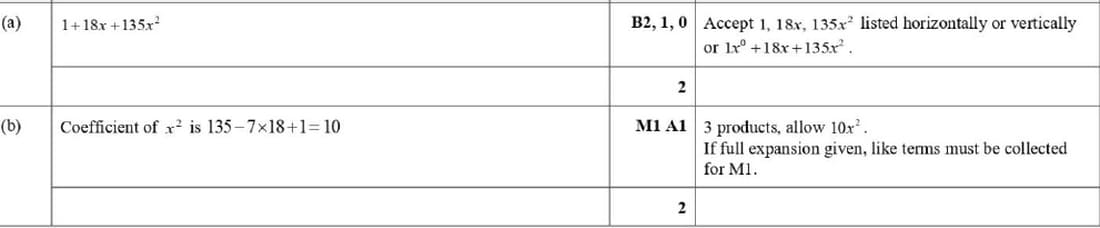
(a) Expand \((1 + 3x)^6\) in ascending powers of \(x\) up to, and including, the term in \(x^2\).
(b) Hence find the coefficient of \(x^2\) in the expansion of \((1 - 7x + x^2)(1 + 3x)^6\).
9709 P11 - Jun 2018 - Q1
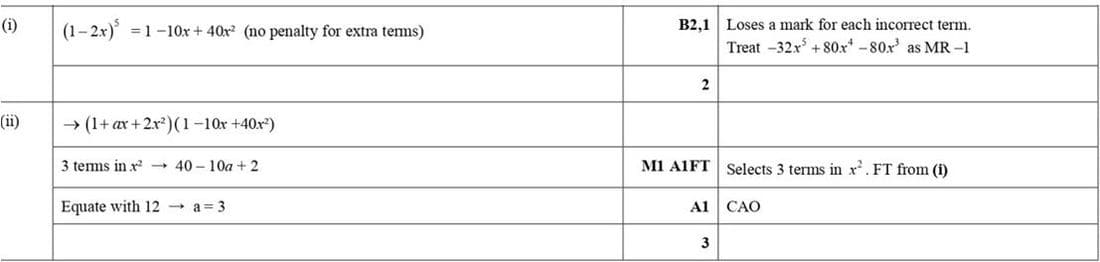
(i) Find the first three terms in the expansion, in ascending powers of x, of \((1 - 2x)^5\).
(ii) Given that the coefficient of \(x^2\) in the expansion of \((1 + ax + 2x^2)(1 - 2x)^5\) is 12, find the value of the constant \(a\).
9709 P13 - Jun 2015 - Q3
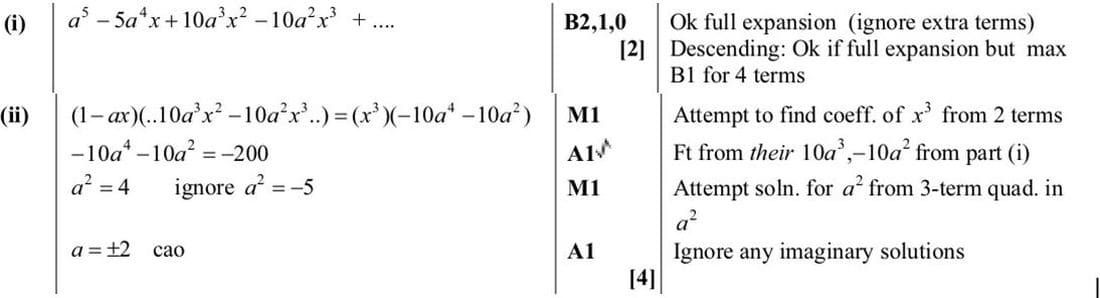
(i) Write down the first 4 terms, in ascending powers of \(x\), of the expansion of \((a-x)^5\).
(ii) The coefficient of \(x^3\) in the expansion of \((1-ax)(a-x)^5\) is \(-200\). Find the possible values of the constant \(a\).
9709 P11 - Jun 2015 - Q3
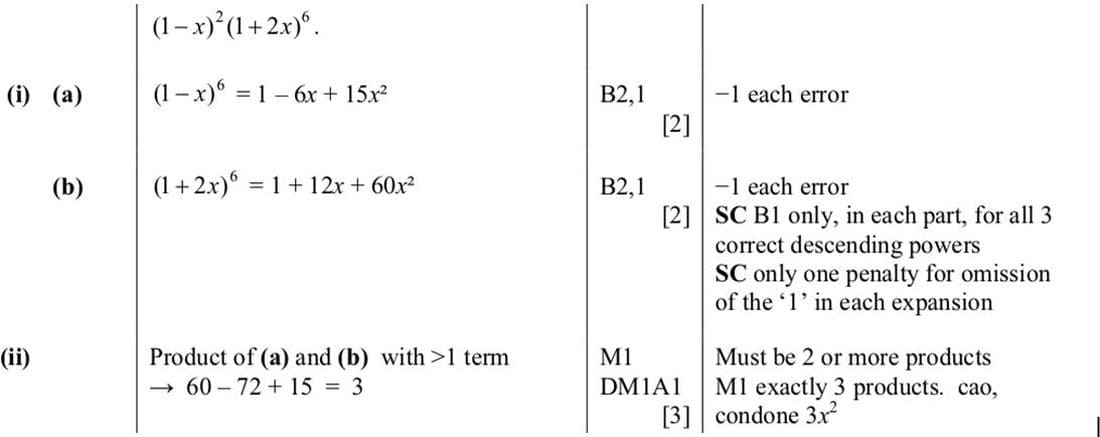
(i) Find the first three terms, in ascending powers of x, in the expansion of
(a) \((1-x)^6\),
(b) \((1+2x)^6\).
(ii) Hence find the coefficient of \(x^2\) in the expansion of \([(1-x)(1+2x)]^6\).
9709 P12 - Nov 2014 - Q3
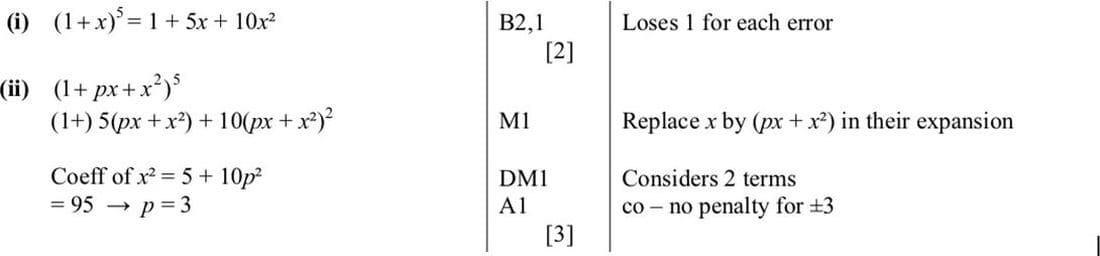
(i) Find the first 3 terms, in ascending powers of \(x\), in the expansion of \((1 + x)^5\).
The coefficient of \(x^2\) in the expansion of \(\left( 1 + (px + x^2) \right)^5\) is 95.
(ii) Use the answer to part (i) to find the value of the positive constant \(p\).
9709 P11 - Nov 2013 - Q1
(i) Find the first three terms when \((2 + 3x)^6\) is expanded in ascending powers of \(x\).
(ii) In the expansion of \((1 + ax)(2 + 3x)^6\), the coefficient of \(x^2\) is zero. Find the value of \(a\).

9709 P13 - Jun 2013 - Q4
(i) Find the first three terms in the expansion of \((2 + ax)^5\) in ascending powers of \(x\).
(ii) Given that the coefficient of \(x^2\) in the expansion of \((1 + 2x)(2 + ax)^5\) is 240, find the possible values of \(a\).

9709 P11 - Jun 2013 - Q2
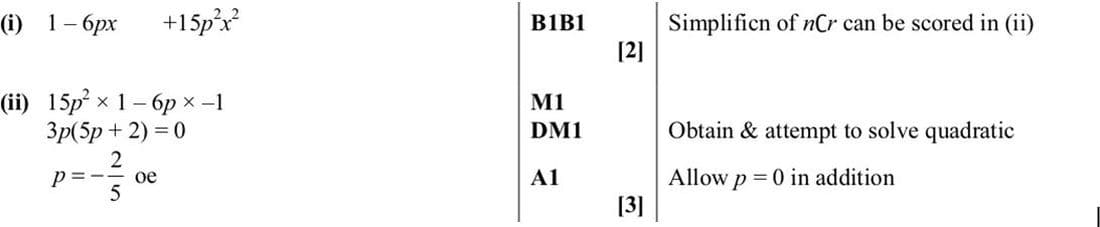
(i) In the expression \((1 - px)^6\), \(p\) is a non-zero constant. Find the first three terms when \((1 - px)^6\) is expanded in ascending powers of \(x\).
(ii) It is given that the coefficient of \(x^2\) in the expansion of \((1 - x)(1 - px)^6\) is zero. Find the value of \(p\).
9709 P11 - Nov 2012 - Q4
(i) Find the first 3 terms in the expansion of \((2x - x^2)^6\) in ascending powers of \(x\).
(ii) Hence find the coefficient of \(x^8\) in the expansion of \((2 + x)(2x - x^2)^6\).

9709 P13 - Jun 2012 - Q3
The first three terms in the expansion of \((1 - 2x)^2(1 + ax)^6\), in ascending powers of \(x\), are \(1 - x + bx^2\). Find the values of the constants \(a\) and \(b\).
9709 P12 - Nov 2010 - Q1
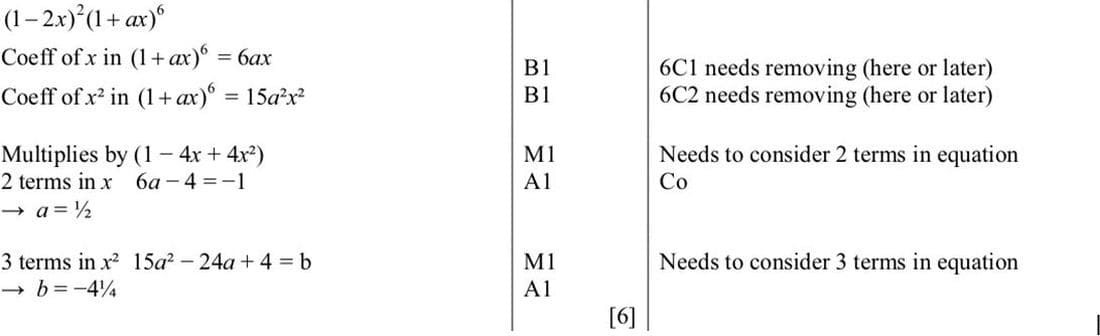
(i) Find the first 3 terms in the expansion, in ascending powers of \(x\), of \((1 - 2x^2)^8\).
(ii) Find the coefficient of \(x^4\) in the expansion of \((2 - x^2)(1 - 2x^2)^8\).
9709 P11 - Jun 2023 - Q2
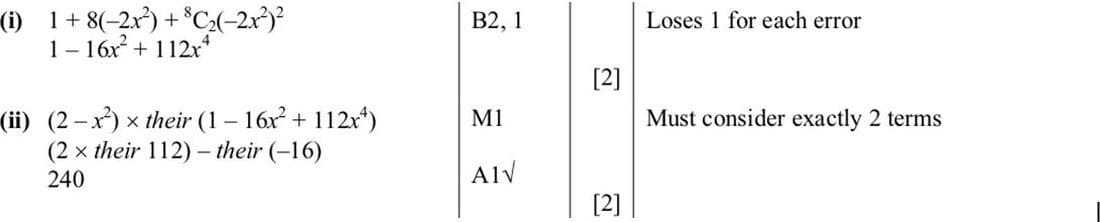
(a) Find the first three terms in the expansion, in ascending powers of \(x\), of \((2 + 3x)^4\).
(b) Find the first three terms in the expansion, in ascending powers of \(x\), of \((1 - 2x)^5\).
(c) Hence find the coefficient of \(x^2\) in the expansion of \((2 + 3x)^4 (1 - 2x)^5\).
9709 P13 - Jun 2010 - Q2
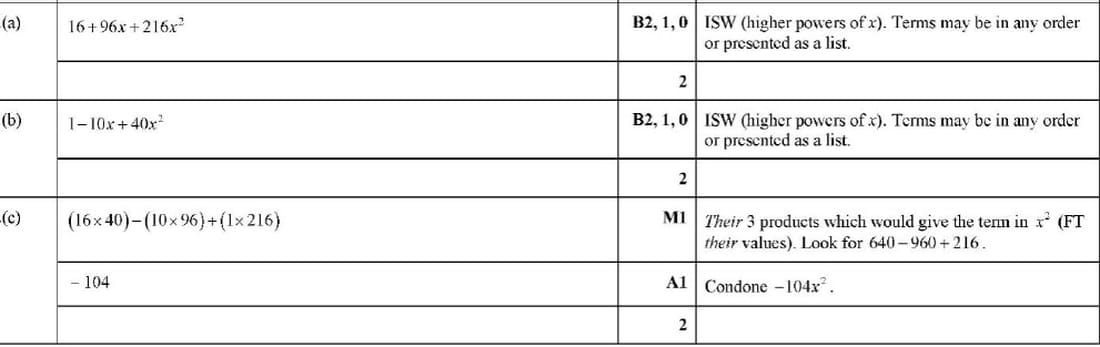
(i) Find the first three terms, in descending powers of x, in the expansion of \(\left( x - \frac{2}{x} \right)^6\).
(ii) Find the coefficient of \(x^4\) in the expansion of \((1 + x^2) \left( x - \frac{2}{x} \right)^6\).

9709 P12 - Jun 2010 - Q6
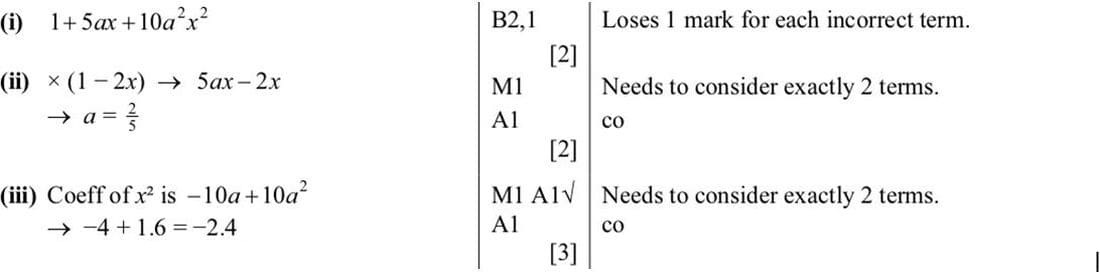
(i) Find the first 3 terms in the expansion of \((1 + ax)^5\) in ascending powers of \(x\).
(ii) Given that there is no term in \(x\) in the expansion of \((1 - 2x)(1 + ax)^5\), find the value of the constant \(a\).
(iii) For this value of \(a\), find the coefficient of \(x^2\) in the expansion of \((1 - 2x)(1 + ax)^5\).
9709 P11 - Jun 2010 - Q2
(i) Find the first 3 terms in the expansion of \(\left( 2x - \frac{3}{x} \right)^5\) in descending powers of \(x\).
(ii) Hence find the coefficient of \(x\) in the expansion of \(\left( 1 + \frac{2}{x^2} \right) \left( 2x - \frac{3}{x} \right)^5\).