(i) Find the first 3 terms in the expansion of \((1 + ax)^5\) in ascending powers of \(x\).
(ii) Given that there is no term in \(x\) in the expansion of \((1 - 2x)(1 + ax)^5\), find the value of the constant \(a\).
(iii) For this value of \(a\), find the coefficient of \(x^2\) in the expansion of \((1 - 2x)(1 + ax)^5\).
Solution
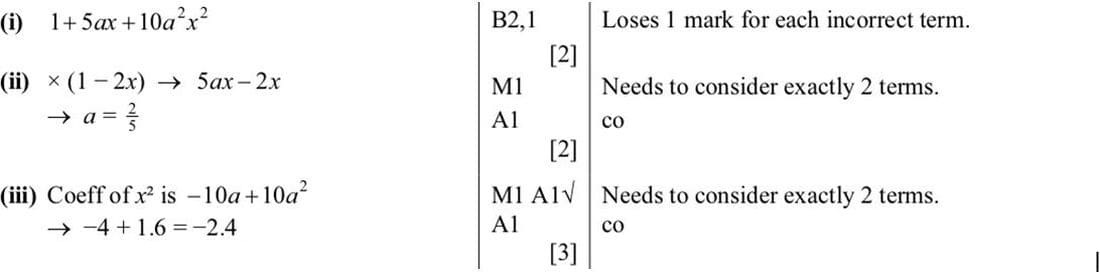
(i) The binomial expansion of \((1 + ax)^5\) is given by:
\(1 + 5(ax) + \frac{5 \times 4}{2}(ax)^2 + \cdots\)
\(= 1 + 5ax + 10a^2x^2\)
(ii) For the expansion of \((1 - 2x)(1 + ax)^5\), the term in \(x\) is:
\((1)(5ax) + (-2x)(1) = 5ax - 2x\)
Setting the coefficient of \(x\) to zero:
\(5a - 2 = 0\)
\(a = \frac{2}{5}\)
(iii) The coefficient of \(x^2\) in \((1 - 2x)(1 + ax)^5\) is:
\((-2x)(5ax) + (1)(10a^2x^2) = -10ax + 10a^2x^2\)
Substituting \(a = \frac{2}{5}\):
\(-10 \times \frac{2}{5} + 10 \left(\frac{2}{5}\right)^2 = -4 + 1.6 = -2.4\)
Log in to record attempts.