Past Exam Questions
← Back9709 P31 - Jun 2014 - Q9
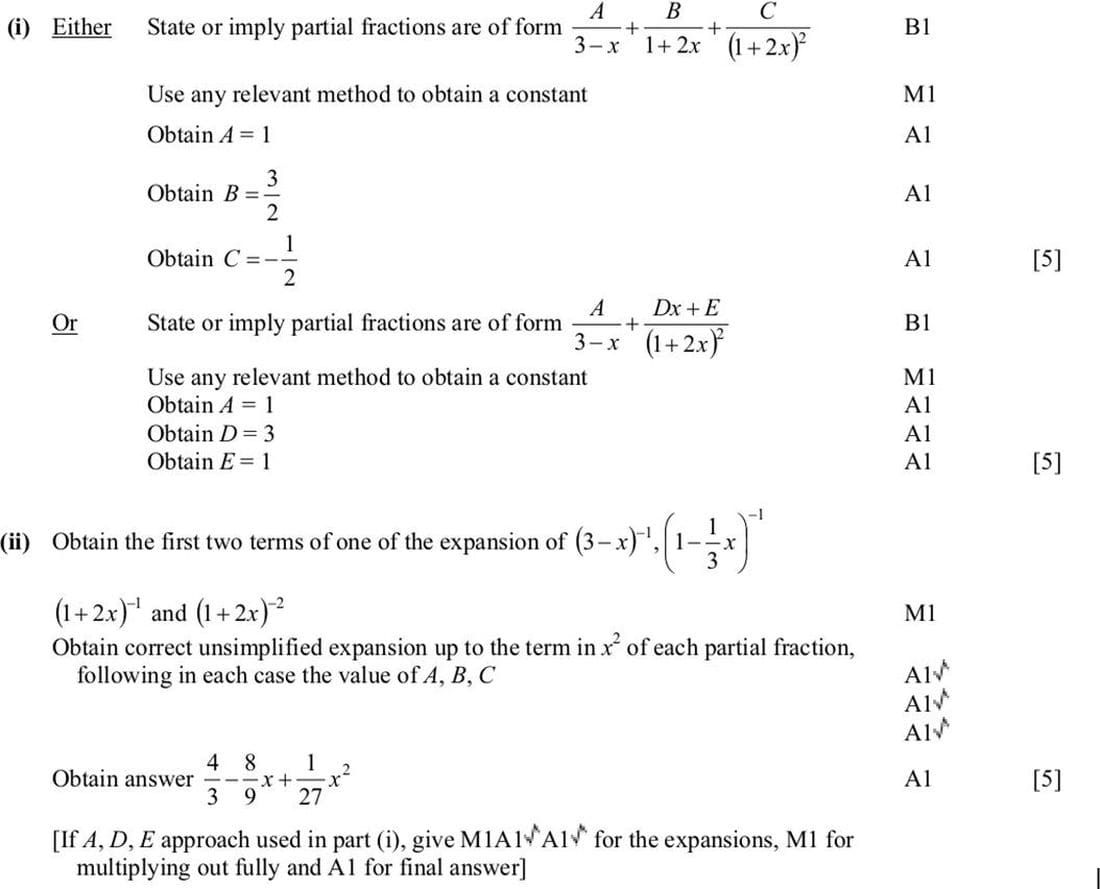
(i) Express \(\frac{4 + 12x + x^2}{(3-x)(1+2x)^2}\) in partial fractions.
(ii) Hence obtain the expansion of \(\frac{4 + 12x + x^2}{(3-x)(1+2x)^2}\) in ascending powers of \(x\), up to and including the term in \(x^2\).
9709 P33 - Nov 2013 - Q8
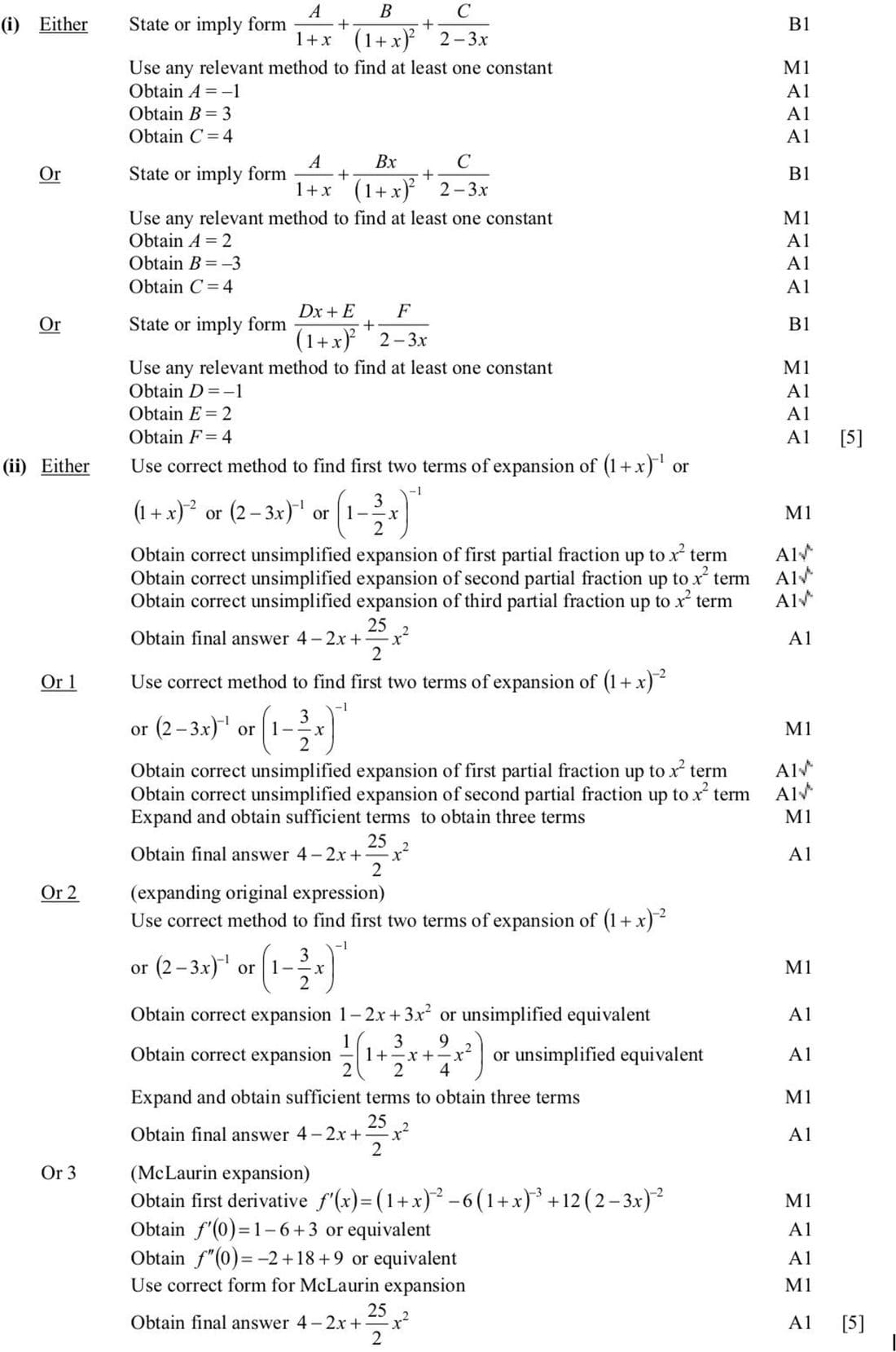
(i) Express \(\frac{7x^2 + 8}{(1+x)^2(2-3x)}\) in partial fractions.
(ii) Hence expand \(\frac{7x^2 + 8}{(1+x)^2(2-3x)}\) in ascending powers of \(x\) up to and including the term in \(x^2\), simplifying the coefficients.
9709 P31 - Nov 2013 - Q7
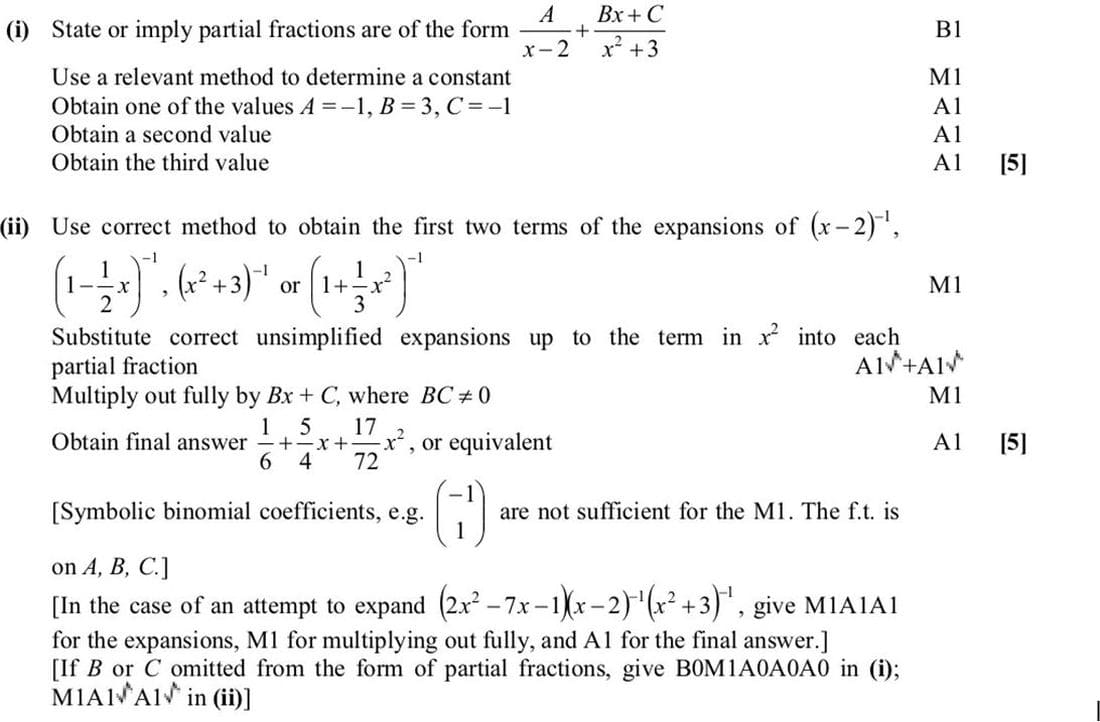
Let \(f(x) = \frac{2x^2 - 7x - 1}{(x-2)(x^2+3)}\).
(i) Express \(f(x)\) in partial fractions.
(ii) Hence obtain the expansion of \(f(x)\) in ascending powers of \(x\), up to and including the term in \(x^2\).
9709 P33 - Nov 2012 - Q9
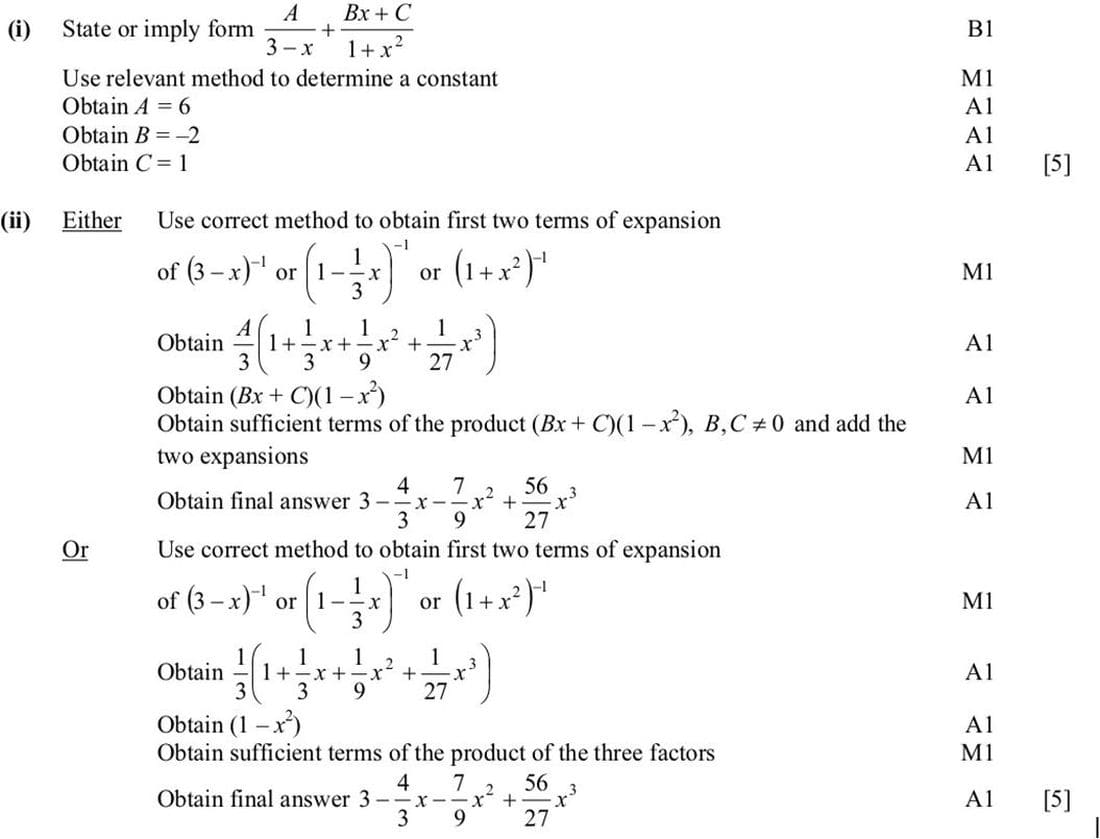
(i) Express \(\frac{9 - 7x + 8x^2}{(3-x)(1+x^2)}\) in partial fractions.
(ii) Hence obtain the expansion of \(\frac{9 - 7x + 8x^2}{(3-x)(1+x^2)}\) in ascending powers of \(x\), up to and including the term in \(x^3\).
9709 P32 - Jun 2011 - Q8
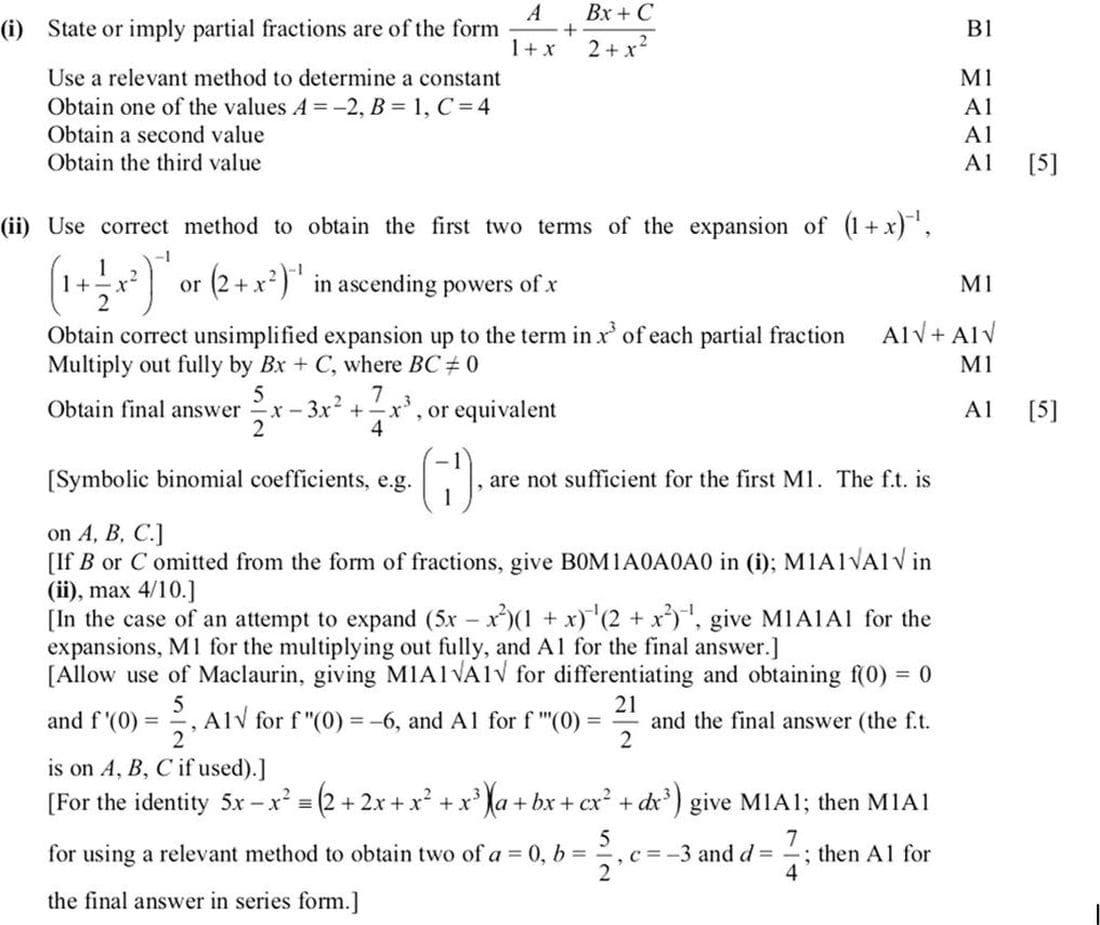
(i) Express \(\frac{5x - x^2}{(1+x)(2+x^2)}\) in partial fractions.
(ii) Hence obtain the expansion of \(\frac{5x - x^2}{(1+x)(2+x^2)}\) in ascending powers of \(x\), up to and including the term in \(x^3\).
9709 P31 - Nov 2010 - Q8
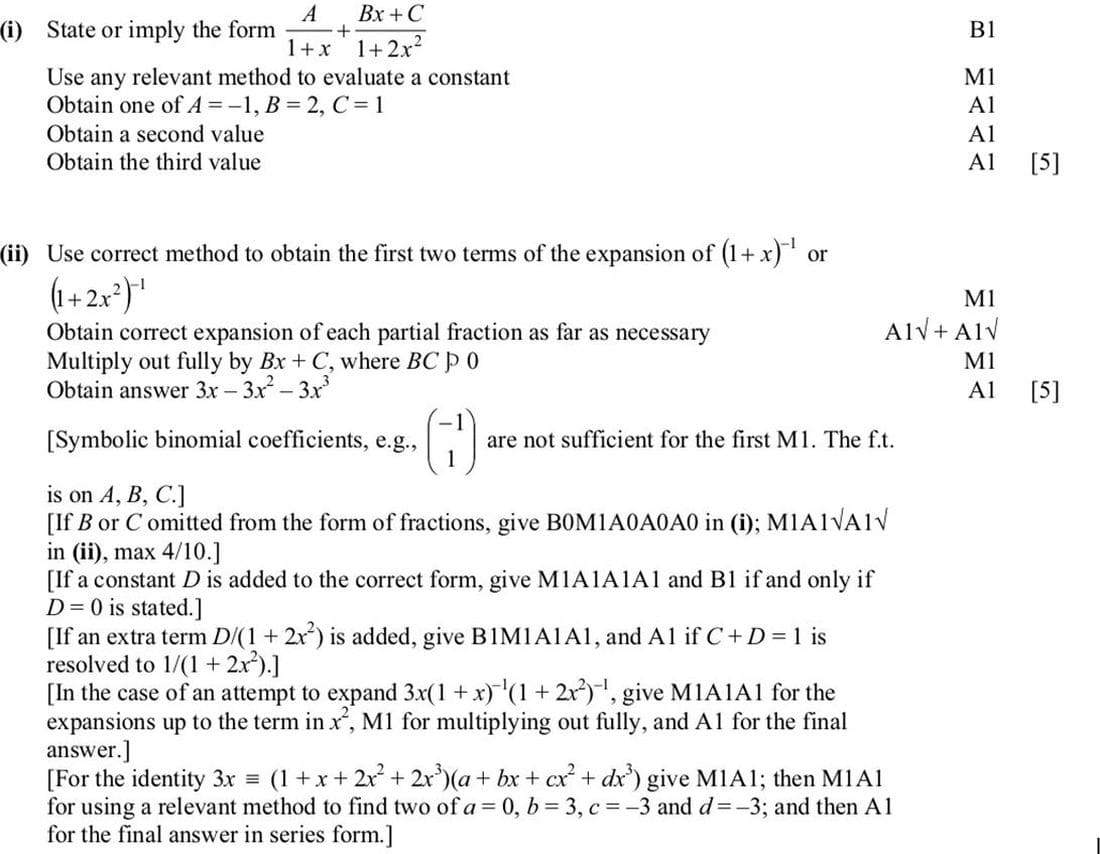
Let \(f(x) = \frac{3x}{(1+x)(1+2x^2)}\).
(i) Express \(f(x)\) in partial fractions. [5]
(ii) Hence obtain the expansion of \(f(x)\) in ascending powers of \(x\), up to and including the term in \(x^3\). [5]
9709 P33 - Jun 2010 - Q9
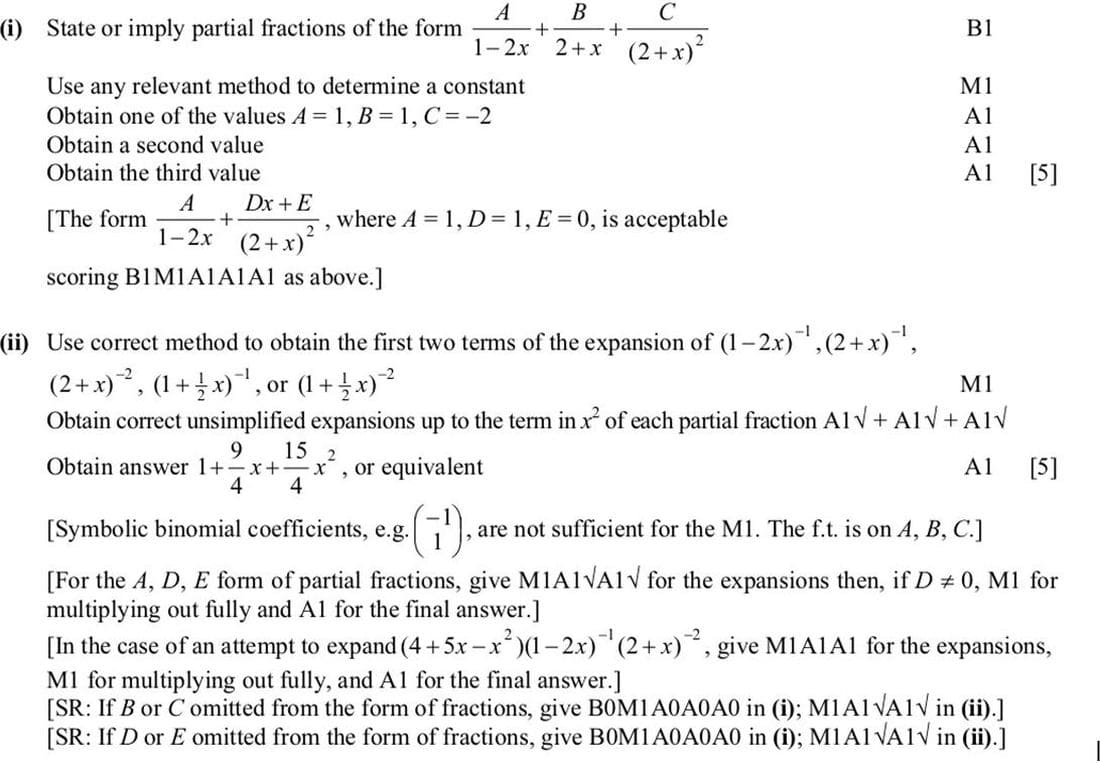
(i) Express \(\frac{4 + 5x - x^2}{(1 - 2x)(2 + x)^2}\) in partial fractions.
(ii) Hence obtain the expansion of \(\frac{4 + 5x - x^2}{(1 - 2x)(2 + x)^2}\) in ascending powers of \(x\), up to and including the term in \(x^2\).
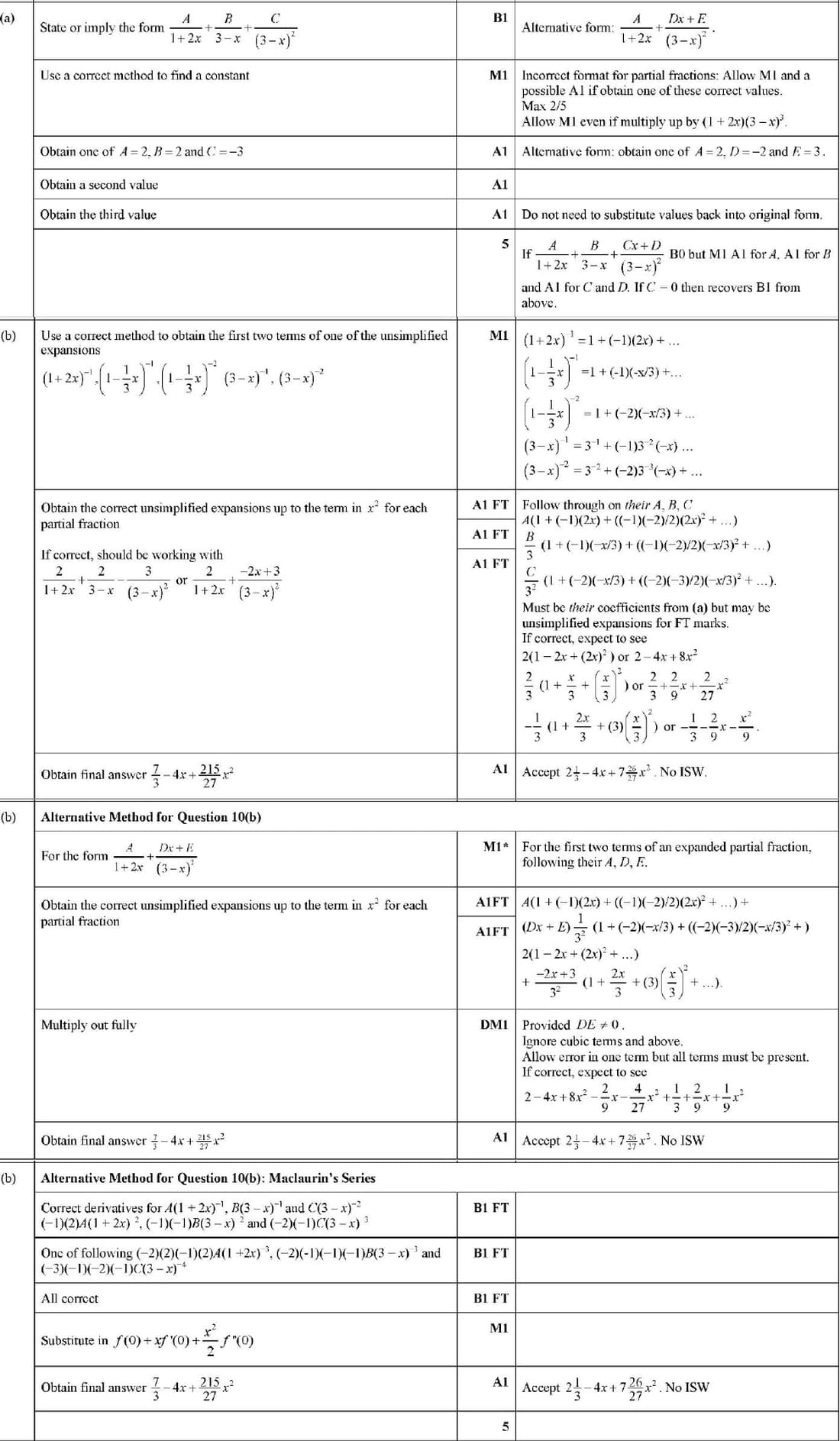
9709 P33 - Jun 2023 - Q10
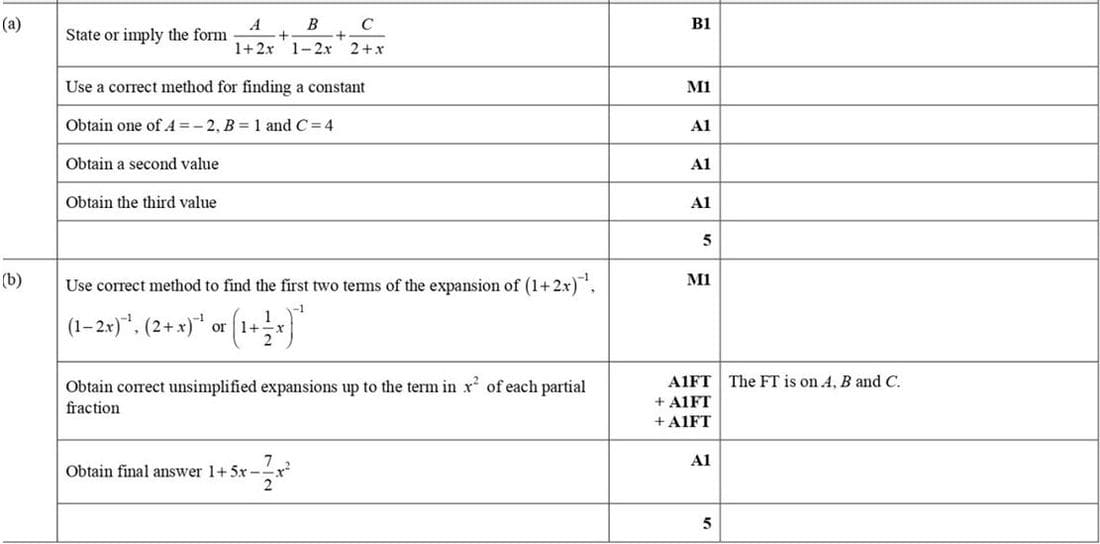
Let \(f(x) = \frac{21 - 8x - 2x^2}{(1 + 2x)(3 - x)^2}\).
(a) Express \(f(x)\) in partial fractions.
(b) Hence obtain the expansion of \(f(x)\) in ascending powers of \(x\), up to and including the term in \(x^2\).
9709 P32 - Nov 2009 - Q8
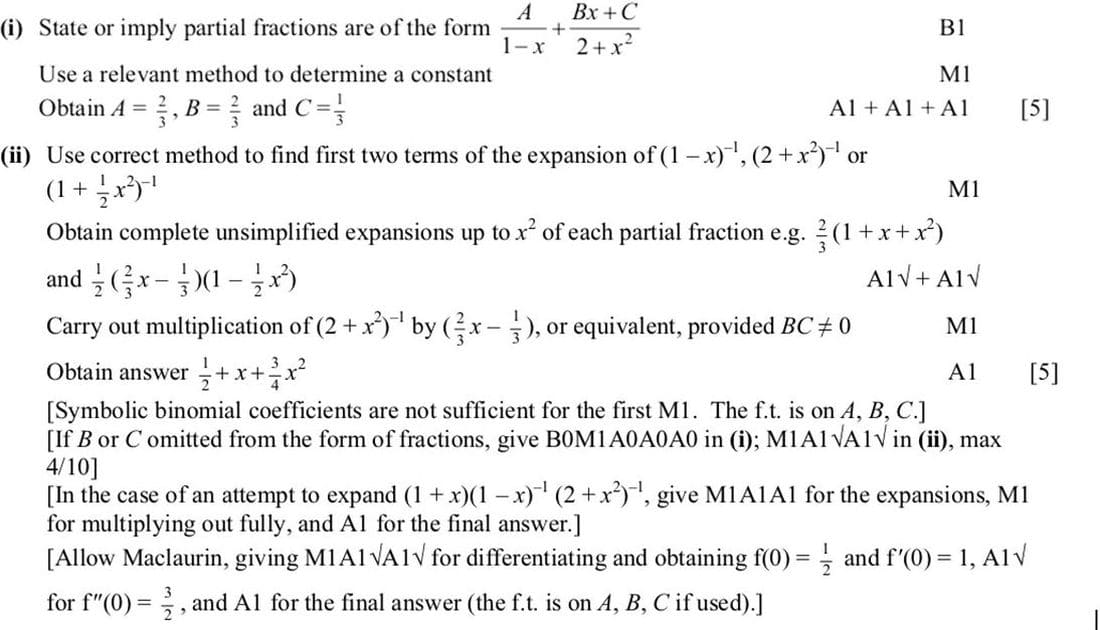
(i) Express \(\frac{1+x}{(1-x)(2+x^2)}\) in partial fractions.
(ii) Hence obtain the expansion of \(\frac{1+x}{(1-x)(2+x^2)}\) in ascending powers of \(x\), up to and including the term in \(x^2\).
9709 P31 - Nov 2009 - Q8
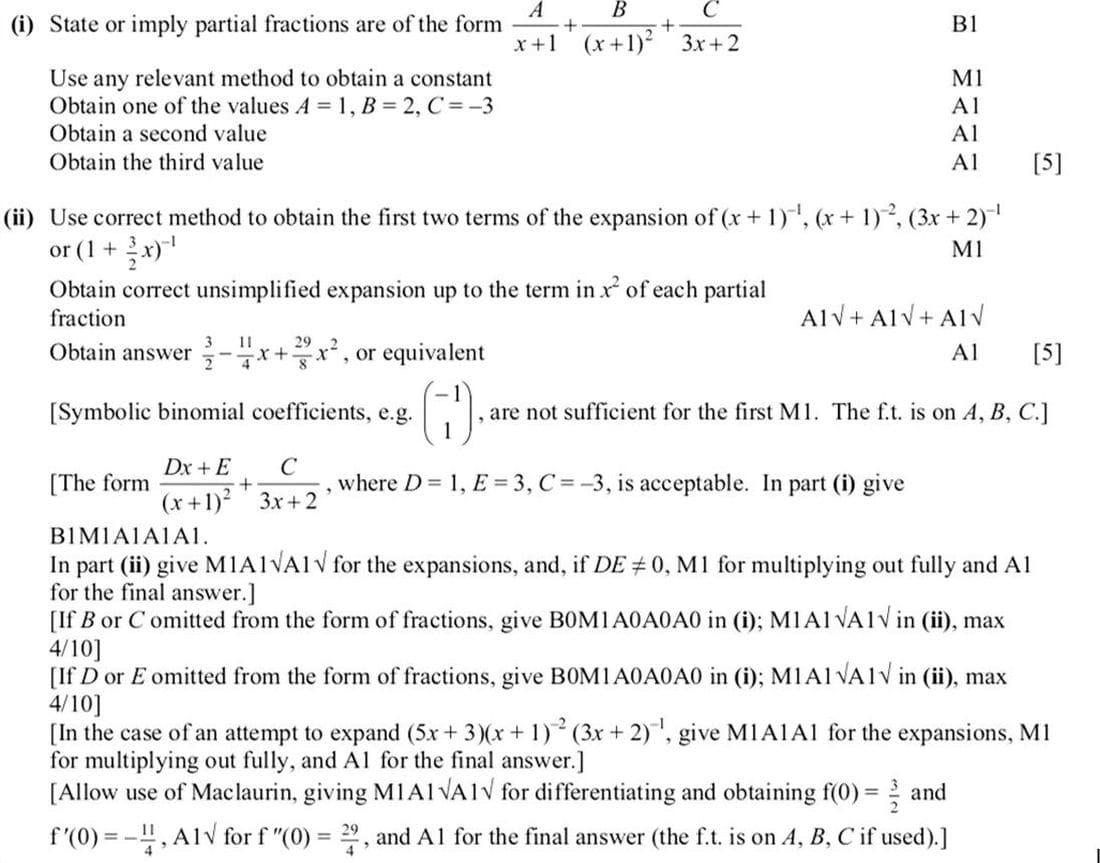
(i) Express \(\frac{5x + 3}{(x + 1)^2(3x + 2)}\) in partial fractions.
(ii) Hence obtain the expansion of \(\frac{5x + 3}{(x + 1)^2(3x + 2)}\) in ascending powers of \(x\), up to and including the term in \(x^2\), simplifying the coefficients.
9709 P3 - Nov 2007 - Q9
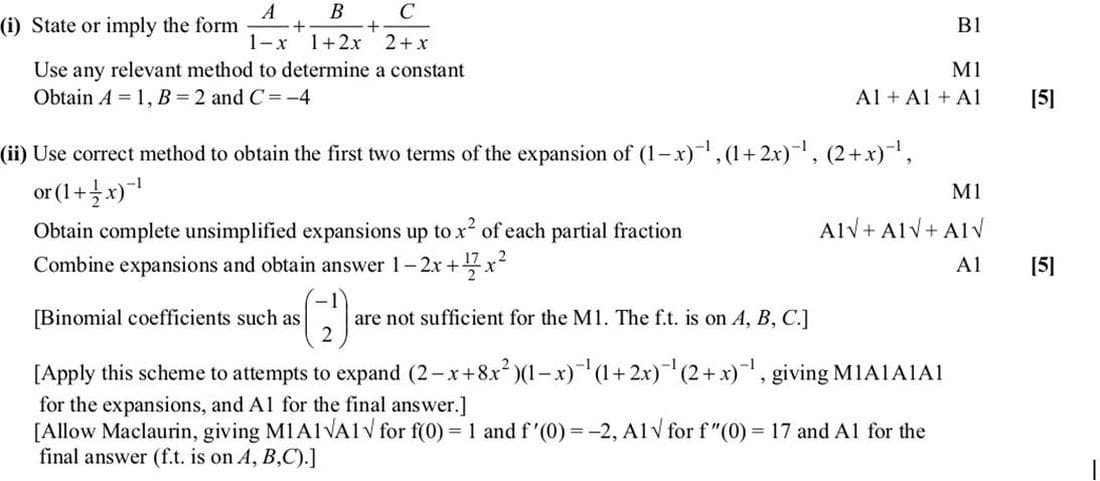
(i) Express \(\frac{2 - x + 8x^2}{(1-x)(1+2x)(2+x)}\) in partial fractions.
(ii) Hence obtain the expansion of \(\frac{2 - x + 8x^2}{(1-x)(1+2x)(2+x)}\) in ascending powers of \(x\), up to and including the term in \(x^2\).
9709 P3 - Jun 2006 - Q9
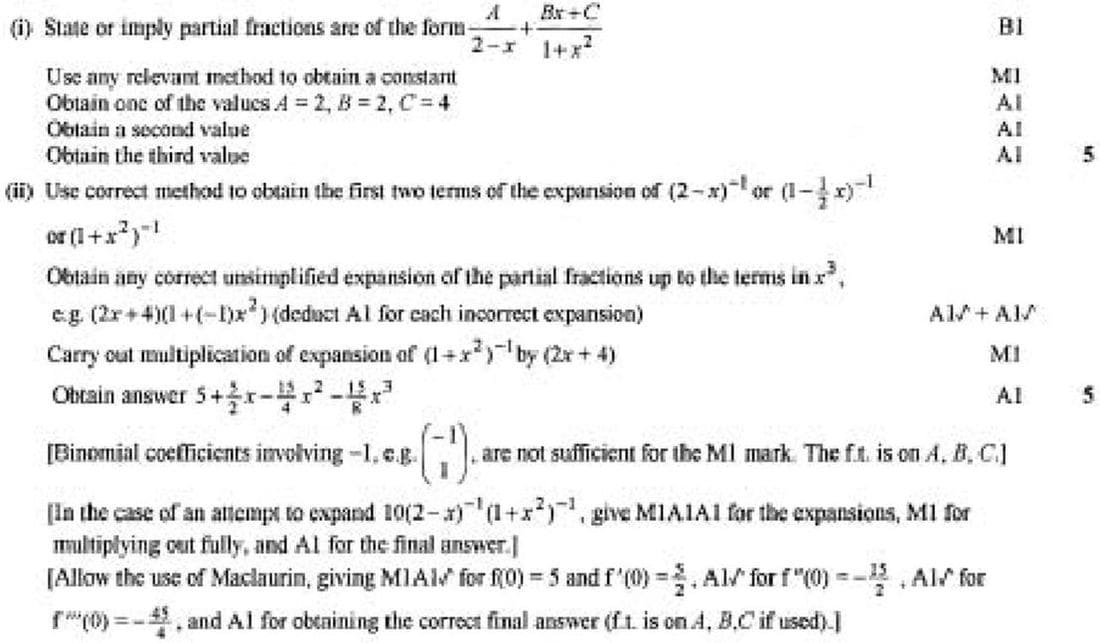
(i) Express \(\frac{10}{(2-x)(1+x^2)}\) in partial fractions.
(ii) Hence, given that \(|x| < 1\), obtain the expansion of \(\frac{10}{(2-x)(1+x^2)}\) in ascending powers of \(x\), up to and including the term in \(x^3\), simplifying the coefficients.
9709 P3 - Nov 2005 - Q9
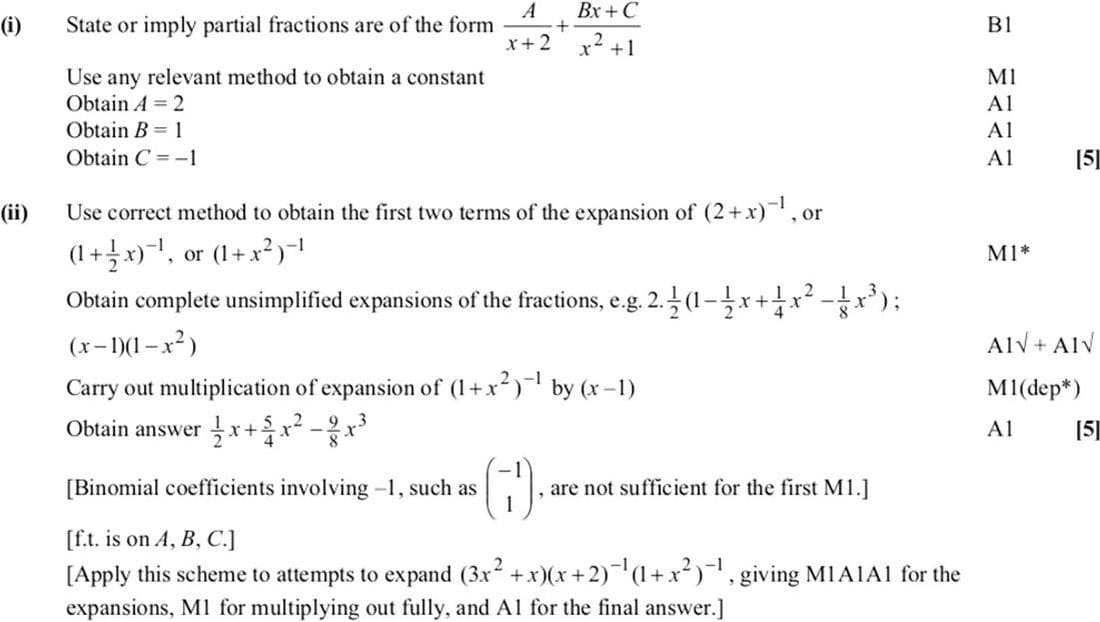
(i) Express \(\frac{3x^2 + x}{(x+2)(x^2+1)}\) in partial fractions.
(ii) Hence obtain the expansion of \(\frac{3x^2 + x}{(x+2)(x^2+1)}\) in ascending powers of \(x\), up to and including the term in \(x^3\).
9709 P3 - Jun 2004 - Q9
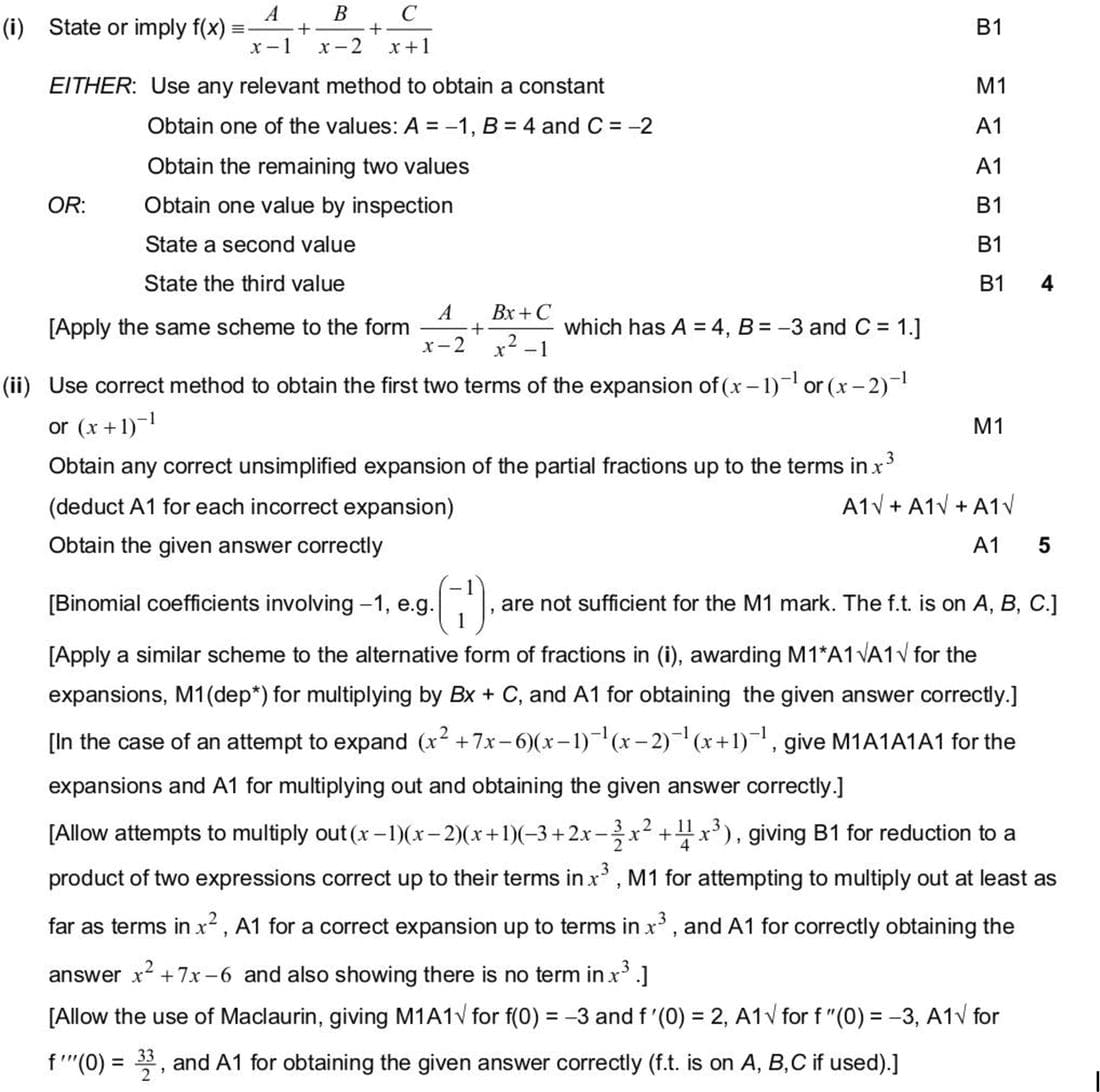
Let \(f(x) = \frac{x^2 + 7x - 6}{(x-1)(x-2)(x+1)}\).
(i) Express \(f(x)\) in partial fractions.
(ii) Show that, when \(x\) is sufficiently small for \(x^4\) and higher powers to be neglected,
\(f(x) = -3 + 2x - \frac{3}{2}x^2 + \frac{11}{4}x^3\).
9709 P3 - Jun 2003 - Q6
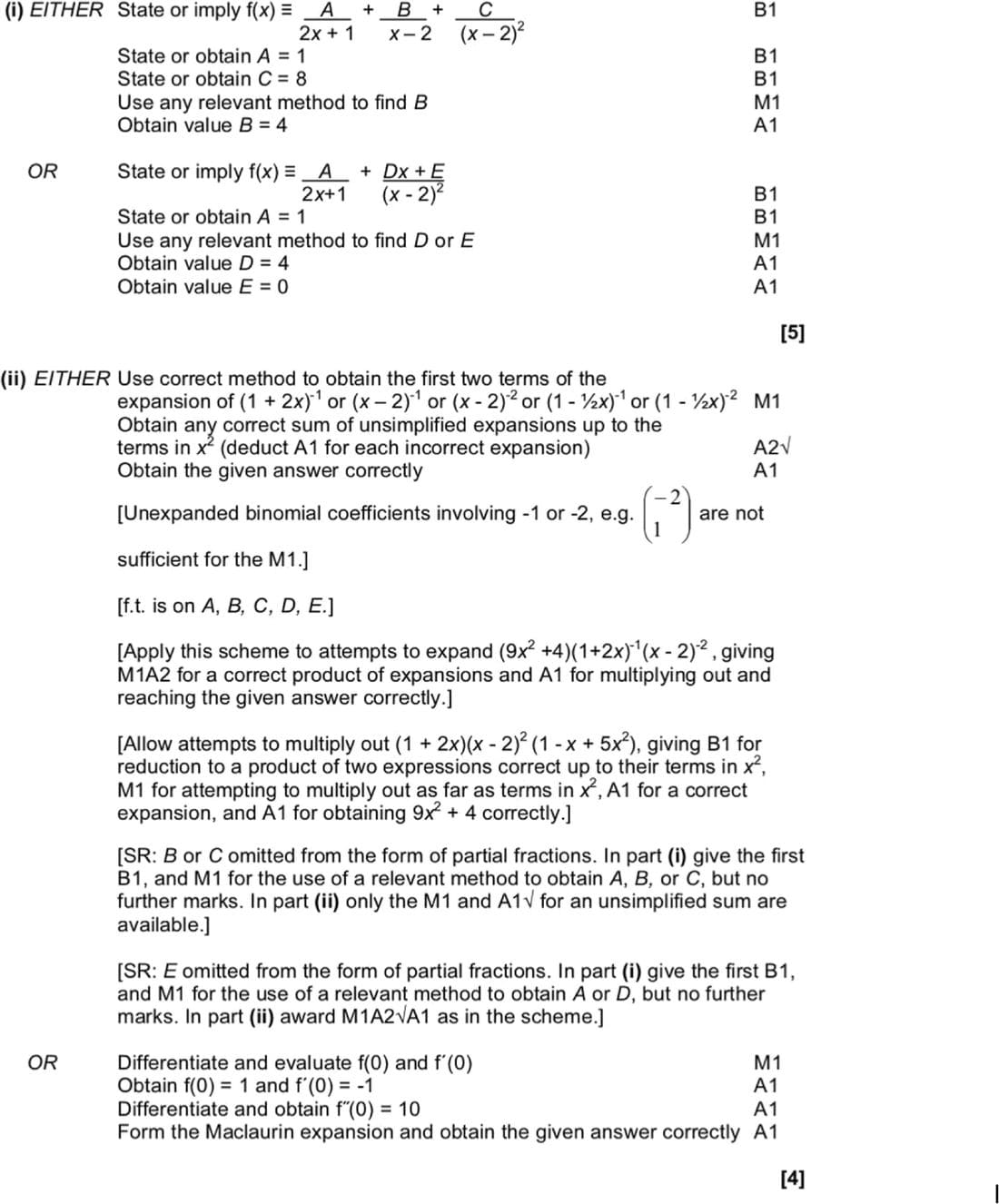
Let \(f(x) = \frac{9x^2 + 4}{(2x + 1)(x - 2)^2}\).
(i) Express \(f(x)\) in partial fractions.
(ii) Show that, when \(x\) is sufficiently small for \(x^3\) and higher powers to be neglected, \(f(x) = 1 - x + 5x^2\).
9709 P3 - Nov 2002 - Q6
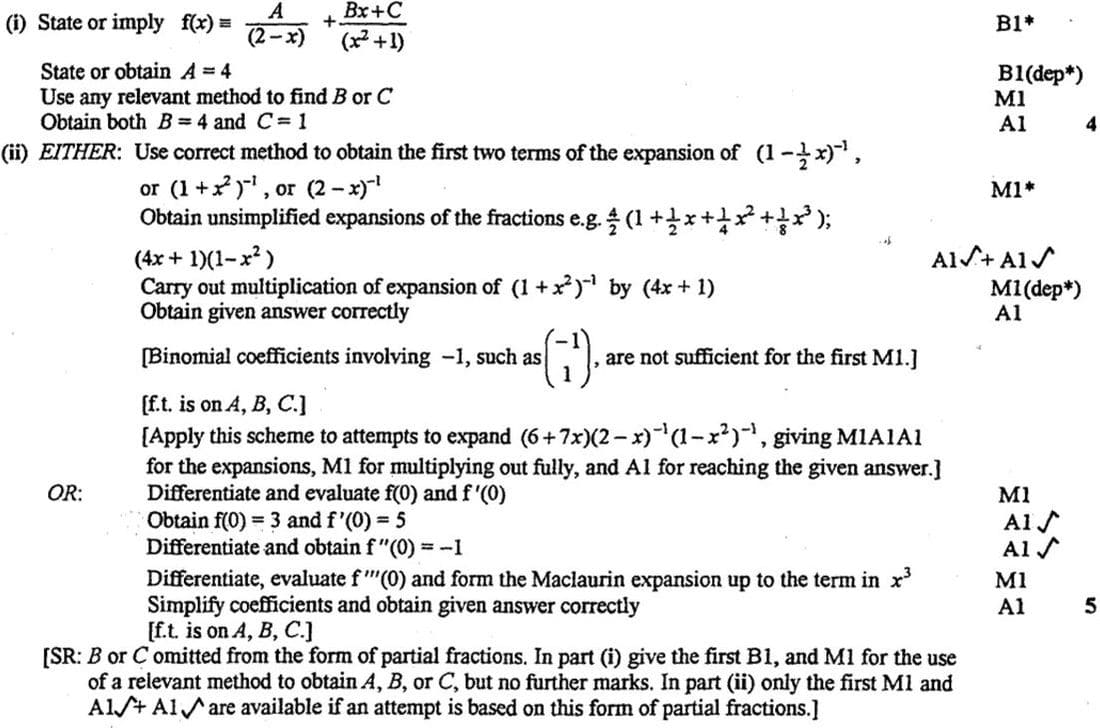
Let \(f(x) = \frac{6 + 7x}{(2-x)(1+x^2)}\).
(i) Express \(f(x)\) in partial fractions.
(ii) Show that, when \(x\) is sufficiently small for \(x^4\) and higher powers to be neglected,
\(f(x) = 3 + 5x - \frac{1}{2}x^2 - \frac{15}{4}x^3\).
9709 P31 - Nov 2022 - Q10
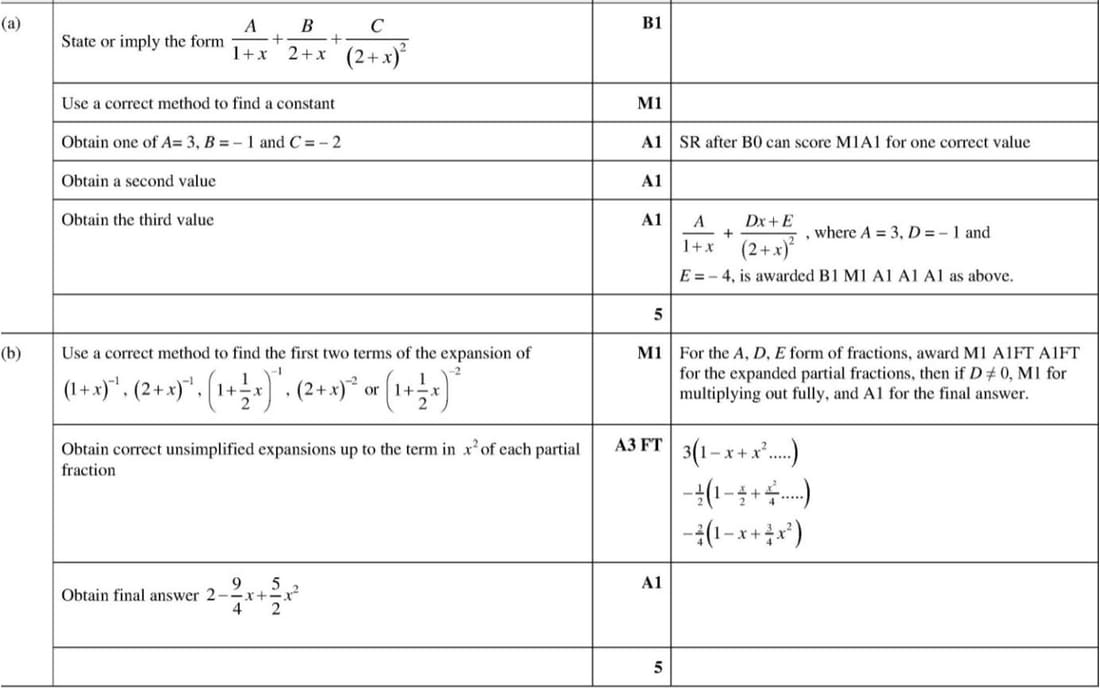
Let \(f(x) = \frac{2x^2 + 7x + 8}{(1+x)(2+x)^2}\).
(a) Express \(f(x)\) in partial fractions.
(b) Hence obtain the expansion of \(f(x)\) in ascending powers of \(x\), up to and including the term in \(x^2\).
9709 P33 - Jun 2022 - Q7
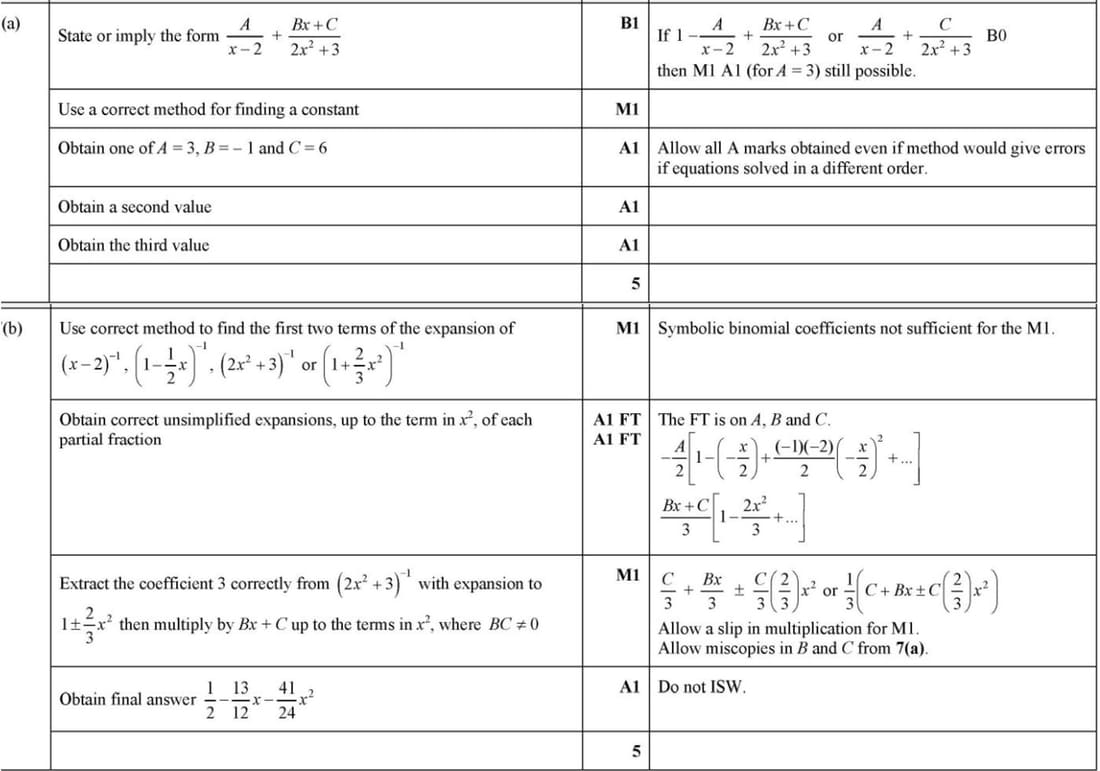
Let \(f(x) = \frac{5x^2 + 8x - 3}{(x-2)(2x^2 + 3)}\).
(a) Express \(f(x)\) in partial fractions.
(b) Hence obtain the expansion of \(f(x)\) in ascending powers of \(x\), up to and including the term in \(x^2\).
9709 P32 - Jun 2021 - Q9
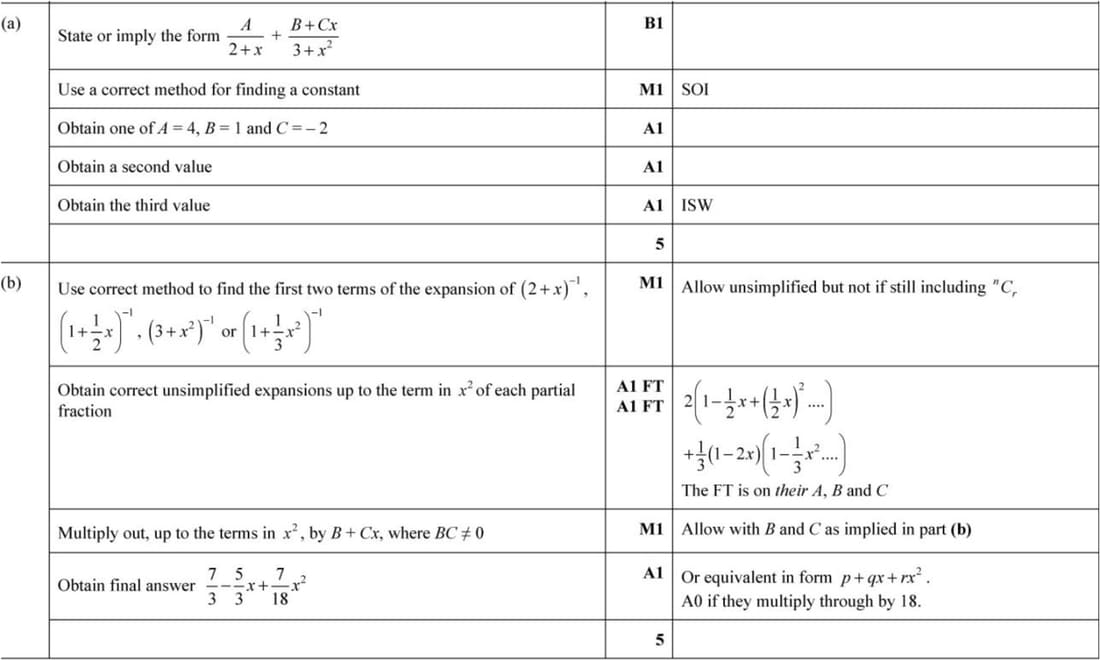
Let \(f(x) = \frac{14 - 3x + 2x^2}{(2 + x)(3 + x^2)}\).
(a) Express \(f(x)\) in partial fractions.
(b) Hence obtain the expansion of \(f(x)\) in ascending powers of \(x\), up to and including the term in \(x^2\).
9709 P32 - Mar 2020 - Q9
Let \(f(x) = \frac{2 + 11x - 10x^2}{(1 + 2x)(1 - 2x)(2 + x)}\).
(a) Express \(f(x)\) in partial fractions. [5]
(b) Hence obtain the expansion of \(f(x)\) in ascending powers of \(x\), up to and including the term in \(x^2\). [5]