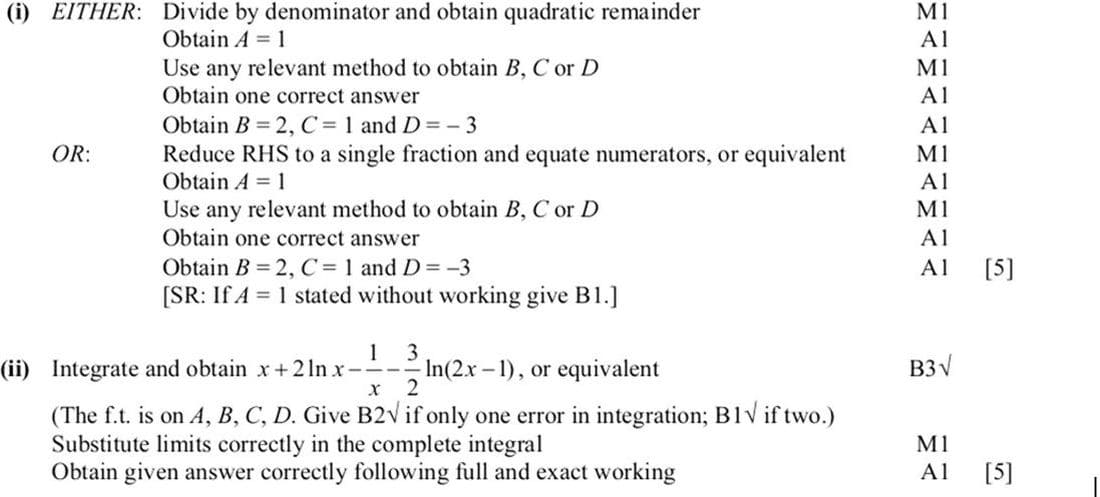
To find the constants \(A, B, C,\) and \(D\), we start by expressing \(\frac{2x^3 - 1}{x^2(2x-1)}\) as a sum of partial fractions:
\(\frac{2x^3 - 1}{x^2(2x-1)} = A + \frac{B}{x} + \frac{C}{x^2} + \frac{D}{2x-1}.\)
Multiply through by the denominator \(x^2(2x-1)\) to clear the fractions:
\(2x^3 - 1 = A x^2(2x-1) + B x(2x-1) + C(2x-1) + D x^2.\)
Expanding and equating coefficients, we find:
\(A = 1\), \(B = 2\), \(C = 1\), \(D = -3\).
For the integral, substitute the partial fraction decomposition:
\(\int_1^2 \left( 1 + \frac{2}{x} + \frac{1}{x^2} - \frac{3}{2x-1} \right) \, dx.\)
Integrate term by term:
\(\int 1 \, dx = x\)
\(\int \frac{2}{x} \, dx = 2 \ln |x|\)
\(\int \frac{1}{x^2} \, dx = -\frac{1}{x}\)
\(\int \frac{-3}{2x-1} \, dx = -\frac{3}{2} \ln |2x-1|\)
Evaluate from 1 to 2:
\(\left[ x + 2 \ln |x| - \frac{1}{x} - \frac{3}{2} \ln |2x-1| \right]_1^2.\)
Substitute the limits:
At \(x = 2\): \(2 + 2 \ln 2 - \frac{1}{2} - \frac{3}{2} \ln 3\)
At \(x = 1\): \(1 + 2 \ln 1 - 1 - \frac{3}{2} \ln 1\)
Calculate the difference:
\(2 + 2 \ln 2 - \frac{1}{2} - \frac{3}{2} \ln 3 - (1 - 1) = \frac{3}{2} + \frac{1}{2} \ln \left( \frac{16}{27} \right)\)