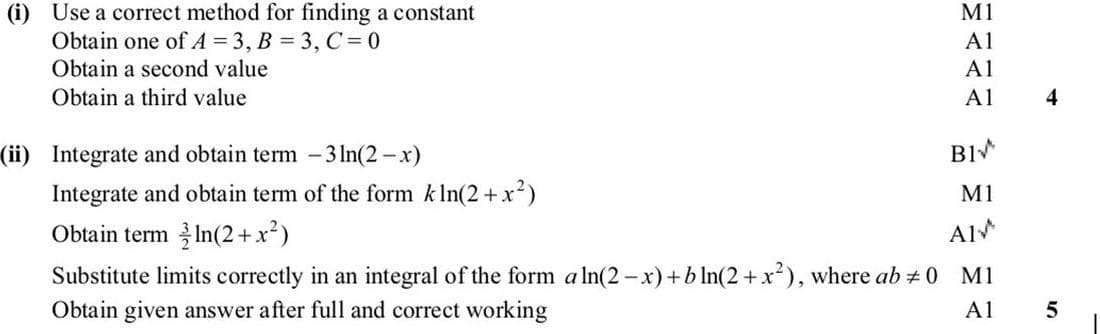
(i) To express \(f(x)\) in the form \(\frac{A}{2-x} + \frac{Bx+C}{2+x^2}\), we equate:
\(\frac{6 + 6x}{(2-x)(2+x^2)} = \frac{A}{2-x} + \frac{Bx+C}{2+x^2}\)
Multiply through by \((2-x)(2+x^2)\) to clear the denominators:
\(6 + 6x = A(2+x^2) + (Bx+C)(2-x)\)
Expand and collect like terms:
\(6 + 6x = 2A + Ax^2 + 2Bx + Cx - Bx^2 - Cx\)
\(6 + 6x = (A-B)x^2 + (2B+C)x + 2A\)
Equating coefficients, we get:
\(A - B = 0\)
\(2B + C = 6\)
\(2A = 6\)
Solving these equations, we find:
\(A = 3\)
\(B = 3\)
\(C = 0\)
(ii) To show \(\int_{-1}^{1} f(x) \, dx = 3 \ln 3\), integrate each term separately:
\(\int \frac{3}{2-x} \, dx = -3 \ln |2-x|\)
\(\int \frac{3x}{2+x^2} \, dx = \frac{3}{2} \ln |2+x^2|\)
\(\int \frac{0}{2+x^2} \, dx = 0\)
Evaluate from \(-1\) to \(1\):
\(-3 \ln |2-1| + \frac{3}{2} \ln |2+1^2| - (-3 \ln |2+1| + \frac{3}{2} \ln |2+(-1)^2|)\)
\(= -3 \ln 1 + \frac{3}{2} \ln 3 + 3 \ln 3 - \frac{3}{2} \ln 3\)
\(= 3 \ln 3\)