Past Exam Questions
← Back9709 P33 - Nov 2016 - Q4
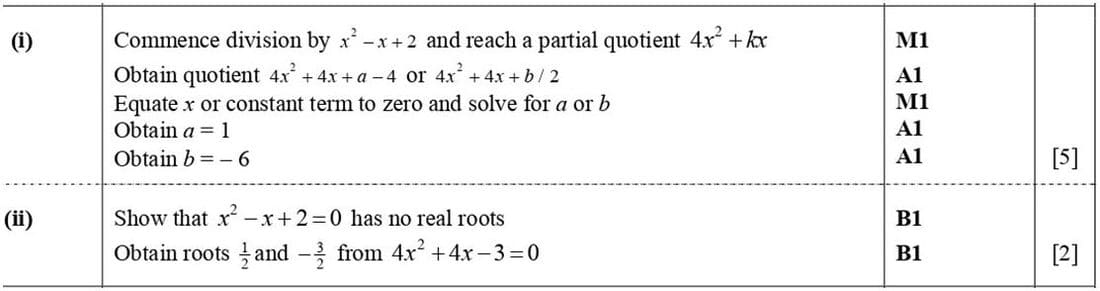
The polynomial \(4x^4 + ax^2 + 11x + b\), where \(a\) and \(b\) are constants, is denoted by \(p(x)\). It is given that \(p(x)\) is divisible by \(x^2 - x + 2\).
- Find the values of \(a\) and \(b\).
- When \(a\) and \(b\) have these values, find the real roots of the equation \(p(x) = 0\).
9709 P32 - Mar 2016 - Q4
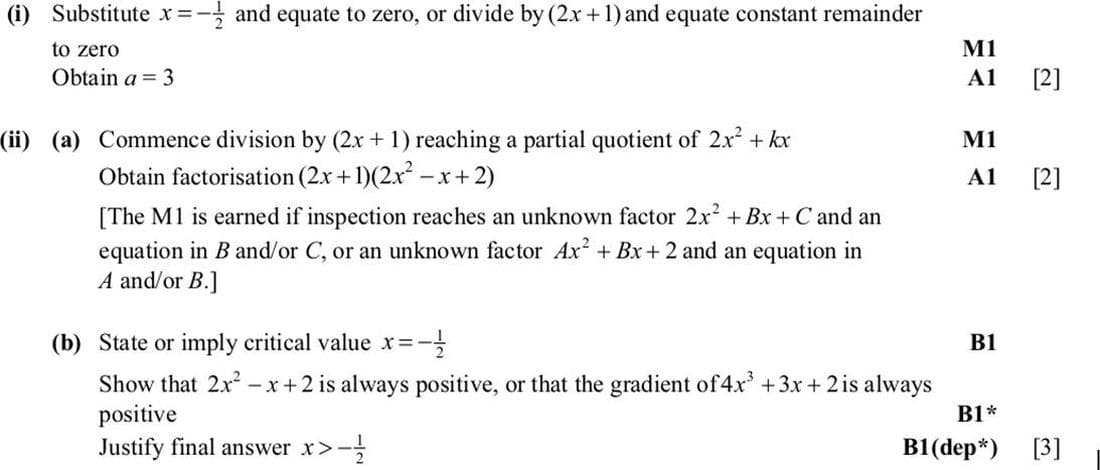
The polynomial \(4x^3 + ax + 2\), where \(a\) is a constant, is denoted by \(p(x)\). It is given that \((2x + 1)\) is a factor of \(p(x)\).
- Find the value of \(a\).
- When \(a\) has this value,
- factorise \(p(x)\),
- solve the inequality \(p(x) > 0\), justifying your answer.
9709 P33 - Nov 2015 - Q7
Show that \((x + 1)\) is a factor of \(4x^3 - x^2 - 11x - 6\).

9709 P31 - Nov 2015 - Q6
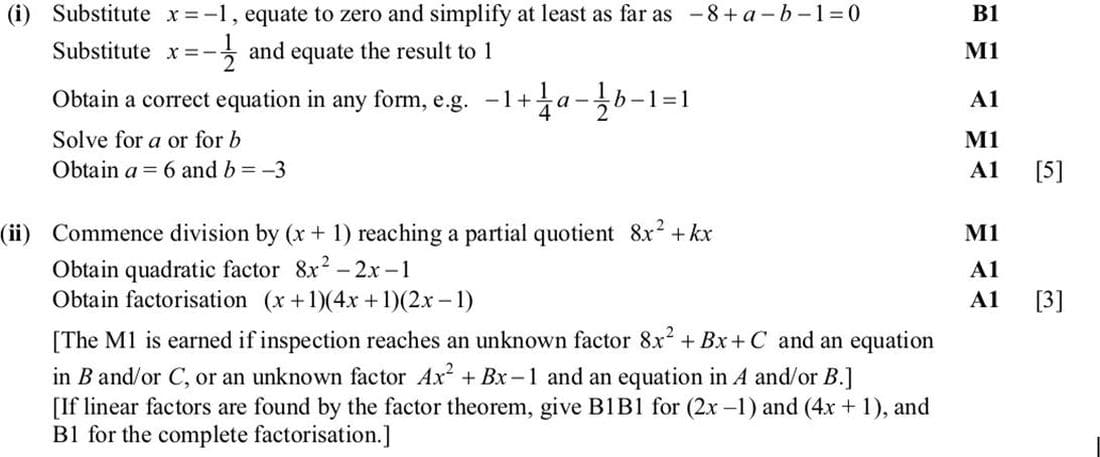
The polynomial \(8x^3 + ax^2 + bx - 1\), where \(a\) and \(b\) are constants, is denoted by \(p(x)\). It is given that \((x + 1)\) is a factor of \(p(x)\) and that when \(p(x)\) is divided by \((2x + 1)\) the remainder is 1.
(i) Find the values of \(a\) and \(b\).
(ii) When \(a\) and \(b\) have these values, factorise \(p(x)\) completely.
9709 P32 - Nov 2023 - Q3
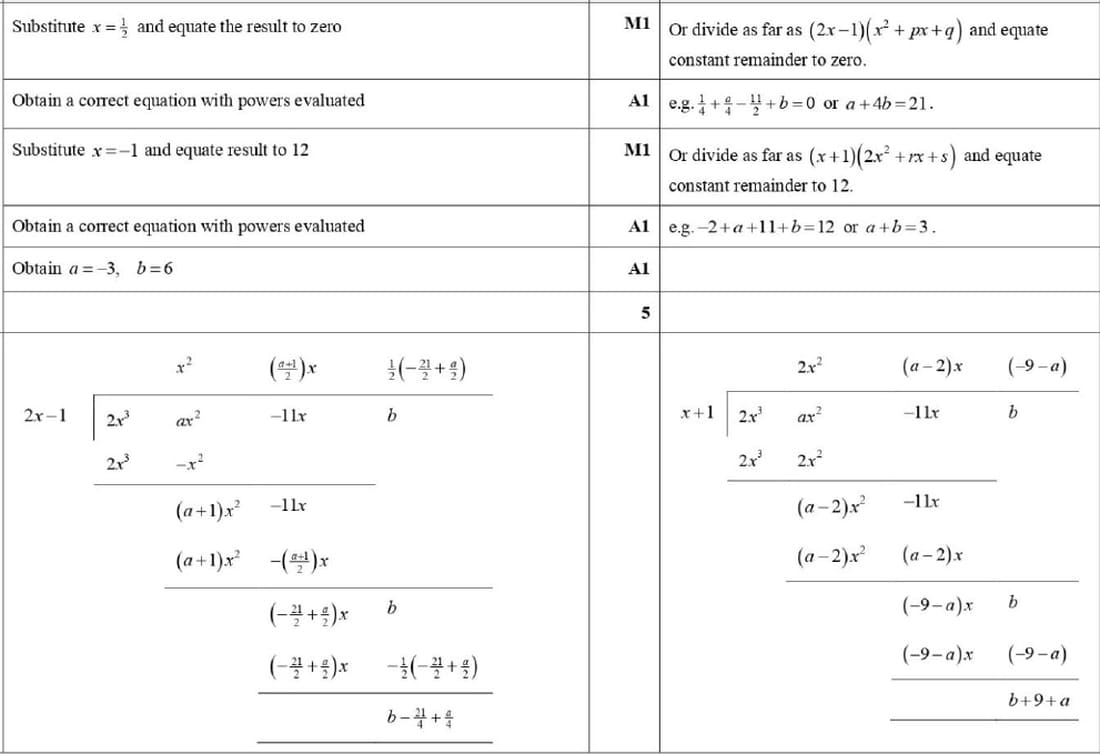
The polynomial \(2x^3 + ax^2 - 11x + b\) is denoted by \(p(x)\). It is given that \(p(x)\) is divisible by \((2x - 1)\) and that when \(p(x)\) is divided by \((x + 1)\) the remainder is 12.
Find the values of \(a\) and \(b\).
9709 P33 - Nov 2014 - Q3
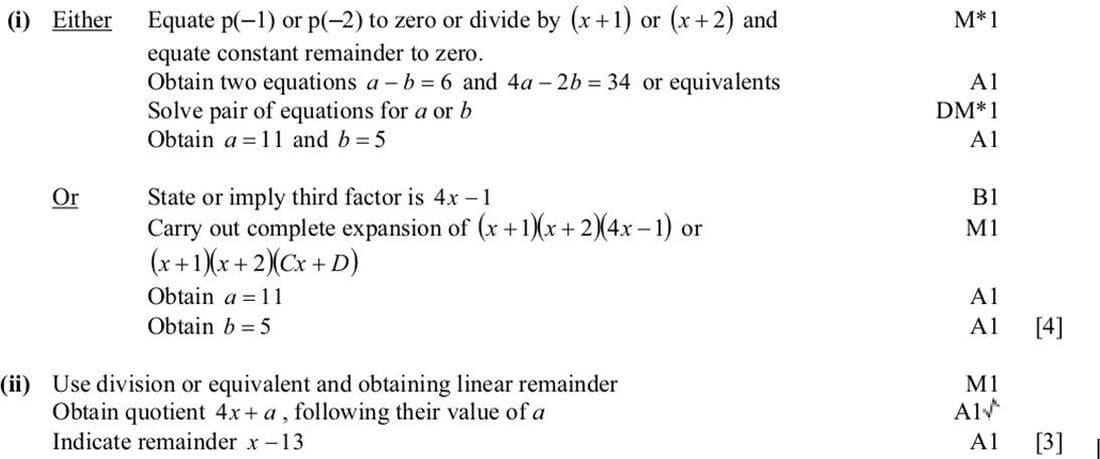
The polynomial \(4x^3 + ax^2 + bx - 2\), where \(a\) and \(b\) are constants, is denoted by \(p(x)\). It is given that \((x+1)\) and \((x+2)\) are factors of \(p(x)\).
(i) Find the values of \(a\) and \(b\).
(ii) When \(a\) and \(b\) have these values, find the remainder when \(p(x)\) is divided by \((x^2 + 1)\).
9709 P31 - Nov 2014 - Q3
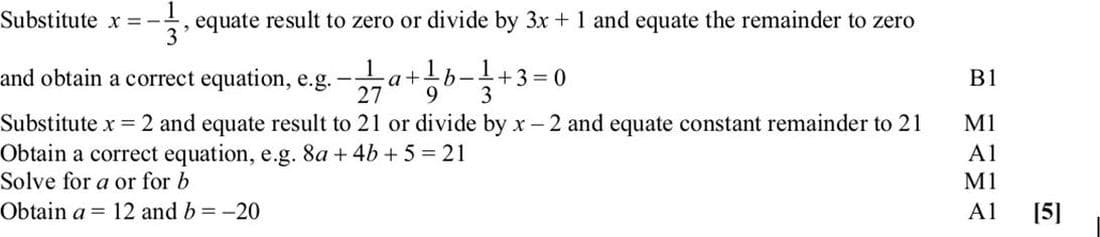
The polynomial \(ax^3 + bx^2 + x + 3\), where \(a\) and \(b\) are constants, is denoted by \(p(x)\). It is given that \((3x + 1)\) is a factor of \(p(x)\), and that when \(p(x)\) is divided by \((x - 2)\) the remainder is 21. Find the values of \(a\) and \(b\).
9709 P33 - Nov 2013 - Q3
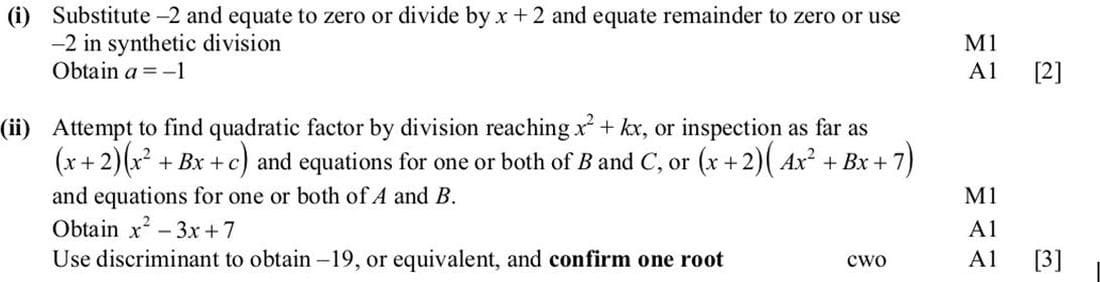
The polynomial \(f(x)\) is defined by
\(f(x) = x^3 + ax^2 - ax + 14\),
where \(a\) is a constant. It is given that \((x + 2)\) is a factor of \(f(x)\).
(i) Find the value of \(a\).
(ii) Show that, when \(a\) has this value, the equation \(f(x) = 0\) has only one real root.
9709 P33 - Jun 2013 - Q5
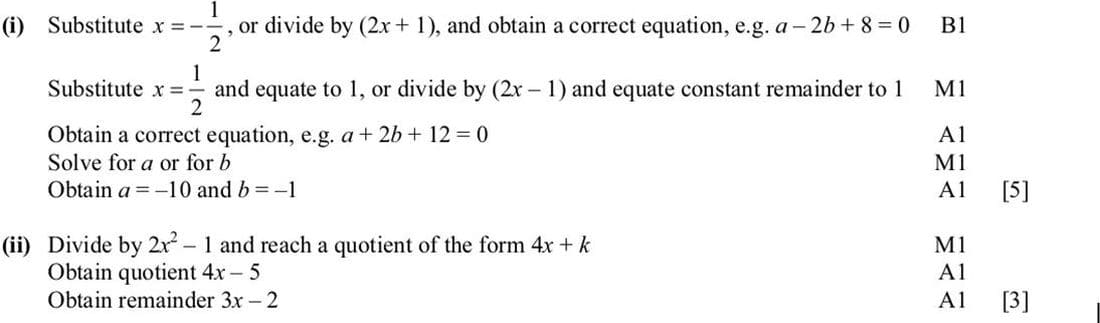
The polynomial \(8x^3 + ax^2 + bx + 3\), where \(a\) and \(b\) are constants, is denoted by \(p(x)\). It is given that \((2x + 1)\) is a factor of \(p(x)\) and that when \(p(x)\) is divided by \((2x - 1)\) the remainder is 1.
- Find the values of \(a\) and \(b\).
- When \(a\) and \(b\) have these values, find the remainder when \(p(x)\) is divided by \(2x^2 - 1\).
9709 P32 - Jun 2013 - Q4
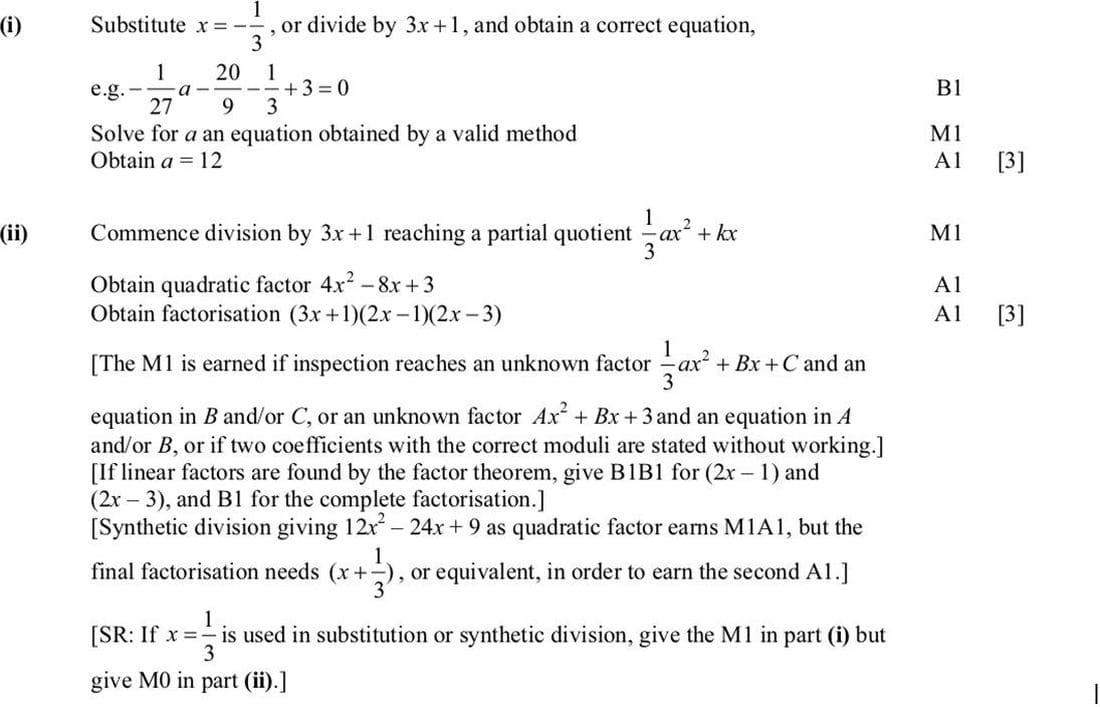
The polynomial \(ax^3 - 20x^2 + x + 3\), where \(a\) is a constant, is denoted by \(p(x)\). It is given that \((3x + 1)\) is a factor of \(p(x)\).
(i) Find the value of \(a\).
(ii) When \(a\) has this value, factorise \(p(x)\) completely.
9709 P31 - Jun 2013 - Q1
Find the quotient and remainder when \(2x^2\) is divided by \(x + 2\).

9709 P31 - Jun 2012 - Q3
The polynomial \(p(x)\) is defined by
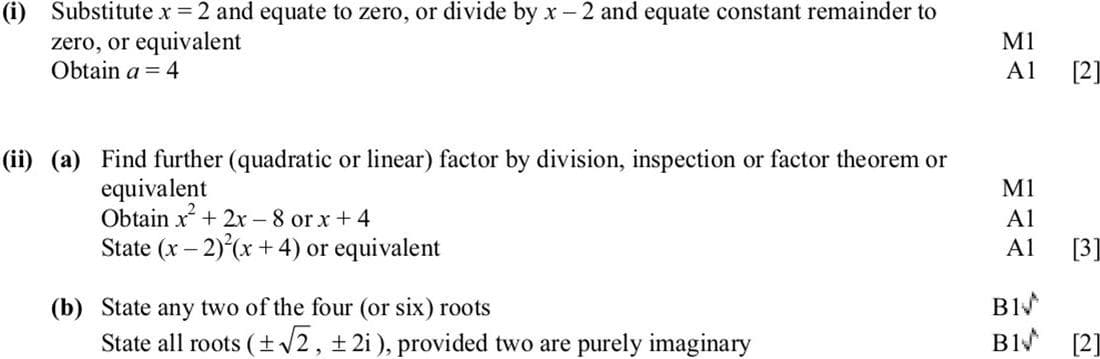
\(p(x) = x^3 - 3ax + 4a\),
where \(a\) is a constant.
(i) Given that \((x - 2)\) is a factor of \(p(x)\), find the value of \(a\).
(ii) When \(a\) has this value,
(a) factorise \(p(x)\) completely,
(b) find all the roots of the equation \(p(x^2) = 0\).
9709 P33 - Nov 2011 - Q7
The polynomial \(p(x)\) is defined by
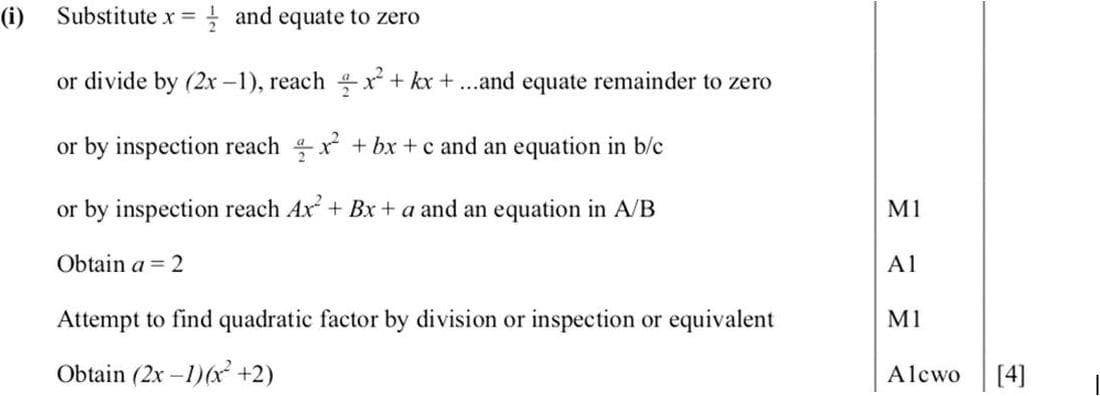
\(p(x) = ax^3 - x^2 + 4x - a\),
where \(a\) is a constant. It is given that \((2x - 1)\) is a factor of \(p(x)\).
Find the value of \(a\) and hence factorise \(p(x)\).
9709 P31 - Nov 2011 - Q3
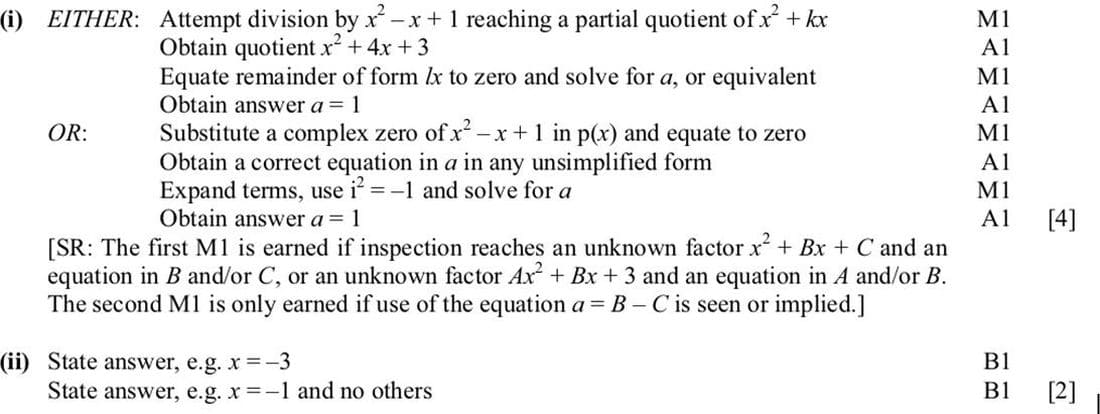
The polynomial \(x^4 + 3x^3 + ax + 3\) is denoted by \(p(x)\). It is given that \(p(x)\) is divisible by \(x^2 - x + 1\).
- Find the value of \(a\).
- When \(a\) has this value, find the real roots of the equation \(p(x) = 0\).
9709 P33 - Jun 2011 - Q5
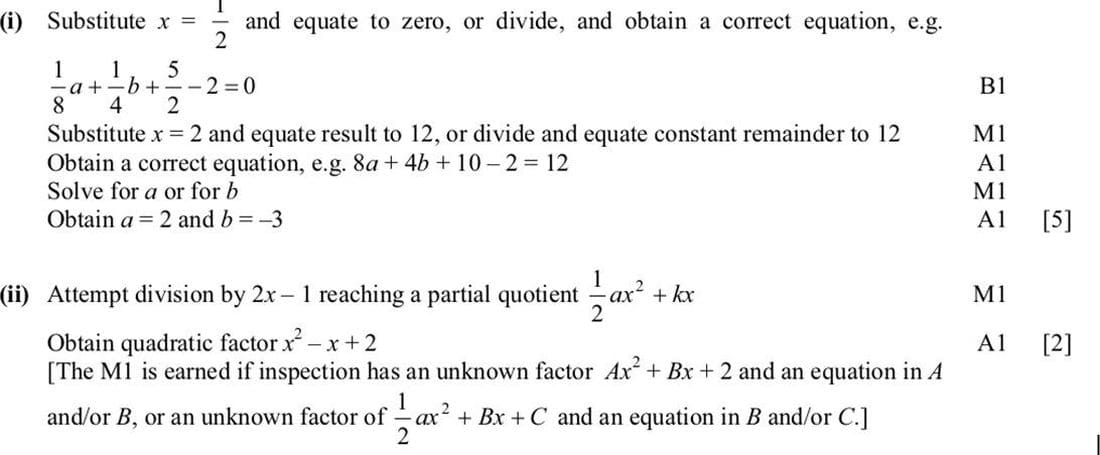
The polynomial \(ax^3 + bx^2 + 5x - 2\), where \(a\) and \(b\) are constants, is denoted by \(p(x)\). It is given that \((2x - 1)\) is a factor of \(p(x)\) and that when \(p(x)\) is divided by \((x - 2)\) the remainder is 12.
(i) Find the values of \(a\) and \(b\).
(ii) When \(a\) and \(b\) have these values, find the quadratic factor of \(p(x)\).
9709 P33 - Jun 2023 - Q2
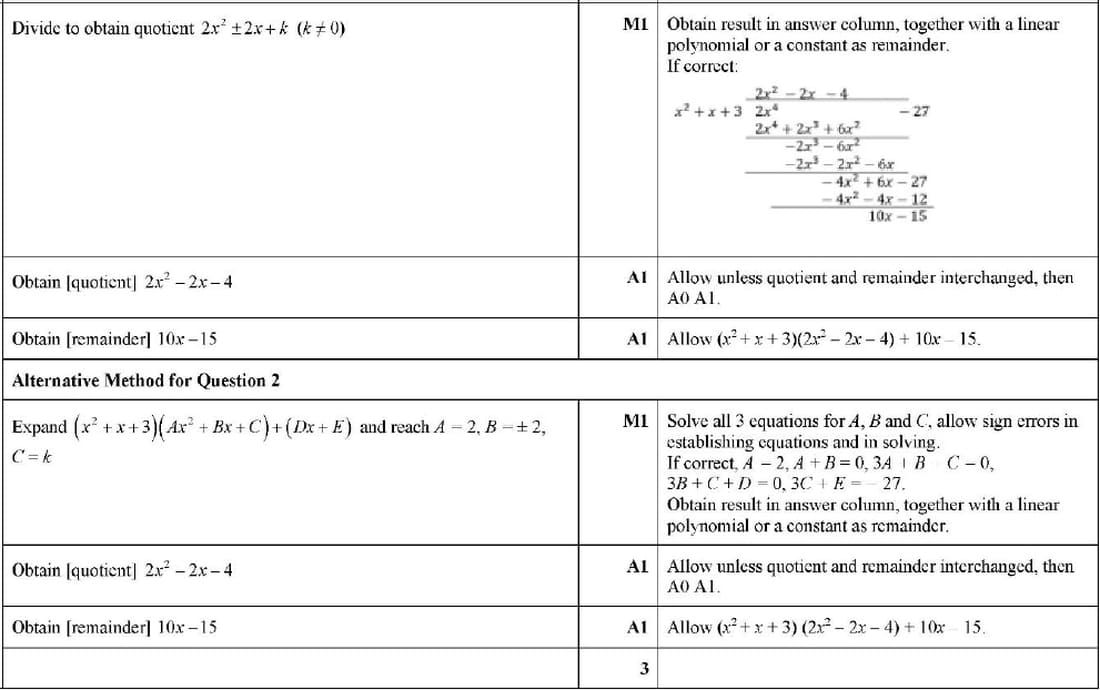
Find the quotient and remainder when \(2x^4 - 27\) is divided by \(x^2 + x + 3\).
9709 P31 - Jun 2011 - Q4
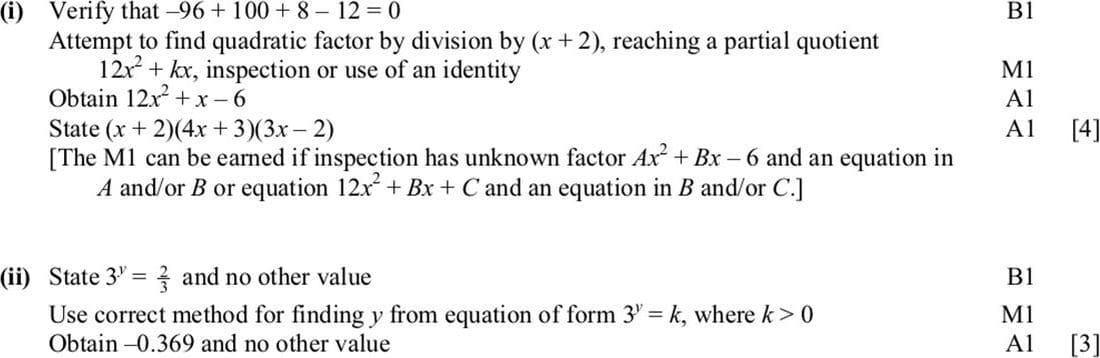
The polynomial \(f(x)\) is defined by
\(f(x) = 12x^3 + 25x^2 - 4x - 12\).
(i) Show that \(f(-2) = 0\) and factorise \(f(x)\) completely.
(ii) Given that
\(12 \times 27^y + 25 \times 9^y - 4 \times 3^y - 12 = 0\),
state the value of \(3^y\) and hence find \(y\) correct to 3 significant figures.
9709 P33 - Nov 2010 - Q10
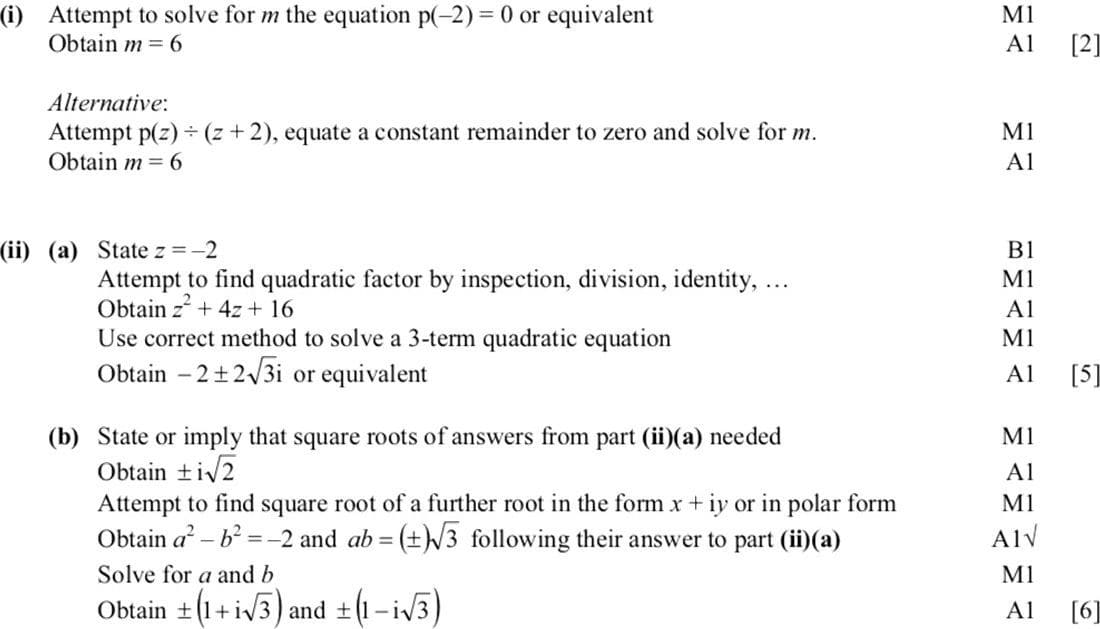
The polynomial \(p(z)\) is defined by
\(p(z) = z^3 + mz^2 + 24z + 32\),
where \(m\) is a constant. It is given that \((z + 2)\) is a factor of \(p(z)\).
- Find the value of \(m\).
- Hence, showing all your working, find
- the three roots of the equation \(p(z) = 0\),
- the six roots of the equation \(p(z^2) = 0\).
9709 P32 - Jun 2010 - Q5
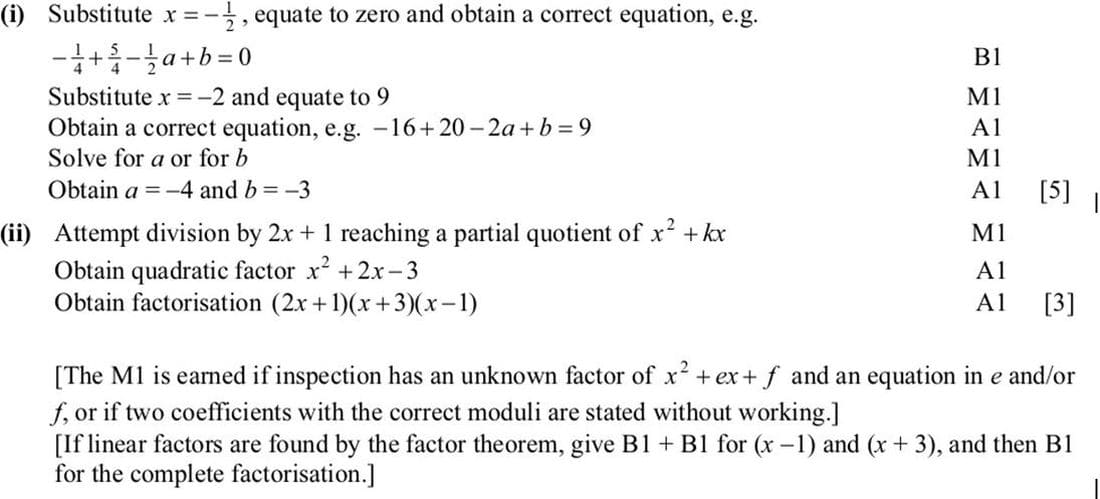
The polynomial \(2x^3 + 5x^2 + ax + b\), where \(a\) and \(b\) are constants, is denoted by \(p(x)\). It is given that \((2x + 1)\) is a factor of \(p(x)\) and that when \(p(x)\) is divided by \((x + 2)\) the remainder is 9.
(i) Find the values of \(a\) and \(b\).
(ii) When \(a\) and \(b\) have these values, factorise \(p(x)\) completely.
9709 P3 - Nov 2008 - Q5
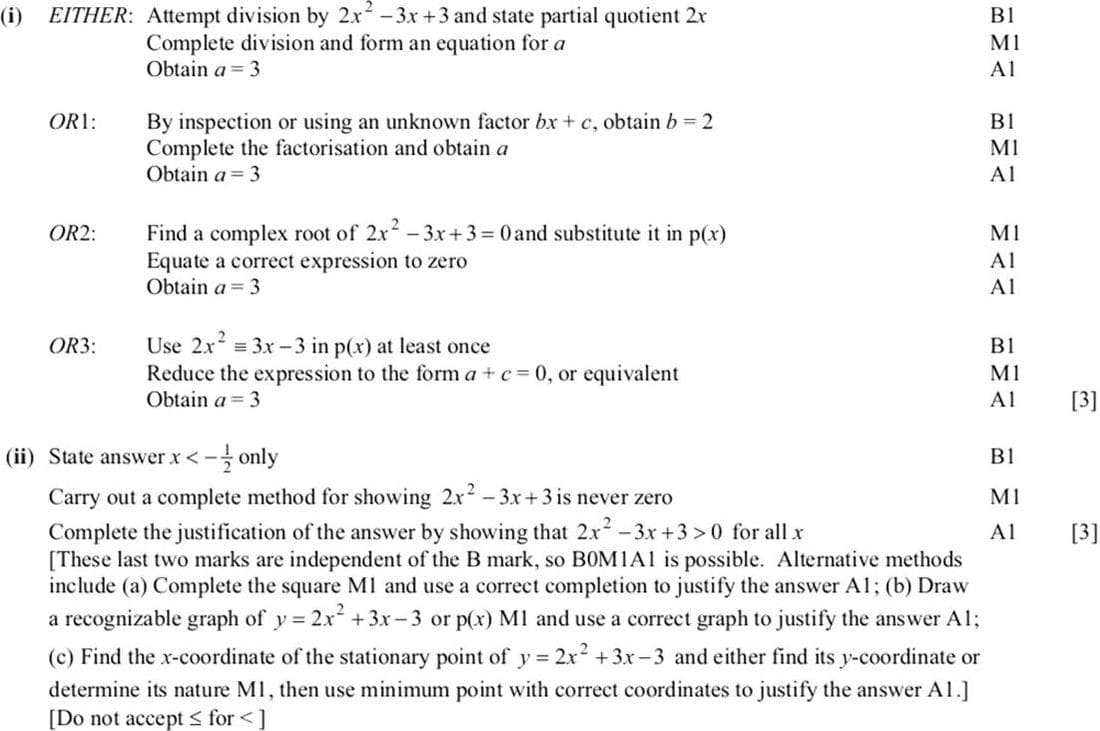
The polynomial \(4x^3 - 4x^2 + 3x + a\), where \(a\) is a constant, is denoted by \(p(x)\). It is given that \(p(x)\) is divisible by \(2x^2 - 3x + 3\).
(i) Find the value of \(a\).
(ii) When \(a\) has this value, solve the inequality \(p(x) < 0\), justifying your answer.